
Turntable Connectivity FAQ
Cables, shielding and grounding for a quieter turntable
A turntable’s signal is tiny, so the cables and ground connection between it and your amplifier matter more than anywhere else in your system. Here’s how to connect it, what to look for in cables, how to fix hum, and how we can help.
The short answer
Yes, turntable cable quality matters. A phono cartridge puts out roughly one-fiftieth to one-sixty-fifth of the voltage of a CD player or streamer, so poor shielding or a marginal connection adds hum, noise and lost detail that becomes very audible once amplified. Use well-shielded RCA interconnects, and connect the turntable’s ground wire firmly to a single ground point on your phono stage or receiver. The ground wire itself doesn’t need shielding.
Connecting your turntable, step by step
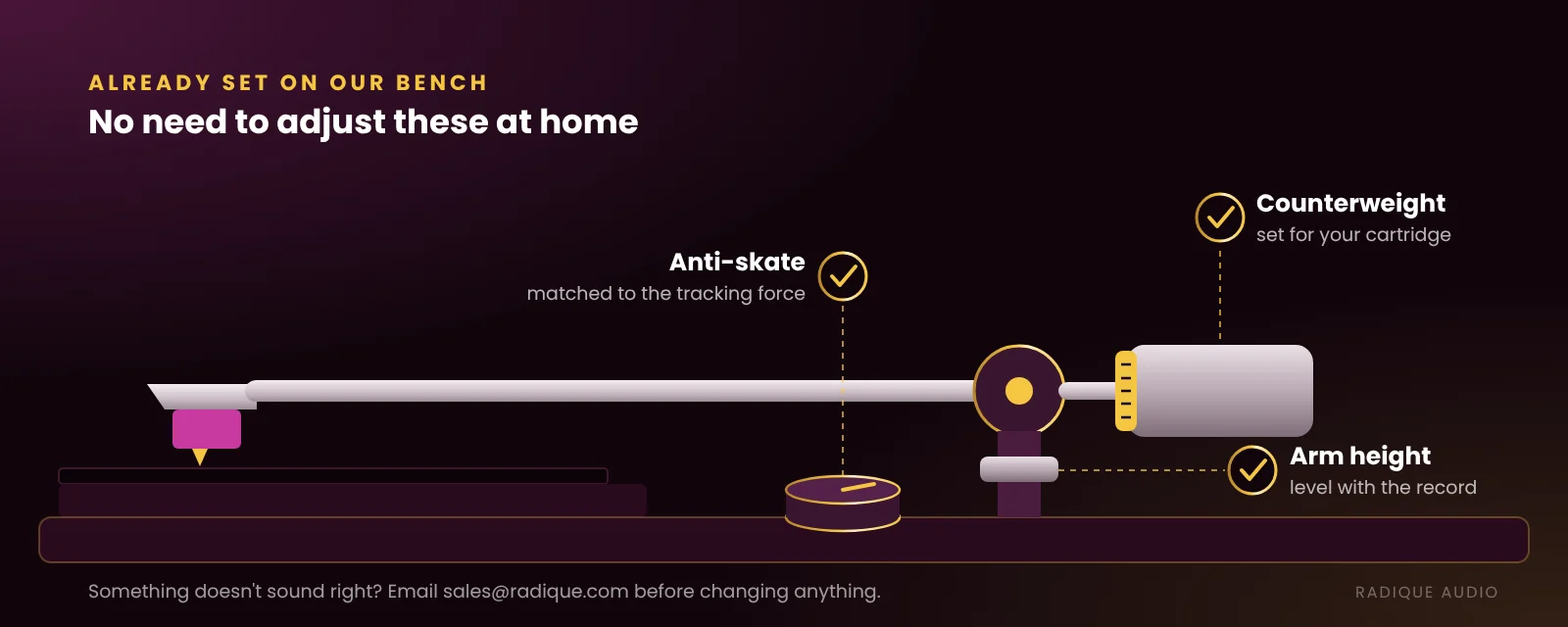
Just brought a turntable home from us? It has already been set up and tested on our bench, so all you need to do is connect it. Here’s how.
-
Give it a level, solid home
Set the turntable on a sturdy, level surface. If you can, keep it off your speakers and a little away from them, so bass and footsteps don’t travel up to the stylus.
-
Plug into the PHONO input
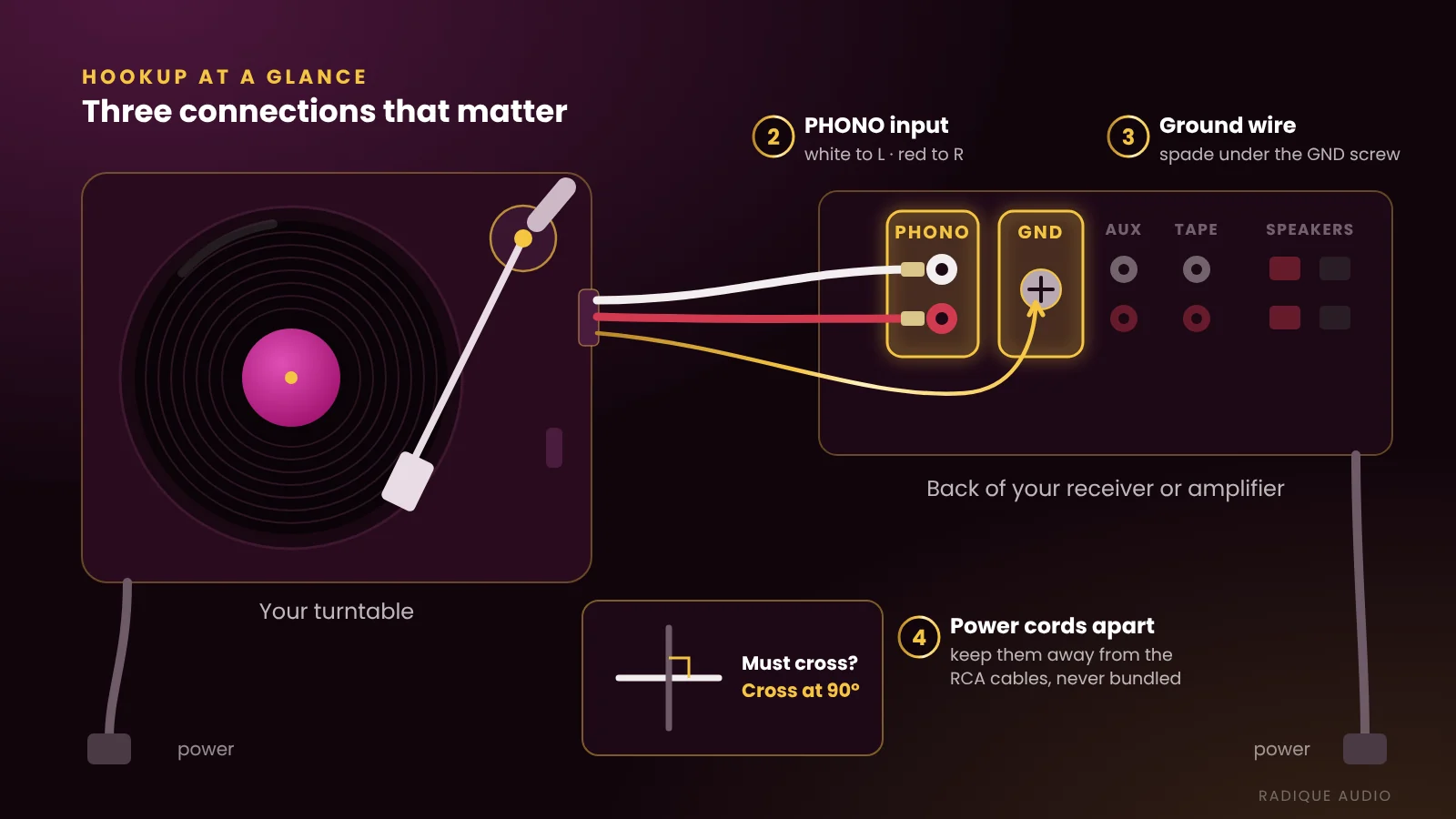
Make sure everything is switched off first. Your turntable and receiver or amplifier should stay off until every cable is connected. Then connect the turntable’s RCA cables to the input marked PHONO on your receiver, amplifier or phono preamp: red to the right (R) jack, white or black to the left (L). Any other input, such as AUX, CD or Tuner, will sound very quiet and thin.
Some powered speakers have a built-in phono stage with a PHONO/LINE switch beside their input. Set it to PHONO. The one exception: if your turntable has its own built-in preamp switched on, it goes to a LINE or AUX input instead.
-
Fasten the ground wire
The thin wire with a small fork (spade) on the end goes to the screw terminal marked GND or GROUND on the same receiver, amplifier, phono preamp or powered speaker, usually right beside the phono input. Loosen the screw, slide the fork under it and tighten it by hand. A loose or missing ground wire is the most common cause of hum.
-
Keep power cords away from the RCA cables
Route the turntable’s power cord, and any other power cords or power bars, away from its RCA cables. Don’t bundle or tie them together, and where they have to cross, cross them at a right angle. A phono signal is tiny, so it picks up hum easily.
-
Power up and play
Only once every cable is connected, plug in the power and switch on, with the volume turned all the way down. Select PHONO (or the input you used), take off the stylus guard if there is one, release the tonearm from its rest, and bring the volume up gently once the record is playing.
What makes a good turntable interconnect
Strong fields from power transformers, wall warts, dimmers and wireless gear can couple into a poorly shielded cable and become audible noise. Look for three things.
Heavy shielding
Braided copper shielding plus aluminum foil, to block electromagnetic and radio-frequency interference before it reaches the phono stage.
Quality conductors
Many strands of high-quality copper, for a clean, low-resistance signal path.
Good connector design
Secure contact without stressing the RCA jacks on your gear — which matters a lot on vintage equipment.
Our Gold Series RCA Interconnects
Radique Audio Gold Series Interconnects use a 6-layer construction with 262 tinned copper strands per channel, heavy braided shielding (128 copper strands plus aluminum foil) and gold-plated RCA connectors. Customers who upgrade typically report a quieter background and better retrieval of fine detail in their records. Available in 8″, 2.5′ and 5′ lengths.
Grounding and hum
Does the ground wire need shielding?
No — a common misconception. The ground wire carries no audio; it provides a reference ground to prevent hum and ground loops between the turntable and your amplifier or phono preamp. With no signal to protect, shielding doesn’t improve it.
What matters for a ground wire
- A solid, secure connection at both the turntable and the amplifier or phono stage.
- Any decent insulated wire — commonly 18–20 AWG stranded — is perfectly adequate.
- Local customers: we can fit a proper spade connector to your existing ground wire for a more secure, easier connection.
Hearing hum? Check these
- A persistent low-frequency hum, around the 60 Hz mains frequency, is the classic sign of a grounding problem.
- Confirm the ground wire is present and firmly attached at both ends.
- Connect it to a single ground point — usually the ground terminal on the phono preamp or receiver — to avoid ground loops.
- Route signal cables and ground wires away from large power transformers and mains cables.
- Still humming? We’re happy to help troubleshoot by email, or in person for local customers.
Gold Series vs basic RCA cables
| Feature | Gold Series Interconnects | Typical basic RCA cables |
|---|---|---|
| Conductor | 262 tinned copper strands per channel, multi-layer construction for low resistance and robustness | Often single or few thin strands, lower and less consistent copper quality |
| Shielding | Heavy braided copper plus aluminum foil for strong noise rejection | Minimal or no shielding; more prone to hum and RF noise |
| Connector fit | Deliberately slightly looser fit, so fragile chassis-mounted vintage RCA jacks aren’t pushed back through the panel | Many aftermarket “audiophile” cables grip extremely tightly and can damage older jacks; cheap cables may be loose in an unreliable way |
| Connector shape | Slim bodies, so adjacent pairs fit vintage amps with closely spaced RCA inputs | Bulkier housings can foul neighbouring jacks on tight vintage layouts |
| Noise performance | Low induction and strong shielding keep the noise floor down on phono signals | More susceptible to interference and added noise, especially on phono |
The Gold Series connectors deliberately balance secure contact with mechanical safety for older equipment — which makes them especially well suited to vintage amplifiers and receivers. They work just as well for CD players, DACs, tuners and any other RCA source.
Fixed turntable cables? We can upgrade them
For turntables with factory hard-wired RCA cables, we can replace the originals with Gold Series Interconnects and add a quality spade to the ground wire if it doesn’t have one. Typical turnaround is about a week or less, depending on the service queue.
Local drop-off only
This service is for customers in the Eastern Ontario / Western Quebec region who can drop off and pick up at our Kanata location — we don’t ship turntables, because the risk of transit damage is too high. Email us your turntable model for pricing and an appointment.
Turntable connectivity FAQ
Which input do I plug my turntable into?
The input marked PHONO on your receiver, amplifier or phono preamp. On powered speakers with a built-in phono stage, use their PHONO/LINE input with the switch set to PHONO. Only a turntable with its own built-in preamp switched on should go to a LINE or AUX input. See Connecting your turntable above.
Where does the turntable ground wire go?
To the screw terminal marked GND or GROUND on the receiver, amplifier, phono preamp or powered speaker your turntable is plugged into, usually right beside the phono input. Slide the spade under the screw and tighten it by hand.
Does turntable cable quality really matter?
Yes. A turntable’s output is roughly one-fiftieth to one-sixty-fifth of the voltage of a line-level source like a CD player or streamer, depending on the cartridge and system. Because the signal is so small, interference, poor shielding or marginal connections add hum, noise and lost detail that become very audible once amplified. Well-shielded RCA cables can make a noticeable difference in clarity, soundstage and low-level detail.
What makes a good turntable interconnect cable?
Heavy shielding (braided copper plus aluminum foil), quality multi-strand copper conductors, and connectors that make secure contact without stressing the jacks on your gear.
Do I need shielded cables for my turntable?
Yes. Turntable RCA cables carry a very low-level signal that picks up hum from power transformers, wall warts, dimmers and wireless gear far more easily than line-level connections. Properly shielded interconnects keep that interference out of the signal path.
Does the turntable ground wire need to be shielded?
No. The ground wire carries no audio signal; it only provides a reference ground to prevent hum and ground loops. What matters is a secure connection at both ends. Any decent insulated wire, commonly 18–20 AWG stranded, is fine.
How can I tell if my turntable hum is a grounding problem?
A persistent low-frequency hum around the 60 Hz mains frequency is the classic sign. Check that the ground wire is firmly attached at both ends, connect it to a single ground point on the phono preamp or receiver, and route signal and ground wires away from power transformers and mains cables.
Can Radique replace the fixed RCA cables on my turntable?
Yes, for local customers. We replace factory hard-wired RCA cables with Gold Series Interconnects and can add a spade connector to the ground wire, usually within about a week. Drop-off and pick-up are at our Kanata location for customers in Eastern Ontario and Western Quebec; we don’t ship turntables because of the risk of transit damage. Email sales@radique.com with your turntable model for pricing.
Can I use the same RCA cables for other sources?
Yes. Turntables benefit most from heavy shielding, but Gold Series Interconnects work very well for CD players, DACs, tuners and any other RCA-connected source, and many customers standardize on one cable type across their system.
Ready to quiet things down?
Order Gold Series Interconnects online, or email us about a fixed-cable upgrade or your specific setup.
Prefer a printable copy? Download the Turntable Connectivity FAQ (PDF, updated November 2026)