
Our Blog
Why Subwoofers Die Young (and How to Keep Yours Alive)

Ask us which part of a home theatre fails most often and the answer is easy, at least in our experience: the subwoofer. It is the hardest-working, most fragile and most misunderstood piece of the system, and the one most often over-driven.
This is a short look at why subwoofers fail, the five habits that keep one alive, and why our subwoofer warranty is different from the warranty on everything else we sell. The long version is our new guide, Caring for Your Subwoofer.
The dorm room sub
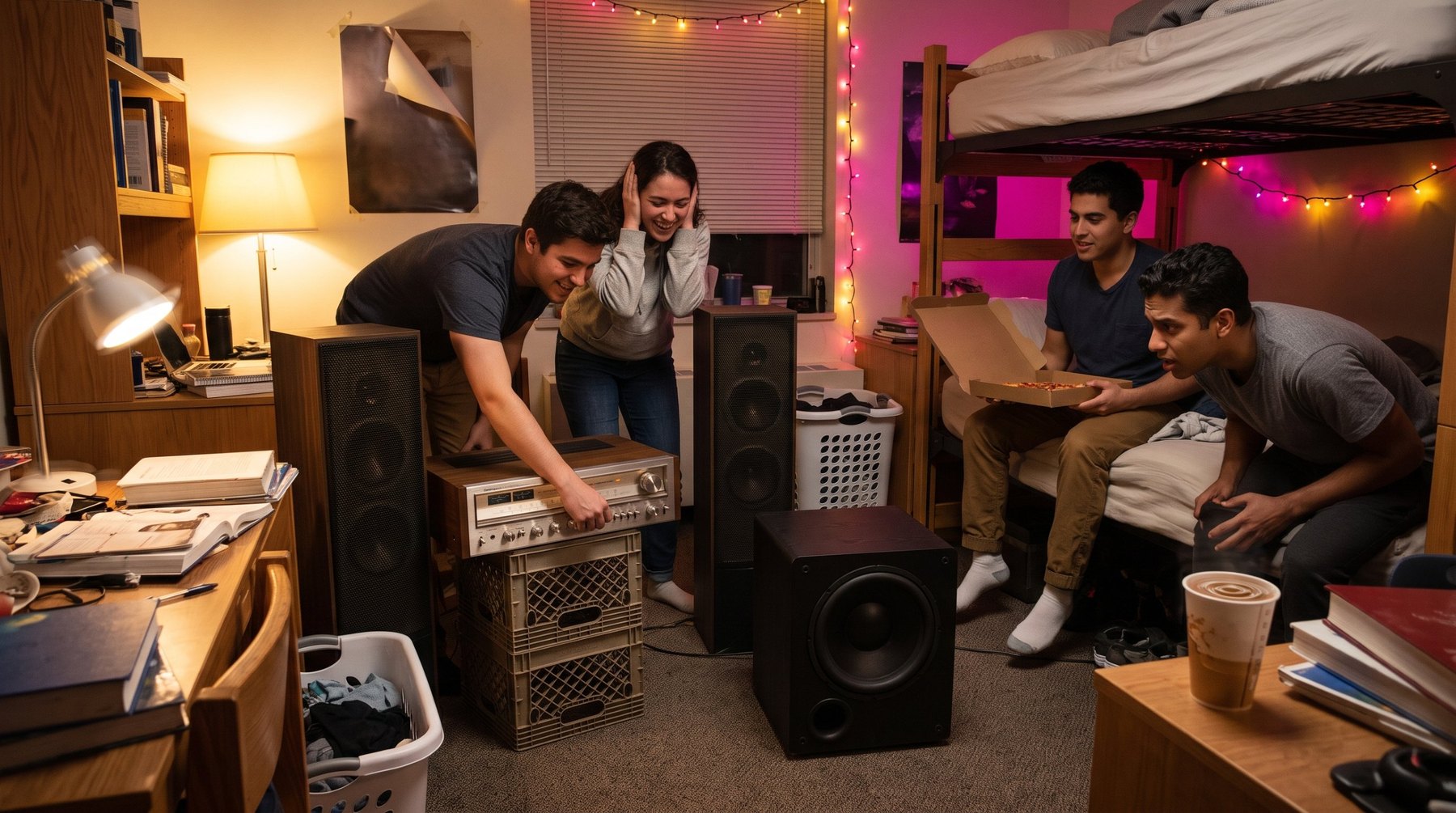
We couldn’t tell you how many times we’ve shuddered when university students buy a subwoofer for their shared dorm. We’re always happy to see someone new falling for good sound.
So we give the warning. And still, in spite of it, the sub gets blown up on its first day home.
Nobody does it on purpose. A new sub is exciting, a shared dorm is a lively place, and it only takes one night that ran too loud. A sub can be damaged in minutes, and from the outside the damage usually doesn’t show.
Why the subwoofer goes first
A subwoofer packs a powerful amplifier, its own power supply and a long-throw driver into one box. It moves more air than anything else in the system, and it usually sits on the floor in a corner, on the same outlet as everything else.
On a powered sub, the part that fails is almost always the built-in amplifier (the “plate amp” on the back panel), not the speaker cone. That amplifier works hard, makes heat, and is the part most exposed to power spikes, brownouts and connections made with the power on.
Most of the failures we see come down to a handful of avoidable things: a cable connected with the power on, a power spike or brownout, a level knob left near maximum, or a sub asked to fill a room much bigger than it was built for.
Five habits that keep a subwoofer alive
These are the essentials. Each one has a full section in the guide.
-
Never connect it hot
Plugging a cable into a live subwoofer or receiver sends a loud thump through the system that can damage the amplifier or the driver. Turn everything off first, make every connection, then power up. Turn the sub on last and off first.
-
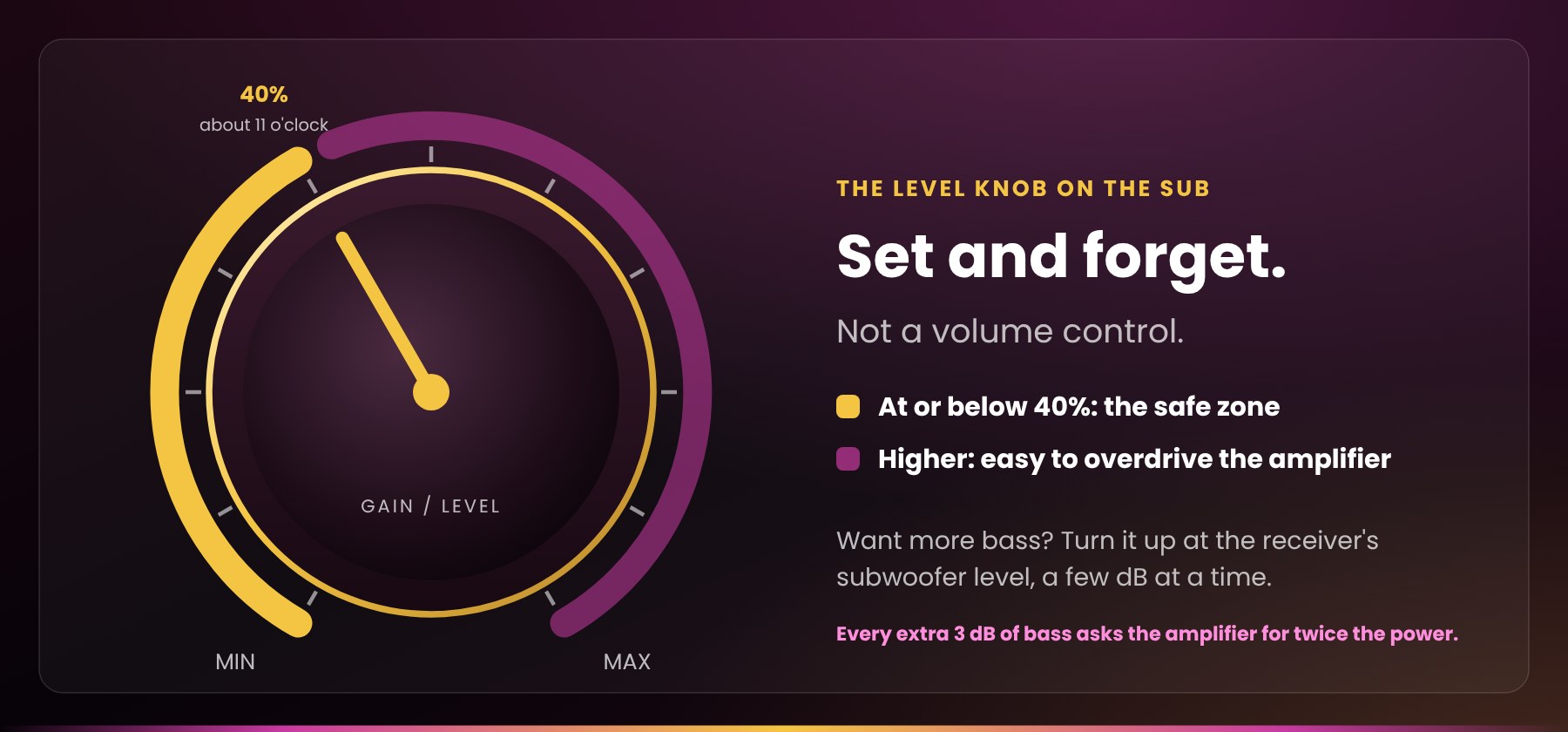
Keep the gain at or below about 40%
Treat the level knob on the sub as “set and forget”, not as a volume control. About 40% is roughly 11 o’clock. A gain knob near maximum is the most common way we see subs overdriven. Want more bass? Turn it up at the receiver, a few dB at a time.
-
Know what a surge protector doesn’t do
A surge protector absorbs spikes. It does not protect against a brownout. When the lights dim or a storm rolls in, switch the system off at the power bar or unplug it. A power conditioner like our Ultralink HDC150 shows the incoming line voltage, so you can see a brownout as it happens.
-
Keep it away from heaters and humidifiers
The metal panel on the back is the amplifier’s heat sink, so it needs air, and it should sit well away from heat registers, radiators and baseboard heaters. Humidifiers are worse: we’ve seen subwoofers age five years in a few months from spending one winter next to one.
-
Switch it fully off when you’re away
Standby still draws power, and it leaves the amplifier connected to every spike on the line. Going away for a few days? Switch it off at the sub or the power bar.
Sounds that mean “turn it down now”: a sharp clack, slap or knock on deep notes, crackling or fuzzy bass at volumes that used to be clean, or the sub cutting out by itself at high volume. If any of these keep happening at normal listening levels, stop using the sub and contact us.
Why our subwoofer warranty is different
Almost everything used that we sell carries our 90-day Bumper-to-Bumper Warranty: if it fails in normal use, we repair or replace it at our expense and start you on a fresh 90 days. Used subwoofers are the one exception, and the dorm room is the reason why.
- What you get: used subwoofers carry a 90-day limited warranty with a 50% deductible. If your sub needs repair or replacement under warranty, you contribute half of what you paid for it and we cover the rest.
- Extended Warranties: subwoofers aren’t eligible for them.
- New special-order subs: covered by us for 30 days, then directly by the manufacturer.
The reason is simple. A subwoofer is the most fragile, most failure-prone and most misunderstood part of a system, and the component most often over-driven. Our warranty covers a component that fails on its own in normal use. Normal use is everyday listening, not a lightning strike, a hot-plug mishap, a coffee incident or an encounter with gravity.
Picking up in person? Let us set the sub up and audition it for you, so you see and hear it working before it goes home. The habits above are what give a sub a long, trouble-free life, and they protect your warranty too.
Read the full guide
Caring for Your Subwoofer covers the rest: crossover and phase, placement and the “sub crawl”, hooking a sub up to a vintage amp with no sub out, curing hum, and a quick checklist. Shopping for one? Here are our used subwoofers.
Questions we hear
Why do subwoofers fail so often?
A subwoofer packs a powerful amplifier, its own power supply and a long-throw driver into one box, and it is the component most often over-driven. Most of the failures we see come down to a cable connected with the power on, a power spike or brownout, a level knob left near maximum, or a sub asked to fill a room much bigger than it was built for.
Which part of a subwoofer usually fails?
On a powered sub it is almost always the built-in amplifier (the “plate amp” on the back panel), not the speaker cone. It works hard, makes heat, and is the part most exposed to power spikes, brownouts and connections made with the power on.
How high should the level knob on my subwoofer be?
No higher than about 40%, roughly 11 o’clock. Treat it as “set and forget”, and get extra level from your receiver’s subwoofer setting instead.
What warranty comes with a used subwoofer from Radique?
A 90-day limited warranty with a 50% deductible: if your sub needs repair or replacement under warranty, you contribute half of what you paid for it and we cover the rest. Subwoofers aren’t eligible for our Extended Warranties. The full terms are in our Warranty FAQ.