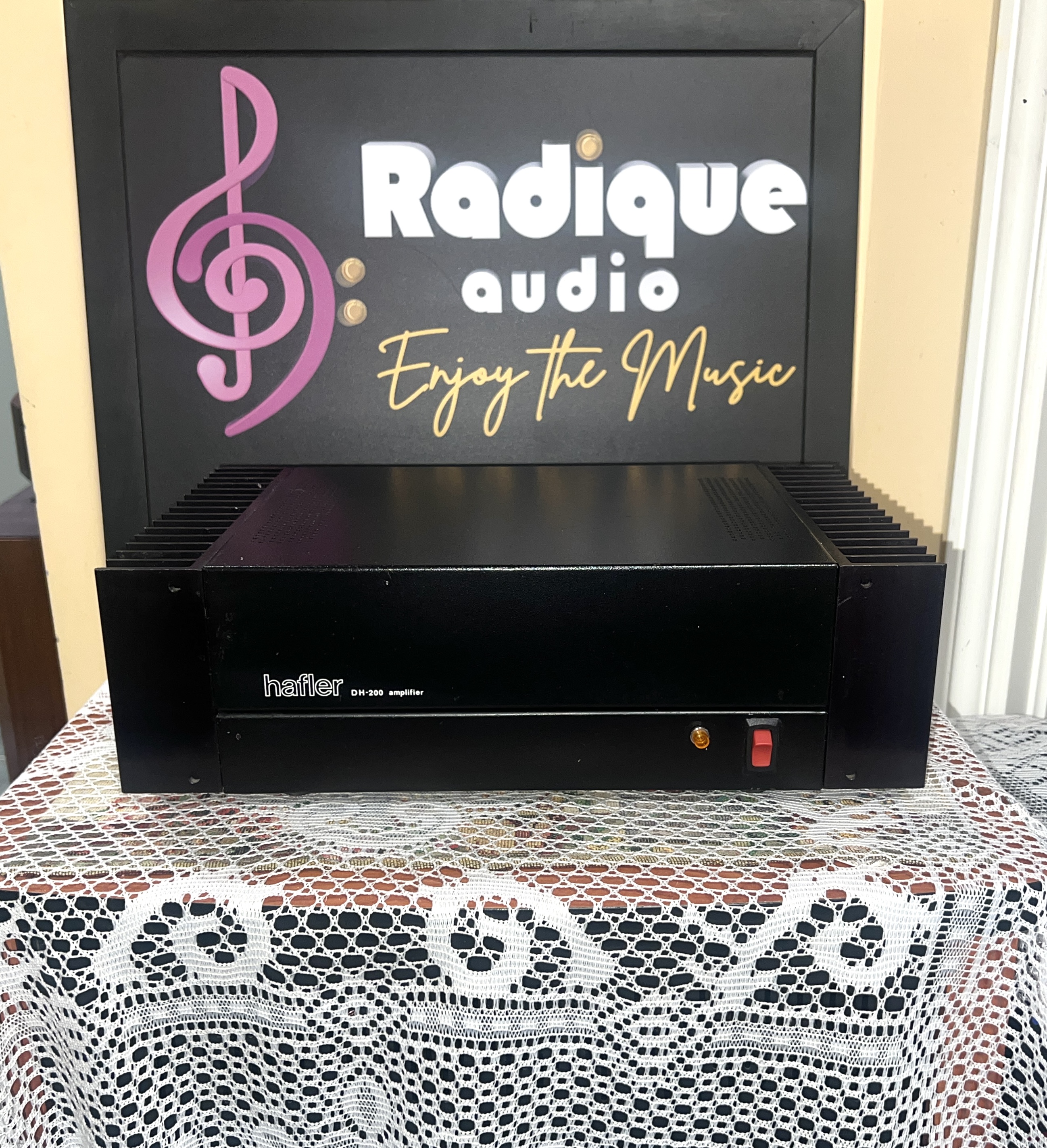
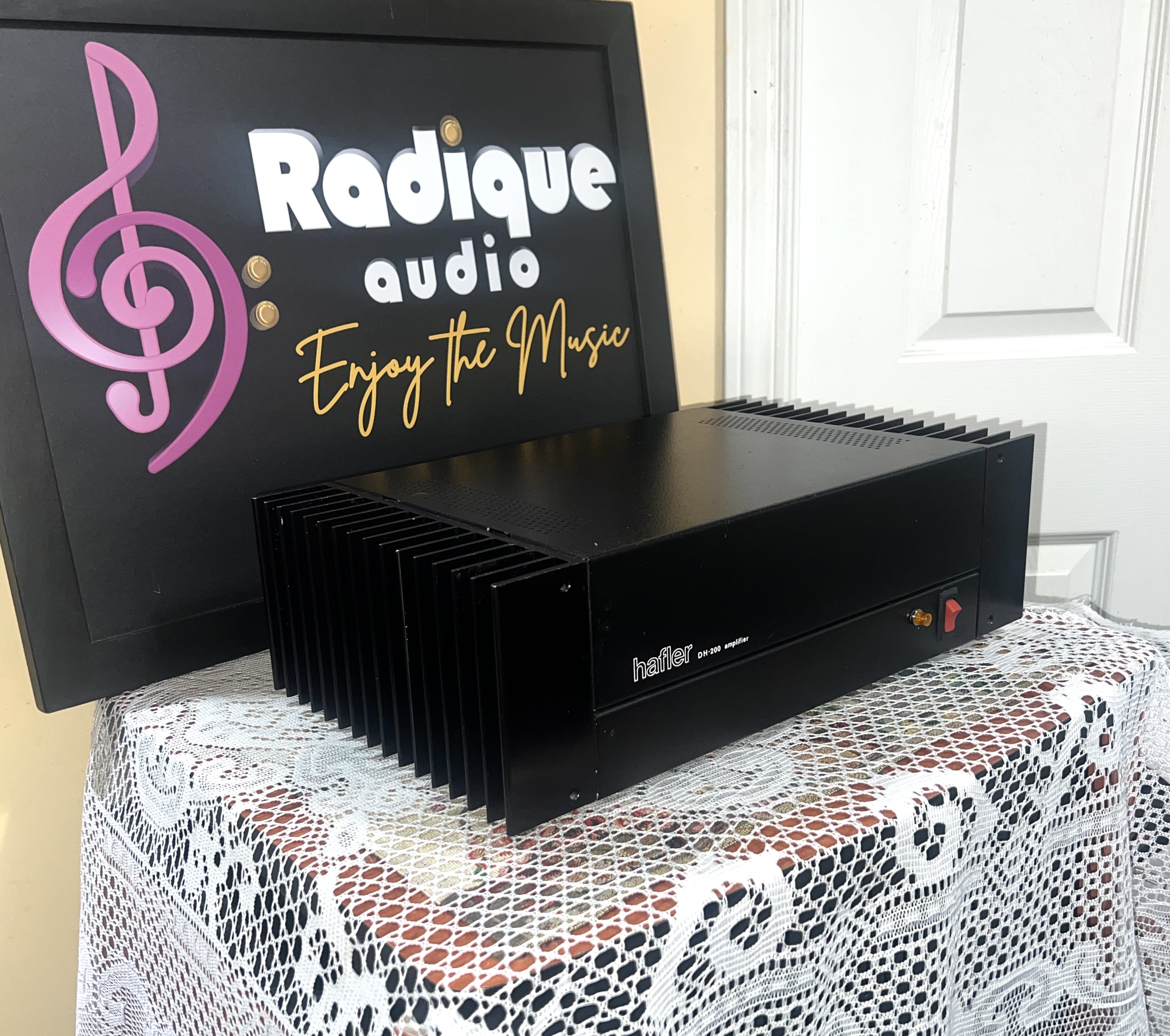
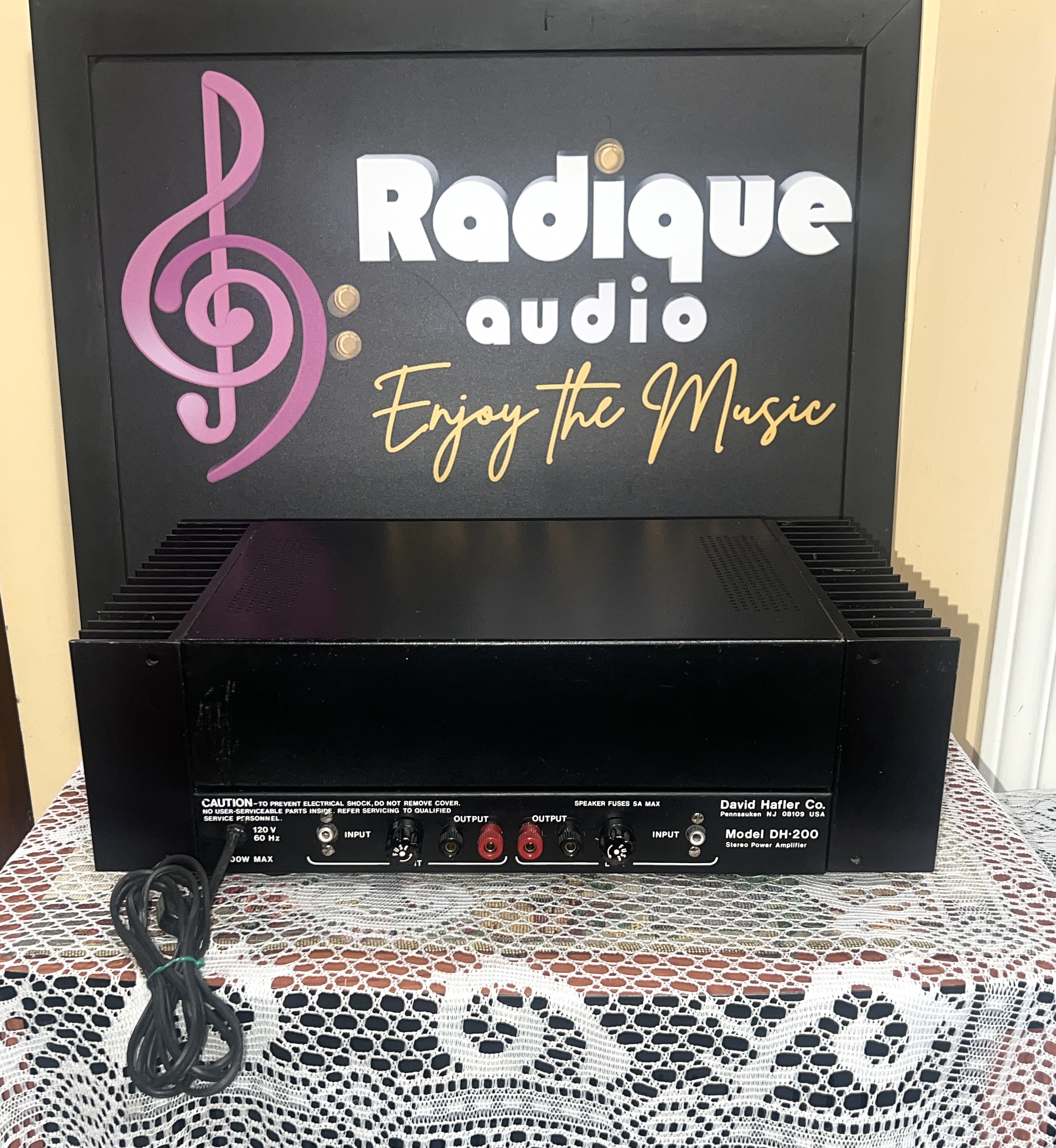
Hafler DH-200 Power Amplifier — 100 WPC MOSFET, Made in USA
$495.00
David Hafler's second act, and the amplifier that put MOSFETs into American hi-fi.
✔️ Condition: Very Good
✔️ Covered by Radique Warranty
✔️ Includes Perpetual Trade-Back Program eligibility
✔️ Expertly packed for safe shipping
1 in stock
David Hafler’s second act, and the amplifier that put MOSFETs into American hi-fi.
Hafler had already built one legend at Dynaco with the ST-70, and when he started again under his own name at the end of the 1970s the DH-200 was the power amplifier that followed. Walt Jung, reviewing it for The Audio Amateur in 1980, noted it was the first American production amplifier he knew of to use complementary MOSFETs in its output stage — which is why this plain black box turns up in conversations about amplifiers costing many times as much.
MOSFETs are the reason it behaves the way it does. They have no thermal runaway and act as low-value resistors when switched on, so the DH-200 needs none of the voltage-current limiting circuitry that bipolar amplifiers of the era relied on. Nothing sits between the output stage and your speakers clamping down on transients. It is also why the amplifier shrugs off loads that made contemporaries fold.
The rating is 100 watts per channel into 8 ohms, and it is a conservative rating. Jung measured over 130 watts per channel at clipping on his bench in 1980, and around 250 watts from a single channel into 4 ohms. Ken Rockwell, measuring a different sample decades later, got 116 watts continuous and 164 watts on burst. Two independent benches, forty years apart, both finding more than the badge claims.
The distortion figures were extraordinary for the price and remain respectable now — the specification is 0.012% total harmonic distortion, and Jung’s bench found it sitting near the residual noise floor of his analyser across most of the audio band. Intermodulation measured at the limits of what his equipment could resolve.
Construction is honest rather than showy. A heavy transformer feeds a 25-amp bridge rectifier and unregulated ±60-volt supplies. The two channels live on the left and right heatsink assemblies, which double as the end panels of the chassis. Protection is layered — a mains fuse, thermal breakers that sense heatsink temperature and shut the amplifier down, individual supply fuses per channel, and speaker fuses inside the feedback loop.
Jung was not uncritical. He heard a high-frequency character on his own system that he called sizzle, and said so at length — though other reviewers of the period reported not hearing it, and he was clear that it depended heavily on the cables and speakers around it. His conclusion on value was unambiguous: at the price, he wrote, it was “one whale of a lot of amplifier.” That is the useful verdict, from someone who had just spent two thousand words telling you exactly what he did not like.
It sold new in 1980 at $429.95 US assembled — about $1,650 in 2026 Canadian dollars — or $329.95 as a kit, the kits arriving with the amplifier modules already built and tested.
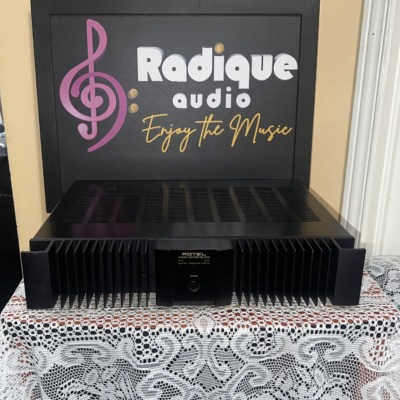
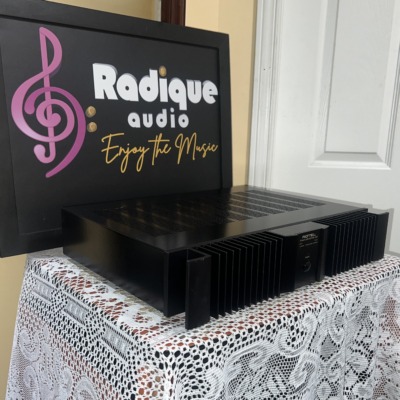
Built in Pennsauken, New Jersey. At 26 pounds in a 5-inch-high chassis it is compact for its output, and it stacks or shelves easily.
Condition is Very Good.
A few relevant specifications:
An American-built MOSFET amplifier from one of the two or three designers whose names still mean something, measuring better than its badge on every bench that has tested one.
Available for pickup in Kanata, or shipped across Canada and internationally — we have sent equipment to fifteen countries in the past year, each piece packed in-house in 275 lb test double-wall boxes. Live shipping rates for your address are calculated at checkout. Backed by Radique Audio’s Bumper-to-Bumper Warranty and our Perpetual Trade-Back Program. Available for audition by appointment in Kanata.
Hafler DH-200 stereo power amplifier, stock Specifications
- Stereo power amplifier, MOSFET output stage
- Power output 100 watts per channel into 8 ohms; 175 watts per channel into 4 ohms
- Total harmonic distortion 0.012%
- Frequency response 10 Hz to 40 kHz
- Signal-to-noise ratio 100 dB
- Input sensitivity 1.5 V
- Damping factor 50
- Semiconductor complement: 26 transistors, 8 MOSFETs, 24 diodes, 4 zener diodes, 1 bridge rectifier
- Thermal shutdown with front-panel indicator; per-channel supply fuses and speaker fuses
- Made in the United States of America
- Dimensions: (Width x Height x Depth) 16 x 5.125 x 10.5 inches (40.6 x 13 x 26.7 cm)
- Weight: 26 lbs (11.8 kg)
🎚️ Gold Series RCA Interconnects
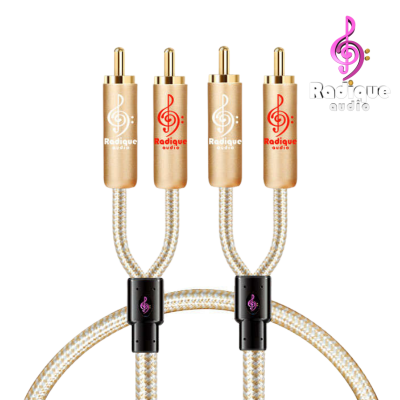
Our own Gold Series RCA Stereo Interconnect is a shielded, gold-plated stereo pair, in stock and ready to go. It is the cable that connects this to the rest of your system, and it is a straightforward upgrade on the free leads that come in the box with most equipment. 👉
🔌 Speaker Cable, Built on Our Own Bench
The speaker terminals here are five-way binding posts, so they take banana plugs or spade lugs and you have the run of the options. We hand-build speaker cable here in any length you need — choose the gauge and the terminations on our Custom Speaker Cable Builder. If you would rather terminate cable you already own, we make our own gold-plated banana plugs and spade connectors as well. 👉
⚠️ Important Information for International Buyers
This unit is configured for North American 110/120V power. Buyers outside North America will require a step-down transformer and appropriate plug adapter.
✅ Buy With Confidence — The Radique Promise
Backed by Radique Audio’s Bumper-to-Bumper Warranty and our Perpetual Trade-Back Program. When you’re ready to move on, we’ll take it back. That’s the Radique difference.
📦 Watch how we protect your gear — our unboxing video.
📺 Curious about our business? Check out our YouTube channel for behind-the-scenes videos and more!
📞 Questions? Use the Ask a Question button above, or call us at 613-416-9995.
| Weight | 28 lbs |
|---|---|
| Dimensions | 14.5 × 20 × 9.12 in |
You may also like…
Gold Series RCA Stereo Interconnect | Radique Audio
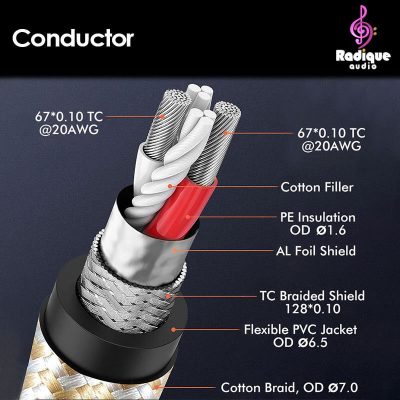
Radique Audio Gold Series RCA Stereo Interconnect — dual RCA to dual RCA with vintage-safe, gold-plated connectors and 6-layer shielded construction. Featuring 262 strands of tinned copper, dual-layer copper and foil shielding, and slim narrow-profile connector barrels designed to fit tightly spaced vintage RCA jacks. Available in 0.2 m, 0.75 m, and 1.5 m lengths. Audiophile quality without the audiophile pricing.
Related Products
NAD C 272 Stereo Power Amplifier 150 WPC, 300 Watts Bridged
Start with the number that is not on the front: 150 watts per channel into 8 ohms and 150 into 4. Most amplifiers quote a comfortable 8 ohm figure and hope you never connect anything harder; this one holds its full rating into half the impedance, from a high-current Holmgren toroidal feeding all-discrete circuitry with NAD's PowerDrive topology behind it. A BRIDGE MODE switch on the back turns it into a single mono channel of roughly 300 watts into 8 ohms, so the system can be rearranged later rather than replaced. Very Good condition.
Audionics of Oregon CC-2 Stereo Power Amplifier 70 WPC — USA
Rotel RB-870 Stereo Power Amplifier – 60 WPC, Bridgeable to 120
Sixty watts a channel into 8 ohms at 0.03% distortion, a damping factor of 280, and response running out to 120kHz. A rear-panel switch bridges the two channels into a single 120-watt mono amplifier, so a second one later gives you monoblocks. The speaker terminals clamp bare wire or spades only — no bananas. Very good condition, inspected and tested.
Nikko Alpha 600 Stereo Power Amplifier 180 WPC, Made in Japan
Rotel RB-1050 Power Amplifier — Serviced 70 WPC, New 5-Way Posts