


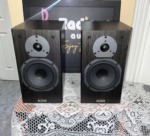
Distinctive, Audiophile Quality NHT Bookshelf speakers 1.3
$295.00
Out of stock
This one has sold. Want first dibs on the next one?
We take these in regularly. Leave your name and email, and we’ll email you the moment one is listed, so you hear first. No cost, no obligation.
Email me when one is listed
Whatever you end up with, it needs cable. Build a set to length →
Other bookshelf speakers we have in stock now
3 in stock · $275.00–$295.00 · all ship
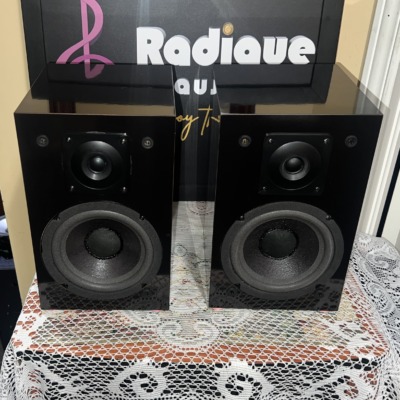 NHT Model 1C Bookshelf Speakers, Pair – Gloss Black, Re-Foamed$275.00Ships
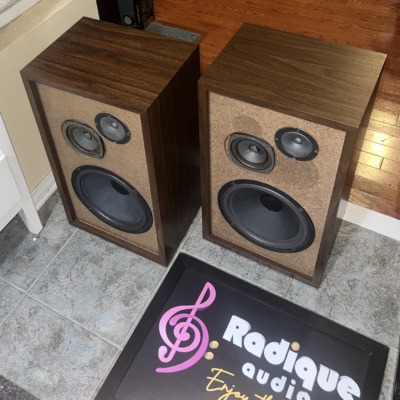 Fisher XP-65S Speakers, Pair — Walnut, Refoamed, 3-Way Sealed$295.00Ships
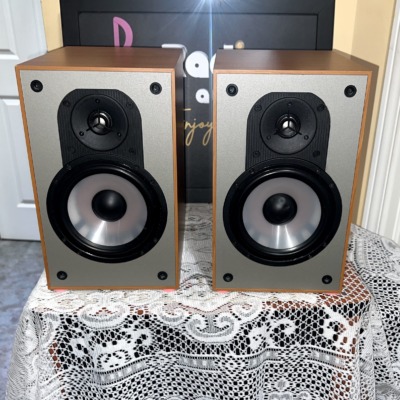 Paradigm Mini Monitor v2 Bookshelf Speakers -Light Cherry Finish$295.00Ships
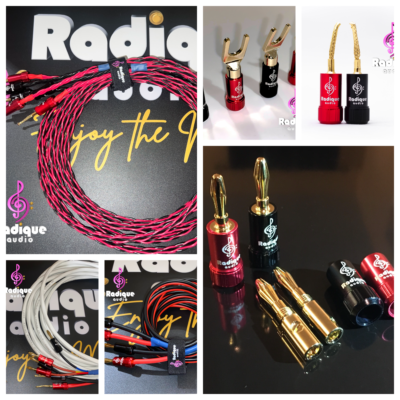
Whatever you end up with, it needs cable.
We hand-build speaker cable to your exact length and terminate it however you like: banana, spade, pin or bare wire. Tell us the run and the ends, and it ships ready to plug in.
Build a set to length →Finished in a gloss-black high-pressure laminate, the 1.3 is elegant, even beautiful, and is distinguished by its unusual angled front baffle.
This design means that the rear baffle is nonparallel to the driver, thus reducing the amount of internal cabinet energy reflected back toward the woofer. This is said to improve imaging and midrange purity by reducing comb filtering. In addition, the angled baffle puts the listener directly on-axis with the loudspeakers pointing straight ahead. This increases the ratio of direct-to-reflected sound reaching the listener and further improves imaging.
Rather than use off-the-shelf drivers, the 6″ woofer and 1″ soft-dome tweeter are custom-made for NHT. The woofer took 18 months to develop from the ground up, and is manufactured in Asia by KSC. The tweeter is made by Tonegen in Japan, to NHT’s specifications. Tonegen manufactures many drivers for high-end loudspeakers, including, I believe, the EMITs for Infinity. The drivers are mounted symmetrically on the front baffle, vertically in-line. Crossover frequency is 3.1kHz, with second-order slopes and a damping compensation network. Air-core inductors are used, along with some polypropylene capacitors. A single pair of five-way binding posts is mounted in a large cup in the rear panel.
In addition to its attractive appearance, the Model 1.3 has excellent fit and finish.
Excerpt from Stereophile’s excellent review:
“Conclusion
The NHT Model 1.3 excels in those areas that are most important musically: tonal neutrality, uncolored and transparent midrange, and well-defined and articulate bass presentation. In these areas, it rivals much more expensive loudspeakers. The midrange is especially clear and detailed, giving instruments and vocals a natural texture and providing an excellent view into the presentation.
I prefer the 1.3’s somewhat lean mid-to-upper bass to a tubby, underdamped bass. This improves the overall presentation by the absence of that thick, congested sound that often accompanies a loose bass. In addition, the bass was articulate and agile, clearly resolving pitch. The slight loss of body and warmth to some instruments was, in my opinion, worth the increase in definition and control. In addition, bass extension was surprising for the 1.3’s cabinet size. I found the brightness in the extreme treble to be a liability, but not significant enough to preclude a recommendation. This minor fault is more than compensated for by the 1.3’s strengths and overall musical performance.
The NHT Model 1.3 offers the audiophile on a budget a glimpse of high-end sound at a mid-fi price. Highly recommended.”
Description:
Two-way loudspeaker with 6½” woofer and 1″ soft-dome tweeter.
Bass alignment: sealed-box.
Crossover frequency: 3100Hz with second-order slopes.
Frequency response: 53Hz–24kHz ±3dB.
Power handling: 150W maximum. Impedance: 8 ohms nominal.
Sensitivity: 86dB, 2.3V at 1m (as published in owner’s manual).
Dimensions: 7″ W by 16½” H by 10″ D. Weight: 15 lbs each, net.
Finish: high-gloss black laminate.
The NHT 1.3 Bookshelf speakers listed for $480 USD when new ~$740 CND with HST. Asking just $295 for these distinctive, great sounding bookshelf speakers from California’s “Now Hear This”
| Weight | 30 lbs |
|---|---|
| Dimensions | 22 × 42 × 28 in |
NHT was founded in Benicia, California, in 1986 by Chris Byrne and engineer Ken Kantor, and the name stands for Now Hear This. We carry NHT bookshelf speakers, towers, centre channels and subwoofers. We've had more than 40 NHT listings so far, covering more than 25 different models. Every used NHT here is inspected, tested and serviced as required, then photographed in-house and covered by our Bumper-to-Bumper Warranty and Perpetual Trade-Back Program. Don't see the model you want? Tell us on First Dibs and we'll email you when one arrives.
The NHT models we've sold most often include the Three and SuperOne bookshelf speakers, the SW2 and Ten subwoofers and the 2.9 tower.
The NHT story
Chris Byrne, who had been Pioneer Electronics' vice-president of marketing, and engineer Ken Kantor, whose career had taken in Acoustic Research, Boston Acoustics and NAD, founded NHT in Benicia, California, in 1986. Its speakers were known for front baffles angled at 21 degrees, which NHT called Focused Image Geometry.
Jensen and Rockford. In 1990 NHT was sold to International Jensen, which also owned AR and Advent and let NHT keep its design independence. The four-way 3.3 flagship followed in the early 1990s, Kantor left in 1997 after designing the 2.9 tower, and by 2004 NHT was part of Rockford Corporation.
Today. Secrets of Home Theater calls the Classic Three of the mid-2000s NHT's best-selling model, and the C Series followed it. NHT is still based in Benicia, making acoustic-suspension and in-ceiling speakers. Chris Byrne died in December 2025.
Which NHT is which?
Original Model line (late 1980s to early 1990s): from the Model 1 to the four-way 3.3, with slim baffles angled at 21 degrees.
2.9 tower (by 1997): Ken Kantor's last NHT design, with separate terminals for bi-amplifying its woofers.
Super series: the SuperZero, SuperOne and SuperTwo, often paired with the SW2 subwoofer.
Subwoofers: the SW2 with its MA-1A amplifier, and the Classic Ten and Classic Twelve.
VT home theatre towers: such as the VT-1 and VT-3.
Classic Series (mid-2000s to 2016) and C Series: including the Classic Three.
Buying used NHT: what to check
Stabilizer bars and spikes. NHT towers such as the VT-3 and SuperTwo rely on stabilizer bars or spikes, so check they come with the pair.
Amplifier match. NHT says underpowered amplifiers are the most common cause of speaker damage, so check the tweeters on any pair that ran on a small receiver.
Subwoofer amps. If an MA-1A's front light doesn't come on, an internal fuse may have blown. On a Classic Ten or Twelve, check that the line-voltage setting is 120 V.
Baffle foam. The original angled models have anti-diffraction foam strips on the baffle, so check they are there.
Everything we list is inspected, tested and serviced as required here, and comes with our warranty.
You may also like…
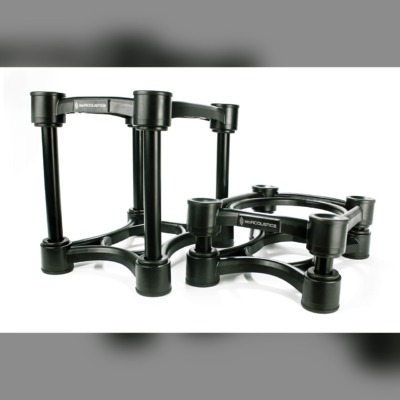

IsoAcoustics ISO-200 Isolation Stands (Pair)
- ✔️ Genuine IsoAcoustics, brand new, from an authorized Canadian dealer
- ✔️ A pair of isolation stands for large speakers and studio monitors
- ✔️ Rated to 75 lb (34 kg) short or 60 lb (27 kg) tall
- ✔️ Short 3.75 in (95 mm) or tall 8.5 in (215 mm), up to 6.5° of tilt
- ✔️ Pick up in Kanata by appointment, or shipped across Canada and internationally
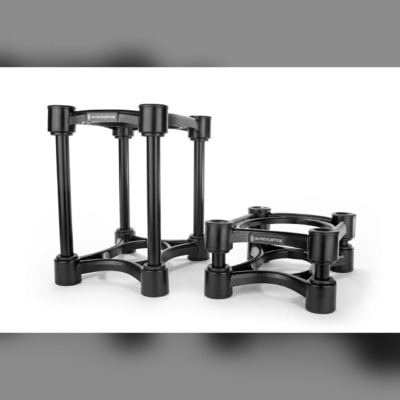

IsoAcoustics ISO-155 Isolation Stands (Pair)
- ✔️ Genuine IsoAcoustics, brand new, from an authorized Canadian dealer
- ✔️ A pair of isolation stands for medium speakers and studio monitors
- ✔️ Rated to 40 lb (18 kg) short or 35 lb (16 kg) tall
- ✔️ Short 3 in (76 mm) or tall 8.25 in (210 mm), up to 6.5° of tilt
- ✔️ Pick up in Kanata by appointment, or shipped across Canada and internationally


IsoAcoustics ISO-130 Isolation Stands (Pair)
- ✔️ Genuine IsoAcoustics, brand new, from an authorized Canadian dealer
- ✔️ A pair of isolation stands for small speakers and studio monitors, rated to 20 lb (9 kg)
- ✔️ Short 2.8 in (71 mm) or tall 8.25 in (210 mm), up to 6.5° of tilt
- ✔️ Top plate 5.1 × 6 in (130 × 152 mm)
- ✔️ Pick up in Kanata by appointment, or shipped across Canada and internationally
Custom Speaker Cable Builder
Your specs, your cable: choose the cable, the length and each connector, with live pricing.
- House CCA, House OFC, House Quad, Kimber 4PR or Kimber 4TC
- Banana, spade, pin, small spade or bare wire, chosen for each end
- Bi-wire on Kimber 4PR, Kimber 4TC and House Quad
- Hand-assembled, heat-shrink reinforced and colour-coordinated
- 1-year warranty
Related Products
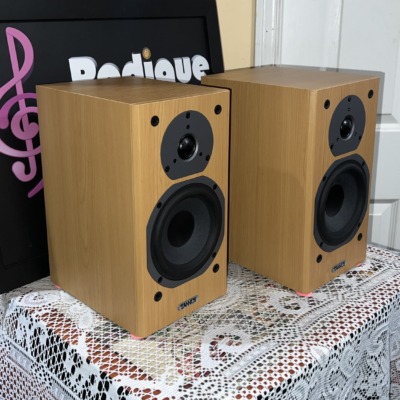
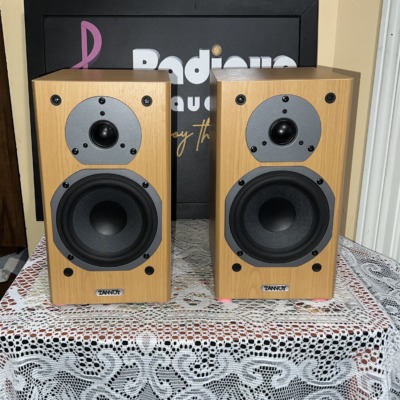
Tannoy Mercury mX1-M Bookshelf Speakers, Pair – Cherry
A pair of Tannoy Mercury mX1-M two-way bookshelf speakers in Tannoy's factory cherry finish, with their grey cloth grilles and removable port bungs. Tested on our bench before listing.
✔️ Tannoy's factory cherry finish, rarely seen
✔️ Removable port bungs: run them sealed or ported
✔️ 87 dB, 8 ohms, 10–100 W: easy to drive
✔️ Very good condition, grilles and port bungs included
✔️ Covered by Radique Warranty
✔️ Includes Perpetual Trade-Back Program eligibility
✔️ Expertly packed for safe shipping
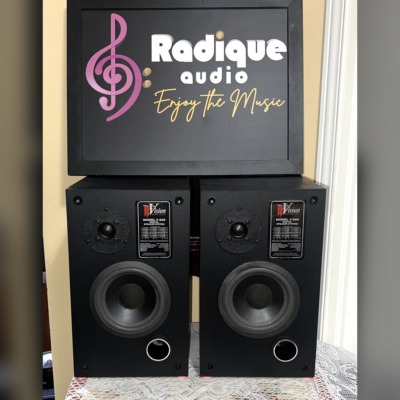
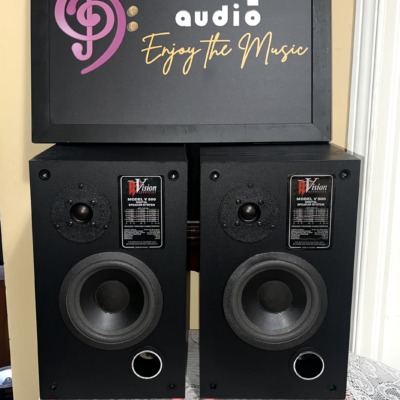
Vision Acoustics V500 Bookshelf Speakers, Pair – Made in Canada
A pair of solidly built, Canadian-made Vision Acoustics V 500 bookshelf speakers in black ash, rated at a sensitive 92 dB, fully tested on our bench and in very good condition.
✔️ Very good condition — free of significant marks, in black ash
✔️ Efficient 92 dB design, easy for a modest receiver to drive
✔️ Made in Canada, with 5-way binding posts
✔️ Covered by Radique Warranty
✔️ Includes Perpetual Trade-Back Program eligibility
✔️ Expertly packed for safe shipping
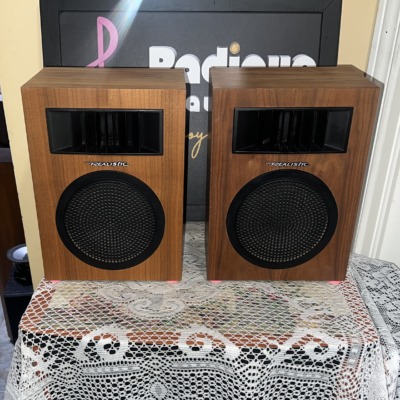
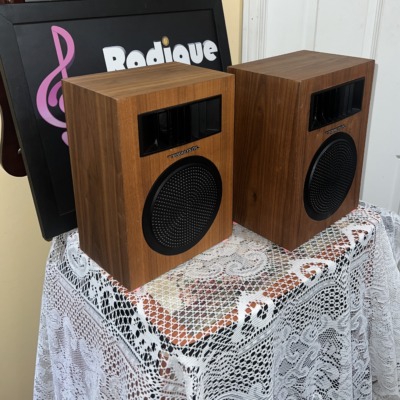
Realistic Minimus-5 Speakers, Pair – Vintage, Real Wood Veneer
A vintage pair of Realistic Minimus-5 two-way bookshelf speakers from Radio Shack, in a warm brown real wood veneer, with horn tweeters, fully tested on our bench and in very good condition.
✔️ Very good condition — free of significant marks
✔️ Real wood veneer, with rigid grilles over the woofers
✔️ Two ways in: small binding posts and an RCA-type speaker-level jack
✔️ Covered by Radique Warranty
✔️ Includes Perpetual Trade-Back Program eligibility
✔️ Expertly packed for safe shipping
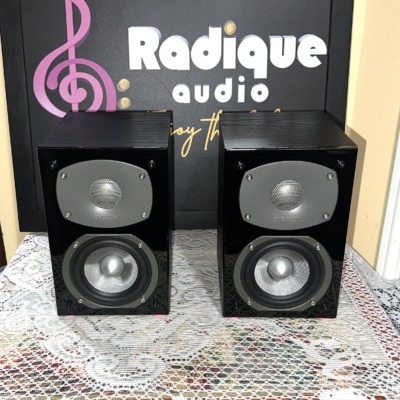
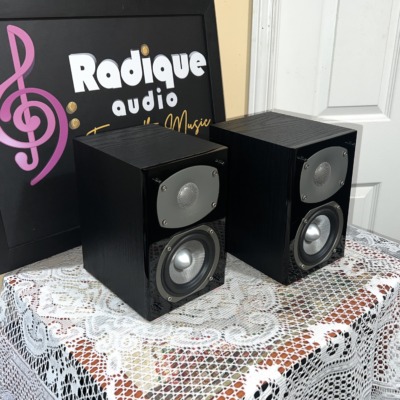
Energy C-50 Bookshelf Speakers, Pair – Ultra-Compact, Black Ash
A pair of ultra-compact Energy C-50 bookshelf speakers, designed and engineered in Canada, in black ash with gloss black front baffles and their black cloth grilles. They have been tested on our bench and are in very good condition.
✔️ Very good condition — black ash with gloss baffles, grilles included
✔️ 1-inch aluminum tweeter and 4½-inch woofer, video-shielded
✔️ Five-way binding posts — designed and engineered in Canada
✔️ Covered by Radique Warranty
✔️ Includes Perpetual Trade-Back Program eligibility
✔️ Expertly packed for safe shipping
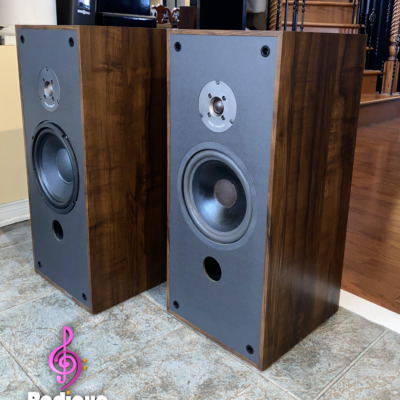
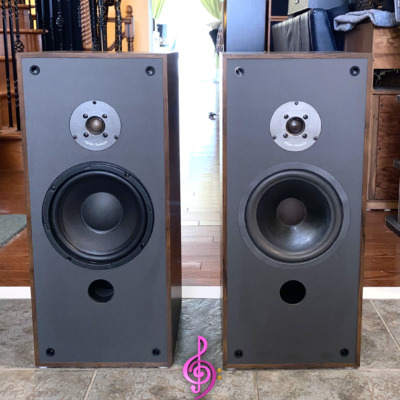
Paisley Reference Two Bookshelf Speakers, Pair – Made in Canada
A pair of Paisley Research Reference Two bookshelf speakers, made in Canada, in walnut-finish cabinets with black front baffles and their black cloth grilles. They have been tested on our bench, they play nicely, and they are in very good condition. One woofer is a replacement fitted by a previous owner, not by us; the details are under Condition.
✔️ Very good condition — walnut-finish cabinets, grilles included
✔️ Tested and playing nicely; one replacement woofer, disclosed below
✔️ 8-inch woofers, front-ported — made in Canada
✔️ Covered by Radique Warranty
✔️ Includes Perpetual Trade-Back Program eligibility
✔️ Expertly packed for safe shipping
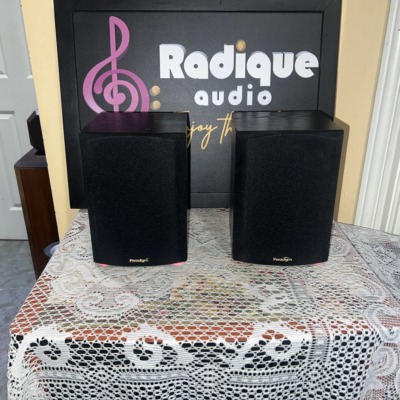
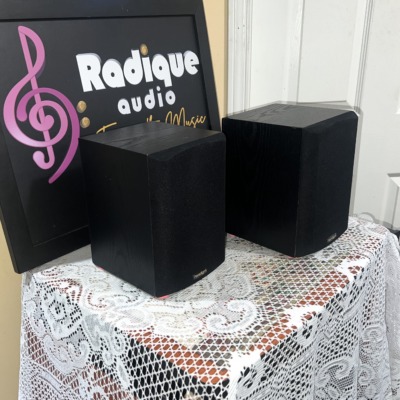
Paradigm Micro v.3 Bookshelf Speakers, Pair – Black Ash
A pair of Paradigm Micro v.3 speakers, the smallest of Paradigm's Canadian-designed Performance Series, with rubber woofer surrounds that will never need refoaming.
✔️ Tested on our bench
✔️ Fair condition, priced to match
✔️ Covered by Radique Warranty
✔️ Includes Perpetual Trade-Back Program eligibility
✔️ Expertly packed for safe shipping
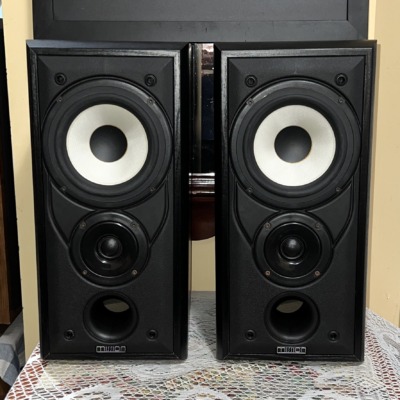
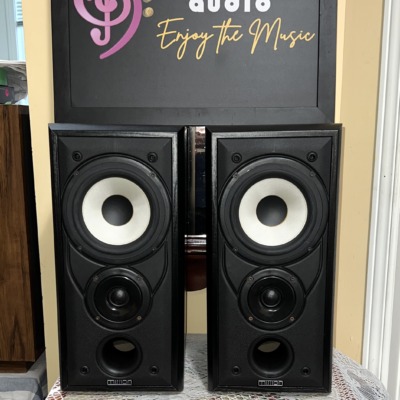
Mission 701 Bookshelf Speakers, Pair – British Design, Black Ash
A pair of Mission 701 two-way bookshelf speakers in black ash, with Mission's inverted driver layout and their grilles. One of our favourites in this size.
✔️ Tested on our bench, woofer and tweeter in each
✔️ Very good, grilles included
✔️ 89 dB, 8 ohms: easy for any receiver
✔️ Covered by Radique Warranty
✔️ Includes Perpetual Trade-Back Program eligibility
✔️ Expertly packed for safe shipping
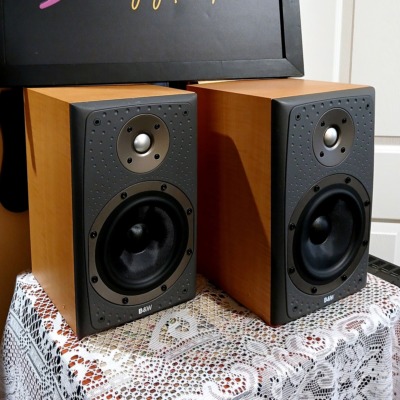
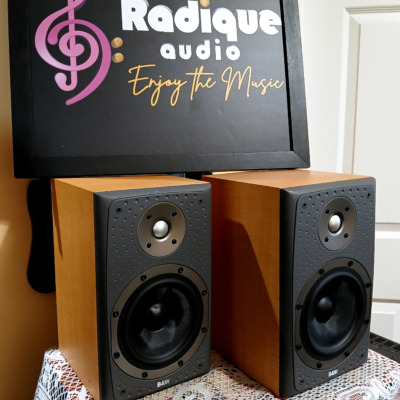
B&W DM303 Bookshelf Speakers, Pair – Made in England, Maple
A pair of B&W DM303 two-way bookshelf speakers in a light maple finish, made in England, with their black cloth grilles. Tested on our bench before listing.
✔️ Nautilus tube-loaded metal-dome tweeter and B&W's dimpled Flowport
✔️ 88 dB, 8 ohms, 25–100 W: easy for any receiver
✔️ Good condition: a few tiny nail holes, presents well
✔️ Covered by Radique Warranty
✔️ Includes Perpetual Trade-Back Program eligibility
✔️ Expertly packed for safe shipping
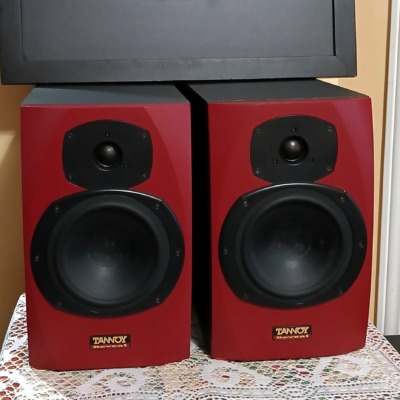
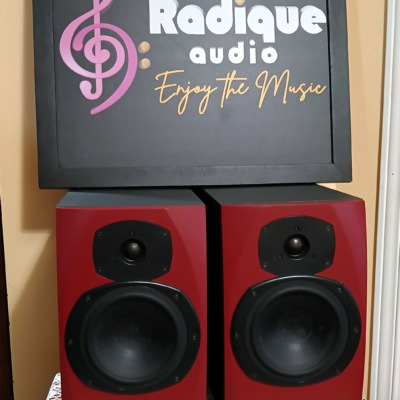
Tannoy Reveal Passive Studio Monitors, Pair – Made in Europe
A pair of Tannoy Reveal passive two-way studio monitors with their distinctive deep-red front baffles and gold Tannoy Reveal badges, in excellent condition. Tested on our bench before listing.
✔️ Real Tannoy studio pedigree for a desk, mixing room or living room
✔️ 90 dB, 6 ohms, 30–100 W: easy to drive
✔️ Magnetically shielded: fine beside a screen
✔️ Excellent condition
✔️ Covered by Radique Warranty
✔️ Includes Perpetual Trade-Back Program eligibility
✔️ Expertly packed for safe shipping
