


Attractive Gloss Black Center Channel from Energy C-C100B
$175.00
Out of stock
Get first dibs on the next one
As one of the most important speakers in any home theater system, the center channel must be articulate and dynamic, expressing the voices and intelligibility of every scene. Today’s digital music and movies put incredible demands on the center speaker so Energy’s engineers invested huge amounts of time and resources when developing the Energy C-C100 center channel speaker.
Its dual 5.5″ composite fiberglass woofers handle incredible amounts of power while delivering the dynamics and vocals that is required of a center channel. The 1″ chambered Hyperbolic(TM) aluminum dome tweeter guarantees that voice and timbre matching from other models is guaranteed. The sleek cabinet design of the C-C100 allows it to look at home on top or below your television. This attention to detail demonstrates Energy’s understanding that a speaker must not only sound good but look good in your home.
System Type: Bass Reflex, Rear Vented
Recommended Amplifier Power: up to 125 watts, Impedance: 8 ohms nominal; 4 ohms minimum
Components: Chambered 1″ Aluminum Dome, Dual 5-1/2″ Composite Fiberglass cones
Frequency Response: 50Hz-20kHz +/- 3 dB, Useable Bass Response: (-10db Anechoic) 45 Hz, Crossover Point : 2.2kHz
Overall Dimensions : W – 19.75″/50cm, H – 6.75″/17cm, D – 10″/25cm
Asking $175
| Weight | 22 lbs |
|---|---|
| Dimensions | 14 × 24 × 10.75 in |
Energy is a Canadian speaker brand from Audio Products International (API) of Scarborough, Ontario, the same company and factory behind Mirage. API was founded in 1973, and the Energy brand dates from the late 1970s or early 1980s. We carry Energy bookshelf speakers, towers, centre channels and subwoofers. We've had more than 170 Energy listings so far, covering more than 75 different models. Every used Energy here is inspected, tested and serviced as required, then photographed in-house and covered by our Bumper-to-Bumper Warranty and Perpetual Trade-Back Program. Don't see the model you want? Tell us on First Dibs and we'll email you when one arrives.
Our five best-selling Energy models so far: the RC-mini bookshelf speakers, the e:XL-S8 and ESW-8 subwoofers, the e:XL-C centre and the C-300 towers.
The Energy story
Howard Heiber founded Audio Products International in 1973 in Scarborough, Ontario, as a builder of private-label speakers. Energy says its brand dates from 1973; other sources point to the late 1970s or early 1980s, when API took on the Energy and Sound Dynamics names.
Research in Canada. Energy took part in the National Research Council of Canada's listening-test research from 1977 to 1986, and its speakers were built at API's Scarborough factory, which it shared with Mirage.
Veritas and Connoisseur. The Veritas v2.8 flagship was shown at the 1993 Winter CES, and the Connoisseur series followed in the mid-1990s. The Take 5 satellite system arrived in 1997.
New owners. Klipsch Group of Indianapolis bought API, with Energy, Mirage and Athena, in August 2006, and production moved to China around 2006 to 2007. VOXX bought Klipsch in 2011, and Gentex bought VOXX in 2025.
Which Energy is which?
Veritas (1993 onward): the flagship line, such as the three-way v2.8.
Connoisseur (mid-1990s to mid-2000s): models such as the C-2, C-3, C-6 and C-8.
Reference Connoisseur (RC): including the RC-70 towers and the RC-mini, one of our best sellers.
Take 5 and Take Classic (1997 onward): small satellite-and-subwoofer systems.
XL and e:XL (2000s): the entry line. Our best-selling e:XL-S8 subwoofer and e:XL-C centre come from here.
C-series (late 2000s): the vinyl-finished budget line, from the C-50 to the C-500, including the C-300 towers.
Subwoofers: the ESW and S-series, such as the ESW-8 we sell often.
Buying used Energy: what to check
Aluminum-dome tweeters. Owners report broken tweeters on some Connoisseur models. Look closely for dented or cracked domes.
Powered subwoofers. Owners report failed plate amplifiers on some S-series subs. Any sub should play cleanly at volume.
Surrounds. Most Energy woofers of the 1990s and 2000s use rubber surrounds, but some models, such as the RVSS dipole, used foam. Press gently on each woofer surround.
Where it was made. Energy speakers were made in Scarborough into the mid-2000s and in China from about 2006 to 2007. Check the rear label if Canadian manufacture matters to you.
Everything we list is inspected, tested and serviced as required here, and comes with our warranty.
You may also like…
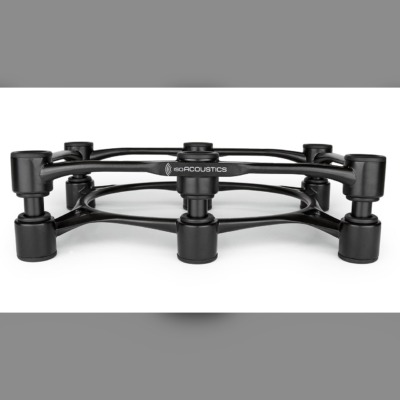

IsoAcoustics Aperta 300 Center Channel Isolation Stand
- ✔️ Genuine IsoAcoustics Aperta 300 center channel isolation stand, brand new in box
- ✔️ Single stand for center-channel speakers and similar applications up to 60 lbs (27.2 kg)
- ✔️ Available in Black or Silver with up to 6.5 degrees of tilt adjustment
- ✔️ Helps reduce cabinet resonance and improve clarity, focus, and dialogue intelligibility
- ✔️ Backed by a 2-year manufacturer's warranty in Canada
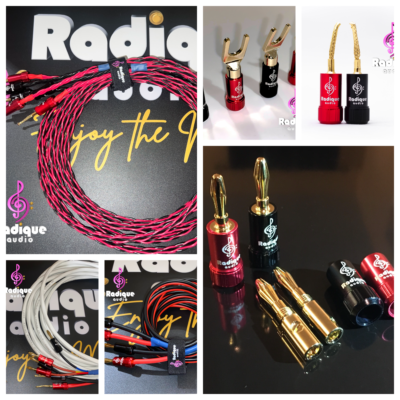
Custom Speaker Cable Builder
Your specs, your cable: choose the cable, the length and each connector, with live pricing.
- House CCA, House OFC, House Quad, Kimber 4PR or Kimber 4TC
- Banana, spade, pin, small spade or bare wire, chosen for each end
- Bi-wire on Kimber 4PR, Kimber 4TC and House Quad
- Hand-assembled, heat-shrink reinforced and colour-coordinated
- 1-year warranty
Related Products
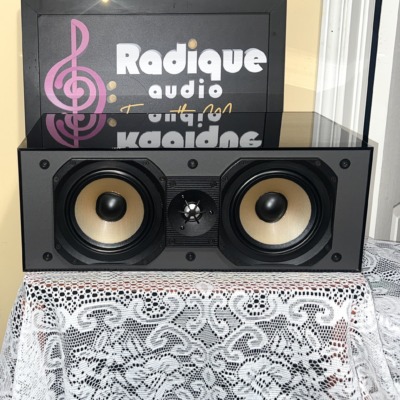
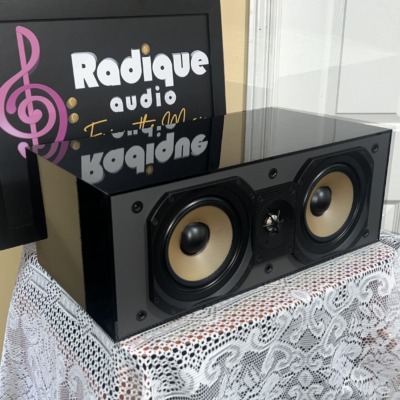
Paradigm Reference LCR-450 — Made in Canada, High Gloss Black
A Canadian-built Reference monitor in a high gloss black we have not had this model in before — the line of this era usually turns up in black, light cherry or dark rosenut. Sealed MTM design with Paradigm's pure-aluminium dome tweeter, and it works as a centre or as a left or right. Excellent, with its original box.
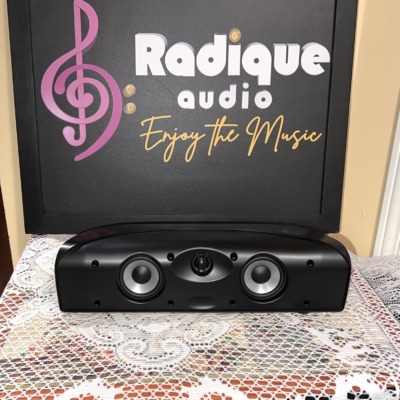
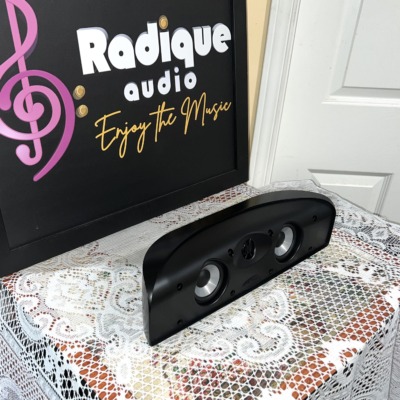
Polk Audio Blackstone TL1 Center Channel Speaker – Gloss Black
A slim, wall-mountable center channel from Polk Audio's Blackstone series, in very good condition, that gives movie dialogue the clarity and presence it deserves.
✔️ Very Good condition — cabinet, baffle and drivers present cleanly; grille included
✔️ Slim and wall-mountable — keyhole slots and a threaded insert on the back
✔️ Covered by Radique Warranty
✔️ Includes Perpetual Trade-Back Program eligibility
✔️ Expertly packed for safe shipping
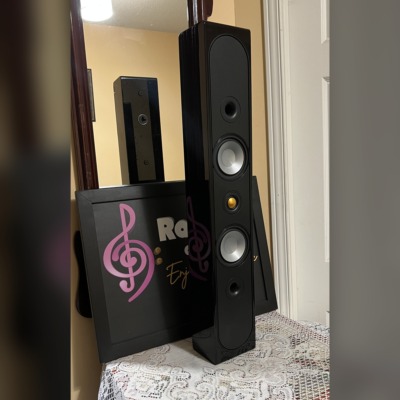
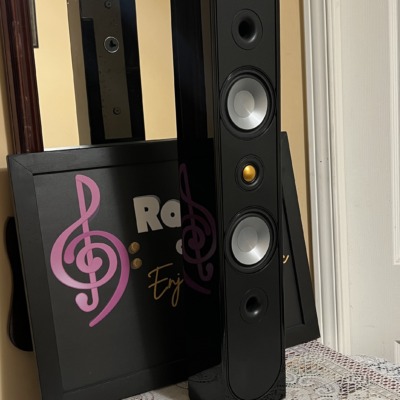
Monitor Audio Radius 250HD LCR Speaker – Gloss Black, Wall-Mount
A slim gloss black Monitor Audio speaker from the Radius HD range, in good condition, built to work as a left, center, right or rear speaker, standing upright, lying flat or hung on a wall.
✔️ Good condition — light scratches visible under bright light; grille included
✔️ One slim speaker for left, center, right or rear duty
✔️ Two rear keyhole slots; the matching wall bracket is listed separately
✔️ Covered by Radique Warranty
✔️ Includes Perpetual Trade-Back Program eligibility
✔️ Expertly packed for safe shipping
Monitor Audio Radius 250HD LCR Speakers, Pair – Gloss Black
A matched pair of slim gloss black Monitor Audio speakers from the Radius HD range, in good condition, each built to work as a left, center, right or rear speaker, standing upright, lying flat or hung on a wall.
✔️ Good condition — light scratches visible under bright light; grilles included
✔️ Two slim speakers for a stereo pair, left and right of a center, or a set of rears
✔️ Two rear keyhole slots on each; the matching wall bracket is listed separately
✔️ Covered by Radique Warranty
✔️ Includes Perpetual Trade-Back Program eligibility
✔️ Expertly packed for safe shipping
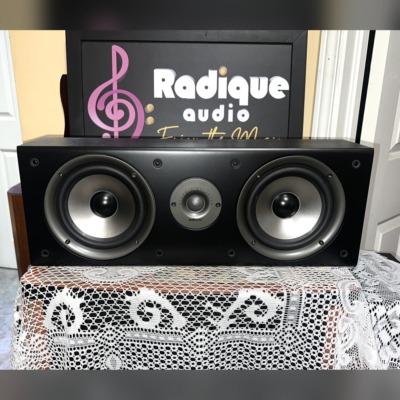
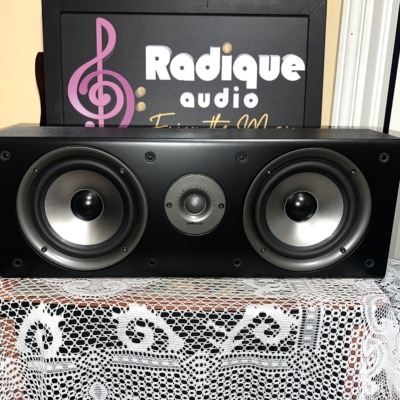
Polk CS2 Series II Center Channel Speaker – Dual 6.5″ Woofers
A Polk Audio Monitor CS2 Series II center channel speaker in black, with dual 6½-inch woofers for full-bodied, clear dialogue. It has been tested on our bench and is in very good condition.
✔️ Very good condition — black wood-grain, black cloth grille included
✔️ Dual 6½-inch Dynamic Balance woofers for clear, full-bodied dialogue
✔️ 90 dB, 8 ohms, magnetically shielded — tested on our bench
✔️ Covered by Radique Warranty
✔️ Includes Perpetual Trade-Back Program eligibility
✔️ Expertly packed for safe shipping
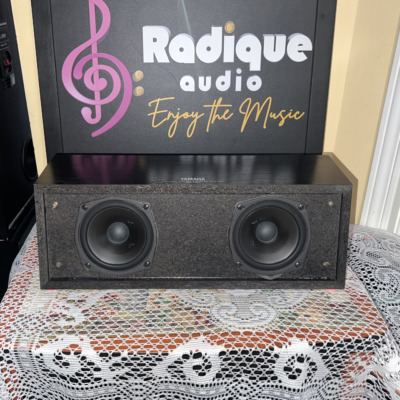
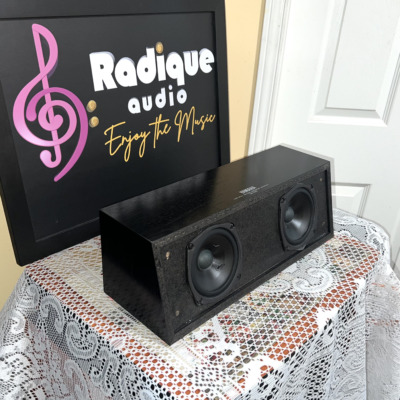
Yamaha NS-C90 Center Speaker – Dual-Angle Tilt, Made in Japan
The cabinet is asymmetrical on purpose: flip it over and it tilts the other way, aiming up at you from a low shelf or down at you from the top of a cabinet. Sealed rather than ported, so it needs no rear clearance. Two full-range drivers, nothing crossing in the vocal band. 6 ohms, 50 watts nominal. Built in Japan; very good condition.
