

Akai was founded in Tokyo in 1929 by Masukichi Akai and his son Saburo as Akai Electric Company, a maker of radio parts. We carry vintage Akai stereo receivers, integrated amplifiers, tuners and cassette decks. We’ve had 18 Akai listings so far, covering 16 different models. Every used Akai here is inspected, tested and serviced as required, then photographed in-house and covered by our Bumper-to-Bumper Warranty and Perpetual Trade-Back Program. Don’t see the model you want? Tell us on First Dibs and we’ll email you when one arrives.
Akai models we’ve sold so far include the AM-U3 integrated amplifier, the AA-1030, AM-A3 and AM-U11 receivers, and the HX-A451W cassette deck.
The Akai story
Masukichi Akai started making radio components in Tokyo in 1929, and his son Saburo grew up in the factory. Some sources date the company to 1946, after the war.
Tape. Akai’s first reel-to-reel, the AT-1, was offered as a kit in 1954, and the company became best known outside Japan for its tape recorders of the 1960s and 1970s, sold in the US through Roberts Electronics.
Hi-fi and music. Akai made receivers, amplifiers, tuners and cassette decks, and around 1980 started Akai Professional, which moved into electronic music in 1984.
Today. Akai Electric filed for insolvency in November 2000. The Akai name has since been used on products made by others, and Akai Professional, sold in 1999, is now owned separately.
Which Akai is which?
Reel-to-reel decks (1950s to 1980s): such as the 4000DS and the GX models.
AA receivers: such as the AA-1030, AA-R22 and AA-R31.
AM integrated amplifiers: such as the AM-A3, AM-U3 and AM-U11.
Tuners and cassette decks: AT tuners such as the AT-K03, and cassette decks such as the HX-A451W.
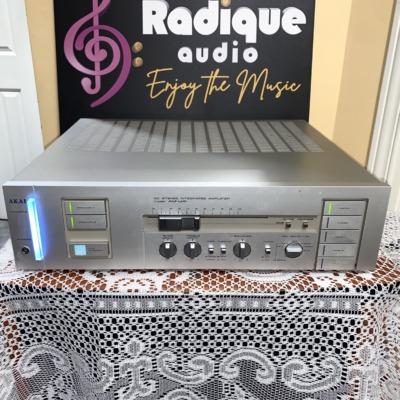
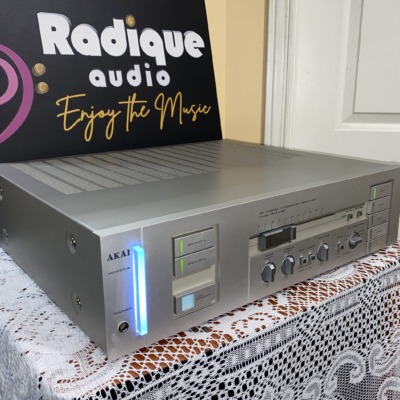
Akai AM-U41 Vintage Integrated Amplifier – 55 WPC, MM/MC Phono
Fifty-five watts a channel into 8 ohms at 0.007% distortion, from a dual supply with separate bridge rectifiers and filter capacitors for each channel. True moving coil phono at 0.25mV sits alongside the 2.5mV moving magnet input, and there is a midrange control at ±6dB — rare on a consumer amplifier. Built in Japan, 1982 to 1983. Level 1 serviced here; condition very good.
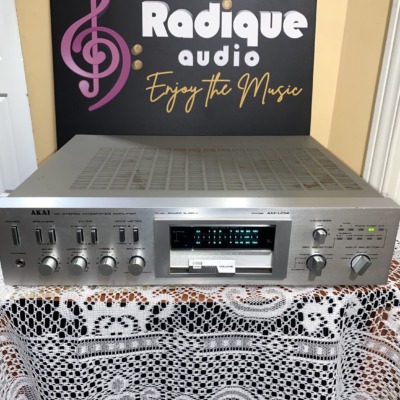
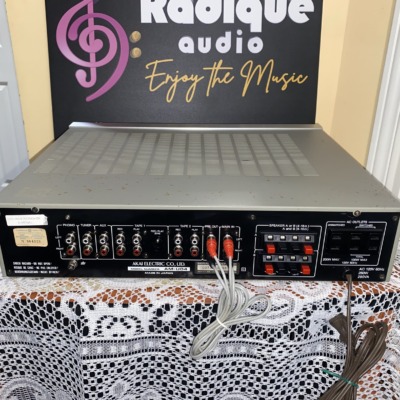
Akai AM-U04 Vintage Integrated Amplifier – 48 WPC, Serviced
Forty-eight watts a channel from a DC-coupled design with a dual power supply feeding separate filter capacitors on each channel. Bass, midrange and treble controls — the midrange one is the rare part — plus MM phono at 3 mV, a DIN line input, tape monitor with source comparison, A/B speaker outputs and a sliding volume control. Built in Japan, 1980–81. Level One serviced; very good cosmetic condition.
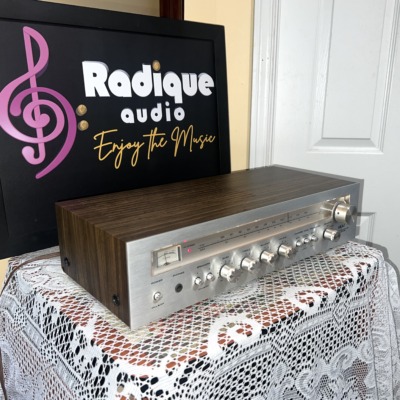
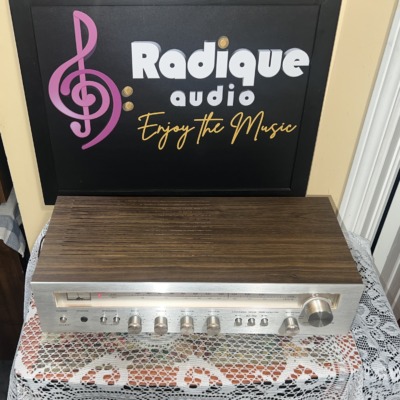
Akai AA-1115 Vintage Stereo Receiver – 15 WPC, Made in Japan
A slim late-1970s Akai AA-1115 AM/FM stereo receiver, made in Japan, silver face in its original woodgrain cabinet.
✔️ Tested on our bench, every input, output and control
✔️ Very good condition
✔️ MM phono, PLL FM tuner, speakers A and B
✔️ Covered by Radique Warranty
✔️ Includes Perpetual Trade-Back Program eligibility
✔️ Expertly packed for safe shipping
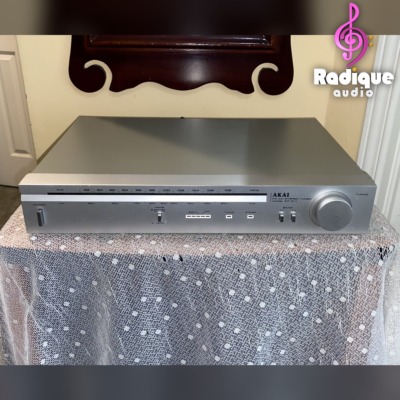
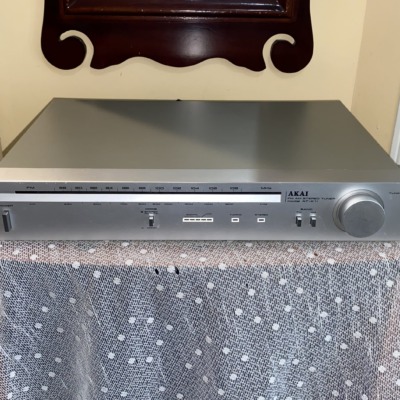
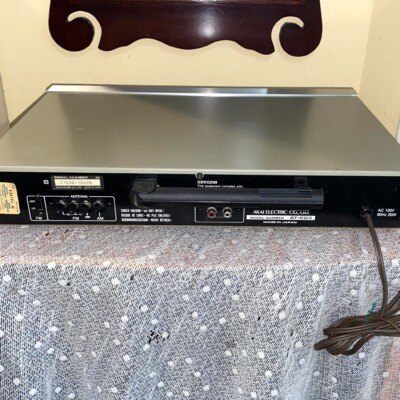
AKAI AT-K11 AM/FM Stereo Tuner – Professional Build Grade
A 1981 analog tuner with a mechanical servo that locks onto a station and holds it, so there is no digital drift to think about. 65dB signal to noise on FM, 775mV out on FM and 250mV on AM, into a single RCA pair. Nearly ten pounds of chassis, heavier than this end of the range usually got. Tested across both bands; good cosmetic condition.
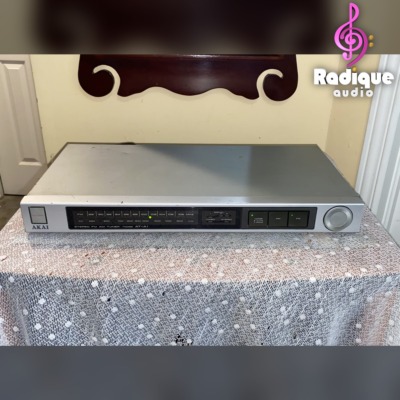

AKAI AT-A1 AM/FM Stereo Tuner – Ultra Slim Profile
An analog tuner from 1980 in a chassis 50mm tall — two inches, which is about as thin as a full-width component gets. Needle-pointer dial with a printed scale, an AM/FM selector, a single RCA output, and nothing else. Tuning engages smoothly across both bands and the output is clean. Condition good, with a clean front bezel and honest age on a 45-year-old component.
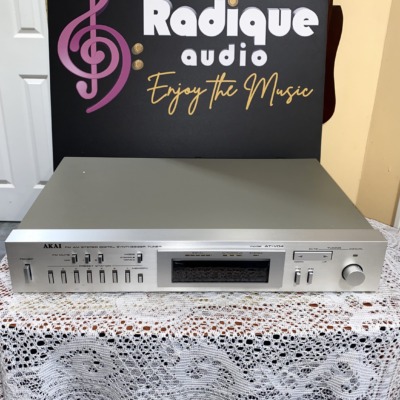

Akai AT-V04 FM/AM Tuner | Digital Synthesizer | Made in Japan
A digital synthesiser tuner with a traditional analog knob, stepping in 0.05 MHz on FM and 1 kHz on AM — fine enough that it works as an AM DX receiver and not only an FM tuner. Seven presets for each band, separate local/distance switches for FM and AM, 300 and 75 ohm antenna inputs, and a rear output level trim. Built in Japan, 1980 to 1981; tested here.