


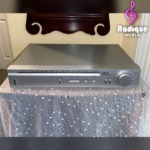

AKAI AT-K03 AM/FM Stereo Tuner – Digital Servo Lock
$75.00
Out of stock
This one has sold. Want first dibs on the next one?
We take these in regularly. Leave your name and email, and we’ll email you the moment one is listed, so you hear first. No cost, no obligation.
Email me when one is listed
Give your next receiver Bluetooth. RA-Twin II, $39.00 →
Other tuners we have in stock now
3 in stock · $65.00–$95.00 · all ship
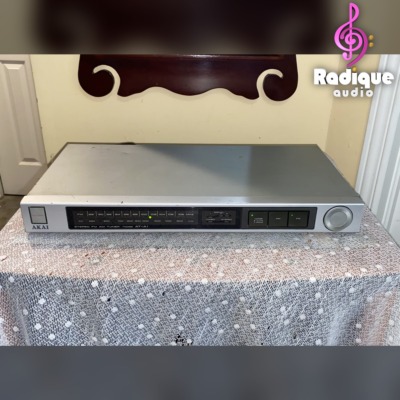 AKAI AT-A1 AM/FM Stereo Tuner - Ultra Slim Profile$65.00Ships
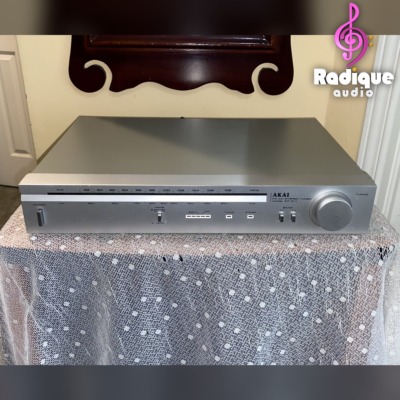 AKAI AT-K11 AM/FM Stereo Tuner - Professional Build Grade$95.00Ships
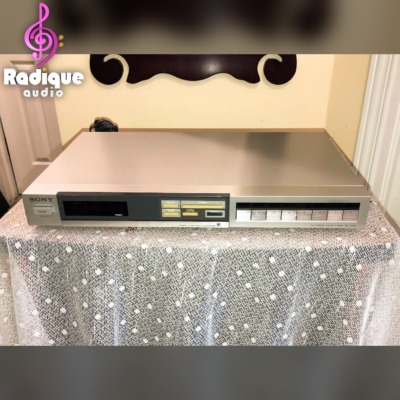 Sony ST-JX44 Quartz-Lock AM/FM Digital Tuner - Slim profile$95.00Ships
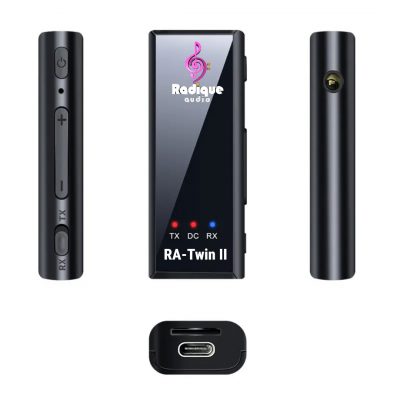
Give your next receiver Bluetooth.
The RA-Twin II adds Bluetooth streaming to any vintage receiver or amp with a spare input. Phone to stereo in about a minute, and nothing on the receiver is modified.
RA-Twin II, $39.00 →AKAI AT-K03 AM/FM Stereo Tuner – Digital Servo Lock
AKAI’s digitally tuned FM/AM receiver from 1980 offers precise station access and excellent reception quality in a compact package. The synthesizer-tuning system locks stations with servo accuracy, eliminating the drift and instability of analog tuning mechanisms while delivering clean, noise-free audio.
This unit has been thoroughly tested and verified: all tuning functions operate smoothly across both FM and AM bands, frequency lock engages reliably, and audio output delivers clean signal to any amplifier. Cosmetically, this player presents in good condition with functional display window and normal signs of age appropriate for a 45-year-old component.
The AT-K03’s standout feature is its 1.9µV FM sensitivity—excellent performance that ensures strong reception even in weak-signal areas or with modest antenna systems. The 73dB signal-to-noise ratio and 0.12% distortion deliver notably clean audio free from the background hum or hiss common in budget tuners of that era. Frequency response spans 30Hz to 15kHz, capturing the full range of broadcast content. The 1000mV FM output (300mV MW) integrates easily with any amplifier or receiver.
Front-panel operation is straightforward: large, tactile tuning buttons with digital frequency display showing exact MHz/kHz, dedicated preset buttons for favorite stations, and a clear AM/FM band selector. The numerical keypad enables direct station entry. RDS was not yet standard on Japanese tuners at this price point, but the servo-tuned mechanism provides rock-solid frequency stability once locked.
At 2.9 kg (6.4 lbs), the AT-K03’s compact metal chassis reflects efficient 1980 engineering, making it ideal for shelving beside vinyl turntables or integrated amplifiers. Power consumption is modest, and the clean industrial styling complements most vintage audio systems.
Key Features & Specifications:
Digital synthesizer FM/AM stereo tuner with servo-tuned accuracy
Excellent FM sensitivity: 1.9µV (typical tuners: 2.5–3µV)
FM signal-to-noise ratio: 73dB; Distortion: 0.12%
FM output: 1000mV; MW output: 300mV
Frequency range: 30Hz–15kHz
Direct station entry via numeric keypad
Multiple preset stations
LED tuning lock indicator
Compact form factor; low power consumption
Thoroughly tested; all functions verified working
Good cosmetic condition
Dimensions: 440 x 80 x 240 mm (17.3 x 3.1 x 9.4 inches)
Weight: 2.9 kg (6 lbs 5 oz)
For listeners valuing precise tuning and strong FM reception from a compact, low-profile tuner, the AT-K03 remains an excellent budget-friendly option.
Backed by Radique Audio’s 90-day warranty and our perpetual trade-back policy, you can purchase with confidence.
Asking $75.
| Weight | 8.4 lbs |
|---|---|
| Dimensions | 13.4 × 21.3 × 7.1 in |
Akai was founded in Tokyo in 1929 by Masukichi Akai and his son Saburo as Akai Electric Company, a maker of radio parts. We carry vintage Akai stereo receivers, integrated amplifiers, tuners and cassette decks. We've had 18 Akai listings so far, covering 16 different models. Every used Akai here is inspected, tested and serviced as required, then photographed in-house and covered by our Bumper-to-Bumper Warranty and Perpetual Trade-Back Program. Don't see the model you want? Tell us on First Dibs and we'll email you when one arrives.
Akai models we've sold so far include the AM-U3 integrated amplifier, the AA-1030, AM-A3 and AM-U11 receivers, and the HX-A451W cassette deck.
The Akai story
Masukichi Akai started making radio components in Tokyo in 1929, and his son Saburo grew up in the factory. Some sources date the company to 1946, after the war.
Tape. Akai's first reel-to-reel, the AT-1, was offered as a kit in 1954, and the company became best known outside Japan for its tape recorders of the 1960s and 1970s, sold in the US through Roberts Electronics.
Hi-fi and music. Akai made receivers, amplifiers, tuners and cassette decks, and around 1980 started Akai Professional, which moved into electronic music in 1984.
Today. Akai Electric filed for insolvency in November 2000. The Akai name has since been used on products made by others, and Akai Professional, sold in 1999, is now owned separately.
Which Akai is which?
Reel-to-reel decks (1950s to 1980s): such as the 4000DS and the GX models.
AA receivers: such as the AA-1030, AA-R22 and AA-R31.
AM integrated amplifiers: such as the AM-A3, AM-U3 and AM-U11.
Tuners and cassette decks: AT tuners such as the AT-K03, and cassette decks such as the HX-A451W.
You may also like…
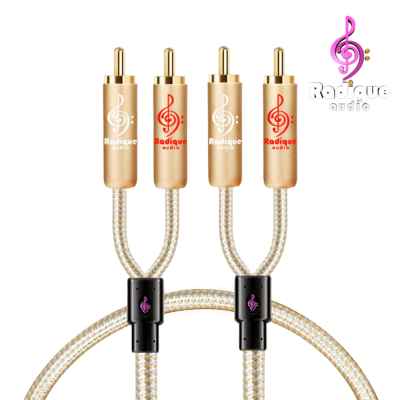
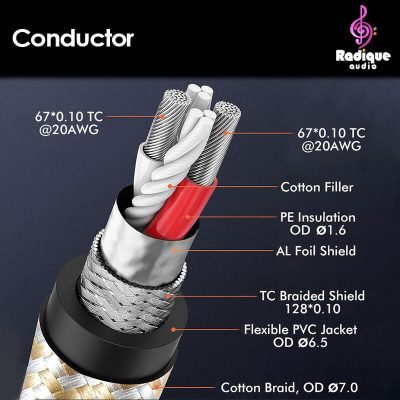
Radique Audio Gold Series RCA Stereo Interconnect Cable
RCA cables that are kind to vintage jacks: dual RCA to dual RCA, in 0.2, 0.75 or 1.5 m.
- Slim gold-plated plugs with vintage-safe grip pressure
- Dual shielding: aluminum foil and 128-strand braided copper
- Reinforced splitters; 7 mm gold cotton and nylon mesh jacket
- Three lengths, chosen above the Add to Cart button
- 1-year warranty
Related Products
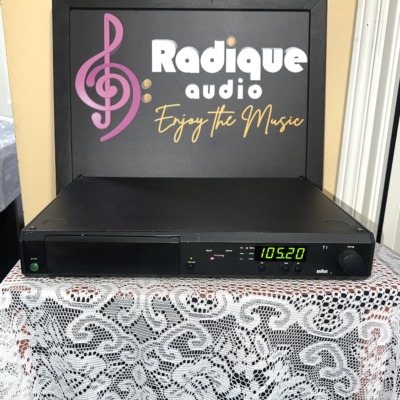
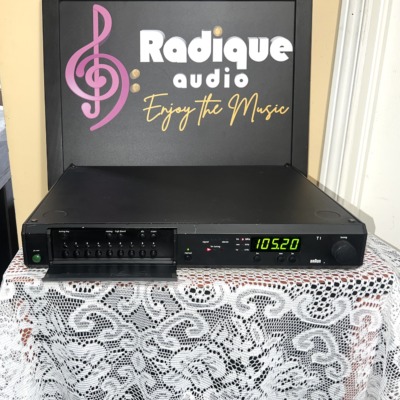
Braun Atelier T1 Slim AM/FM Tuner — 9 Presets, Quartz, Japan
An analogue tuner given a quartz-referenced five-digit readout — the precision of a synthesised design with a real analogue front end behind it, which tends to hold a weak signal more gracefully. The nine presets are not memories: each station button carries its own tuning adjustment, set by hand with a small screwdriver through the panel, so it is effectively nine little tuners in one chassis. Made in Japan, 445 mm wide and 70 mm tall to match the Atelier deck. Good condition.
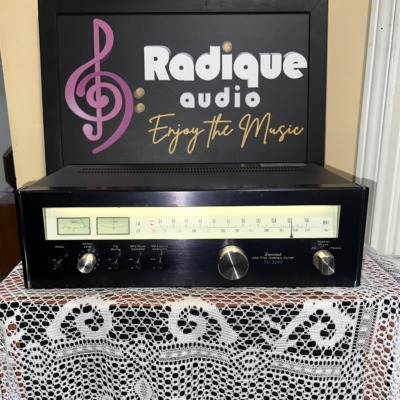
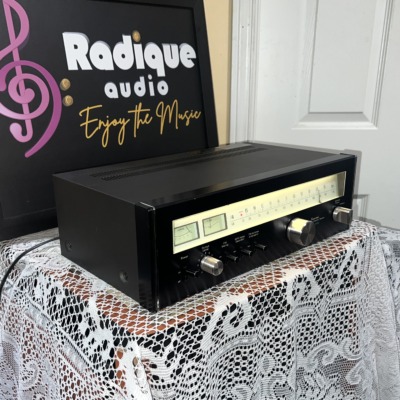
Sansui TU-5900 AM/FM Stereo Tuner — Dolby FM, Made in Japan
An analogue AM/FM stereo tuner from Sansui's strongest years, built in Japan in the mid-seventies as the matching partner to the AU-series integrated amplifiers, and a good deal more serious inside than its modest size suggests.
✔️ Condition: Very Good
✔️ Level One — named in the copy
✔️ Covered by Radique Warranty
✔️ Includes Perpetual Trade-Back Program eligibility
✔️ Expertly packed for safe shipping
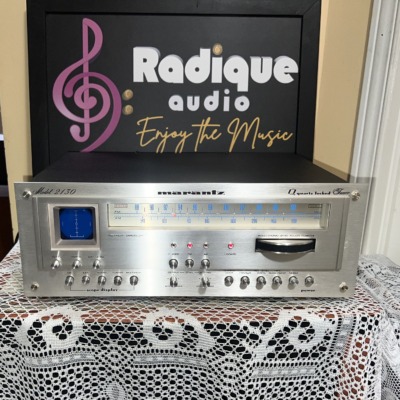
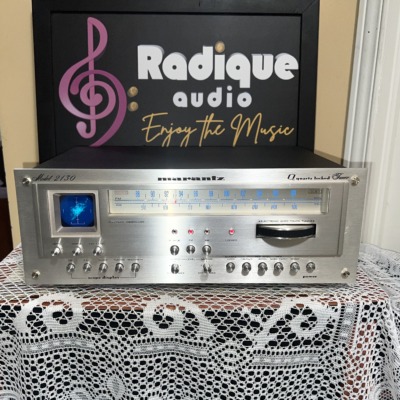
Marantz Model 2130 AM/FM Tuner – Oscilloscope, Original Box
Marantz's quartz-locked flagship tuner with its built-in oscilloscope, in excellent condition and complete with its original Marantz carton.
✔️ Excellent condition — the scope traces cleanly, and the original Marantz carton is included
✔️ Tested on our bench and needed no service
✔️ Built-in oscilloscope, quartz lock and wide/narrow IF — Marantz's flagship tuner of 1978
✔️ Covered by Radique Warranty
✔️ Includes Perpetual Trade-Back Program eligibility
✔️ Expertly packed for safe shipping
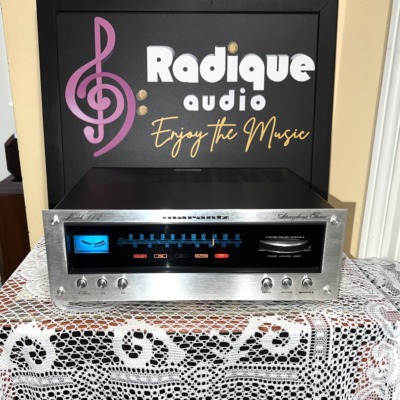
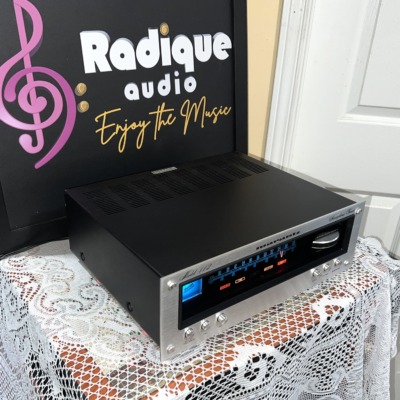
Marantz Model 112 Vintage AM/FM Stereo Tuner – Made in Japan
A mid-1970s Marantz Model 112 AM/FM stereo tuner, designed in the USA and made in Japan, serviced on our bench.
✔️ Serviced on our bench, dial lamps replaced
✔️ Very good condition
✔️ Gyro-Touch flywheel tuning, tuning meter, FM stereo in our bench test
✔️ Bare chassis, or in a cherry cabinet built by our master woodworker
✔️ Covered by Radique Warranty
✔️ Includes Perpetual Trade-Back Program eligibility
✔️ Expertly packed for safe shipping
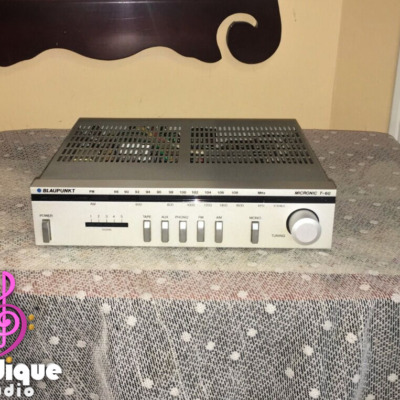
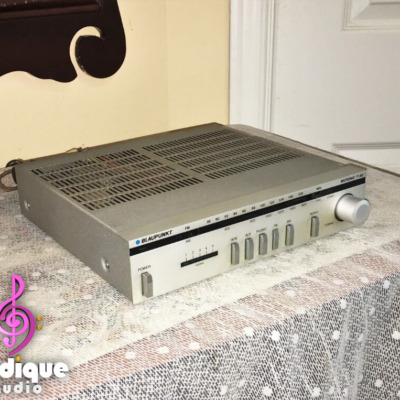
Blaupunkt Micronic T-60 AM/FM Tuner & Preamp – Made in Japan
A rare Blaupunkt Micronic T-60 AM/FM tuner and preamplifier from 1981, designed in Germany and made in Japan, with a phono input for your turntable.
✔️ Tested on our bench, every input, the output and the tuner
✔️ Very good condition
✔️ AM/FM tuner plus phono, aux and tape inputs
✔️ Covered by Radique Warranty
✔️ Includes Perpetual Trade-Back Program eligibility
✔️ Expertly packed for safe shipping
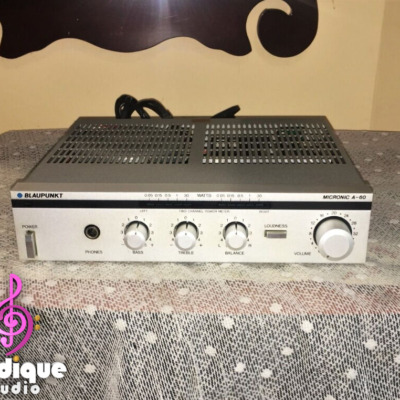
Blaupunkt Micronic A-60 + T-60 Micro System – 20 WPC, Bundle
The complete Blaupunkt Micronic 60 system from 1981, the A-60 amplifier and the matching T-60 AM/FM tuner and preamplifier, together for less than buying them separately.
✔️ Tested on our bench, both units
✔️ Both very good
✔️ Radio, phono, tape and a 20-watt amplifier in a stack 25 cm wide
✔️ Covered by Radique Warranty
✔️ Includes Perpetual Trade-Back Program eligibility
✔️ Expertly packed for safe shipping
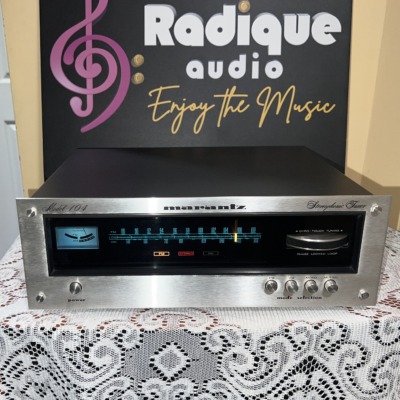

Marantz Model 104 AM/FM Tuner — Made in Japan, Excellent
We sold this tuner ourselves and it came back through our Perpetual Trade-Back Program — so we know what it was when it left, and it has been through our bench again since. A 1976 Model 104 in excellent cosmetic condition: silver face, blue dial lighting, made in Japan.
