



Heavy Duty 46″ B&W VM1 Speaker Stands
$145.00
An extruded aluminium stem on a cast iron base, 46 inches to the top — B&W’s own stand for the VM1. The speaker slots into the stem, which swallows the cable and covers the terminals with it. Clear-lacquered aluminium with a dark grey base and trim, 9 lbs each. Likely the most solidly built satellite stands we have had through here.
Out of stock
This one has sold. Want first dibs on the next one?
We take these in regularly. Leave your name and email, and we’ll email you the moment one is listed, so you hear first. No cost, no obligation.
Email me when one is listed
How we get a component ready for sale. What our bench covers →
Other speaker stands we have in stock now
3 in stock · $75.00–$245.00 · all ship
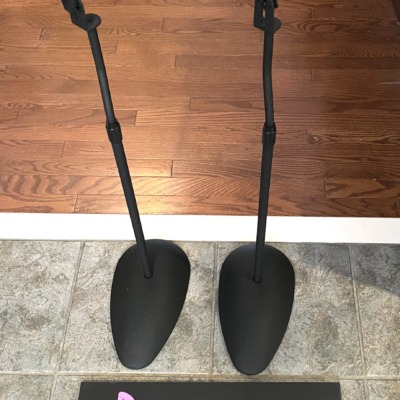
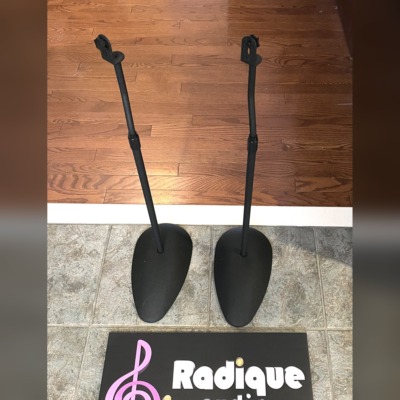 Height adjustable Black satellite stands with Oval Bases$75.00Ships
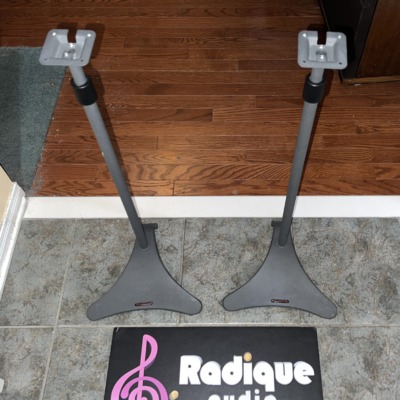 All Metal Atlantic Adjustable Satellite Speaker Stands 27" - 49"$75.00Ships
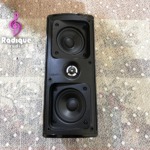
 High Quality, Well-Reviewed B&W Satellite speakers VM1$245.00Ships
How we get a component ready for sale.
Before a used or vintage component is listed, it goes through our bench, and anything we service is tested again by a different tech. See exactly what our bench covers.
What our bench covers →Heavy Duty 46″ B&W VM1 Speaker Stands.
Radique’s Take: As usual, no half-measures from B&W here. These are likely the heaviest, most solidly constructed satellite speaker stands we have ever seen. Designed specifically for B&W’s excellent VM1 speakers.
From B&W:
“46” Floor stand for VM1 with Brushed aluminum finish
With its elegant extruded aluminum stem and weighty cast iron base, this floor stand is the perfect partner to the VM1, raising it to the correct listening height. The speaker simply slots into the top of the stem, which also serves to hide the cable tidily. Even the terminals are covered from view.”
Stands are attractively finished with clear lacquered aluminum stem and dark grey base and trim.
Dimensions: (Width x Height x Depth) Approx. 250 x 1,170 x 300 mm (9.8 x 46 x 11.8 inches), Weight: 9lbs (4.1 kg) each
| Weight | 19 lbs |
|---|---|
| Dimensions | 15.8 × 11.8 × 48 in |
Bowers & Wilkins began in Worthing, England, in 1966, founded by John Bowers. The name comes from the Worthing electrical shop he ran with Roy Wilkins. Its 800 Series monitors have been used at Abbey Road Studios since 1980, Abbey Road says. We carry B&W towers, bookshelf speakers, centre channels and stands. We've had more than 200 B&W listings so far. Every used B&W here is inspected, tested and serviced as required, then photographed in-house and covered by our Bumper-to-Bumper Warranty and Perpetual Trade-Back Program. Don't see the model you want? Tell us on First Dibs and we'll email you when one arrives.
The Bowers & Wilkins story, 1966 to today
John Bowers founded B&W in Worthing, England, in 1966, after hand-assembling speakers at the electrical shop he ran with Roy Wilkins. Its first speaker, the P1, used B&W's own cabinet and crossover with bought-in drivers, and the DM1 and DM3 "Domestic Monitors" followed in 1968.
Kevlar and the 801. B&W identified Kevlar as a cone material in 1974, and the DM6 of the mid-1970s used Kevlar cones. The original 801 monitor of 1979 to 1980 made its name in recording studios: Abbey Road says it was the first studio to use it, in 1980, and has used the 800 Series ever since.
Matrix and Nautilus. The Matrix cabinet bracing arrived in the mid-to-late 1980s. John Bowers started the project that became the Nautilus, the spiral-shell flagship, before he died in 1987, and it launched in 1993. The first 600 Series followed in 1995, and diamond-dome tweeters arrived in 2005.
New owners. EVA Automation bought B&W in 2016, Sound United in 2020 and Masimo in 2022, and in September 2025 HARMAN, a Samsung company, completed its purchase of Sound United. The 800 Series Diamond D5, unveiled in June 2026, is built in Worthing.
A Canadian connection. Classé Audio of Montreal was part of the B&W Group from 2001 until B&W closed its Montreal headquarters in 2017.
Which B&W is which?
DM (Domestic Monitor), 1968 onward: from the DM1 and DM3 to models such as the DM6 and DM7. The DM prefix carried into early 600 Series names.
600 Series (1995 to today): B&W's entry hi-fi line; the 2020 Anniversary Edition was its seventh generation. The 606 belongs here.
CDM (mid-1990s to about 2003): such as the CDM 1, with a metal-dome tweeter and a Kevlar cone.
700 Series (about 2003 to 2006): Nautilus technology at mainstream prices, such as the 703 and 705.
CM Series (2006 to 2017): such as the CM1 and the CM4 towers, replaced by the 700 Series S2 in 2017.
800 Series (from 1979 to 1980): from the original 801 through the Matrix, Nautilus 800, Diamond, D3, D4 and D5 generations.
Nautilus (1993): the spiral-shell flagship, still made in small numbers.
Buying used B&W: what to check
Tweeter domes. B&W used metal-dome tweeters in the CDM, 600 and CM lines, and owners report squashed domes. Inspect each dome closely.
Original tweeters. Some CDM-era tweeters are discontinued, and rebuilt or substitute tweeters change the sound. Ask whether the originals are fitted.
Woofer surrounds. Owners report rubber surrounds that have hardened with age. Press each surround gently: it should feel supple.
1970s DM models. Expect crossover capacitors in a 40-year-old DM to need replacing.
Where it was made. The 800 Series is built in Worthing; the 600 and 700 Series are made in China. Check the label before calling a B&W "made in England".
Everything we list is inspected, tested and serviced as required here, and comes with our warranty.
Related Products
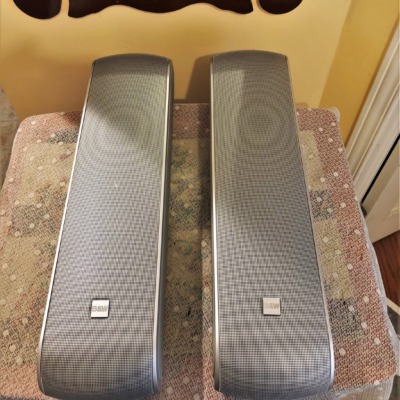
High Quality, Well-Reviewed B&W Satellite speakers VM1
A two-way vented-box satellite: 125mm cone bass/mid, 25mm high-frequency unit, crossed at 3.5 kHz, 91 dB into 8 ohms. Magnetically shielded, 20.6 inches tall on a footprint under five inches wide. Each speaker comes with its own all-metal shelf stand for horizontal or vertical placement, no extra hardware needed. They retailed around $600 Canadian.
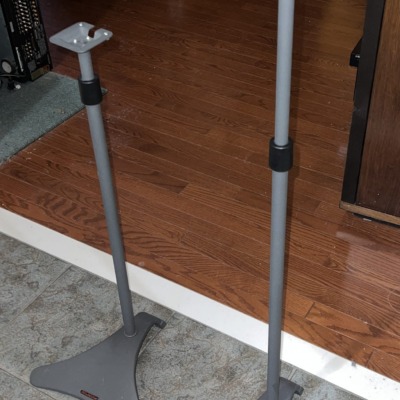
All Metal Atlantic Adjustable Satellite Speaker Stands 27″ – 49″
All-metal stands that adjust tool-free from roughly 27 to 49 inches, which covers seated ear height or a surround position well above it. Speaker wire runs inside the hollow column, and the wide base is fitted with felt feet for hard floors. Rated to about 10 lbs a stand — satellites and small bookshelves. Condition very good, light signs of use.
