


Impressive Klipsch 10″ Active Subwoofer KSW-10
$245.00
Out of stock
Get first dibs on the next one
In order to complete a powerful home theater system deep driving bass is necessary. The Klipsch KSW-10 incorporates the right cosmetics and technology resulting in the ideal subwoofer for high performance Synergy Series configurations. This versatile piece of machinery adds significant bass impact to any home theater space.
The KSW-10 couples a 10-inch driver to the floor for optimal performance. This subwoofer’s high-output down-firing design “grips” the air and fills a room with low frequency energy that’s heard and felt with undetectable distortion. The built-in discrete MOSFET amplifier and 10-inch fiber-composite woofer are as efficient as they are reliable.
This subwoofer accepts LFE line-level and speaker level inputs.
Power and clarity are not the only assets this sub has to offer. The KSW-10’s jet ash veneer vinyl finish creates a deceivingly subtle exterior for its earthshaking sound capabilities.
Type: 10″ bass reflex, tuned port enclosure
Amplifier: Peak output power 225 watts into 4 ohms
FTC Rated Power: 55 watts continuous, 22-125Hz @ 1% THD m a x i m u m
Auto Power On: 2 second ON delay, 15 minute OFF delay
Frequency Response: 29-120Hz±3dB
Maximum Acoustic Output: 110dB 1/8 space 1 meter
Low Pass Crossover: Continuously variable from 40-120Hz, 24dB/octave slope above 120Hz
Inputs: 2) Line level RCA phono jacks 2) High level speaker terminals
Phase: Switchable 0-180 degrees
Drive Component: K-1070-K 10″ (25.4cm) driver
Dimensions: Net Weight: 29 lbs. (13.18kg), Height: 15.5″ (39.37cm), Width: 13.5″ (34.3cm), Depth: 13.5″ (34.3cm)
MSRP of $399 USD. Asking just $245 for this Klipsch performer in very good condition.
| Weight | 36 lbs |
|---|---|
| Dimensions | 17.5 × 17.5 × 19.5 in |
Klipsch began in Hope, Arkansas, in 1946, when Paul W. Klipsch started building his corner-horn Klipschorn, and its Heritage speakers are still built by hand in Hope. We carry Klipsch towers, centre channels, bookshelf speakers and subwoofers. We've had more than 160 Klipsch listings so far. Every used Klipsch here is inspected, tested and serviced as required, then photographed in-house and covered by our Bumper-to-Bumper Warranty and Perpetual Trade-Back Program. Don't see the model you want? Tell us on First Dibs and we'll email you when one arrives.
The Klipsch story, 1946 to today
Paul W. Klipsch was posted to Hope, Arkansas, in 1941 as an Army officer. He patented his corner-horn design in the mid-1940s and founded Klipsch in Hope in 1946; Klipsch says its first speaker was built by hand there that year, with the horn made in a tin shed. He hired his first employee in 1948.
The Heritage line. The Klipschorn of 1946 was followed by the Heresy (1957), designed as a centre speaker to sit between a pair of Klipschorns, the Cornwall (1959), the La Scala (1963) and the Forte (1985).
A new generation. Fred Klipsch bought the company from Paul Klipsch in 1989, and headquarters later moved to Indianapolis. Paul Klipsch died in 2002 at 98. The Reference Series arrived in 1999.
A Canadian connection. In 2006 Klipsch bought Audio Products International of Toronto, with its Energy and Mirage brands. Audiovox, later VOXX, bought Klipsch in 2011, and Gentex bought VOXX in 2025.
Which Klipsch is which?
Heritage: the Klipschorn, Heresy, Cornwall, La Scala and Forte, built to order by hand in Hope. Drivers change between generations, so identify the version.
KG series (mid-1980s to early 1990s): lower-priced horn-tweeter floorstanders such as the KG 4 (1985 to 1992) and KG 5.5.
Reference (1999 onward): horn-tweeter towers, bookshelf speakers and centres, from the RB-5 and RF-7 to the later RF, RB and RC models.
Synergy (late 1990s and 2000s): such as the KSF 8.5 and the SF-1.
Subwoofers: powered models such as the RPW-10.
Buying used Klipsch: what to check
Horn diaphragms. The compression drivers in older Klipsch speakers age; owners report tired midrange diaphragms on Heritage models and raspy tweeters on some KG pairs. Listen to each horn on its own at a moderate level.
Reference tweeters. A crackling tweeter can be a loose connection, and owners say these tweeters can fail if played very loud.
Crossovers and passive radiators. Many Heritage and KG owners recap their crossovers, and KG passive radiators can have cracked surrounds.
Modifications. Aftermarket diaphragms and crossovers are common upgrades on Heritage and KG models. Ask what has been changed.
Where it was made. Heritage models are built in Hope. Check the label before calling any other Klipsch "made in USA".
Everything we list is inspected, tested and serviced as required here, and comes with our warranty.
You may also like…


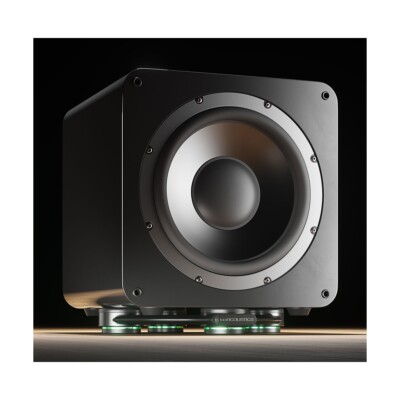
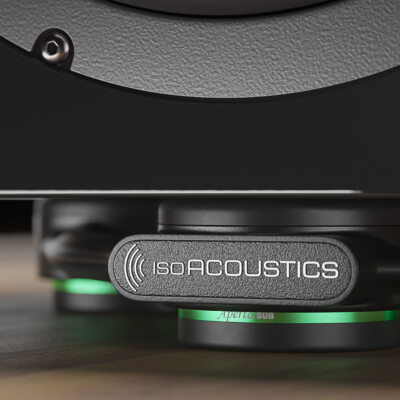
IsoAcoustics Aperta Sub XL Subwoofer Isolation Stand
- ✔️ Genuine IsoAcoustics Aperta Sub XL, brand new in box
- ✔️ Low-profile isolation stand for front-firing and side-firing subwoofers up to 160 lbs (72.6 kg)
- ✔️ Includes 1 stand plus 4 carpet discs for carpeted surfaces
- ✔️ Helps reduce energy transfer, room rattle, and muddy bass smear for tighter low-frequency performance
- ✔️ Backed by a 2-year manufacturer’s warranty in Canada
IsoAcoustics Aperta Sub Subwoofer Isolation Stand
- ✔️ Genuine IsoAcoustics Aperta Sub, brand new in box
- ✔️ Low-profile isolation stand for front-firing and side-firing subwoofers up to 80 lbs (36.3 kg)
- ✔️ Includes 1 stand plus 4 carpet discs for carpeted surfaces
- ✔️ Helps reduce energy transfer, room rattle, and muddy bass smear for tighter low-frequency performance
- ✔️ Backed by a 2-year manufacturer’s warranty in Canada
Related Products
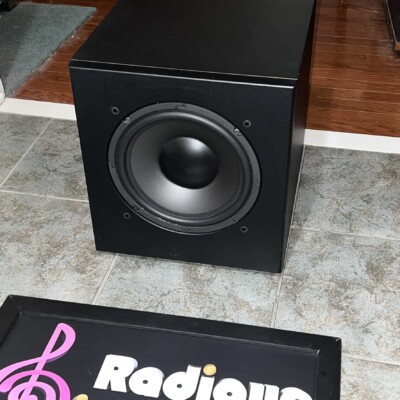
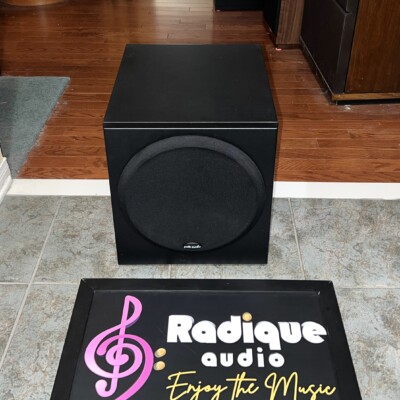
Polk Audio PSW350 10″ Front-Firing Powered Subwoofer 260W
A 10-inch front-firing Dynamic Balance woofer on a 100-watt RMS amplifier — 260 watts dynamic — in a dual-rear-ported cabinet good for 25 to 180 Hz. Speaker-level in and out, stereo line inputs and an unfiltered LFE jack, with a variable 60 to 160 Hz low-pass and a phase switch. 37 lbs, black matte. Very good cosmetic condition.
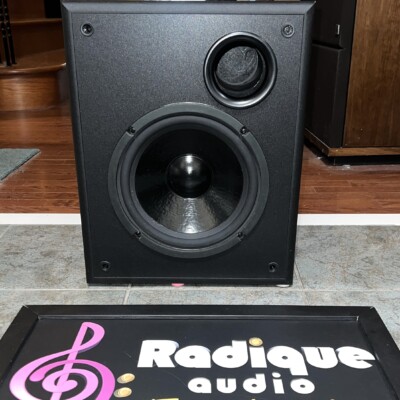
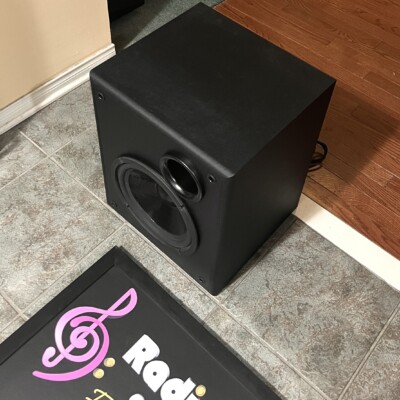
Yamaha SW-3 Active Servo Subwoofer — 10″ Woofer | Air Woofer Tec
Yamaha’s Active Servo Technology couples a negative-impedance drive amplifier to a Helmholtz resonator port — the Air Woofer opening — so the amplifier corrects the driver’s motion as it works. 100 watts into a 25 cm cone, rated down to 25 Hz, with a continuously variable 50–150 Hz high-cut at 24 dB per octave. Speaker-level and line inputs both. Very good condition.
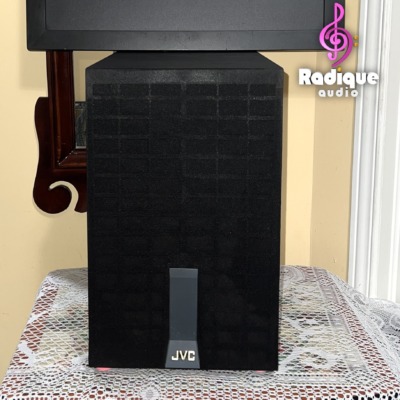
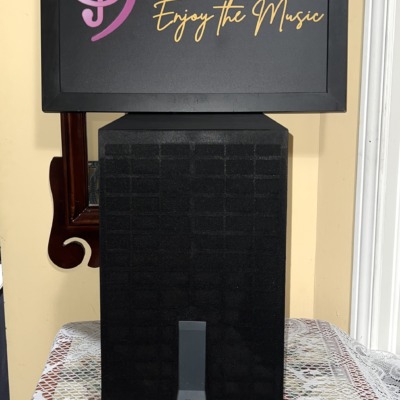
JVC SX-PW33 Slim Tower Subwoofer — 6.5in, 100W, High-Pass Out
A tall, narrow bass column meant to stand beside a cabinet rather than in front of it — 8.25 inches across the front and unusually deep at 17, which is the trade: the depth buys back the internal volume the narrow baffle gives away, so a 6.5 inch woofer is properly loaded in a strip of floor barely wider than a hardcover book. Driven by an integrated 100 watt amplifier, with speaker-level inputs and high-pass outputs so it works with an amplifier that has no subwoofer output at all. Good condition.
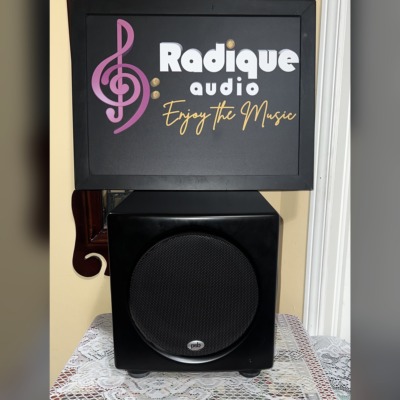
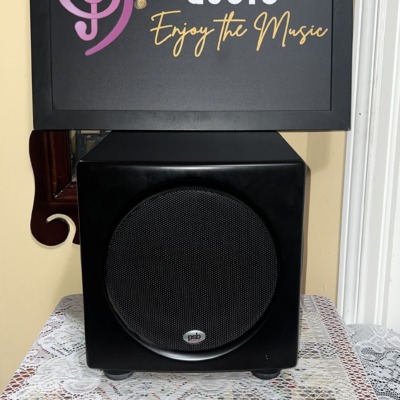
PSB SubSeries HD10 10″ Powered Subwoofer — 750W, 2000W Peak!
A serious subwoofer in about a square foot of floor, from one of the most respected names in Canadian loudspeaker design, with deep, powerful bass for home theatre and most music.
✔️ Good condition — light scuffs on the top, and a little vibration when played loud (details below)
✔️ 10-inch driver, two passive radiators and a 750 W Class H amplifier
✔️ Line-level and high-level inputs — works even with a receiver that has no sub out
✔️ Covered by Radique Warranty
✔️ Includes Perpetual Trade-Back Program eligibility
✔️ Expertly packed for safe shipping
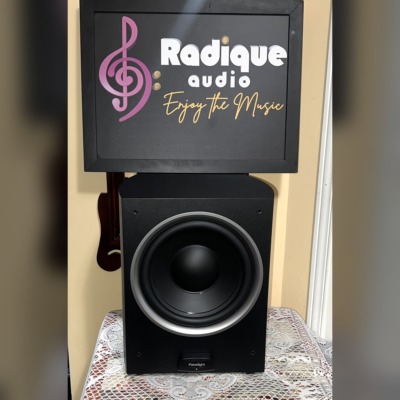
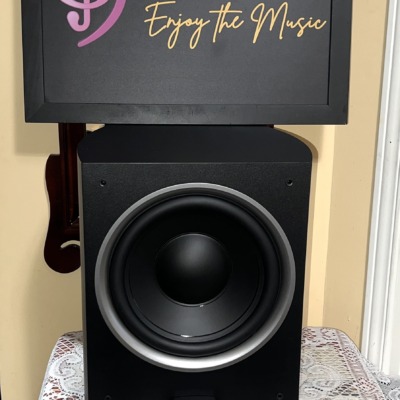
Paradigm PDR-10 v.4 10″ Powered Subwoofer – 300W Peak, Serviced
A black Paradigm PDR-10 v.4 powered subwoofer, with a 10-inch forward-firing driver and 100 watts RMS (300 watts dynamic peak) on board, serviced on our bench and in very good condition.
✔️ Very good condition — free of significant marks
✔️ Serviced on our bench and tested before listing
✔️ 10-inch forward-firing driver, 100 W RMS and 300 W dynamic peak
✔️ Covered by Radique Warranty
✔️ Includes Perpetual Trade-Back Program eligibility
✔️ Expertly packed for safe shipping
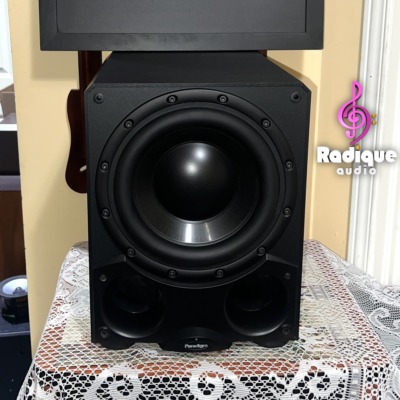
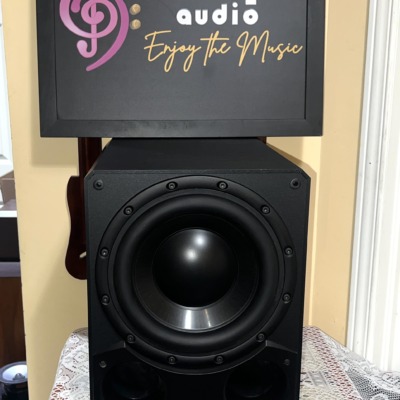
Paradigm DSP-3100 v.2 10″ Subwoofer – 600W Peak, Made in Canada
A black Paradigm DSP-3100 v.2 powered subwoofer, made in Canada, with a 10-inch front-firing driver and 200 watts RMS (600 watts dynamic peak) on board. It has been tested on our bench and is in very good condition.
✔️ Very good condition — removable black cloth grille included
✔️ 10-inch front-firing driver, 200 W RMS / 600 W peak Class-D
✔️ Front ports for hidden installs — made in Canada
✔️ Covered by Radique Warranty
✔️ Includes Perpetual Trade-Back Program eligibility
✔️ Expertly packed for safe shipping
