





JVC SX-PW33 Slim Tower Subwoofer — 6.5in, 100W, High-Pass Out
$125.00
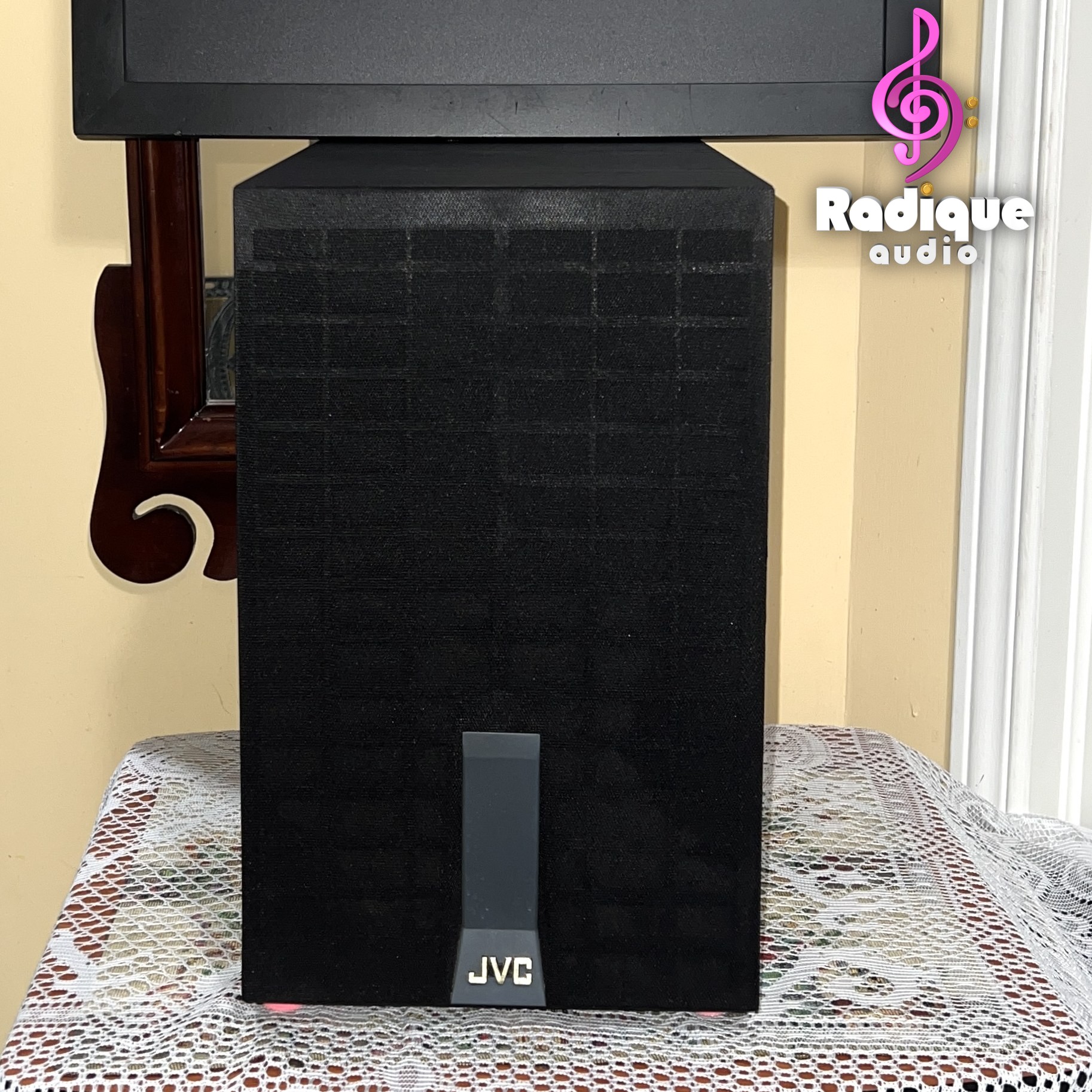
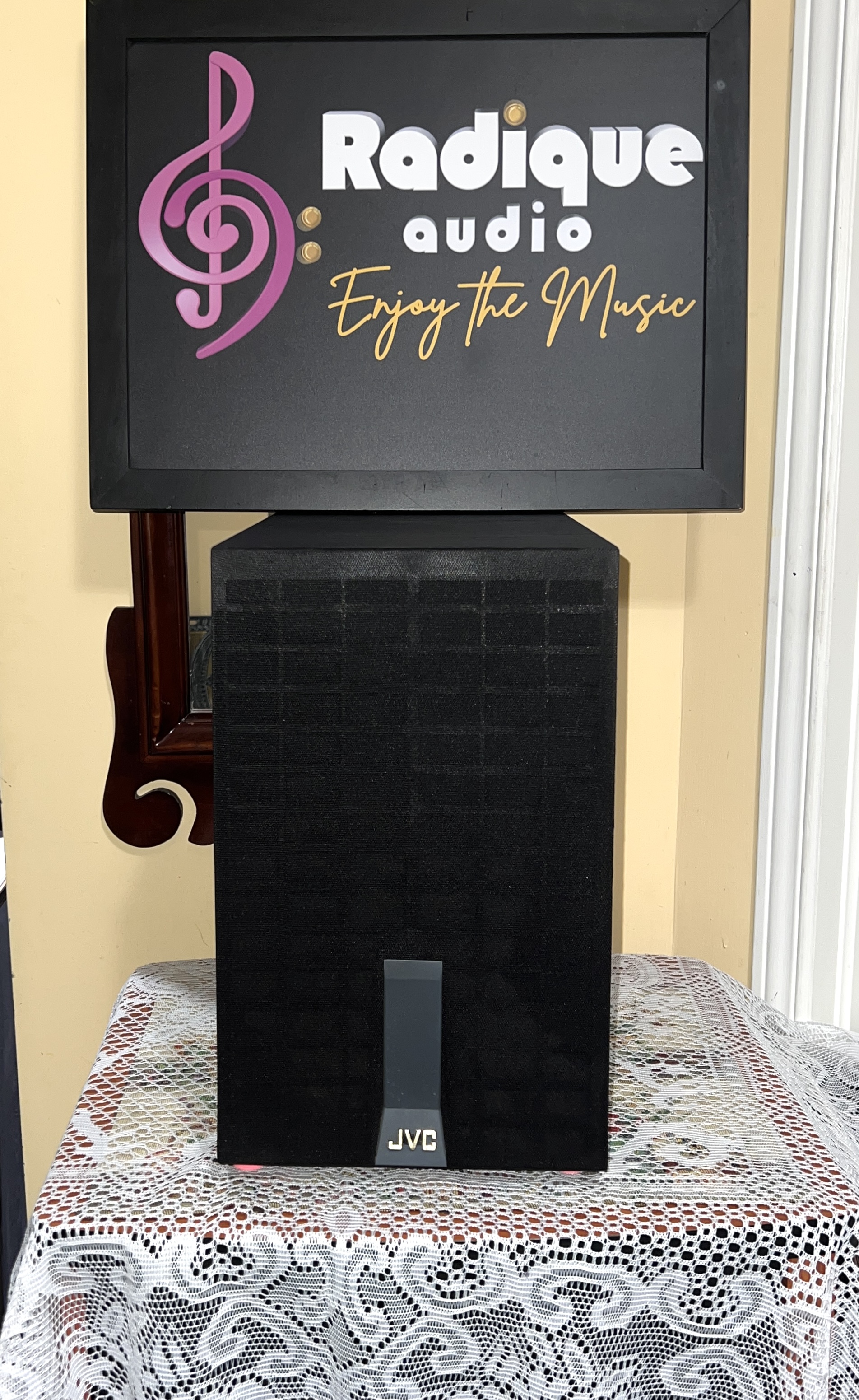
A tall, narrow bass column meant to stand beside a cabinet rather than in front of it — 8.25 inches across the front and unusually deep at 17, which is the trade: the depth buys back the internal volume the narrow baffle gives away, so a 6.5 inch woofer is properly loaded in a strip of floor barely wider than a hardcover book. Driven by an integrated 100 watt amplifier, with speaker-level inputs and high-pass outputs so it works with an amplifier that has no subwoofer output at all. Good condition.
1 in stock
JVC SX-PW33 — A Slim 100-Watt Bass Column with High-Pass Outputs for Your Main Speakers
A slim powered subwoofer column built to stand beside a cabinet rather than in front of it, with speaker-level inputs and high-pass outputs that let it work with amplifiers that have no subwoofer output at all.
The Cabinet
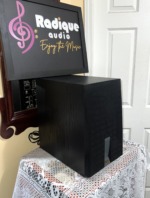
The SX-PW33 is a tall, narrow bass column, 8.25 inches across the front and 23.25 inches high, and unusually deep at 17 inches. That is a deliberate trade. The depth buys back the internal volume the narrow baffle gives away, so the cabinet holds enough air to load a woofer properly while occupying a strip of floor barely wider than a hardcover book. In a room where a conventional cube subwoofer has nowhere to go, this one slides into the gap between an entertainment unit and the wall and disappears.
Driver and Amplifier
Inside is a 6.5 inch woofer in a bass-reflex enclosure, driven by an integrated 100 watt amplifier. A small driver in a deep, well-tuned box is a different proposition from a large one in a shallow cube: it will not shake the floor, and it was never meant to, but it fills in the bottom two octaves that stand-mount and satellite speakers simply cannot reach, and it does so without the one-note boom that ported compacts often produce.
Connections
The back panel is where this subwoofer earns its place, and it is more thoughtfully laid out than most modern equivalents. There are low-level RCA inputs for any receiver with a subwoofer output, but there are also high-level spring-clip inputs that take speaker wire directly from an amplifier’s speaker terminals. That matters enormously for anyone running a vintage integrated or receiver, because a great many of them, including some very fine ones, were built before subwoofer outputs existed. This subwoofer connects to them anyway.
Better still, it carries high-pass speaker outputs alongside the inputs. Rather than simply adding bass underneath speakers still running full range, it can pass filtered signal back out to the main speakers with the deep bass removed, so the small speakers stop trying to reproduce frequencies they cannot manage and the subwoofer takes over cleanly. Compact speakers gain headroom and clarity through the midrange from that arrangement, and it is a facility most subwoofers at this size and price never offered.
Setting It Up
The low-pass crossover is a continuous dial from 50 Hz to 150 Hz rather than a fixed setting, so the handover point can be matched to whatever the main speakers actually do rather than to an assumption. A master volume control sets level, and an auto-on circuit wakes the amplifier when it senses signal and lets it sleep when the system is off.
Condition
Cosmetically this subwoofer is graded Good, showing wear consistent with its age and ordinary household use, with nothing that affects how it performs.
A practical and unusually flexible compact subwoofer, and one of the few that will pair properly with a vintage amplifier as easily as with a modern receiver. Available for pickup in Kanata, or shipped across Canada and internationally — we have sent equipment to fifteen countries in the past year, each piece packed in-house in 275 lb test double-wall boxes. Live shipping rates for your address are calculated at checkout. Backed by Radique Audio’s Bumper-to-Bumper Warranty and our Perpetual Trade-Back Program. Available for audition by appointment in Kanata.
JVC SX-PW33 Specifications
- Type: Powered subwoofer, slim tower column, bass-reflex
- Driver: 6.5 inch woofer
- Amplifier power: 100 watts
- Low-pass crossover: Continuously adjustable, 50 Hz – 150 Hz
- Inputs: Low-level RCA line, and high-level speaker-wire spring clips
- Outputs: High-pass speaker-wire terminals to main speakers
- Controls: Master volume, low-pass crossover, auto-on
- Power supply: 110 – 120 V AC
- Dimensions: (Width x Height x Depth) 8.25 x 23.25 x 17 inches (210 x 590 x 430 mm)
- Weight: 17 lbs (7.7 kg)
⚠️ Important Information for International Buyers
This unit is configured for North American 110/120V power. Buyers outside North America will require a step-down transformer and appropriate plug adapter.
✅ Buy With Confidence — The Radique Promise
Backed by Radique Audio’s Bumper-to-Bumper Warranty and our Perpetual Trade-Back Program. When you’re ready to move on, we’ll take it back. That’s the Radique difference.
📦 Watch how we protect your gear — our unboxing video.
📺 Curious about our business? Check out our YouTube channel for behind-the-scenes videos and more!
📞 Questions? Use the Ask a Question button above, or call us at 613-416-9995.
⭐ Don’t Just Take Our Word For It
Radique Audio holds over 600 customer ratings averaging 4.97 stars across six public platforms — Facebook Marketplace, Kijiji, Canuck Audio Mart, Google and others. Every rating lives somewhere we don’t control, so you can read the originals yourself, including the less flattering ones. See what our customers say. 👉
| Weight | 19 lbs |
|---|---|
| Dimensions | 21 × 12.25 × 27.25 in |
JVC was founded in Yokohama, Japan, in 1927 as the Japanese arm of America's Victor Talking Machine Company, first making phonographs and records. We carry JVC stereo receivers and AV receivers, cassette decks, CD players, turntables and speakers. We've had more than 90 JVC listings so far, covering more than 80 different models. Every AV receiver we list is tested input by input on our bench: each HDMI input and output, the analog, optical and coaxial inputs, the subwoofer outputs and the wireless features where it has them. Every used JVC here is inspected, tested and serviced as required, then photographed in-house and covered by our Bumper-to-Bumper Warranty and Perpetual Trade-Back Program. Don't see the model you want? Tell us on First Dibs and we'll email you when one arrives.
JVC models we've sold more than once include the RX-7000VBK and RX-8000VBK AV receivers.
The JVC story, 1927 to today
JVC began in 1927 as the Japanese subsidiary of the Victor Talking Machine Company, making phonographs and records, and built a large plant in Yokohama in 1930. RCA bought Victor in 1929, and in the late 1930s JVC passed to Japanese owners.
Stereo, quad and video. JVC joined the Matsushita (Panasonic) group in the early 1950s. It developed the CD-4 discrete four-channel record system in the early 1970s and the SEA graphic equalizer built into its receivers, and in 1976 its video division introduced VHS.
Hi-fi highlights. The late 1970s and early 1980s brought the JR-S receivers, whose SEA sliders replaced the tone controls, the Super-A amplifiers and the QL quartz-lock turntables, and around 1990 the XL-Z CD players with JVC's K2 Interface.
Today. JVC merged with Kenwood between 2008 and 2011, and JVCKENWOOD Corporation now owns the brand. JVC has had its own Canadian distribution since the 1970s, and JVCKENWOOD Canada is based in Mississauga, Ontario.
Which JVC is which?
1970s receivers: early four-channel models with CD-4 demodulators, and the JR-S series of 1976 to 1977, with built-in SEA equalizers.
Super-A amplifiers and receivers (1979 to the early 1980s): such as the A-X5 and A-X9 amplifiers and the R-S33 receiver.
Turntables: QL quartz-lock direct-drive models such as the QL-A7 and QL-Y5F, and belt-drive automatics such as the JL-A1.
Cassette decks and CD players: KD and CD-S decks from the 1970s, TD-W dual-well decks, and XL-Z CD players and XL changers.
AV receivers (2000 to 2004): the RX-x000V, RX-x010V and RX-x020V families, including the RX-7000VBK, RX-8000VBK and RX-6020VBK, and the RX-8040B.
Buying used JVC: what to check
SEA sliders. On JR-S and R-S receivers, work every equalizer slider through its range and listen for crackle or a channel dropping out.
FM muting. Stereo Review found the JR-S600's muting could thump when tuning on or off a station, so turn the volume down before tuning.
AV receivers. Run every channel, centre and surrounds included, at moderate volume. Owners report overload shutdowns on some 2000s models, which can come from a short in the speaker wiring.
Turntables. On QL servo turntables, check that the tracking-force and damping dials respond and that the arm finds the lead-in at both record sizes. Older JL automatics often need old grease cleaned out and a new belt.
Cassette decks. Treat belts and pinch rollers on any 1970s to 1990s deck as service items.
Everything we list is inspected, tested and serviced as required here, and comes with our warranty.
You may also like…


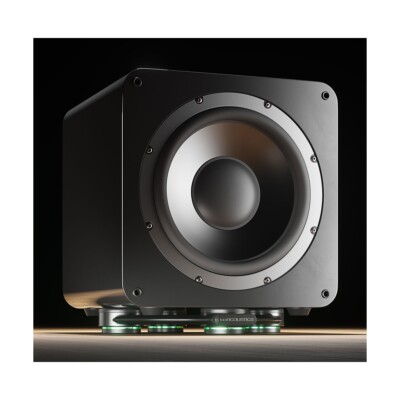
IsoAcoustics Aperta Sub XL Subwoofer Isolation Stand
- ✔️ Genuine IsoAcoustics Aperta Sub XL, brand new in box
- ✔️ Low-profile isolation stand for front-firing and side-firing subwoofers up to 160 lbs (72.6 kg)
- ✔️ Includes 1 stand plus 4 carpet discs for carpeted surfaces
- ✔️ Helps reduce energy transfer, room rattle, and muddy bass smear for tighter low-frequency performance
- ✔️ Backed by a 2-year manufacturer’s warranty in Canada
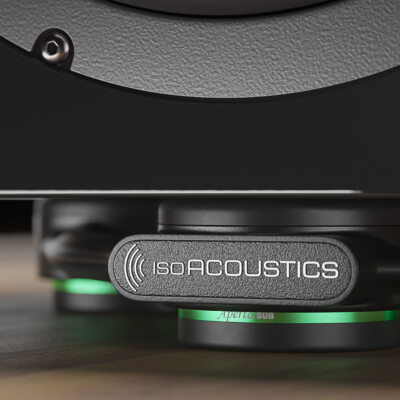
IsoAcoustics Aperta Sub Subwoofer Isolation Stand
- ✔️ Genuine IsoAcoustics Aperta Sub, brand new in box
- ✔️ Low-profile isolation stand for front-firing and side-firing subwoofers up to 80 lbs (36.3 kg)
- ✔️ Includes 1 stand plus 4 carpet discs for carpeted surfaces
- ✔️ Helps reduce energy transfer, room rattle, and muddy bass smear for tighter low-frequency performance
- ✔️ Backed by a 2-year manufacturer’s warranty in Canada
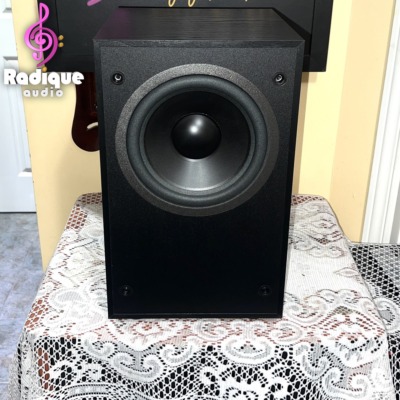

Energy e:XL-S8 8″ Front-Firing Subwoofer 400W Peak! – Canada
An 8-inch driver on a discrete MOSFET amplifier rated 100 watts RMS and 400 peak, in a vented cabinet that reaches 29 Hz. The rear panel gives you continuously variable phase, a low-frequency EQ of plus or minus 3 dB, an adjustable low-pass, and both high- and low-level inputs. Black ash, 25.9 lbs, made in Canada. Very good cosmetic condition.

Related Products
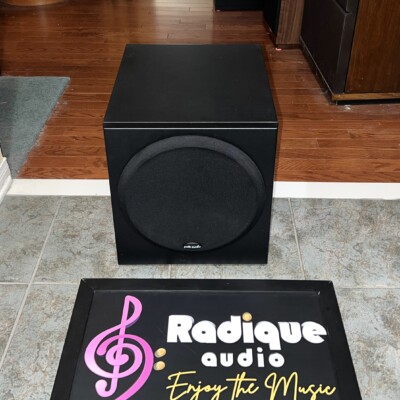
Polk Audio PSW350 10″ Front-Firing Powered Subwoofer 260W
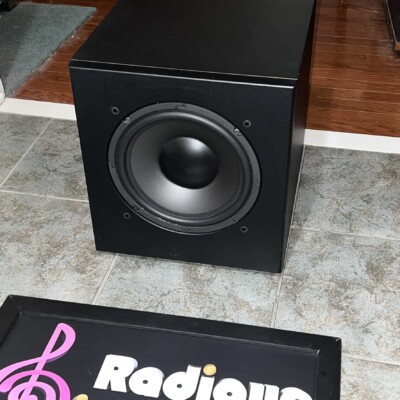
A 10-inch front-firing Dynamic Balance woofer on a 100-watt RMS amplifier — 260 watts dynamic — in a dual-rear-ported cabinet good for 25 to 180 Hz. Speaker-level in and out, stereo line inputs and an unfiltered LFE jack, with a variable 60 to 160 Hz low-pass and a phase switch. 37 lbs, black matte. Very good cosmetic condition.
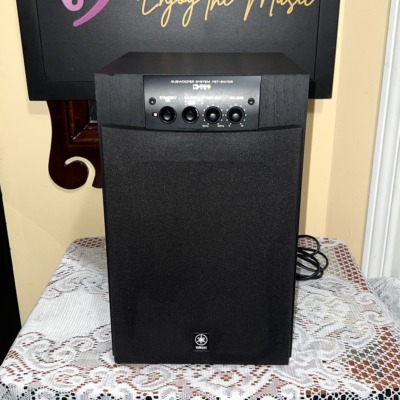
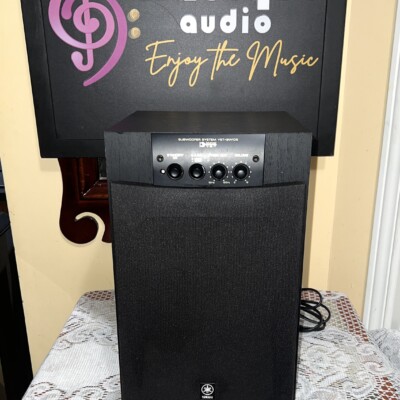
Yamaha YST-SW105 Active Servo Subwoofer — Compact 100W
An 8-inch front-firing paper cone on Yamaha's Advanced Active Servo amplifier — 100 watts into 5 ohms, down to 30 Hz, from a cabinet small enough to tuck beside a bookshelf pair. Continuously variable high-cut from 50 to 150 Hz, a Music/Movie voicing switch, RCA and speaker-level inputs plus full-range pass-through outputs. Very good condition.
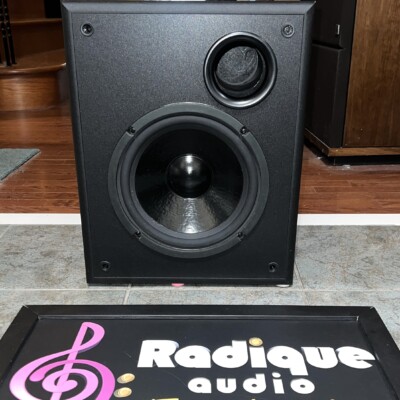
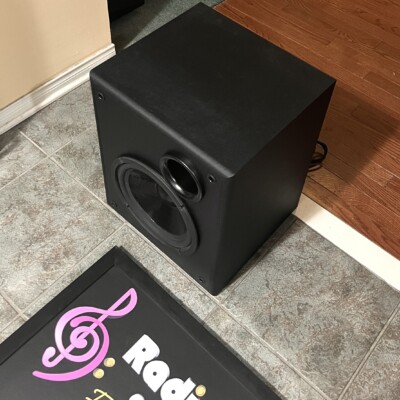
Yamaha SW-3 Active Servo Subwoofer — 10″ Woofer | Air Woofer Tec
Yamaha’s Active Servo Technology couples a negative-impedance drive amplifier to a Helmholtz resonator port — the Air Woofer opening — so the amplifier corrects the driver’s motion as it works. 100 watts into a 25 cm cone, rated down to 25 Hz, with a continuously variable 50–150 Hz high-cut at 24 dB per octave. Speaker-level and line inputs both. Very good condition.
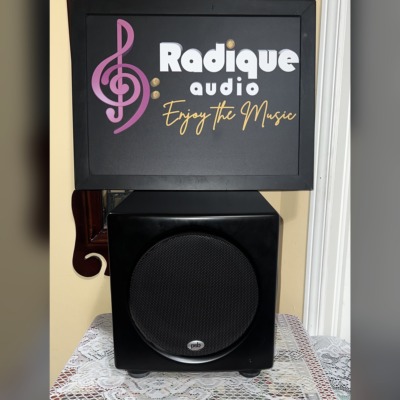
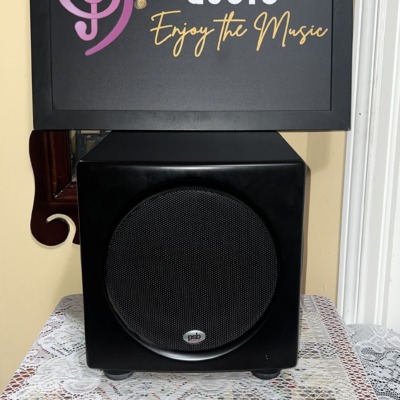
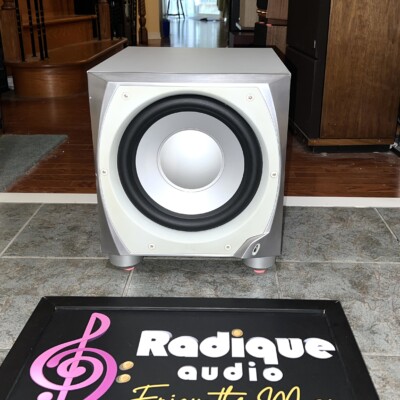
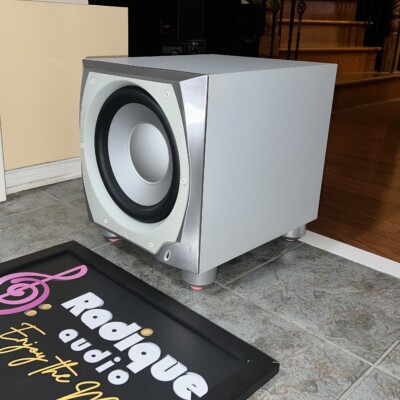
PSB SubSeries HD10 10″ Powered Subwoofer — 750W, 2000W Peak!
A serious subwoofer in about a square foot of floor, from one of the most respected names in Canadian loudspeaker design, with deep, powerful bass for home theatre and most music.
✔️ Good condition — light scuffs on the top, and a little vibration when played loud (details below)
✔️ 10-inch driver, two passive radiators and a 750 W Class H amplifier
✔️ Line-level and high-level inputs — works even with a receiver that has no sub out
✔️ Covered by Radique Warranty
✔️ Includes Perpetual Trade-Back Program eligibility
✔️ Expertly packed for safe shipping
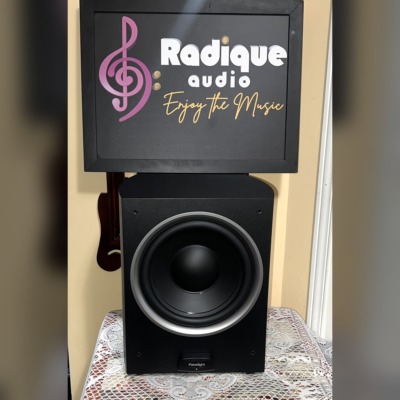
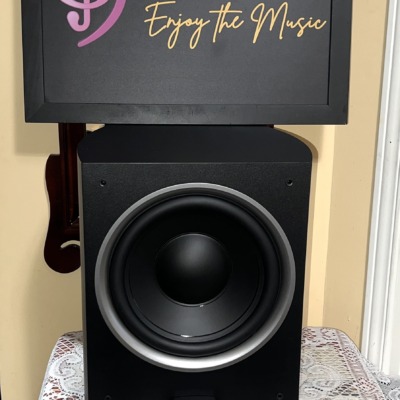
Paradigm PDR-10 v.4 10″ Powered Subwoofer – 300W Peak, Serviced
A black Paradigm PDR-10 v.4 powered subwoofer, with a 10-inch forward-firing driver and 100 watts RMS (300 watts dynamic peak) on board, serviced on our bench and in very good condition.
✔️ Very good condition — free of significant marks
✔️ Serviced on our bench and tested before listing
✔️ 10-inch forward-firing driver, 100 W RMS and 300 W dynamic peak
✔️ Covered by Radique Warranty
✔️ Includes Perpetual Trade-Back Program eligibility
✔️ Expertly packed for safe shipping
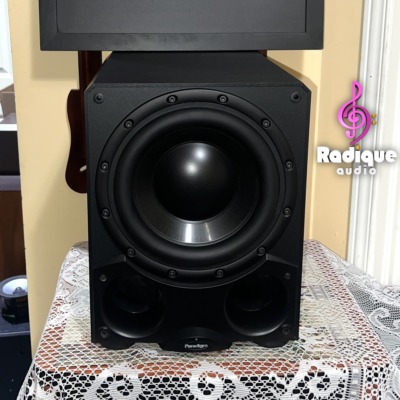
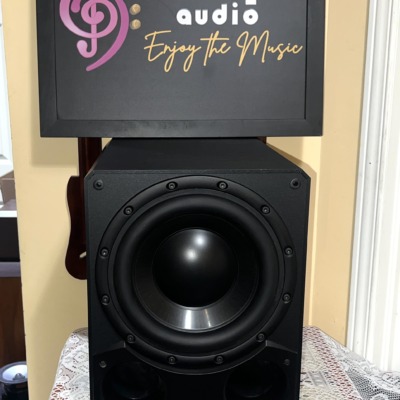
Paradigm DSP-3100 v.2 10″ Subwoofer – 600W Peak, Made in Canada
A black Paradigm DSP-3100 v.2 powered subwoofer, made in Canada, with a 10-inch front-firing driver and 200 watts RMS (600 watts dynamic peak) on board. It has been tested on our bench and is in very good condition.
✔️ Very good condition — removable black cloth grille included
✔️ 10-inch front-firing driver, 200 W RMS / 600 W peak Class-D
✔️ Front ports for hidden installs — made in Canada
✔️ Covered by Radique Warranty
✔️ Includes Perpetual Trade-Back Program eligibility
✔️ Expertly packed for safe shipping
