


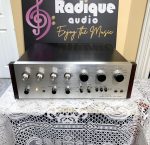


Pioneer SA-900 Vintage Integrated Amplifier – 50 WPC, Rosewood
$595.00
Out of stock
Get first dibs on the next one
Pioneer SA-900 Integrated Amplifier – 50WPC, MM/MC Phono, Rosewood Trim, Tested, Made in Japan 1970
Experience the refined engineering and warm tonal character of the Pioneer SA-900—a landmark integrated amplifier from 1970-1971 that stands as one of the finest examples of early solid-state audio design. Built at the dawn of the transistor era with meticulous attention to detail, the SA-900 combines a professional-grade preamplifier, versatile control section, and powerful 50-watt per channel amplifier in a chassis accented with attractive rosewood trim flanking the faceplate. Thoroughly tested and in very good condition, this unit includes vintage speaker output adapters to convert the original 2-prong connectors (common in early 1970s Japanese audio equipment) to modern set-screw terminals compatible with today’s speaker cables.
Why This Pioneer SA-900 Stands Out
Early Pioneer Engineering Excellence: The SA-900 represents Pioneer’s uncompromising philosophy of building amplifiers without shortcuts. Featuring a quasi-complementary single-ended push-pull power amplifier design with silicon transistors and FET circuitry, the SA-900 delivers 50 watts per channel at 8Ω with total harmonic distortion below 0.3%, powering efficient bookshelf speakers to concert-hall levels without strain. More impressively, the continuous output is rated at a realistic 50W × 2 at 8Ω—not inflated “music power” claims, but honest, sustained performance. One reviewer noted that “don’t let the specs fool you,” as the conservative rating belies a power supply “disproportionately large, resembling components from competing 50-watt receivers”.
Professional-Grade Control Section: What sets the SA-900 apart is its unusually comprehensive control architecture—more typical of separate pre/power amplifier systems than integrated amps. The preamplifier stage uses low-noise silicon transistors with direct-coupled, 3-stage feedback circuitry, yielding exceptional signal-to-noise performance and minimal distortion across the frequency spectrum. The damping factor exceeds 67 at 8Ω, a hallmark of tight, controlled bass and strong speaker control.
Dual Phono Prowess: The SA-900 features two dedicated phono inputs—one optimized for high-output MM cartridges, the other tailored for low-output MC cartridges with minimal noise. Both inputs feature true RIAA equalization, and the MC stage uses carefully selected low-noise transistors for exceptional clarity. Input sensitivity is precisely matched: 3.1mV for MM and 0.155mV for MC cartridges, with signal-to-noise ratios of 85dB and 80dB respectively.
Design & Features
The SA-900 is a true audio control center—worthy of partnership with a quality turntable and tape deck. While modest in power at 50 watts per channel, it drives efficient speakers (86dB+ sensitivity) with authority, making it ideal for small-to-medium listening rooms.
Performance highlights:
Quasi-complementary SEPP power amplifier with silicon transistors and temperature compensation
Direct-coupled 3-stage feedback preamplifier with FET input stage
Exceptional damping factor (>67) for tight bass control and speaker authority
Precision tone controls with accurate 3dB steps that actually flatten when set to “flat”
Professional -6dB/octave filters at 50Hz and 10kHz for noise reduction
Loudness contour with adjustable bass and treble boost for low-volume listening
-20dB muting switch for instant level reduction
Tape monitor loop for source/tape comparison
Two speaker output pairs with A/B selection for zone switching
Pre/main amplifier separation for independent use or multi-channel configurations
Headphone output (6.3mm) for private listening
Connectivity & Control:
Dual phono inputs: MM (3.1mV/47kΩ) and MC (0.155mV/150kΩ) with pushbutton selection
Line inputs: Tuner, Tape, Aux (180mV/200kΩ each)
Tape monitor loop with DIN-standard connectors
Tone controls: Bass (±12dB @ 100Hz) and Treble (±9dB @ 10kHz) with independent left/right channels
Main-in/pre-out jacks for separate amplifier use
Speaker switching: Main/Remote pairs with vintage 2-pin connectors
Headphone output (6.3mm)
Vintage Connector Solution:
The SA-900 features the 2-prong speaker connectors common on premium Japanese audio components from 1970-1972. This unit includes vintage adapters that plug into the original speaker outputs, converting them to versatile dual set-screw terminals compatible with modern speaker cables, spade connectors, or bare wire—no modifications required.
Technical Specifications
Power Output (Continuous RMS): 50W/ch @ 8Ω, 64W/ch @ 4Ω (both channels driven, 20Hz–20kHz, THD <0.3%)
Music Power Output (IHF): 145W @ 8Ω, 200W @ 4Ω (distortion <0.3% at 1kHz)
Total Harmonic Distortion: <0.3% (rated output), <0.08% (45W at 1kHz)
Frequency Response: 20Hz–50kHz (±1dB), 20Hz–40kHz (audio band)
Power Bandwidth: 20Hz–50kHz (distortion <0.3%)
Damping Factor: >67 at 8Ω (at 1kHz)
Signal-to-Noise Ratio: 85dB (phono MM), 80dB (phono MC), 95dB (line inputs)
Phono Input Sensitivity: 3.1mV/47kΩ (MM), 0.155mV/150kΩ (MC)
Line Input Sensitivity: 180mV/200kΩ (tuner, tape, aux)
Speaker Load Impedance: 4Ω–16Ω
Tone Control Range: Bass ±12dB @ 100Hz, Treble ±9dB @ 10kHz (3dB steps)
Filters: Low -6dB/oct @ 50Hz, High -6dB/oct @ 10kHz
Loudness Contour: +14dB @ 50Hz, +7dB @ 10kHz (at -40dB volume setting)
Components: 2 FETs, 29 transistors, 7 diodes
Dimensions: 405 × 140 × 339 mm (15.9″ × 5.5″ × 13.3″)
Weight: 12.3 kg (27 lbs)
Era: 1970–1971, Made in Japan
Power Requirements: 110/117/130/220/240V (switchable), 50/60Hz AC
Power Consumption: 250VA max
Condition Notes
This unit is in very good cosmetic condition with light signs of responsible use. The rosewood trim is intact and rich with patina, the brushed aluminum faceplate is clean with crisp lettering, knobs turn smoothly with satisfying detents, and the overall presentation is clean and well-maintained. It has been fully tested to ensure it is ready to perform:
All input channels functional and clean
Phono stage (both MM and MC) tested and performing quietly with proper RIAA equalization
Tone controls smooth across full range with accurate flat response
Power output verified on both channels at rated specifications
Selector switches and input selector responsive and clean
Included speaker adapters confirm proper operation of both speaker output pairs
Purchase with Confidence
Includes Radique Audio “Bumper to Bumper” Warranty
Perpetual Trade-Back Policy—upgrade or swap with peace of mind
Classic Japanese engineering—tested, very good condition, ready to play; asking $595.
| Weight | 30 lbs |
|---|---|
| Dimensions | 17.3 × 19.9 × 9.5 in |
| Mains Voltage | Selectable / Universal Voltage |
Pioneer began in Tokyo in January 1938, when Nozomu Matsumoto set up shop around the A-8 speaker he had built the year before. By the late 1970s its SX receivers were at the heart of the hi-fi power race. We carry Pioneer stereo receivers and AV receivers, CD players, cassette decks, tuners and equalizers. We've had more than 240 Pioneer listings so far, covering 140 different models. Every used Pioneer here is inspected, tested and serviced as required, then photographed in-house and covered by our Bumper-to-Bumper Warranty and Perpetual Trade-Back Program. Don't see the model you want? Tell us on First Dibs and we'll email you when one arrives.
Pioneer is one of our two top-selling brands of vintage amps and receivers, along with Marantz. Our five best-selling Pioneer models so far: the SX-650, SX-750, SX-580, SX-780 and SX-680, all vintage stereo receivers from the 1976 and 1978 SX families. We also offer our custom cherry cabinets for these vintage Pioneers, hand-made from all-natural Ottawa Valley cherry, and we've upgraded dozens of Pioneers with them so far.
The Pioneer story, 1938 to today
Nozomu Matsumoto developed the A-8 speaker in 1937, and in January 1938 he set up Fukuin Shokai Denki Seisakusho in Tokyo. "Pioneer" was first the name of that speaker. Some histories give 1936 in Osaka as the start, but Pioneer dates itself to January 1938 in Tokyo. The company was incorporated in 1947 and renamed Pioneer Electronic Corporation in 1961.
Stereo and the US. In 1962 Pioneer introduced the PSC-5A, which it calls the first stereo with separate speaker cabinets, and its first PL turntables. Pioneer Electronics U.S.A. was founded in New York in 1966.
The power race. After a 1974 US Federal Trade Commission rule tightened how amplifier power was rated, receiver makers competed on watts. Pioneer's SX-1250 of 1976 was rated at 160 watts per channel, and the SX-1980 of 1978 to 1980 at 270.
CD and Elite. The P-D1 of 1982 was Pioneer's first CD player, and Elite-branded components were on sale by 1985.
Today. Pioneer sold its home audio business to Onkyo in 2015, keeping its car and DJ businesses, and Pioneer-branded home theatre gear was later made under licence. In December 2025 CarUX, part of Taiwan's Innolux, completed its purchase of Pioneer Corporation, which now focuses on in-car products.
Which Pioneer is which?
Early-1970s SX receivers: models such as the SX-424 to SX-828, rated at about 15 to 50 watts per channel.
The 1976 "x50" SX receivers: from the SX-450 at 15 watts per channel up to the SX-1250 at 160. Our best-selling SX-650 and SX-750 come from this family.
The 1978 "x80" SX receivers: including the SX-580, SX-680 and SX-780 we sell most, up to the SX-1980 flagship with quartz-lock tuning, which weighs more than 35 kg.
Spec and Exclusive separates: higher-end amplifiers such as the Spec-1 preamplifier (1976 to 1980) and the Exclusive C3/M3 pair (1974).
Elite: Pioneer's upper line from the mid-1980s, for example the PD-9010X CD player.
PL turntables, CT cassette decks and CD players: PL turntables from 1962, such as the PL-12 and the linear-tracking PL-L1; CT decks such as the three-head CT-F1000; and CD players from the 1982 P-D1 to magazine-loading changers such as the PD-M6.
Buying used Pioneer: what to check
Controls and switches. Crackle when you turn a control or work a switch usually means dirt, and restorers clean every pot and switch.
Capacitors. Electrolytic capacitors in 1970s receivers are often past their best, and full restorations replace them.
Big SX models. Owners and restorers report heat stress on the power-supply board of large receivers such as the SX-1250. Ask what has been done.
Relay, lamps and bias. The protection relay is a common replacement, dial lamps burn out and are often converted to LED, and restorers set the bias and DC offset.
Cassette decks. Check the heads, fast-forward and rewind, Dolby and every button. Belts age even when the deck looks perfect.
Everything we list is inspected, tested and serviced as required here, and comes with our warranty.
You may also like…
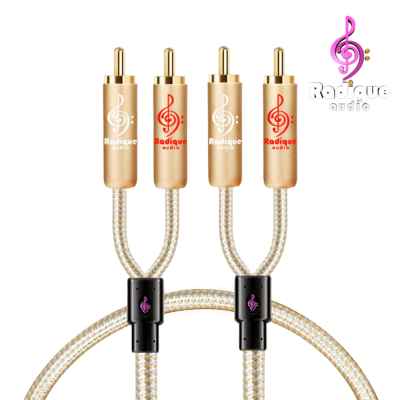
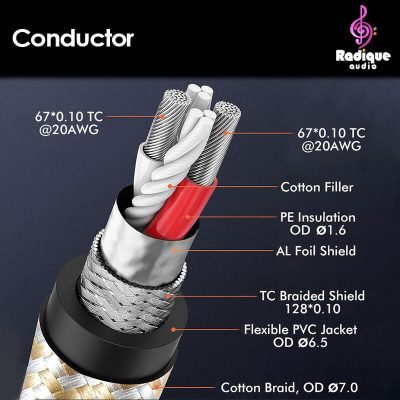
Radique Audio Gold Series RCA Stereo Interconnect Cable
RCA cables that are kind to vintage jacks: dual RCA to dual RCA, in 0.2, 0.75 or 1.5 m.
- Slim gold-plated plugs with vintage-safe grip pressure
- Dual shielding: aluminum foil and 128-strand braided copper
- Reinforced splitters; 7 mm gold cotton and nylon mesh jacket
- Three lengths, chosen above the Add to Cart button
- 1-year warranty
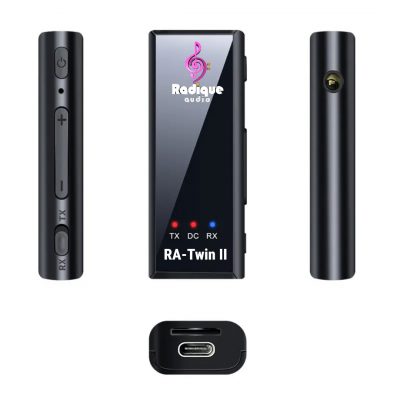
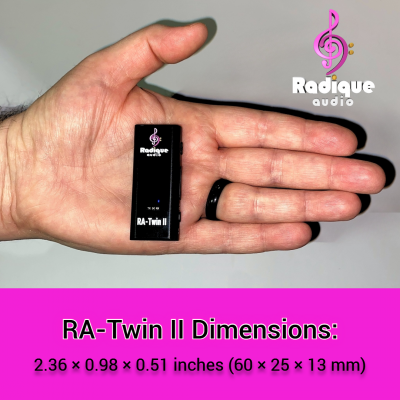
RA-Twin II Bluetooth Adapter for Vintage Stereo – Receiver & Transmitter
Add Bluetooth to any vintage stereo, amplifier or car stereo, or send your TV or stereo to Bluetooth headphones. Tiny but mighty, and set up in minutes.
- RX, TX and Mobile (microSD) modes
- Bluetooth 5.4, up to 10 m range
- Up to 10 hours per charge, USB-C
- Clear online manual in English & French
- 1-year warranty, Ottawa-based support
Related Products
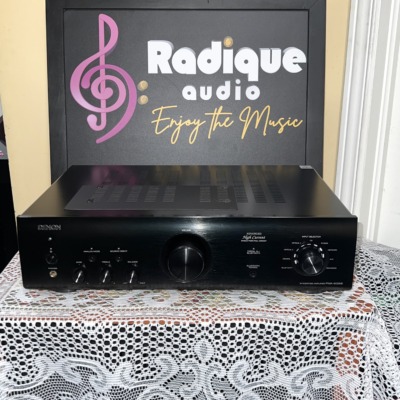
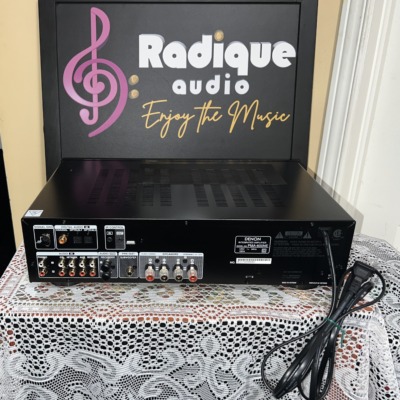
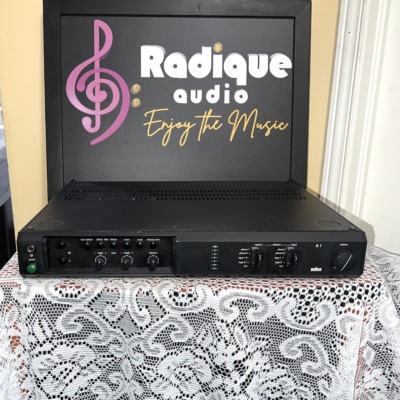
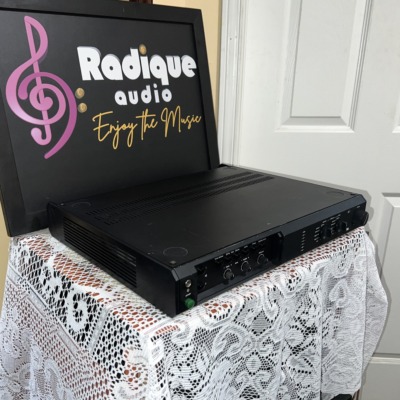
Braun Atelier A1 Vintage Integrated Amp – 55 WPC, Pre-Out, Japan
The component that makes the rest of an Atelier system work, and the one people hunting these usually look for first. 55 watts per channel into 8 ohms and 80 into 4, with a preamplifier section that separates from the power stage — engineering that is not an afterthought to the industrial design. 445 mm wide and 70 mm tall, the exact footprint of the T1 tuner and C1 deck, so the stack reads as one machined object. Made in Japan for Braun. Good condition.
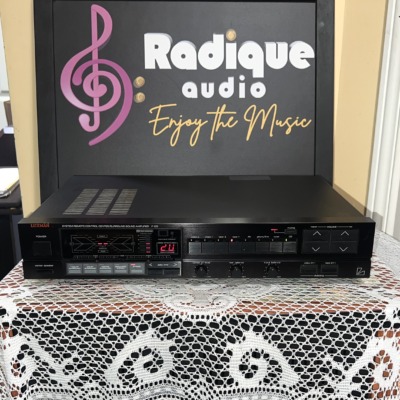
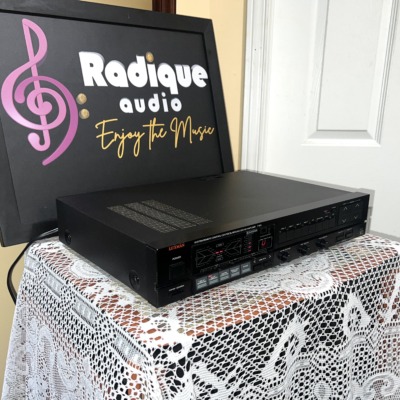
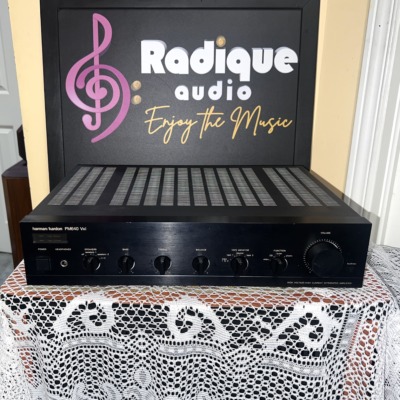
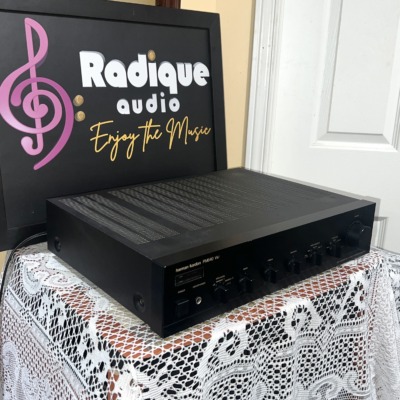
Harman Kardon PM640VXi Vintage Integrated Amp – 45 WPC, Japan
A 45-watt amplifier built by a company that spent the 1980s arguing the watts were the wrong thing to look at.
✔️ Condition: Very Good
✔️ Covered by Radique Warranty
✔️ Includes Perpetual Trade-Back Program eligibility
✔️ Expertly packed for safe shipping
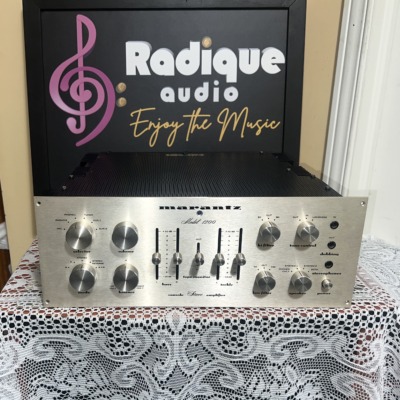
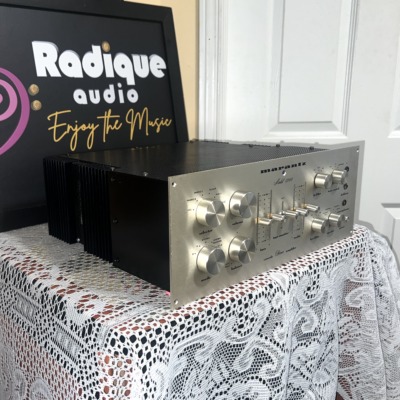
Marantz 1200 Vintage Integrated Amplifier – 100 WPC, Made in USA
Marantz's flagship integrated of the early seventies, built in Sun Valley, California, through our Level 2 service and playing as it should.
✔️ Very Good condition — faceplate and knobs present well, light marks of age; offered in the stock black metal case
✔️ Through our Level 2 service — a substantial round of component replacement on the bench, then bias and offset set and the amp run in
✔️ Covered by Radique Warranty
✔️ Includes Perpetual Trade-Back Program eligibility
✔️ Expertly packed for safe shipping
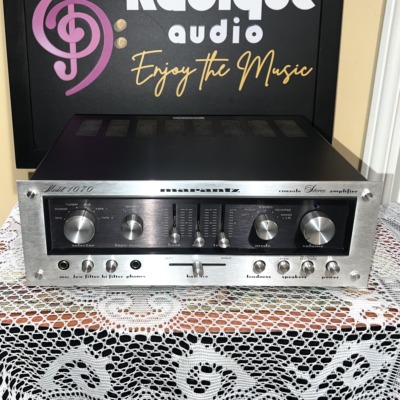
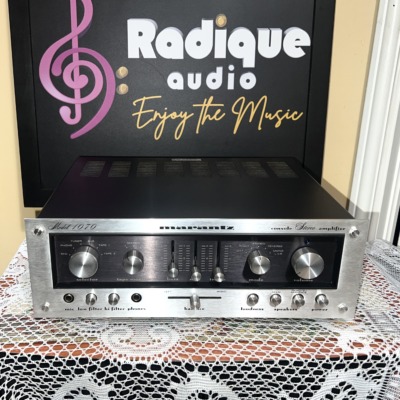
Marantz 1070 Vintage Integrated Amplifier – 35 WPC, Serviced
A slim mid-seventies Marantz integrated amplifier, through our Level 1 service, in very good condition, with a phono stage, a three-band tone section and a microphone input on the front panel.
✔️ Very good condition — free of significant marks
✔️ Through our Level 1 service on our own bench
✔️ MM phono stage, three-band tone sliders and a front-panel mic input
✔️ Covered by Radique Warranty
✔️ Includes Perpetual Trade-Back Program eligibility
✔️ Expertly packed for safe shipping
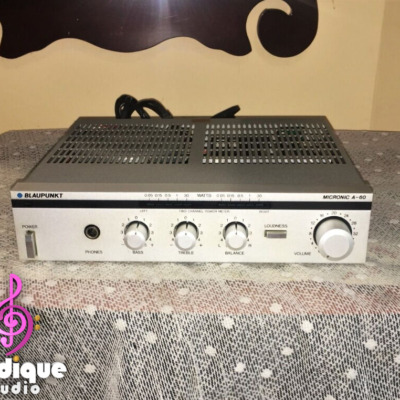
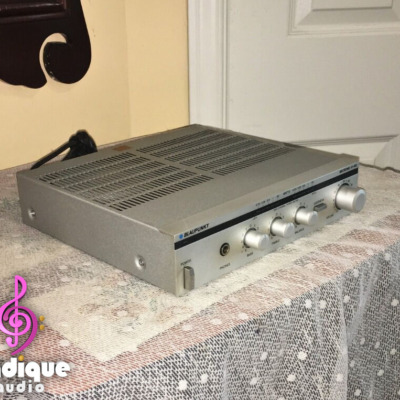
Blaupunkt Micronic A-60 Micro Amplifier – 20 WPC, Made in Japan
A rare Blaupunkt Micronic A-60 micro amplifier from 1981, designed in Germany and made in Japan: 20 watts per channel with LED power meters, in a case 25 cm wide.
✔️ Tested on our bench, input, outputs and every control
✔️ Very good condition
✔️ 20 WPC, LED power meters, one RCA input
✔️ Covered by Radique Warranty
✔️ Includes Perpetual Trade-Back Program eligibility
✔️ Expertly packed for safe shipping
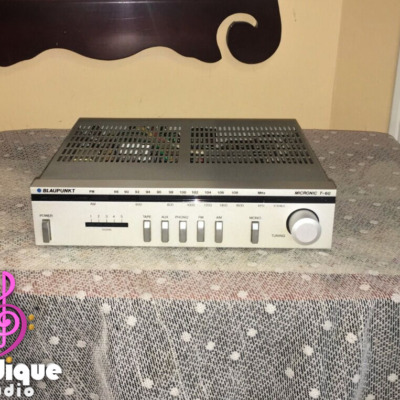
Blaupunkt Micronic A-60 + T-60 Micro System – 20 WPC, Bundle
The complete Blaupunkt Micronic 60 system from 1981, the A-60 amplifier and the matching T-60 AM/FM tuner and preamplifier, together for less than buying them separately.
✔️ Tested on our bench, both units
✔️ Both very good
✔️ Radio, phono, tape and a 20-watt amplifier in a stack 25 cm wide
✔️ Covered by Radique Warranty
✔️ Includes Perpetual Trade-Back Program eligibility
✔️ Expertly packed for safe shipping
