


Very Cool Technics 14-Band Computer Equalizer SH-8057
$295.00
Out of stock
This one has sold. Want first dibs on the next one?
We take these in regularly. Leave your name and email, and we’ll email you the moment one is listed, so you hear first. No cost, no obligation.
Email me when one is listed
How we get a component ready for sale. What our bench covers →
Other equalizers we have in stock now
3 in stock · $145.00–$345.00 · all ship
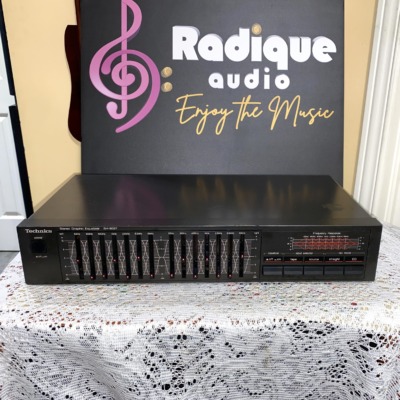 Technics 7-Band Graphic Equalizer – Made in Japan SH-8027$145.00Ships
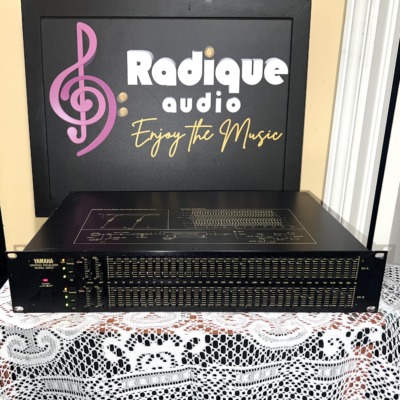 Yamaha Q2031 Dual 31-Band Graphic Equalizer – Made in Japan, 2U$295.00Ships
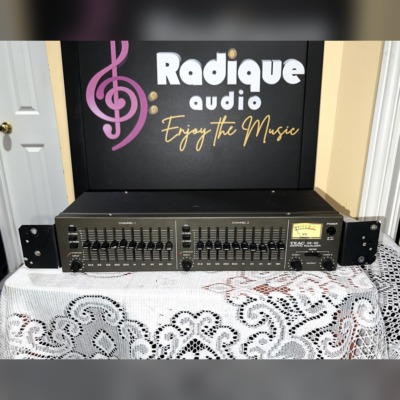 Teac GE-20 2-Channel 10-Band Stereo Graphic Equalizer, Japan$345.00Ships
How we get a component ready for sale.
Before a used or vintage component is listed, it goes through our bench, and anything we service is tested again by a different tech. See exactly what our bench covers.
What our bench covers →Japanese-made Technics SH-8057 Computer Equalizer featuring advanced spectrum analyzer display, programmable memory presets, and precise 14-band frequency control for exceptional audio customization.
This sophisticated equalizer represents the pinnacle of 1980s Japanese audio engineering, combining a dual-channel real-time spectrum analyzer with a precision 7-band per channel graphic equalizer. The distinctive “Computer Equalizer” designation reflects its advanced microprocessor-controlled features, including three programmable user memory presets alongside fixed Rock, Jazz, and Vocal presets for instant sonic optimization. The dual LED spectrum displays provide real-time frequency visualization with adjustable sensitivity levels, making it both a powerful audio tool and captivating visual centerpiece.
The SH-8057 delivers exceptional audio performance with virtually inaudible distortion and impressive dynamic range. Its wide frequency response ensures every nuance of your music is preserved while the precision frequency controls allow fine-tuning across seven carefully chosen bands from deep bass through sparkling highs. The unit features multiple input selection capabilities and seamless tape monitoring integration, making it perfectly suited for complex hi-fi systems.
Specifications:
Frequency Response: 5 Hz to 100 kHz (-3 dB)
Total Harmonic Distortion: 0.005% (20 Hz-20 kHz), 0.003% (1 kHz)
Signal-to-Noise Ratio: 107 dB/1V (IHF A)
Maximum Output/Input Voltage: 8V (1 kHz)
Input Impedance: 47 kΩ
Equalization Range: ±12 dB in 2 dB steps
Center Frequencies: 63 Hz, 160 Hz, 400 Hz, 1 kHz, 2.5 kHz, 6.3 kHz, 16 kHz
Power Consumption: 13W (7.5W standby)
Dimensions: 16 15/16″ x 3 7/8″ x 9 1/4″ (430 x 98 x 229 mm) Weight: 6.2 lbs (2.8 kg)
Experience the legendary Japanese precision of Technics engineering with this remarkable Computer Equalizer that transforms any audio system into a professional-grade setup – contact us today to add this exceptional piece to your collection.
Asking $295; buy with confidence and benefit from Radique’s “Bumper to Bumper” warranty and Perpetual trade back policy.
| Weight | 8 lbs |
|---|---|
| Dimensions | 13.25 × 21 × 8 in |
Technics is the premium audio name Matsushita (now Panasonic) created in Osaka in 1965, and its direct-drive turntables, above all the SL-1200, made it famous. We carry Technics turntables, stereo receivers, amplifiers, CD players, cassette decks and equalizers. We've had more than 160 Technics listings so far, covering more than 115 different models. Every used Technics here is inspected, tested and serviced as required, then photographed in-house and covered by our Bumper-to-Bumper Warranty and Perpetual Trade-Back Program. Turntables don't travel well by courier, so ours are pickup in Kanata or Curbside Delivery only. Don't see the model you want? Tell us on First Dibs and we'll email you when one arrives.
Our best-selling Technics models so far are two turntables, the SL-3200 and the SL-220.
The Technics story, 1965 to today
Matsushita Electric of Osaka created Technics in 1965 as its premium audio brand. The first product to carry the name was the Technics 1 bookshelf speaker.
Direct drive. The SP-10 of 1969 or 1970 (sources differ), built around a motor invented by Shuichi Obata, is what Technics calls the world's first direct-drive turntable. The SL-1200 followed in 1972 as a home hi-fi turntable, and the SL-1200MK2 of 1979 was redesigned with DJs in mind. About 3.5 million SL-1200s were made.
CD and the 1980s. The SL-P10 of 1982 was Technics' first CD player.
Pause and return. Panasonic ended SL-1200 production in 2010 and brought Technics back in 2014. A new SL-1200G arrived in 2016 and the SL-1200MK7 DJ model in 2019, and turntable production moved from Japan to Malaysia in 2021.
Which Technics is which?
SL-1200 and SL-1210: the MK2 of 1979 added quartz-locked speed control and a slider pitch control. The 1210 is the black version, often with dual-voltage switching.
SL-B, SL-D and SL-Q turntables: in the early-1980s range, Q models were fully automatic and quartz-locked, D models were not, and the SL-B models were belt-drive budget decks.
SL-3200, SL-220 and other home turntables: the Technics decks we sell most often.
SA receivers and SU amplifiers: such as the SA-1000 of 1978 to 1979. The SA-202 is one of the Technics receivers we've sold most.
RS tape decks, SL-P CD players and SB speakers: from the RS-1500U open-reel deck of 1976 to the SB-7000 linear-phase speakers of 1975.
Buying used Technics: what to check
Speed and pitch. On an SL-1200 or SL-1210, use the strobe to confirm the dots hold steady, and sweep the pitch fader at 33 and 45 rpm.
Tonearm. It should move smoothly with no play in the bearings, the headshell should clamp firmly, and the anti-skate, arm lock and cue lift should all work.
Connections. Loose leads cause crackling. Check the ground wire and both channels.
Everything we list is inspected, tested and serviced as required here, and comes with our warranty.
Related Products
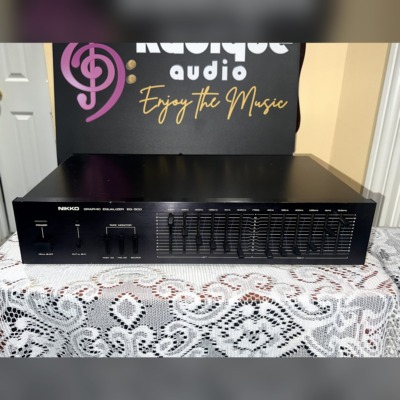
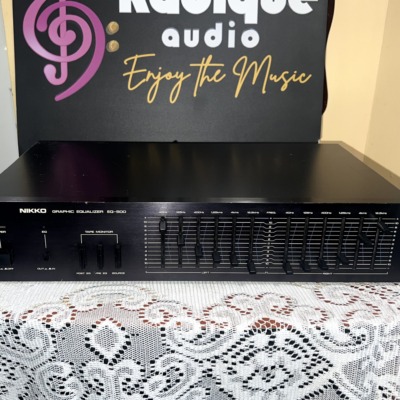
Nikko EQ-500 6-Band Stereo Graphic Equalizer Made in Japan
Six sliders a channel at 40, 125, 400, 1,250, 4,000 and 12,500 Hz, each giving 12 dB of cut or boost in 2 dB steps. Distortion is 0.01%, signal-to-noise better than 100 dB, response 10 Hz to 30 kHz — it adds nothing of its own. Bypass switch and a pre/post-EQ tape loop. Made in Japan. Cosmetic condition fair; fully tested and working.
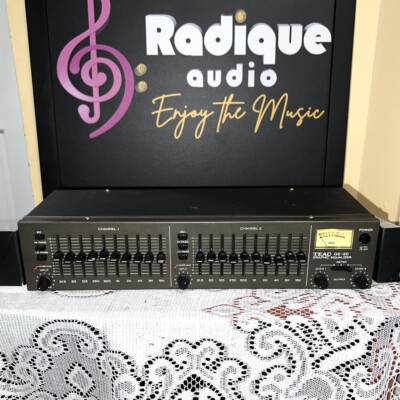
Teac GE-20 2-Channel 10-Band Stereo Graphic Equalizer, Japan
Ten ISO-standard bands per channel from 31.5 Hz to 16 kHz at ±12 dB, with separate left and right sliders and switchable VU metering. Filters at 31.5 Hz and 16 kHz roll off rumble and ultrasonic noise without touching the audible band, and an EQ defeat switch lets you A/B against flat. Made in Japan, 1978; serviced, good cosmetic condition.
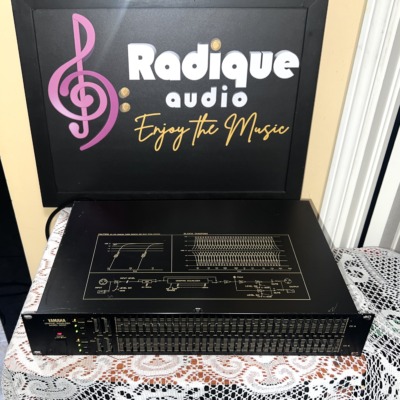
Yamaha Q2031 Dual 31-Band Graphic Equalizer – Made in Japan, 2U
Thirty-one bands per channel on ISO third-octave centres, 20Hz to 20kHz, on two fully independent channels — fine enough to pull a single room mode down without touching what sits either side of it. A range switch halves boost and cut to ±6dB for careful work, and the high-pass filters sweep from 20 to 200Hz. Balanced XLR and 1/4-inch throughout, 2U rack. Condition good.
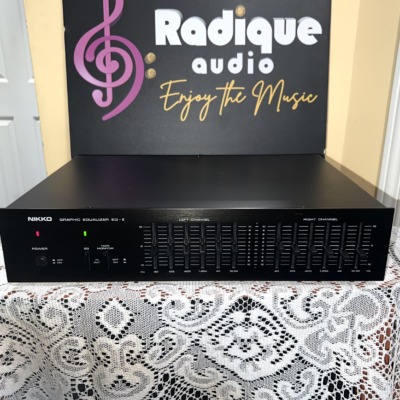
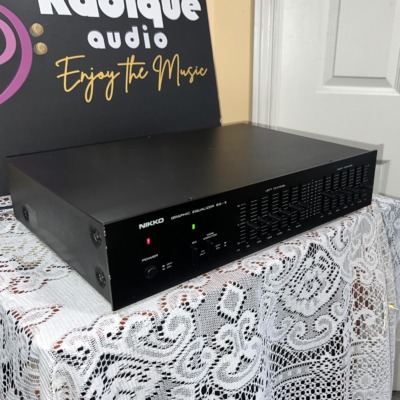
Nikko EQ-II 6-Band Stereo Graphic Equalizer Made in Japan
Six sliders a channel at 40Hz, 125Hz, 400Hz, 1.25kHz, 4kHz and 12.5kHz, each with 12dB of boost or cut, and a bypass switch for an instant A/B against the unprocessed signal. 0.01% distortion, better than 100dB signal to noise, 10Hz to 30kHz — it adds nothing of its own. Built in Tokyo between 1977 and 1981. Excellent condition, fully tested.
