
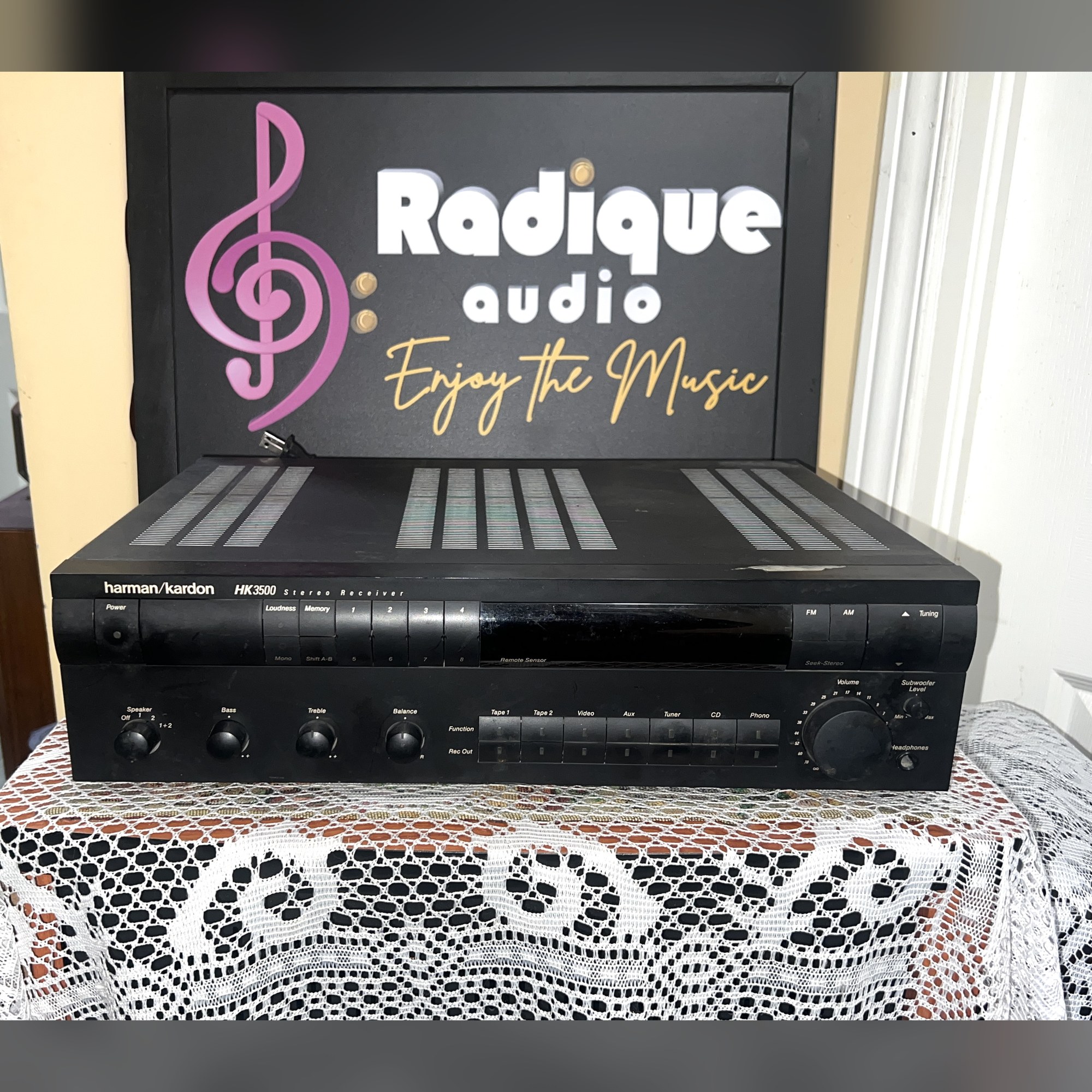
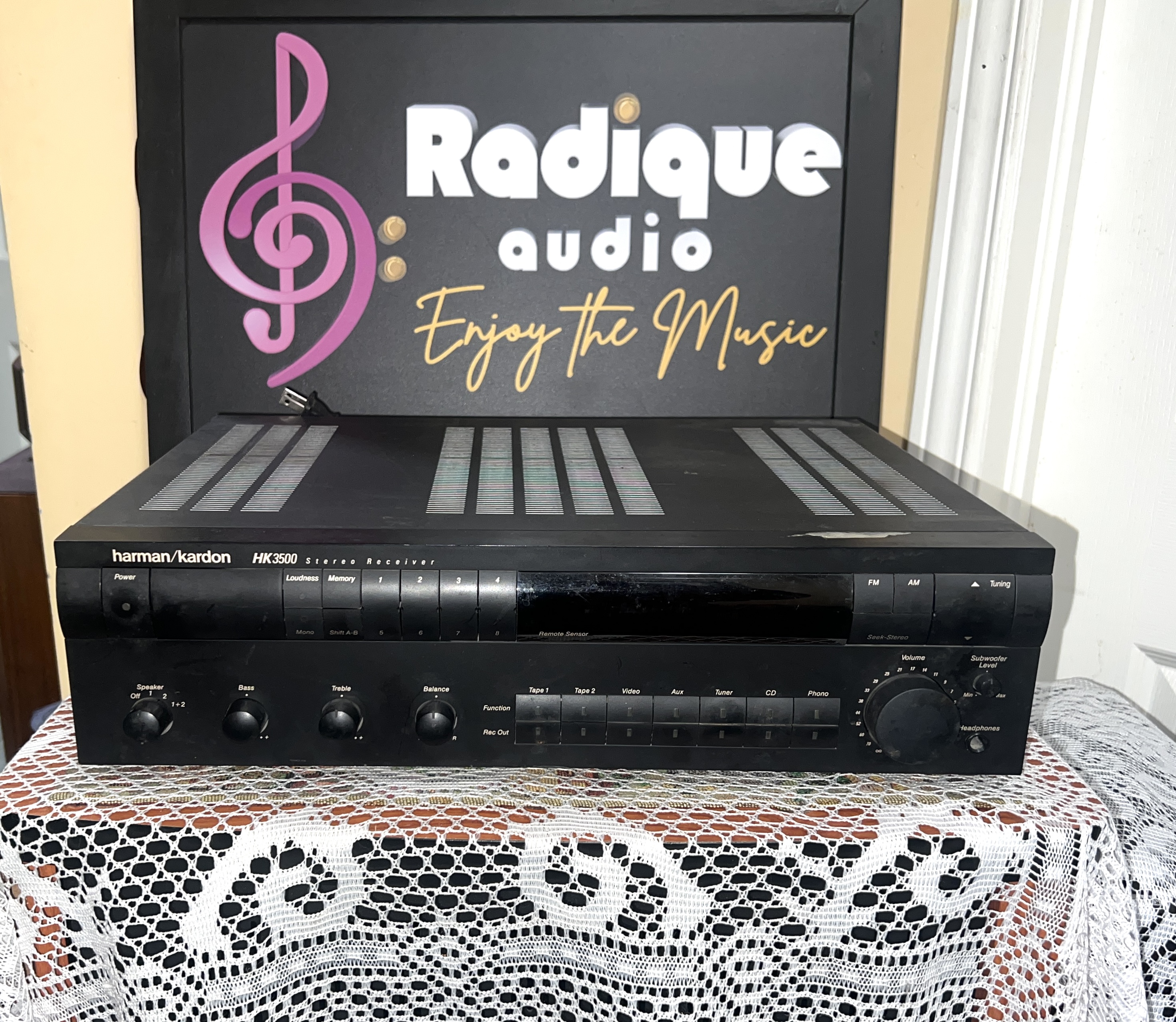
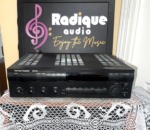
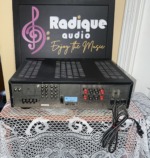
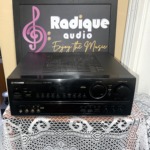
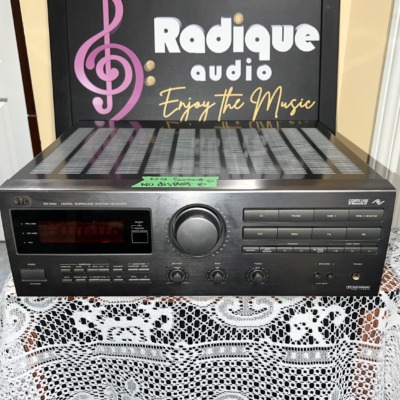
Harman Kardon HK3500 Stereo Receiver – 50 WPC, For Parts/Repair
$75.00
Sold as-is for parts or repair, with no warranty and no trade-back: input lights stay on, the tuner input only holds while its button is pressed, and the controls crackle. A 50-watt-per-channel Harman Kardon with a subwoofer out, for the DIY tech.
✔️ Sold as-is, for parts or repair
✔️ No warranty or trade-back; all sales final
✔️ Expertly packed for safe shipping
1 in stock
An early-1990s Harman Kardon HK3500 stereo receiver, rated at 50 watts per channel, sold as-is for parts or repair.
Our senior technician has assessed this early-1990s stereo receiver as repairable, but with a large backlog of billable client work, plus in-house service of higher-value components, both of which need to take priority, we cannot dedicate the bench time to service it. It is being sold strictly “as-is” for parts or repair. This unit holds excellent 2-channel potential for a DIY audio technician looking to bring a classic piece back to spec.
What we found
There may well be other issues. These are the ones we know about.
Condition
Cosmetically, there is adhesive residue from an old label on the top cover, near the front right corner.
Available for pickup in Kanata, or shipped across Canada and internationally. Live shipping rates for your address are calculated at checkout.
Sold as-is, for parts or repair. This unit is not covered by our Bumper-to-Bumper Warranty, is not eligible for our Perpetual Trade-Back Program, and all sales are final.
Can you fix this one?
If you could bring this receiver back to life, and you enjoy working on used and vintage audio gear, we might have a spot for you on our team. Read our tech wanted ad on our Join Our Team page.
Harman Kardon HK3500 Stereo Receiver Specifications
- The input indicator lights stay on
- The tuner input only engages while its button is held down
- Static (crackle) in the controls
- It needs a thorough cleaning, inside and out
- Type: stereo receiver
- Power output: 50 watts per channel into 8 ohms
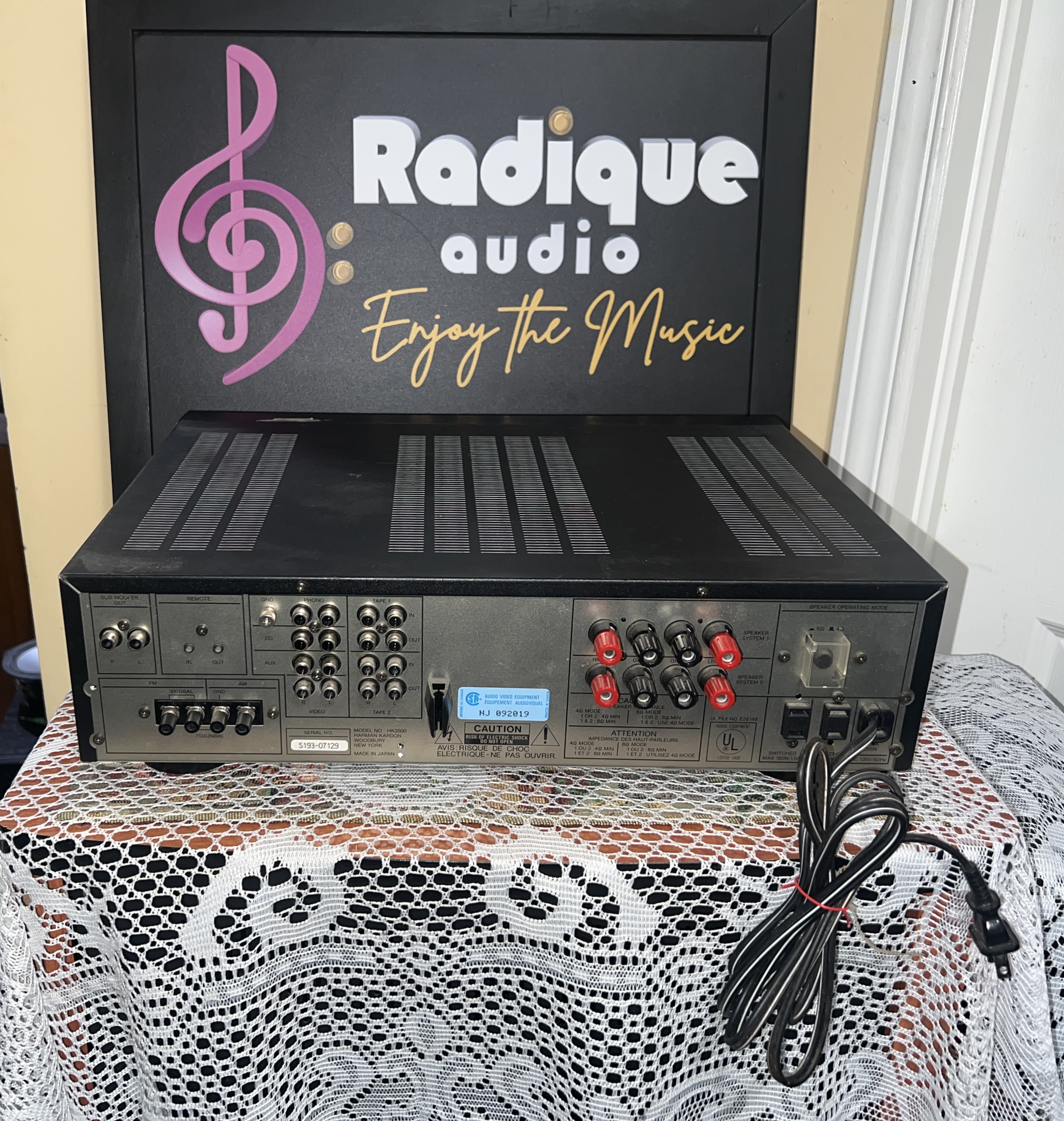
- Inputs: phono (MM), CD, tape 1 and 2, video, aux
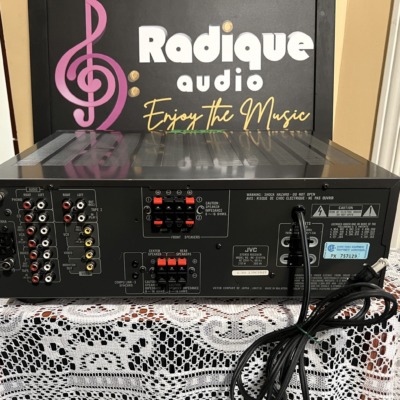
- Outputs: speaker systems 1 and 2, subwoofer out, headphones
- Rear 4-ohm / 8-ohm speaker operating-mode switch
- Remote sensor on the front panel (no remote included)
- Early 1990s
- Dimensions: (Width x Height x Depth) 17.4 x 5 x 13.75 inches (443 x 126 x 349 mm)
- Weight: 16.5 lbs (7.5 kg)
⚠️ Important Information for International Buyers
This unit is configured for North American 110/120V power. Buyers outside North America will require a step-down transformer and appropriate plug adapter.
Sold As-Is — Please Read
This unit is offered as-is for parts or repair. It is not covered by our Bumper-to-Bumper Warranty and is not eligible for the Perpetual Trade-Back Program. All sales final.
📞 Questions? Use the Ask a Question button above, or call us at 613-416-9995.
| Weight | 18.5 lbs |
|---|---|
| Dimensions | 17.75 × 21.4 × 9 in |
Harman Kardon began in New York in 1953, founded by Sidney Harman, who was born in Montreal, and Bernard Kardon. Harman Kardon calls its 1954 Festival D1000 the first hi-fi receiver. We carry Harman Kardon stereo receivers, AV receivers, integrated amplifiers, cassette decks and CD players. We've had more than 130 Harman Kardon listings so far. Every used Harman Kardon here is inspected, tested and serviced as required, then photographed in-house and covered by our Bumper-to-Bumper Warranty and Perpetual Trade-Back Program. Every AV receiver we list is tested input by input on our bench: each HDMI input and output, the analog, optical and coaxial inputs, the subwoofer outputs and the wireless features where it has them. Don't see the model you want? Tell us on First Dibs and we'll email you when one arrives.
The Harman Kardon story, 1953 to today
Sidney Harman and Bernard Kardon left the David Bogen Company, where Kardon was chief engineer, and founded Harman Kardon in New York in 1953. Harman was born in Montreal in 1918 and grew up in New York. Kardon retired in the 1950s.
Receivers first. Harman Kardon calls the Festival D1000 of 1954 the first hi-fi receiver and the Festival TA230 of 1958 the first stereo receiver. The Citation II tube power amplifier of 1959, designed by Stu Hegeman, sold as a kit or ready-built.
Cassette and the 1970s. Harman Kardon says its CAD-5 of 1970 was the first hi-fi cassette recorder with Dolby noise reduction. Its "Twin Powered" receivers of the 1970s, such as the 430 and 730, gave each channel its own power supply.
Owners. Sidney Harman sold the company to Beatrice Foods in the late 1970s, when he became US Deputy Secretary of Commerce. He formed Harman International in 1980 and bought Harman Kardon back in 1985. Samsung bought HARMAN in 2017, and Harman Kardon remains one of its brands.
Which Harman Kardon is which?
Tube era (1950s and 1960s): Festival receivers, and Citation kits and factory-built units such as the Citation I preamplifier and II amplifier.
1970s receivers: the 330 series, the Twin Powered 630, 930, 430 and 730, and the HK670.
1980s receivers: the "i" models such as the hk690i, advertised for its high current capability, and the 330i.
Citation separates: solid-state Citation amplifiers and preamplifiers from 1970 to the 1990s, including the Citation XX of the early 1980s.
Cassette decks: from the CAD-4 and CAD-5 to the 1980s decks numbered CD91 to CD491. Those "CD" models are cassette decks, not CD players; Harman Kardon CD players carry "HD" names.
AV receivers (late 1990s on) and later stereo: the AVR line, such as the AVR 3600, and stereo models such as the HK 3700 and HK 990.
Buying used Harman Kardon: what to check
Dial and meter lamps. Owners report dead or flickering lamps on 1970s receivers such as the 930, 430 and 330C; many are replaced with LEDs.
Capacitors. Expect a 1970s receiver that hasn't been recapped to need it.
Output stage. Owners report blown output transistors on the 730 and 430, often caused by a failed part nearby. Both channels should play cleanly at a realistic level.
Switches. Owners say the 1980s "i" receivers are prone to dirty switches that make channels cut out. Try every input and the balance control.
AV receivers. HDMI is usually the first thing to fail on a modern AV receiver. We test every HDMI input and output before listing.
Everything we list is inspected, tested and serviced as required here, and comes with our warranty.
Related Products

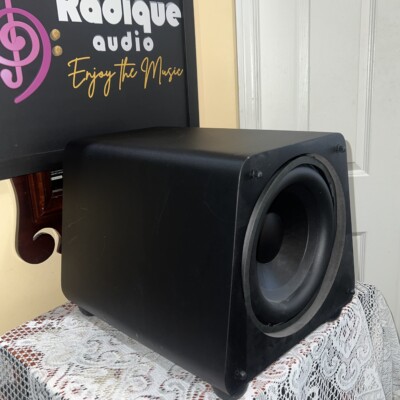
GoldenEar ForceField 4 Subwoofer – Parts/Repair, Amp Needs Work
Sold as-is for parts or repair — the amplifier board requires service and is not represented as working. What is good: the cabinet, very good cosmetically with its non-parallel walls intact; the custom front-firing 10-inch long-throw woofer, tested and working; and the 11 by 13 inch quadratic planar down-firing passive radiator, undamaged. GoldenEar supplies a replacement amplifier board through its service channel.

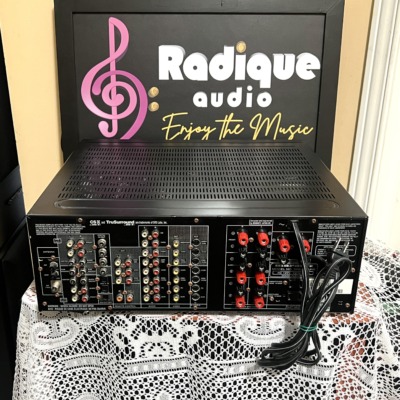
Marantz SR6300 6.1-Ch AV Receiver 100 WPC — For Parts/Repair
Does not power on. Sold as-is for parts or repair, with no warranty and no trade-back. Cosmetically it presents very well, with no significant marks to the faceplate or cabinet. Working, it was a 100-watt-per-channel 6.1 receiver with Dolby Digital EX, DTS-ES and a full set of 6.1 pre-outs. 32.7 lbs of bench project.
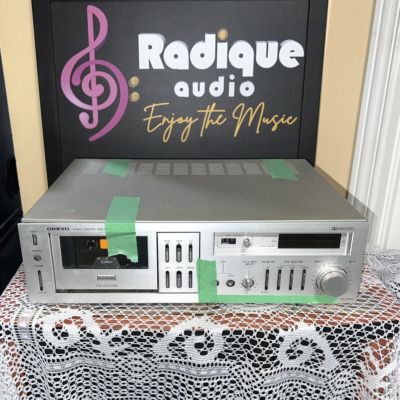
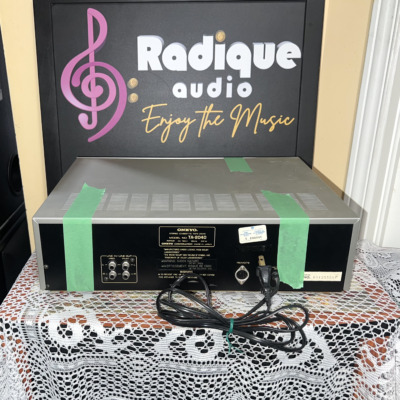
Onkyo TA-2040 Cassette Deck – Silver, Japan, For Parts/Repair
Sold as-is for parts or repair: multiple faults, not covered by our warranty, not eligible for trade-back, all sales final. What it is, is a 1980 Japanese-built two-head deck with a sendust head, full-logic transport, FG-servo motor and Dolby B — not economic for our bench, and a completely different arithmetic if you have a soldering iron.
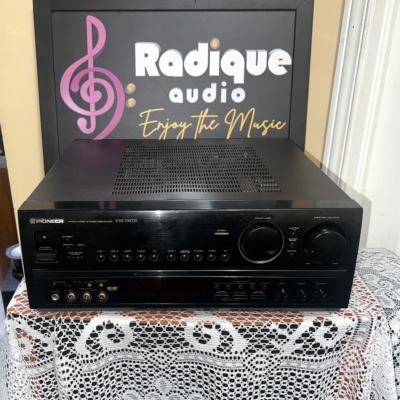
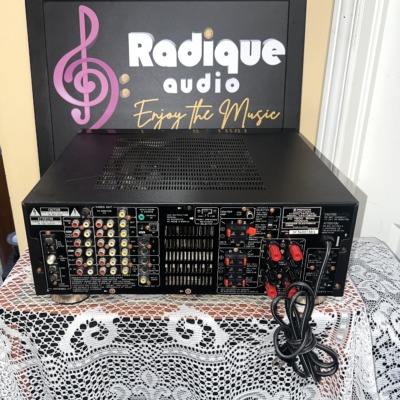
Pioneer VSX-D903S AV Receiver – 1994, For Parts/Repair
Sold as-is for parts or repair, with no warranty and no trade-back: it powers on, but there is no sound from the front or surround speakers. A 1994 Pioneer Pro Logic receiver for a donor or a DIY repair.
✔️ Sold as-is, for parts or repair
✔️ No warranty or trade-back; all sales final
✔️ Expertly packed for safe shipping
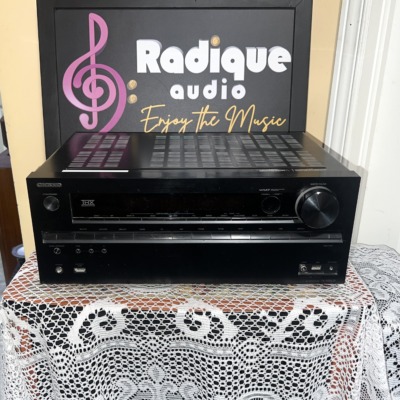
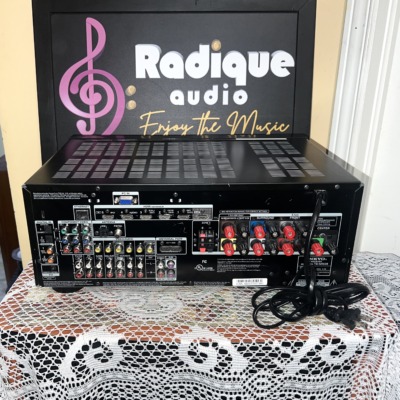
Onkyo TX-NR609 7.2 AV Receiver – 2011, For Parts/Repair
Sold as-is for parts or repair, with no warranty and no trade-back: a relay clicks repeatedly but it never powers on, and our senior tech was uncertain it could be repaired. A 2011 Onkyo 7.2 receiver for a donor or a troubleshooting project.
✔️ Sold as-is, for parts or repair
✔️ No warranty or trade-back; all sales final
✔️ Expertly packed for safe shipping
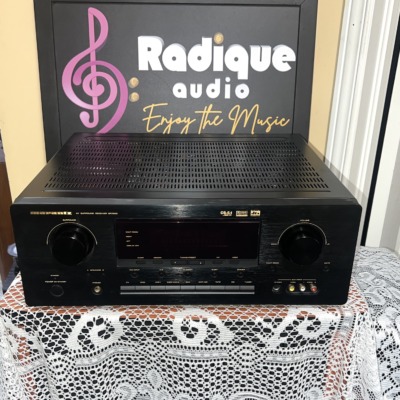
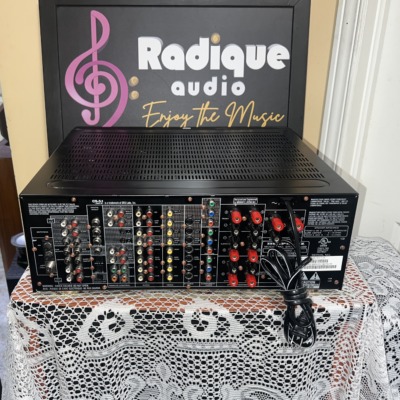
Marantz SR7200 6.1 AV Receiver – For Parts/Repair
Sold as-is for parts or repair, with no warranty and no trade-back: our confirmed issue is a scratchy front left channel that cuts in and out when its connection is wiggled. A Marantz 6.1 receiver of 2001 for a DIY repair or high-quality donor parts.
✔️ Sold as-is, for parts or repair
✔️ No warranty or trade-back; all sales final
✔️ Expertly packed for safe shipping
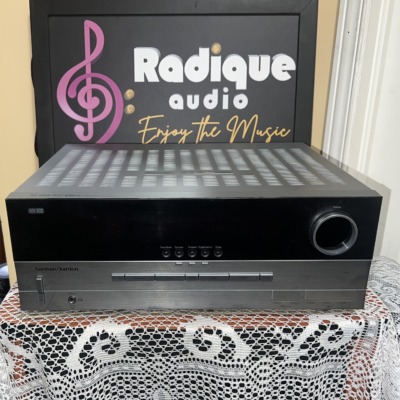
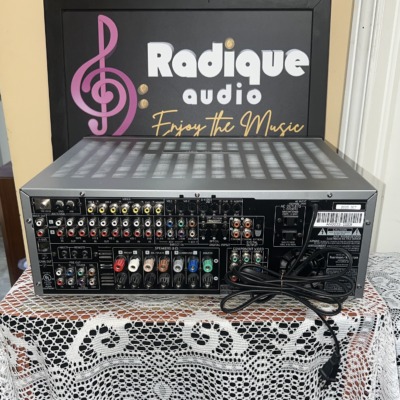
Harman Kardon AVR 340 7.1 AV Receiver – For Parts/Repair
Sold as-is for parts or repair, with no warranty and no trade-back: sound comes only from the subwoofer output, on analog and digital, even after a factory reset. A Harman Kardon 7.1 receiver for the DIY repair crowd.
✔️ Sold as-is, for parts or repair
✔️ No warranty or trade-back; all sales final
✔️ Expertly packed for safe shipping


Yamaha RX-V1070 AV Receiver – As-Is, For Parts or Repair
Sold as-is, for parts or repair, with no warranty and no trade-back. There is no sound output from any channel and the display is frozen. It has not been serviced. For someone who repairs things.
✔️ Sold as-is for parts or repair: all sales final
✔️ No sound output from any channel
✔️ Display frozen (unresponsive)
✔️ Not serviced or repaired
✔️ When it worked: 110 watts per channel, Dolby Pro Logic, MM phono, pre-outs
✔️ 18.6 kg (41 lbs)
✔️ Expertly packed for safe shipping


Sony RCD-W3 Single Deck Playback – See Description
Sold as-is, and here is why: the left tray's laser has failed, so it will not record and will not play from that side. The right tray still plays CD, CD-R and CD-RW, and the digital outputs, analogue outputs and headphone jack with level control all work. That makes it a working CD player, a repair project, or parts. No returns, no warranty.
