
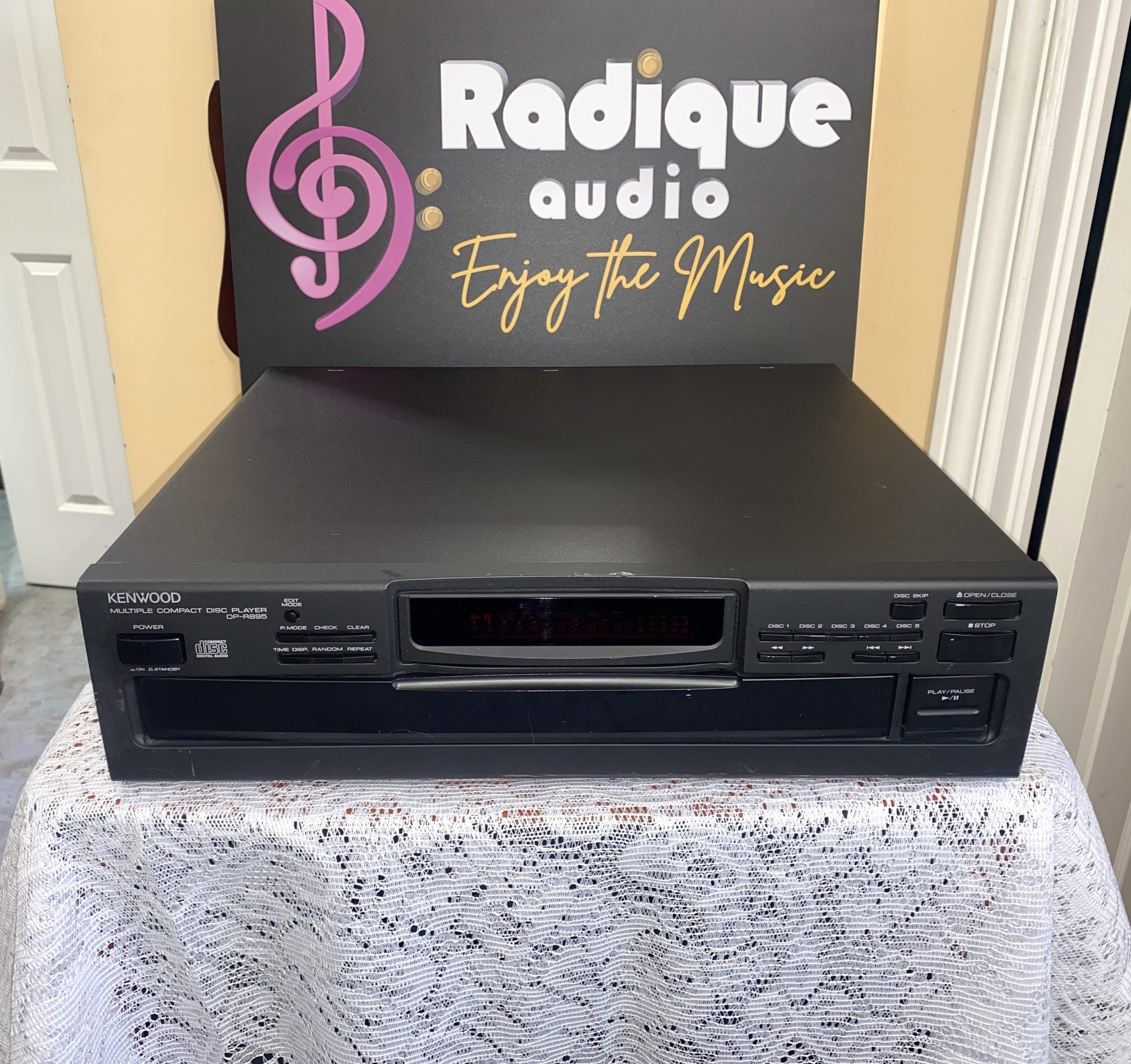
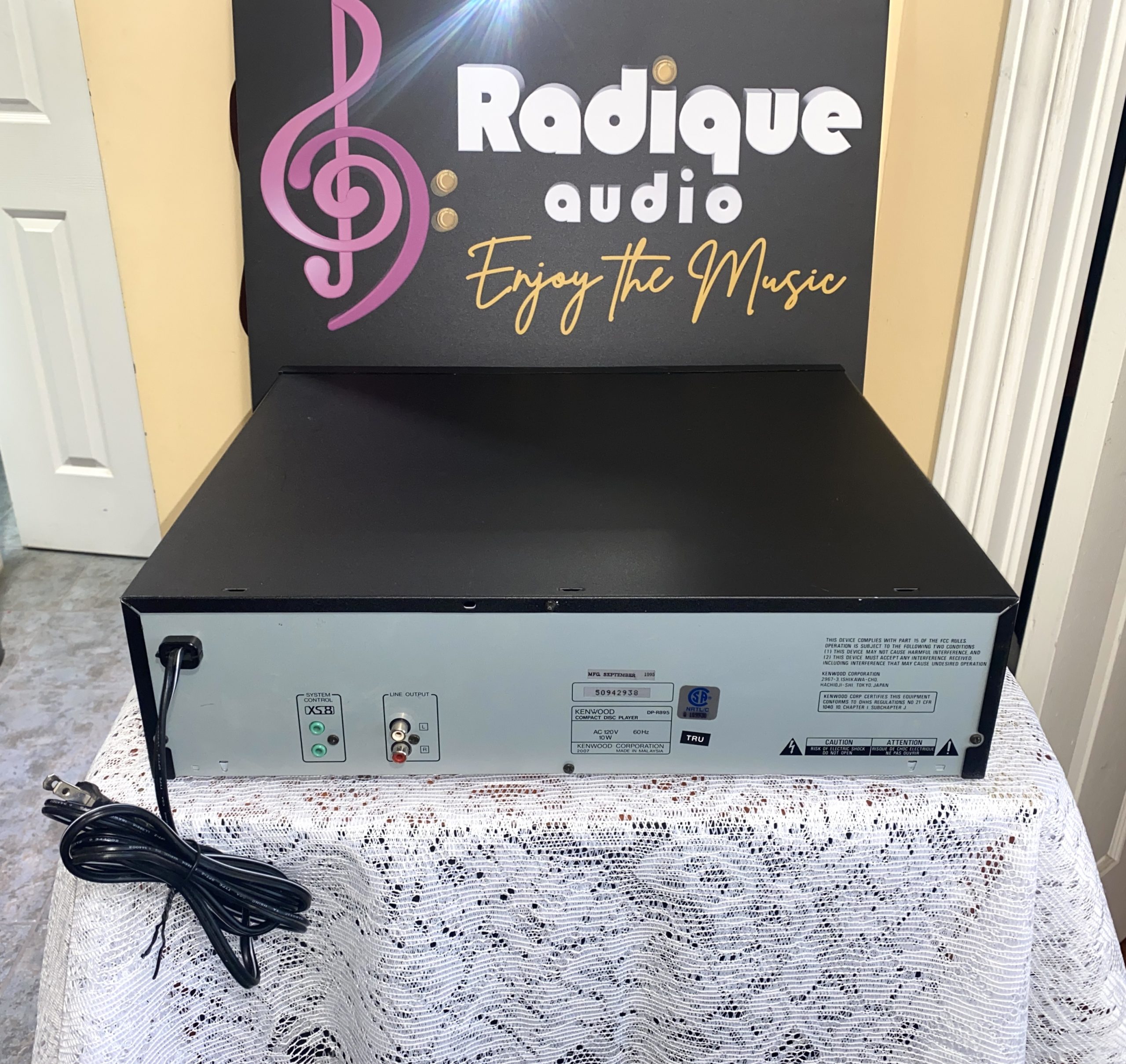

Kenwood 5 Disc CD Changer DP-R895
$95.00
One-bit conversion at eight-times oversampling, 352.8 kHz, with total harmonic distortion under 0.007% and dynamic range better than 94 dB. Fixed 2-volt output at 3.3 kilohms, 4 Hz to 20 kHz, channel separation better than 90 dB. Reads CD and CD-R. Eleven pounds. A soft copy of the manual is included as a PDF.
1 in stock
The Kenwood DP-R895 is a mid-range CD player offering good quality and useful features for a reasonable price.
This unit boasts a robust design and high-quality components, including a 1-bit digital-to-analog converter with 8x oversampling for superior sound clarity. Its semiconductor laser ensures accurate playback, while the dynamic range of over 94 dB and total harmonic distortion below 0.007% guarantee crystal-clear audio reproduction. The DP-R895 supports standard CDs and CD-R’s, offering reliable performance for your music collection.
Key Features:
Compact Disc Digital Audio System with 2-channel playback
Semiconductor laser for precise reading and playback rotation speeds of 200–500 rpm (CLV)
1-bit D/A conversion with 8x oversampling (352.8 kHz)
Frequency response: 4 Hz–20 kHz ±1.0 dB
Signal-to-noise ratio: More than 96 dB
Dynamic range: More than 94 dB
Total harmonic distortion: Less than 0.007% (at 1 kHz)
Channel separation: More than 90 dB (at 1 kHz)
Output level/impedance: Fixed at 2.0 V/3.3 kΩ
Specifications:
Power consumption: 10 W
Dimensions: Width x Height x Depth – 440 x 128 x 392 mm (17.3 x 5 x 15.4 inches)
Weight: 5 kg (11 lbs)
In summary, the Kenwood DP-R895 is a reliable CD player, offering excellent sound quality and versatility. If you’re looking for a good-quality used CD player for a reasonable price, this model is an excellent choice. Includes soft copy of manual in PDF. Asking just $95.
| Weight | 13 lbs |
|---|---|
| Dimensions | 19.4 × 21.3 × 9 in |
Kenwood began in 1946 as Kasuga Radio in Nagano Prefecture, Japan. As Trio, it sold its products in America under the Kenwood name, and took that name worldwide in 1986. We carry Kenwood stereo receivers and AV receivers, power amplifiers, preamplifiers, tuners and CD players. We've had nearly 60 Kenwood listings so far, covering about 50 different models. Every used Kenwood here is inspected, tested and serviced as required, then photographed in-house and covered by our Bumper-to-Bumper Warranty and Perpetual Trade-Back Program. Don't see the model you want? Tell us on First Dibs and we'll email you when one arrives.
Kenwood models we've sold more than once include the KM-208 power amplifier and the KA-550D integrated amplifier.
The Kenwood story, 1946 to today
Kasuga Radio was founded in 1946 in Nagano Prefecture, Japan, making radio components, and opened a mass-production plant in Tokyo in 1955. It was renamed Trio around 1960.
Where the name came from. Kenwood was coined in America. Bill Kasuga and George Aratani set up Kenwood Electronics in the early 1960s to sell Trio products in the US, and Kasuga said he chose "Ken" because it works as both a Japanese and an American name. Trio later bought Kenwood Electronics, and in 1986 the whole company became Kenwood Corporation.
The hi-fi years. Trio-Kenwood built KR receivers through the 1970s, the KA-1000 integrated amplifier with heat-pipe cooling in 1980, and late-1980s amplifiers with Sigma Drive, which takes the feedback loop out to the speaker terminals. The KR-A receivers ran from the mid 1980s to the mid 1990s.
Today. Kenwood merged with JVC between 2008 and 2011, and JVCKENWOOD Corporation now owns the brand. In Canada, Kenwood today sells car audio, two-way radios and earbuds rather than home hi-fi.
Which Kenwood is which?
1970s KR receivers: such as the KR-2600 of 1976 to 1978, at 15 watts per channel.
KA integrated amps: the KA-1000 of 1980, and the late-1980s "D" models such as the KA-990D, KA-880D and KA-550D, with Sigma Drive.
Power amps and separates: such as the KM-208 power amp of 1987 to 1988, the high-end L-series, and the Basic M and C separates.
KR-A receivers (1984 to 1996) and later AV receivers such as the KRF-A 4020 of 1999.
Tuners and CD players: KT tuners and DP CD players and changers.
You may also like…


Related Products
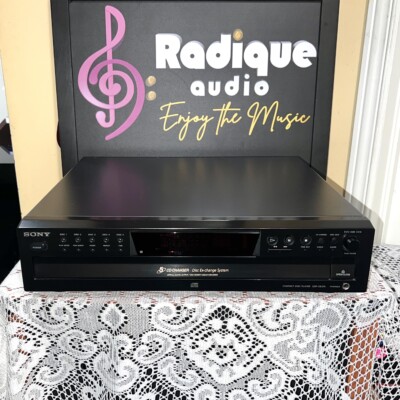
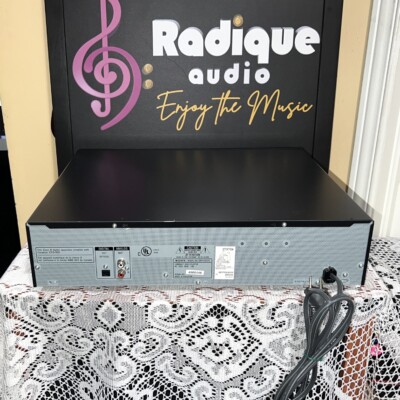
Sony CDP-CE375 5-Disc CD Changer — Optical Out | Play & Exchange
A five-disc carousel using Sony's Play 1/Exchange 4 mechanism — you can swap four discs while the fifth keeps playing. Hybrid Pulse D/A conversion, 0.0045% distortion, better than 102 dB signal-to-noise, and a Toslink optical output for an outboard DAC or receiver. Reads CD-R and CD-RW. A third-party universal remote comes with it, covering the key functions but not all of the original ones.
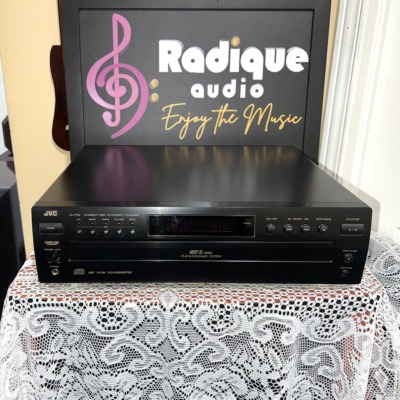
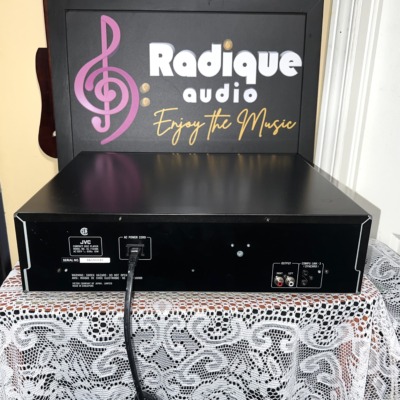
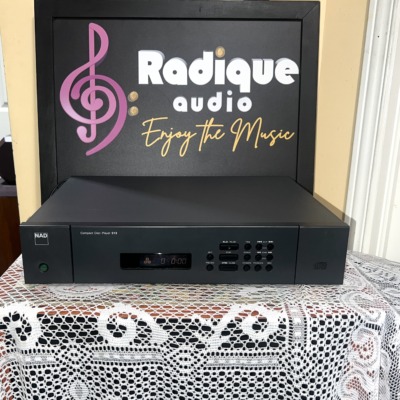
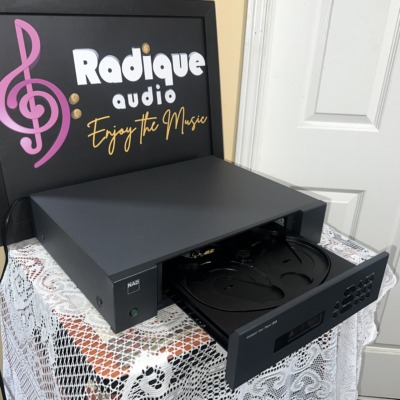
NAD 513 3-Disc CD Changer – Original Remote, Serviced
A 1995 NAD 513 three-disc CD changer hidden in a slim, minimalist case, with a 1-bit MASH converter, CD-R playback and NAD's original remote.
✔️ Serviced on our bench
✔️ Original remote included
✔️ Very good condition
✔️ Covered by Radique Warranty
✔️ Includes Perpetual Trade-Back Program eligibility
✔️ Expertly packed for safe shipping
