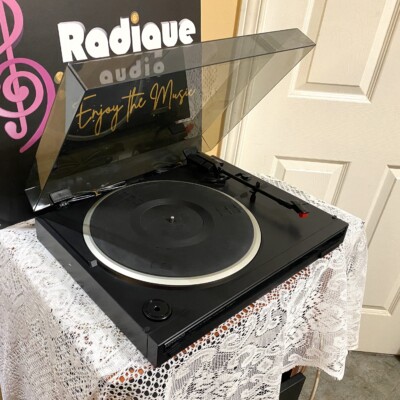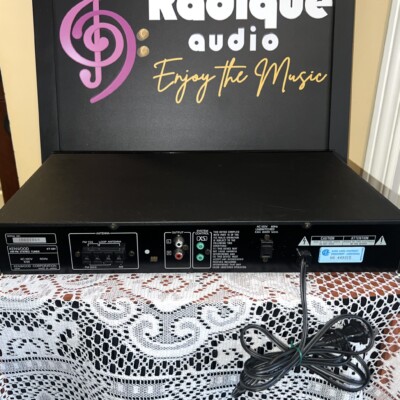


Kenwood began in 1946 as Kasuga Radio in Nagano Prefecture, Japan. As Trio, it sold its products in America under the Kenwood name, and took that name worldwide in 1986. We carry Kenwood stereo receivers and AV receivers, power amplifiers, preamplifiers, tuners and CD players. We’ve had nearly 60 Kenwood listings so far, covering about 50 different models. Every used Kenwood here is inspected, tested and serviced as required, then photographed in-house and covered by our Bumper-to-Bumper Warranty and Perpetual Trade-Back Program. Don’t see the model you want? Tell us on First Dibs and we’ll email you when one arrives.
Kenwood models we’ve sold more than once include the KM-208 power amplifier and the KA-550D integrated amplifier.
The Kenwood story, 1946 to today
Kasuga Radio was founded in 1946 in Nagano Prefecture, Japan, making radio components, and opened a mass-production plant in Tokyo in 1955. It was renamed Trio around 1960.
Where the name came from. Kenwood was coined in America. Bill Kasuga and George Aratani set up Kenwood Electronics in the early 1960s to sell Trio products in the US, and Kasuga said he chose “Ken” because it works as both a Japanese and an American name. Trio later bought Kenwood Electronics, and in 1986 the whole company became Kenwood Corporation.
The hi-fi years. Trio-Kenwood built KR receivers through the 1970s, the KA-1000 integrated amplifier with heat-pipe cooling in 1980, and late-1980s amplifiers with Sigma Drive, which takes the feedback loop out to the speaker terminals. The KR-A receivers ran from the mid 1980s to the mid 1990s.
Today. Kenwood merged with JVC between 2008 and 2011, and JVCKENWOOD Corporation now owns the brand. In Canada, Kenwood today sells car audio, two-way radios and earbuds rather than home hi-fi.
Which Kenwood is which?
1970s KR receivers: such as the KR-2600 of 1976 to 1978, at 15 watts per channel.
KA integrated amps: the KA-1000 of 1980, and the late-1980s “D” models such as the KA-990D, KA-880D and KA-550D, with Sigma Drive.
Power amps and separates: such as the KM-208 power amp of 1987 to 1988, the high-end L-series, and the Basic M and C separates.
KR-A receivers (1984 to 1996) and later AV receivers such as the KRF-A 4020 of 1999.
Tuners and CD players: KT tuners and DP CD players and changers.
Showing 1–12 of 13 resultsSorted by price: high to low
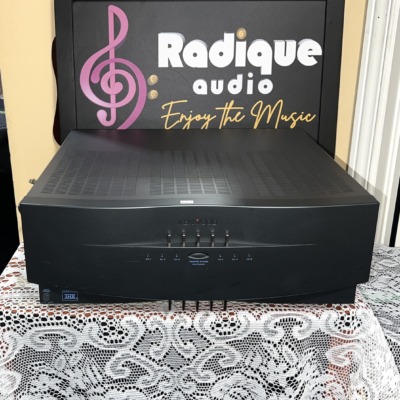
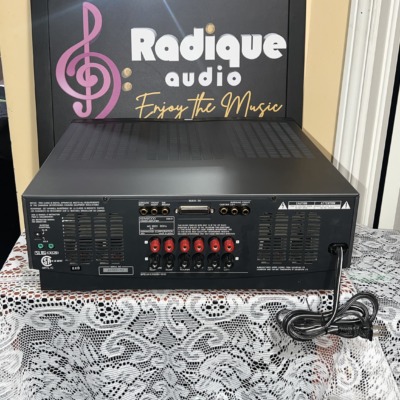

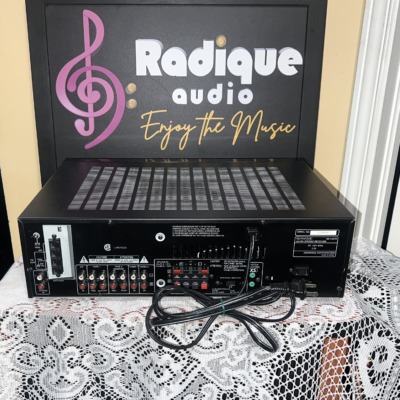
Kenwood KR-A4070 Stereo Receiver – 60 WPC, Phono, Remote
Sixty watts a channel into 8 ohms across the full band at 0.01% distortion, with an MM phono input at 2.5mV, a tape monitor loop, and separate bass, treble and balance. The original Kenwood remote is here, which is uncommon on a receiver of this age. Level 1 serviced; cosmetically graded Good, with honest wear for its years.
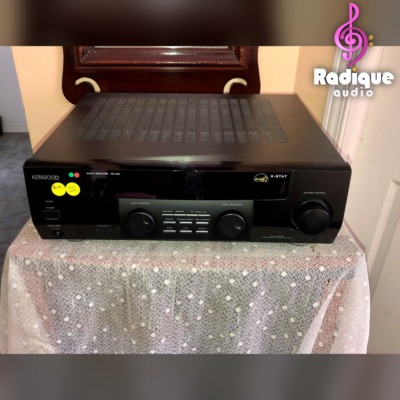

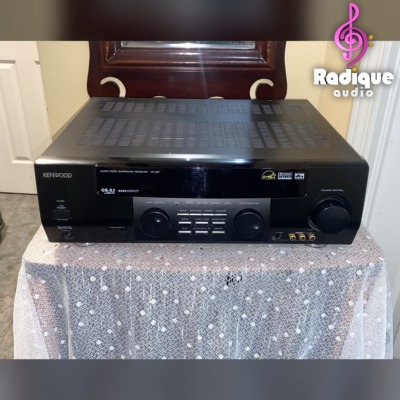

Kenwood VR-507 5.1 AVR 500W with Phono Input
One hundred watts into 8 ohms on each of five channels, with Dolby Digital, DTS, Pro Logic II and Circle Surround, and 96 kHz/24-bit conversion. A real MM phono input with ground terminal, two optical and two coaxial digital inputs, and a 5.1 analog input for an SACD or DVD-Audio player. Original Kenwood remote included; good condition.
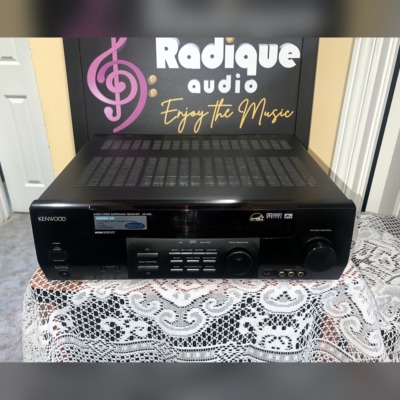

Kenwood VR-506 5.1 AVR 500W with Phono Input
One hundred watts into 8 ohms on each of five channels at 0.7% distortion, with Dolby Digital, DTS and Pro Logic decoding and 24-bit conversion throughout. It shares the VR-507’s power rating but drops Pro Logic II, Circle Surround and one digital input. MM phono with ground terminal, 5.1 analog input, original RC-R0615 remote. Good cosmetic condition.
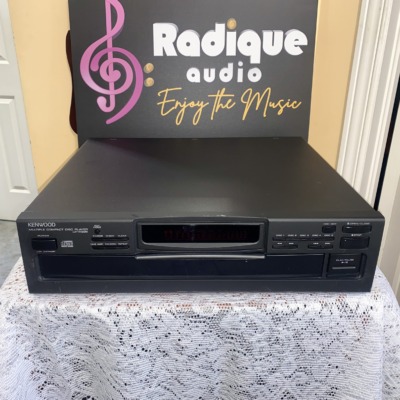

Kenwood 5 Disc CD Changer DP-R895
One-bit conversion at eight-times oversampling, 352.8 kHz, with total harmonic distortion under 0.007% and dynamic range better than 94 dB. Fixed 2-volt output at 3.3 kilohms, 4 Hz to 20 kHz, channel separation better than 90 dB. Reads CD and CD-R. Eleven pounds. A soft copy of the manual is included as a PDF.


Large, Budget Friendly Kenwood Center Speaker CS-01
The unusually deep cabinet was not a styling decision — it was built as a platform for a CRT television to stand on, and it will still take a flat screen or a stack of components. Seventeen inches wide by fourteen deep and only 4.75 tall, about 10 lbs, rated 80 watts at 8 ohms. Tested and working nicely.