


Late Model JVC Dual Cassette Deck w/ Auto Reverse TD-W505
$145.00
Out of stock
Get first dibs on the next one
Late Model JVC Dual Cassette Deck w/ Auto Reverse, in good cosmetic condition, tested and working well.
The JVC TD-W505 features Dolby B/C and HX-Pro noise reduction, pitch control, and high speed dubbing.
It also boasts an electronic tape counter with 4 digits, tape type selection with support for normal, chrome and metal tapes.
Level meters used on the TD-W505 are generic digital peak reading meters. Playback speed may be adjusted with pitch control.
Dolby C-type used in the TD-W505 provides 20 dB of noise reduction above about 1,000 Hz, fully doubling the amount given by B-type. The Dolby HX PRO system provides precise bias control during recording to reduce distortion and improve linearity in the high-frequency range, the result is recorded sound that is highly faithful to the original.
Connection to other audio components for play-back can be achieved by a RCA cable and recording from a source by a RCA cable.
Specifications
Type: auto reverse, double compact cassette deck
Track System: 4-track, 2-channel stereo
Tape Speed: 4.8 cm/s
Heads: 1 x playback, 1 x record/playback, 1 x erase
Motor: 2 x reel, 2 x capstan, 2 x mech
Tape Type: type I, CrO2, Metal
Noise Reduction: B, C
Frequency Response: 20Hz to 17kHz (Metal tape)
Signal to Noise Ratio: 73dB (dolby C)
Wow and Flutter: 0.08%
Total Harmonic Distortion: 0.8%
Input: 80mV (line)
Output: 0.3V (line)
Dimensions: 400 x 127 x 360mm, Weight: 4.6kg
Year: 1997
Includes soft copy of manual in PDF. Asking $145 for this well-equipped Dual Cassette Deck from JVC.
| Weight | 10.14 lbs |
|---|---|
| Dimensions | 19.75 × 9.00 × 18.17 in |
| Cassette Wells | Dual Well (Dubbing) |
| Noise Reduction | Dolby B, Dolby C |
JVC was founded in Yokohama, Japan, in 1927 as the Japanese arm of America's Victor Talking Machine Company, first making phonographs and records. We carry JVC stereo receivers and AV receivers, cassette decks, CD players, turntables and speakers. We've had more than 90 JVC listings so far, covering more than 80 different models. Every AV receiver we list is tested input by input on our bench: each HDMI input and output, the analog, optical and coaxial inputs, the subwoofer outputs and the wireless features where it has them. Every used JVC here is inspected, tested and serviced as required, then photographed in-house and covered by our Bumper-to-Bumper Warranty and Perpetual Trade-Back Program. Don't see the model you want? Tell us on First Dibs and we'll email you when one arrives.
JVC models we've sold more than once include the RX-7000VBK and RX-8000VBK AV receivers.
The JVC story, 1927 to today
JVC began in 1927 as the Japanese subsidiary of the Victor Talking Machine Company, making phonographs and records, and built a large plant in Yokohama in 1930. RCA bought Victor in 1929, and in the late 1930s JVC passed to Japanese owners.
Stereo, quad and video. JVC joined the Matsushita (Panasonic) group in the early 1950s. It developed the CD-4 discrete four-channel record system in the early 1970s and the SEA graphic equalizer built into its receivers, and in 1976 its video division introduced VHS.
Hi-fi highlights. The late 1970s and early 1980s brought the JR-S receivers, whose SEA sliders replaced the tone controls, the Super-A amplifiers and the QL quartz-lock turntables, and around 1990 the XL-Z CD players with JVC's K2 Interface.
Today. JVC merged with Kenwood between 2008 and 2011, and JVCKENWOOD Corporation now owns the brand. JVC has had its own Canadian distribution since the 1970s, and JVCKENWOOD Canada is based in Mississauga, Ontario.
Which JVC is which?
1970s receivers: early four-channel models with CD-4 demodulators, and the JR-S series of 1976 to 1977, with built-in SEA equalizers.
Super-A amplifiers and receivers (1979 to the early 1980s): such as the A-X5 and A-X9 amplifiers and the R-S33 receiver.
Turntables: QL quartz-lock direct-drive models such as the QL-A7 and QL-Y5F, and belt-drive automatics such as the JL-A1.
Cassette decks and CD players: KD and CD-S decks from the 1970s, TD-W dual-well decks, and XL-Z CD players and XL changers.
AV receivers (2000 to 2004): the RX-x000V, RX-x010V and RX-x020V families, including the RX-7000VBK, RX-8000VBK and RX-6020VBK, and the RX-8040B.
Buying used JVC: what to check
SEA sliders. On JR-S and R-S receivers, work every equalizer slider through its range and listen for crackle or a channel dropping out.
FM muting. Stereo Review found the JR-S600's muting could thump when tuning on or off a station, so turn the volume down before tuning.
AV receivers. Run every channel, centre and surrounds included, at moderate volume. Owners report overload shutdowns on some 2000s models, which can come from a short in the speaker wiring.
Turntables. On QL servo turntables, check that the tracking-force and damping dials respond and that the arm finds the lead-in at both record sizes. Older JL automatics often need old grease cleaned out and a new belt.
Cassette decks. Treat belts and pinch rollers on any 1970s to 1990s deck as service items.
Everything we list is inspected, tested and serviced as required here, and comes with our warranty.
Related Products
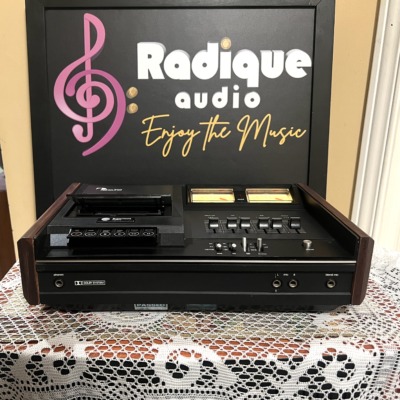
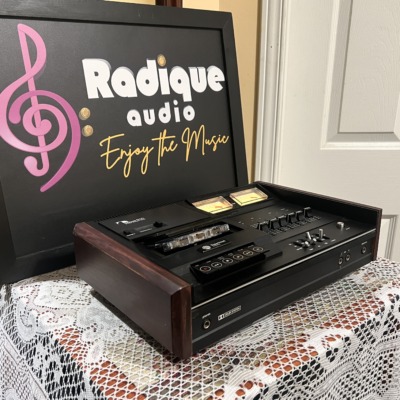
Nakamichi 500 Dual-Tracer Cassette Deck – Walnut, Made in Japan
Nakamichi's mid-seventies top-loading deck with walnut side panels, serviced on our bench and playing as it should.
✔️ Good condition — honest general wear for a fifty-year-old deck, and no damage
✔️ Serviced on our bench — our standard cassette deck service before it was listed
✔️ Walnut side panels fitted, with the original white side panels included
✔️ Covered by Radique Warranty
✔️ Includes Perpetual Trade-Back Program eligibility
✔️ Expertly packed for safe shipping
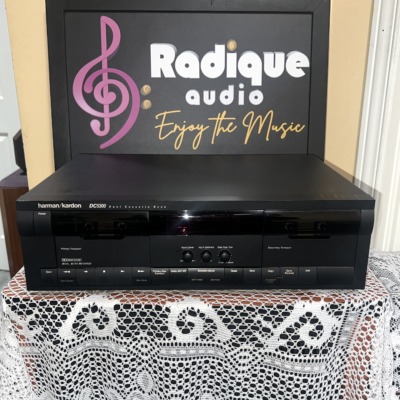
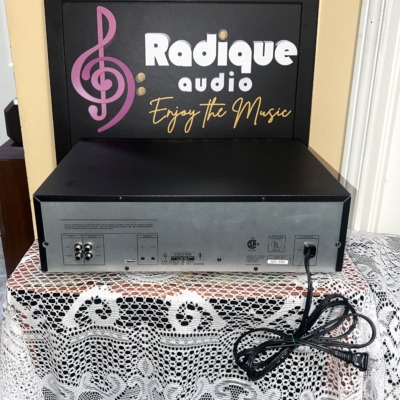
Harman Kardon DC5300 Dual Cassette Deck – Serviced, Japan
A Japanese-built Harman Kardon dual cassette deck from the early nineties, serviced on our bench and in very good condition.
✔️ Very Good condition — faceplate, cassette doors and display window present cleanly
✔️ Serviced on our bench — our standard cassette deck service before it was listed
✔️ Two auto-reverse decks with Dolby B and C, made in Japan
✔️ Covered by Radique Warranty
✔️ Includes Perpetual Trade-Back Program eligibility
✔️ Expertly packed for safe shipping
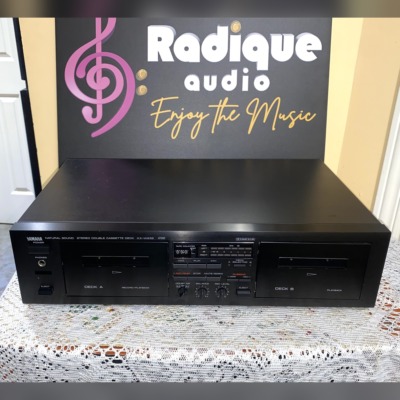
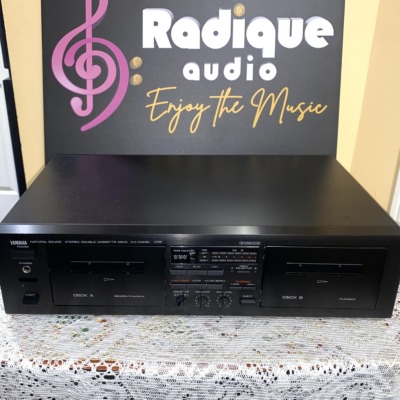
Yamaha KX-W232 Dual Cassette Deck – Dolby B & C, Made in Japan
A Japanese-built Yamaha dual cassette deck from the early nineties, tested on our bench and in good condition, priced to reflect one door quirk we describe below.
✔️ Good condition — a rear-panel crack and a Deck A door quirk, both explained below
✔️ Tested on our bench and working as it should
✔️ Two decks with Dolby B and C — made in Japan
✔️ Covered by Radique Warranty
✔️ Includes Perpetual Trade-Back Program eligibility
✔️ Expertly packed for safe shipping
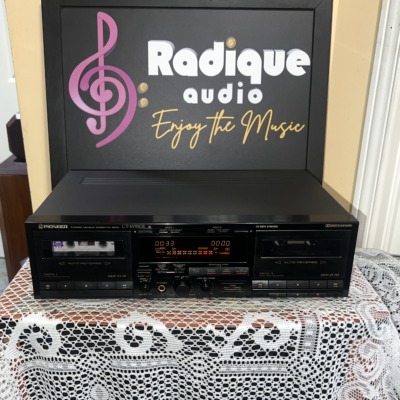
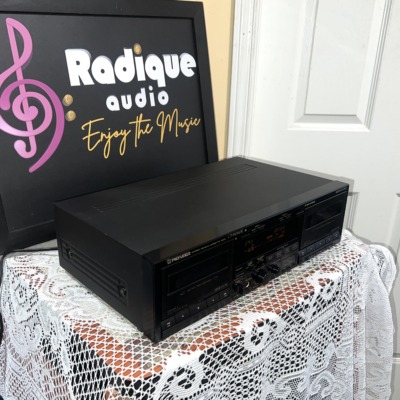
Pioneer CT-W550R Dual Cassette Deck – Dolby B/C, HX Pro, Japan
A 1991 Pioneer CT-W550R twin cassette deck, made in Japan, with auto-reverse on both decks, Dolby B and C and Dolby HX Pro.
✔️ Serviced on our bench
✔️ Very good condition
✔️ High-speed dubbing, CD synchro recording, music search
✔️ Covered by Radique Warranty
✔️ Includes Perpetual Trade-Back Program eligibility
✔️ Expertly packed for safe shipping
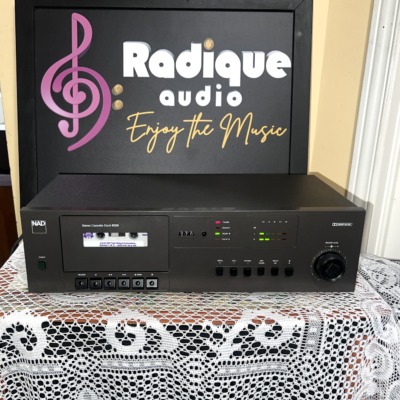
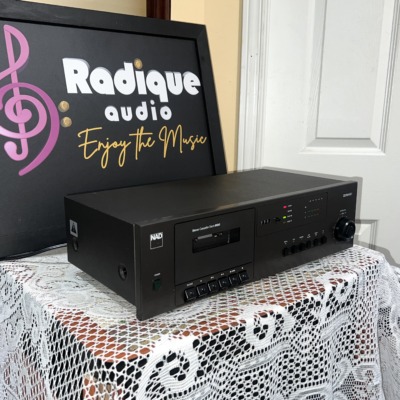
NAD 6130 Stereo Cassette Deck – Dolby B/C, Serviced, Japan
A mid-1980s NAD 6130 cassette deck, made in Japan, with Dolby B and C, a hard permalloy head and a belt-driven flywheel transport.
✔️ Serviced on our bench
✔️ Very good condition
✔️ Covered by Radique Warranty
✔️ Includes Perpetual Trade-Back Program eligibility
✔️ Expertly packed for safe shipping
