


The Award-Winning Klipsch RP-600M Bookshelf Speakers – Ebony
$595.00
Out of stock
Get first dibs on the next one
The Award-Winning Klipsch RP-600M Bookshelf Speakers – Ebony
The Award-Winning Klipsch Reference Premiere RP-600M earned Sound & Vision’s 2018 Reference Bookshelf Loudspeaker of the Year award and a coveted Class B rating in Stereophile’s Recommended Components list — a rare combination of accolades that cemented its reputation as one of the best value high-performance bookshelf speakers available at any price.
The RP-600M sits at the top of Klipsch’s highly regarded Reference Premiere bookshelf lineup, and its performance easily justifies that position. At the heart of each cabinet is Klipsch’s signature 1-inch titanium-dome tweeter mounted in a redesigned hybrid Tractrix horn — a design that delivers effortless top-end detail, excellent dispersion, and the kind of dynamic “get-up-and-go” clarity that makes Klipsch speakers so immediately engaging. Paired with a 6.5-inch spun-copper Cerametallic woofer, the RP-600M punches well above its class for bass impact and scale, delivering the kind of “small-floorstander” bass presence that reviewers have consistently praised.
The cabinet is finished in Klipsch’s Ebony vinyl — a scratch-resistant, woodgrain finish with a satin-painted front baffle that presents a clean, modern, and distinctly Klipsch look when paired with the signature spun-copper woofers visible through the detachable magnetic grilles. Dual five-way binding posts on the rear enable bi-wiring or bi-amping for those seeking to explore further system refinement. A rear-firing Tractrix port contributes to the clean, controlled bass extension.
This pair is in excellent cosmetic condition throughout and comes complete in its original retail box with all original accessories and documentation. The pair has been thoroughly inspected and tested to confirm full functionality. The 96 dB sensitivity means these speakers will sing with as little as 20 watts of amplifier power, making them an exceptionally easy match for virtually any integrated amplifier or AV receiver.
Specifications:
Design: Two-way, rear-ported bass-reflex bookshelf
High-frequency driver: 1 in. (25 mm) titanium LTS vented tweeter in hybrid Tractrix horn
Low-frequency driver: 6.5 in. (165 mm) spun-copper Cerametallic cone woofer
Frequency response (±3 dB): 45 Hz – 25 kHz
Crossover frequency: 1.8 kHz
Sensitivity: 96 dB (2.83 V @ 1 m)
Nominal impedance: 8 ohms compatible
Power handling: 100 W continuous / 400 W peak
Binding posts: Dual pairs, 5-way (bi-amp/bi-wire capable)
Grilles: Detachable magnetic
Finish: Ebony vinyl
Includes: Original retail box, grilles, documentation
Dimensions (per speaker, W x H x D): 8.0 x 15.7 x 11.9 inches (202 x 400 x 301 mm)
Weight (per speaker): 16 lbs (7.3 kg)
A genuinely award-winning pair of high-efficiency, high-performance Klipsch bookshelves in excellent condition with the original retail box — one of the most highly regarded bookshelf speakers of its generation, now available at significant savings against the original retail.
Backed by Radique Audio’s 90-day warranty and our perpetual trade-back policy, you can purchase with confidence.
| Weight | 35 lbs |
|---|---|
| Dimensions | 15.9 × 22 × 19.7 in |
Klipsch began in Hope, Arkansas, in 1946, when Paul W. Klipsch started building his corner-horn Klipschorn, and its Heritage speakers are still built by hand in Hope. We carry Klipsch towers, centre channels, bookshelf speakers and subwoofers. We've had more than 160 Klipsch listings so far. Every used Klipsch here is inspected, tested and serviced as required, then photographed in-house and covered by our Bumper-to-Bumper Warranty and Perpetual Trade-Back Program. Don't see the model you want? Tell us on First Dibs and we'll email you when one arrives.
The Klipsch story, 1946 to today
Paul W. Klipsch was posted to Hope, Arkansas, in 1941 as an Army officer. He patented his corner-horn design in the mid-1940s and founded Klipsch in Hope in 1946; Klipsch says its first speaker was built by hand there that year, with the horn made in a tin shed. He hired his first employee in 1948.
The Heritage line. The Klipschorn of 1946 was followed by the Heresy (1957), designed as a centre speaker to sit between a pair of Klipschorns, the Cornwall (1959), the La Scala (1963) and the Forte (1985).
A new generation. Fred Klipsch bought the company from Paul Klipsch in 1989, and headquarters later moved to Indianapolis. Paul Klipsch died in 2002 at 98. The Reference Series arrived in 1999.
A Canadian connection. In 2006 Klipsch bought Audio Products International of Toronto, with its Energy and Mirage brands. Audiovox, later VOXX, bought Klipsch in 2011, and Gentex bought VOXX in 2025.
Which Klipsch is which?
Heritage: the Klipschorn, Heresy, Cornwall, La Scala and Forte, built to order by hand in Hope. Drivers change between generations, so identify the version.
KG series (mid-1980s to early 1990s): lower-priced horn-tweeter floorstanders such as the KG 4 (1985 to 1992) and KG 5.5.
Reference (1999 onward): horn-tweeter towers, bookshelf speakers and centres, from the RB-5 and RF-7 to the later RF, RB and RC models.
Synergy (late 1990s and 2000s): such as the KSF 8.5 and the SF-1.
Subwoofers: powered models such as the RPW-10.
Buying used Klipsch: what to check
Horn diaphragms. The compression drivers in older Klipsch speakers age; owners report tired midrange diaphragms on Heritage models and raspy tweeters on some KG pairs. Listen to each horn on its own at a moderate level.
Reference tweeters. A crackling tweeter can be a loose connection, and owners say these tweeters can fail if played very loud.
Crossovers and passive radiators. Many Heritage and KG owners recap their crossovers, and KG passive radiators can have cracked surrounds.
Modifications. Aftermarket diaphragms and crossovers are common upgrades on Heritage and KG models. Ask what has been changed.
Where it was made. Heritage models are built in Hope. Check the label before calling any other Klipsch "made in USA".
Everything we list is inspected, tested and serviced as required here, and comes with our warranty.
You may also like…
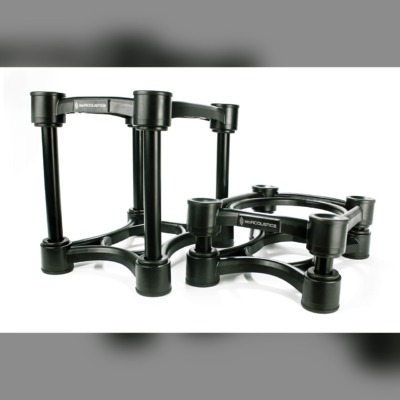

IsoAcoustics ISO-200 Isolation Stands (Pair)
- ✔️ Genuine IsoAcoustics, brand new, from an authorized Canadian dealer
- ✔️ A pair of isolation stands for large speakers and studio monitors
- ✔️ Rated to 75 lb (34 kg) short or 60 lb (27 kg) tall
- ✔️ Short 3.75 in (95 mm) or tall 8.5 in (215 mm), up to 6.5° of tilt
- ✔️ Pick up in Kanata by appointment, or shipped across Canada and internationally
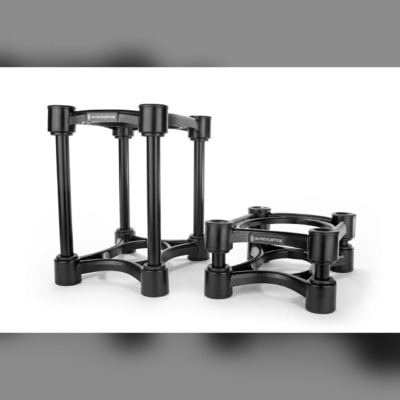

IsoAcoustics ISO-155 Isolation Stands (Pair)
- ✔️ Genuine IsoAcoustics, brand new, from an authorized Canadian dealer
- ✔️ A pair of isolation stands for medium speakers and studio monitors
- ✔️ Rated to 40 lb (18 kg) short or 35 lb (16 kg) tall
- ✔️ Short 3 in (76 mm) or tall 8.25 in (210 mm), up to 6.5° of tilt
- ✔️ Pick up in Kanata by appointment, or shipped across Canada and internationally


IsoAcoustics ISO-130 Isolation Stands (Pair)
- ✔️ Genuine IsoAcoustics, brand new, from an authorized Canadian dealer
- ✔️ A pair of isolation stands for small speakers and studio monitors, rated to 20 lb (9 kg)
- ✔️ Short 2.8 in (71 mm) or tall 8.25 in (210 mm), up to 6.5° of tilt
- ✔️ Top plate 5.1 × 6 in (130 × 152 mm)
- ✔️ Pick up in Kanata by appointment, or shipped across Canada and internationally
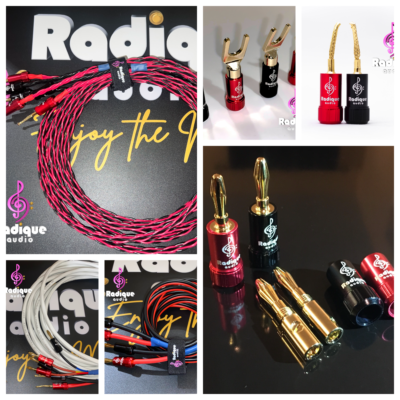
Custom Speaker Cable Builder
Your specs, your cable: choose the cable, the length and each connector, with live pricing.
- House CCA, House OFC, House Quad, Kimber 4PR or Kimber 4TC
- Banana, spade, pin, small spade or bare wire, chosen for each end
- Bi-wire on Kimber 4PR, Kimber 4TC and House Quad
- Hand-assembled, heat-shrink reinforced and colour-coordinated
- 1-year warranty
Related Products
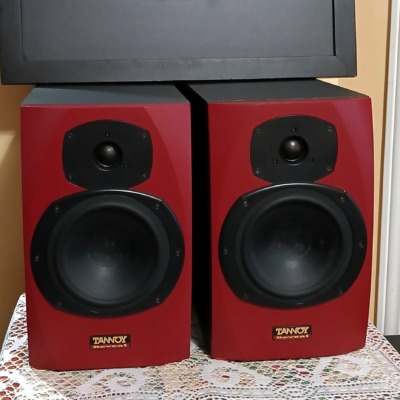
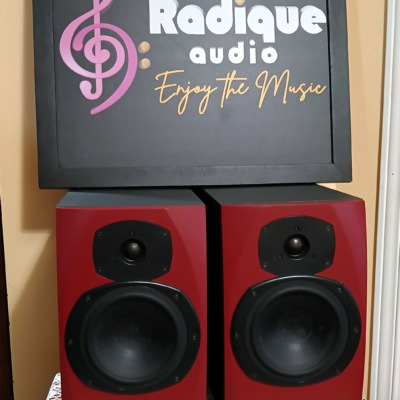
Tannoy Reveal Passive Studio Monitors, Pair – Made in Europe
A pair of Tannoy Reveal passive two-way studio monitors with their distinctive deep-red front baffles and gold Tannoy Reveal badges, in excellent condition. Tested on our bench before listing.
✔️ Real Tannoy studio pedigree for a desk, mixing room or living room
✔️ 90 dB, 6 ohms, 30–100 W: easy to drive
✔️ Magnetically shielded: fine beside a screen
✔️ Excellent condition
✔️ Covered by Radique Warranty
✔️ Includes Perpetual Trade-Back Program eligibility
✔️ Expertly packed for safe shipping
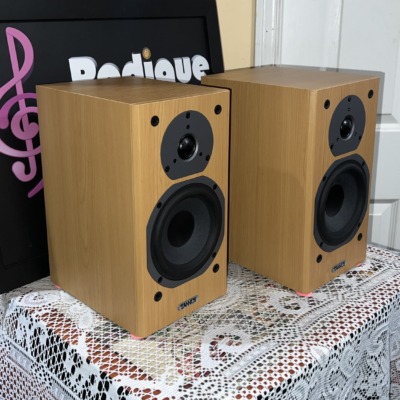
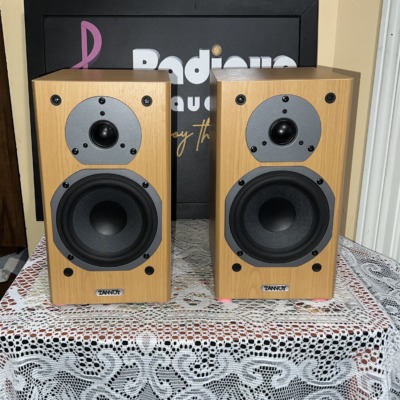
Tannoy Mercury mX1-M Bookshelf Speakers, Pair – Cherry
A pair of Tannoy Mercury mX1-M two-way bookshelf speakers in Tannoy's factory cherry finish, with their grey cloth grilles and removable port bungs. Tested on our bench before listing.
✔️ Tannoy's factory cherry finish, rarely seen
✔️ Removable port bungs: run them sealed or ported
✔️ 87 dB, 8 ohms, 10–100 W: easy to drive
✔️ Very good condition, grilles and port bungs included
✔️ Covered by Radique Warranty
✔️ Includes Perpetual Trade-Back Program eligibility
✔️ Expertly packed for safe shipping
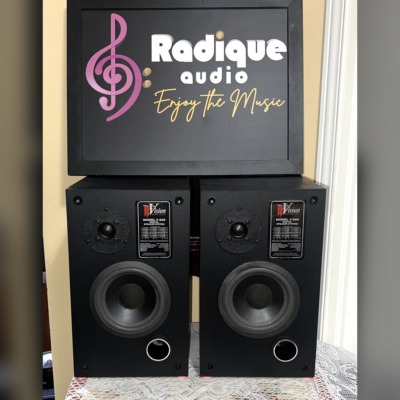
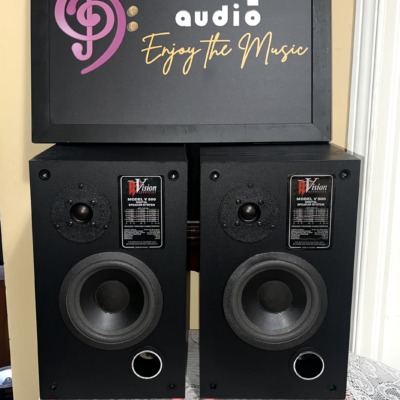
Vision Acoustics V500 Bookshelf Speakers, Pair – Made in Canada
A pair of solidly built, Canadian-made Vision Acoustics V 500 bookshelf speakers in black ash, rated at a sensitive 92 dB, fully tested on our bench and in very good condition.
✔️ Very good condition — free of significant marks, in black ash
✔️ Efficient 92 dB design, easy for a modest receiver to drive
✔️ Made in Canada, with 5-way binding posts
✔️ Covered by Radique Warranty
✔️ Includes Perpetual Trade-Back Program eligibility
✔️ Expertly packed for safe shipping
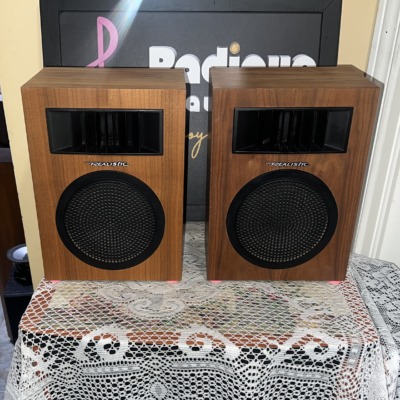
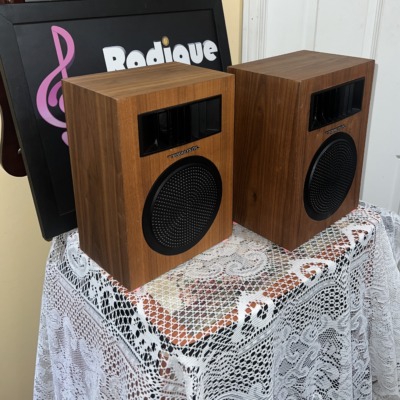
Realistic Minimus-5 Speakers, Pair – Vintage, Real Wood Veneer
A vintage pair of Realistic Minimus-5 two-way bookshelf speakers from Radio Shack, in a warm brown real wood veneer, with horn tweeters, fully tested on our bench and in very good condition.
✔️ Very good condition — free of significant marks
✔️ Real wood veneer, with rigid grilles over the woofers
✔️ Two ways in: small binding posts and an RCA-type speaker-level jack
✔️ Covered by Radique Warranty
✔️ Includes Perpetual Trade-Back Program eligibility
✔️ Expertly packed for safe shipping
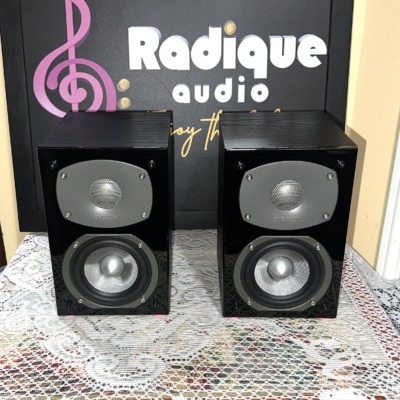
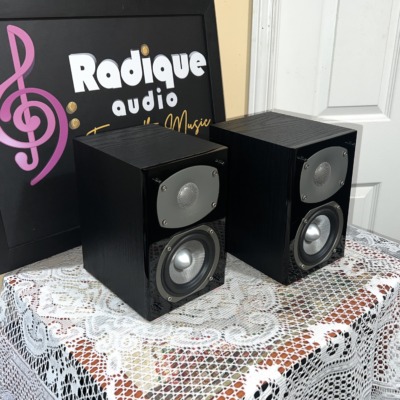
Energy C-50 Bookshelf Speakers, Pair – Ultra-Compact, Black Ash
A pair of ultra-compact Energy C-50 bookshelf speakers, designed and engineered in Canada, in black ash with gloss black front baffles and their black cloth grilles. They have been tested on our bench and are in very good condition.
✔️ Very good condition — black ash with gloss baffles, grilles included
✔️ 1-inch aluminum tweeter and 4½-inch woofer, video-shielded
✔️ Five-way binding posts — designed and engineered in Canada
✔️ Covered by Radique Warranty
✔️ Includes Perpetual Trade-Back Program eligibility
✔️ Expertly packed for safe shipping
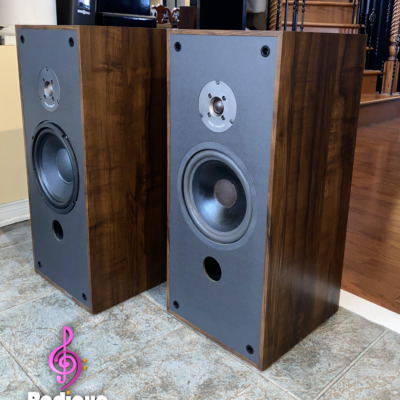
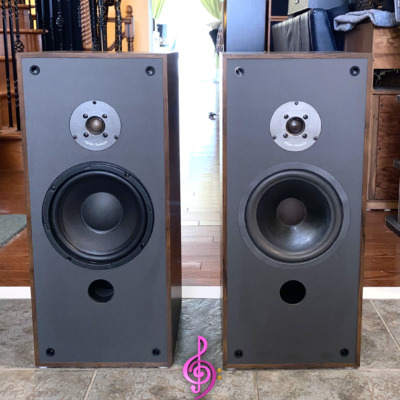
Paisley Reference Two Bookshelf Speakers, Pair – Made in Canada
A pair of Paisley Research Reference Two bookshelf speakers, made in Canada, in walnut-finish cabinets with black front baffles and their black cloth grilles. They have been tested on our bench, they play nicely, and they are in very good condition. One woofer is a replacement fitted by a previous owner, not by us; the details are under Condition.
✔️ Very good condition — walnut-finish cabinets, grilles included
✔️ Tested and playing nicely; one replacement woofer, disclosed below
✔️ 8-inch woofers, front-ported — made in Canada
✔️ Covered by Radique Warranty
✔️ Includes Perpetual Trade-Back Program eligibility
✔️ Expertly packed for safe shipping
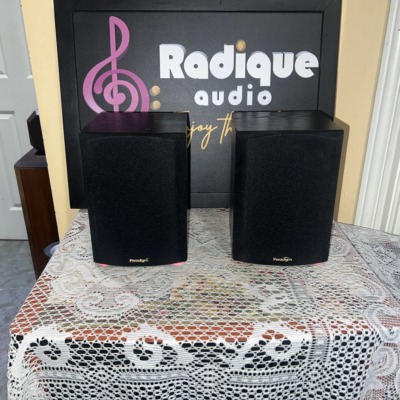
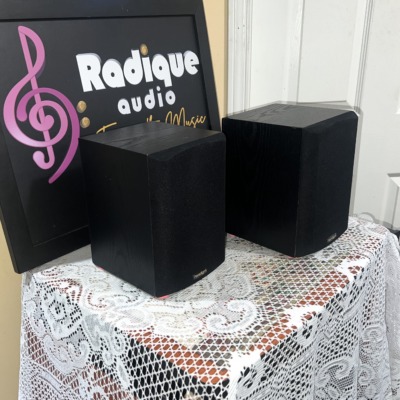
Paradigm Micro v.3 Bookshelf Speakers, Pair – Black Ash
A pair of Paradigm Micro v.3 speakers, the smallest of Paradigm's Canadian-designed Performance Series, with rubber woofer surrounds that will never need refoaming.
✔️ Tested on our bench
✔️ Fair condition, priced to match
✔️ Covered by Radique Warranty
✔️ Includes Perpetual Trade-Back Program eligibility
✔️ Expertly packed for safe shipping
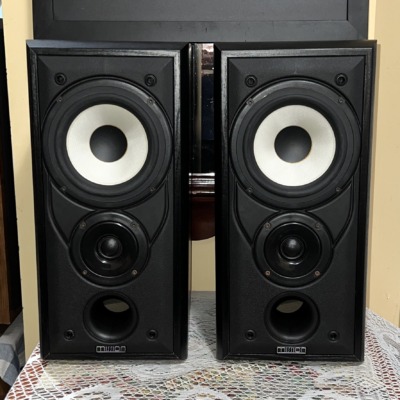
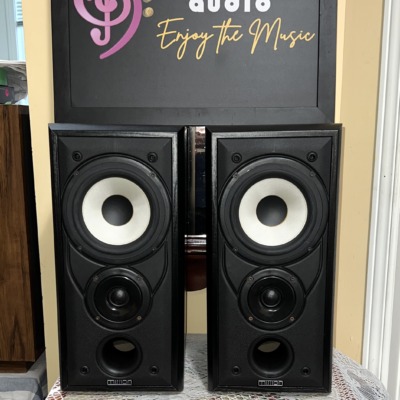
Mission 701 Bookshelf Speakers, Pair – British Design, Black Ash
A pair of Mission 701 two-way bookshelf speakers in black ash, with Mission's inverted driver layout and their grilles. One of our favourites in this size.
✔️ Tested on our bench, woofer and tweeter in each
✔️ Very good, grilles included
✔️ 89 dB, 8 ohms: easy for any receiver
✔️ Covered by Radique Warranty
✔️ Includes Perpetual Trade-Back Program eligibility
✔️ Expertly packed for safe shipping
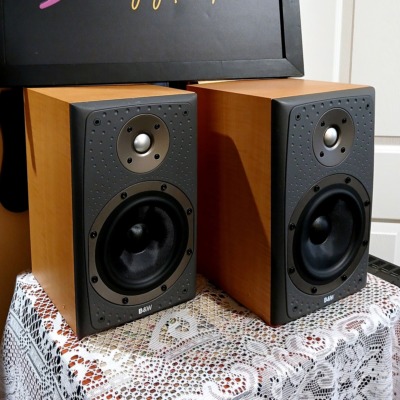
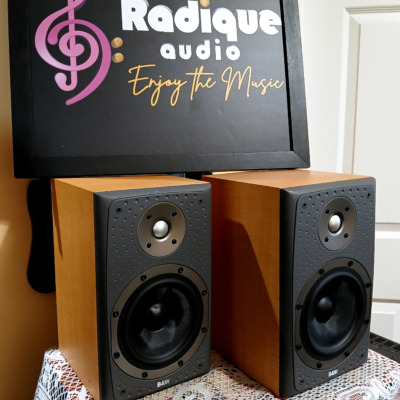
B&W DM303 Bookshelf Speakers, Pair – Made in England, Maple
A pair of B&W DM303 two-way bookshelf speakers in a light maple finish, made in England, with their black cloth grilles. Tested on our bench before listing.
✔️ Nautilus tube-loaded metal-dome tweeter and B&W's dimpled Flowport
✔️ 88 dB, 8 ohms, 25–100 W: easy for any receiver
✔️ Good condition: a few tiny nail holes, presents well
✔️ Covered by Radique Warranty
✔️ Includes Perpetual Trade-Back Program eligibility
✔️ Expertly packed for safe shipping
