


Harman Kardon HD7300 Compact Disc Player – Premium Quality
$195.00
Out of stock
Get first dibs on the next one
Harman Kardon HD7300 Compact Disc Player – Plays CDs and CDRs, Tested and Working Well, Good Cosmetics
Experience the refined audio engineering of the Harman Kardon HD7300—a premium single-tray CD player from 1991-1994 that exemplifies Harman Kardon’s commitment to sonic purity and meticulous component design. This accomplished CD transport delivers exceptional clarity and musical coherence through sophisticated circuitry and precision mechanics. Fully tested and working well, it plays both commercial CDs and CDR recordings.
Sophisticated Audio Architecture:
The HD7300 employs a revolutionary quad-power-supply design that fundamentally isolates the critical audio sections from digital interference—a sophisticated approach rare even among high-end players today:
Dedicated power supply for analog output circuits (preserves sonic purity)
Independent digital power supply (prevents noise injection into audio path)
Separate transport power supply (isolates mechanical noise from signal path)
Isolated display power supply (keeps LED switching noise away from audio)
This quad-isolation strategy results in exceptional signal-to-noise performance (100dB) and vanishingly low distortion (0.008%)—metrics that rival contemporary high-end CD players costing significantly more.
Premium Digital Conversion:
The HD7300 utilizes the PCM61P 18-bit digital converter with 4x oversampling at 176.4kHz—sophisticated filtering that reconstructs analog waveforms with exceptional smoothness and detail. The result is a natural, musical sound character that many audiophiles prefer to later Delta-Sigma designs.
Precision Transport Mechanics:
KSS-150A CD mechanism – Proven laser pickup and transport system
3-beam optical laser – Precision tracking for reliable reading
Audible 2-speed cue and review – Convenient searching and preview
Front-loading single-disc tray – Intuitive operation
CDR Compatibility:
This player is fully compatible with CDR (CD-R) recordings, making it ideal for playing homemade compilations and burned audio discs—a valuable feature for audiophiles with extensive burned libraries.
Key Features:
36-track program memory – Store favorite tracks for instant access
Single disc tray – Front-loading convenience
Headphone output – 3.5mm jack with independent level control
RCA line output – High-quality audio output to any receiver or amplifier
Three-digit track display – Clear track indication
Power indicator – LED power status
Compact footprint – Space-efficient design for any audio system
Specifications:
Type: Single-Disc Compact Disc Player
Disc Format: CD, CD-R (CDR compatible)
Digital Converter: PCM61P, 18-bit linear
Oversampling: 4x oversampling (176.4kHz)
Frequency Response: 4Hz – 20kHz (±0dB / -1.5dB)
Dynamic Range: 96dB
Signal-to-Noise Ratio: 100dB
Total Harmonic Distortion: 0.008%
CD Mechanism: KSS-150A with 3-beam optical laser
Output Level: 2V (line output, RCA)
Headphone Output: Independent jack with level control
Program Memory: 36 tracks
Power Consumption: 15 watts
Dimensions: 443 × 103 × 330mm (17.4″ × 4.1″ × 13.0″)
Weight: 5kg (11 lbs)
Years Produced: 1991–1994
Original Price: ~499 DM (approximately $300 USD, 1991)
Why the HD7300 Remains Respected:
The Harman Kardon HD7300 is celebrated by audiophiles for its musical character, robust construction, and reliability. The quad-power-supply design—still considered advanced for its era—ensures that digital noise remains completely isolated from the audio path. Users consistently praise its smooth, natural sound without the sterile character of many mid-1990s players. The 18-bit PCM converter with 4x oversampling imparts a warm, detailed presentation that many prefer to later, more aggressive digital filtering schemes.
Remarkably, the HD7300 reads nearly every CD ever made, including problematic discs with manufacturing defects—a testament to its robust error correction and precision tracking.
Cosmetic Condition:
This unit is in good cosmetic condition with the expected light patina of a 33-year-old player. The black metal chassis shows minor surface marks and light signs of age, while all buttons, displays, and mechanical elements remain intact and functional. The overall appearance reflects honest vintage character without significant cosmetic deterioration.
Summary:
The Harman Kardon HD7300 represents a turning point in CD player design—the moment when manufacturers realized that isolating power supplies could dramatically improve sonic performance. Fully tested and ready to play, this player delivers the musicality and reliability that made Harman Kardon legendary. Whether you’re seeking a dedicated CD transport, a CDR-compatible player, or a component with genuine vintage sonic character, the HD7300 performs admirably.
Purchase with Confidence
Includes Radique Audio “Bumper to Bumper” Warranty
Perpetual Trade-Back Policy—upgrade or swap with peace of mind
A masterpiece of refined CD player engineering—fully tested, good cosmetics, and ready to breathe new life into your music collection. Asking $195.
| Weight | 13 lbs |
|---|---|
| Dimensions | 17 × 21.4 × 8.1 in |
Harman Kardon began in New York in 1953, founded by Sidney Harman, who was born in Montreal, and Bernard Kardon. Harman Kardon calls its 1954 Festival D1000 the first hi-fi receiver. We carry Harman Kardon stereo receivers, AV receivers, integrated amplifiers, cassette decks and CD players. We've had more than 130 Harman Kardon listings so far. Every used Harman Kardon here is inspected, tested and serviced as required, then photographed in-house and covered by our Bumper-to-Bumper Warranty and Perpetual Trade-Back Program. Every AV receiver we list is tested input by input on our bench: each HDMI input and output, the analog, optical and coaxial inputs, the subwoofer outputs and the wireless features where it has them. Don't see the model you want? Tell us on First Dibs and we'll email you when one arrives.
The Harman Kardon story, 1953 to today
Sidney Harman and Bernard Kardon left the David Bogen Company, where Kardon was chief engineer, and founded Harman Kardon in New York in 1953. Harman was born in Montreal in 1918 and grew up in New York. Kardon retired in the 1950s.
Receivers first. Harman Kardon calls the Festival D1000 of 1954 the first hi-fi receiver and the Festival TA230 of 1958 the first stereo receiver. The Citation II tube power amplifier of 1959, designed by Stu Hegeman, sold as a kit or ready-built.
Cassette and the 1970s. Harman Kardon says its CAD-5 of 1970 was the first hi-fi cassette recorder with Dolby noise reduction. Its "Twin Powered" receivers of the 1970s, such as the 430 and 730, gave each channel its own power supply.
Owners. Sidney Harman sold the company to Beatrice Foods in the late 1970s, when he became US Deputy Secretary of Commerce. He formed Harman International in 1980 and bought Harman Kardon back in 1985. Samsung bought HARMAN in 2017, and Harman Kardon remains one of its brands.
Which Harman Kardon is which?
Tube era (1950s and 1960s): Festival receivers, and Citation kits and factory-built units such as the Citation I preamplifier and II amplifier.
1970s receivers: the 330 series, the Twin Powered 630, 930, 430 and 730, and the HK670.
1980s receivers: the "i" models such as the hk690i, advertised for its high current capability, and the 330i.
Citation separates: solid-state Citation amplifiers and preamplifiers from 1970 to the 1990s, including the Citation XX of the early 1980s.
Cassette decks: from the CAD-4 and CAD-5 to the 1980s decks numbered CD91 to CD491. Those "CD" models are cassette decks, not CD players; Harman Kardon CD players carry "HD" names.
AV receivers (late 1990s on) and later stereo: the AVR line, such as the AVR 3600, and stereo models such as the HK 3700 and HK 990.
Buying used Harman Kardon: what to check
Dial and meter lamps. Owners report dead or flickering lamps on 1970s receivers such as the 930, 430 and 330C; many are replaced with LEDs.
Capacitors. Expect a 1970s receiver that hasn't been recapped to need it.
Output stage. Owners report blown output transistors on the 730 and 430, often caused by a failed part nearby. Both channels should play cleanly at a realistic level.
Switches. Owners say the 1980s "i" receivers are prone to dirty switches that make channels cut out. Try every input and the balance control.
AV receivers. HDMI is usually the first thing to fail on a modern AV receiver. We test every HDMI input and output before listing.
Everything we list is inspected, tested and serviced as required here, and comes with our warranty.
Related Products
Sony CDP-CE375 5-Disc CD Changer — Optical Out | Play & Exchange
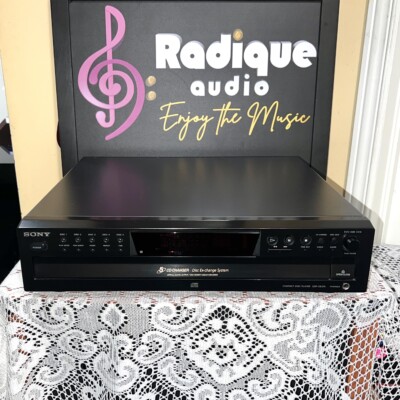
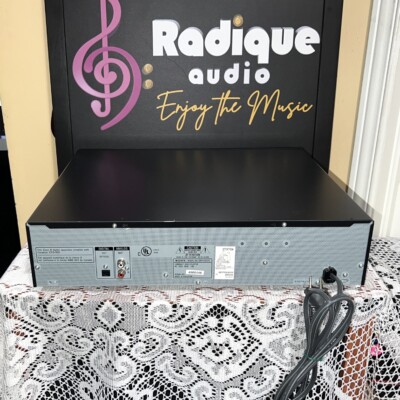
A five-disc carousel using Sony's Play 1/Exchange 4 mechanism — you can swap four discs while the fifth keeps playing. Hybrid Pulse D/A conversion, 0.0045% distortion, better than 102 dB signal-to-noise, and a Toslink optical output for an outboard DAC or receiver. Reads CD-R and CD-RW. A third-party universal remote comes with it, covering the key functions but not all of the original ones.
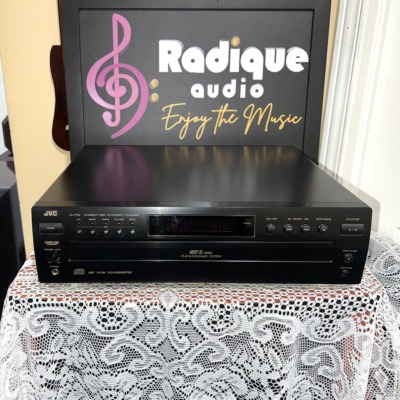
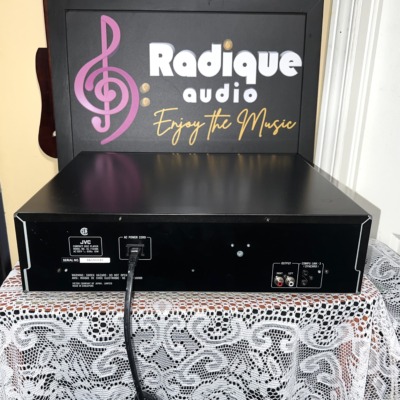
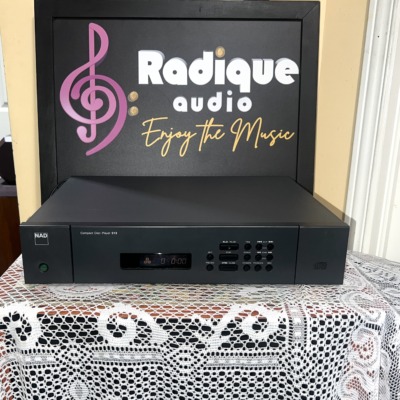
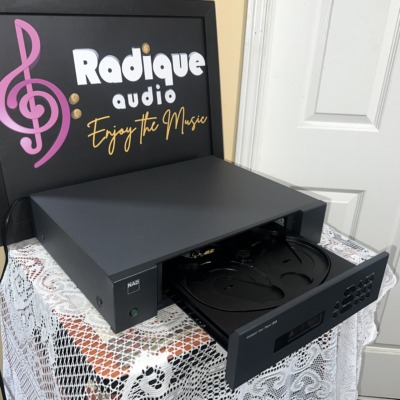
NAD 513 3-Disc CD Changer – Original Remote, Serviced
A 1995 NAD 513 three-disc CD changer hidden in a slim, minimalist case, with a 1-bit MASH converter, CD-R playback and NAD's original remote.
✔️ Serviced on our bench
✔️ Original remote included
✔️ Very good condition
✔️ Covered by Radique Warranty
✔️ Includes Perpetual Trade-Back Program eligibility
✔️ Expertly packed for safe shipping
