


Harman Kardon Slim Compact Disc Player, Made in Japan HD200
$195.00
Out of stock
Get first dibs on the next one
Harman Kardon HD200 CD Player – Vintage Digital Classic, Fully Tested, Made in Japan.
Rediscover your music collection with this Harman Kardon HD200 CD player, a vintage classic engineered for audiophile performance and timeless reliability. Thoroughly tested and in excellent working condition, this HD200 brings high-fidelity digital playback to any stereo system, capturing the rich, clear sound that made Harman Kardon famous.
The HD200 features a precision linear-tracking laser pickup and a robust, vibration-resistant chassis designed to minimize distortion and maximize detail. Oversized digital/analog conversion circuitry delivers natural, open, and dynamic sound—even with demanding recordings. Simple, intuitive front-panel controls are paired with a crisp display for easy track navigation, and the original remote (if available) allows for convenient, full-featured operation from your listening chair.
Built with Harman Kardon’s classic minimalist styling, the HD200 complements any vintage or modern setup. A sturdy disc tray mechanism and hassle-free error correction ensure smooth loading and playback of your favorite CDs, while the player’s output flexibility makes system integration simple through standard line-level RCA connections.
Specifications:
Format: Single-disc CD player, linear tracking mechanism (Red Book (Original) CD’s only, no CDR’s)
Digital Conversion: High-quality DAC, low jitter circuitry
Frequency Response: 5Hz–20,000Hz (±1dB)
Signal-to-Noise Ratio: 98dB
Total Harmonic Distortion: <0.005%
Output: Line-level RCA fixed
Controls: Play, Pause, Skip, Search, Track select, Repeat, Program
Display: Fluorescent numeric/track display
Cabinet: Anti-resonance chassis, Harman Kardon black/silver design
Dimensions: 17.1 x 4.3 x 11.3 inches (435 x 110 x 288 mm)
Weight: 10.8 lbs (4.9 kg)
Enjoy sparkling digital playback and vintage style with this made in Japan Harman Kardon HD200 CD player—fully tested, in very good condition, and ready to make your collection sound its best.
Asking $195; buy with confidence and benefit from Radique’s “Bumper to Bumper” warranty and Perpetual trade back policy.
| Weight | 13 lbs |
|---|---|
| Dimensions | 15.3 × 21 × 8.3 in |
Harman Kardon began in New York in 1953, founded by Sidney Harman, who was born in Montreal, and Bernard Kardon. Harman Kardon calls its 1954 Festival D1000 the first hi-fi receiver. We carry Harman Kardon stereo receivers, AV receivers, integrated amplifiers, cassette decks and CD players. We've had more than 130 Harman Kardon listings so far. Every used Harman Kardon here is inspected, tested and serviced as required, then photographed in-house and covered by our Bumper-to-Bumper Warranty and Perpetual Trade-Back Program. Every AV receiver we list is tested input by input on our bench: each HDMI input and output, the analog, optical and coaxial inputs, the subwoofer outputs and the wireless features where it has them. Don't see the model you want? Tell us on First Dibs and we'll email you when one arrives.
The Harman Kardon story, 1953 to today
Sidney Harman and Bernard Kardon left the David Bogen Company, where Kardon was chief engineer, and founded Harman Kardon in New York in 1953. Harman was born in Montreal in 1918 and grew up in New York. Kardon retired in the 1950s.
Receivers first. Harman Kardon calls the Festival D1000 of 1954 the first hi-fi receiver and the Festival TA230 of 1958 the first stereo receiver. The Citation II tube power amplifier of 1959, designed by Stu Hegeman, sold as a kit or ready-built.
Cassette and the 1970s. Harman Kardon says its CAD-5 of 1970 was the first hi-fi cassette recorder with Dolby noise reduction. Its "Twin Powered" receivers of the 1970s, such as the 430 and 730, gave each channel its own power supply.
Owners. Sidney Harman sold the company to Beatrice Foods in the late 1970s, when he became US Deputy Secretary of Commerce. He formed Harman International in 1980 and bought Harman Kardon back in 1985. Samsung bought HARMAN in 2017, and Harman Kardon remains one of its brands.
Which Harman Kardon is which?
Tube era (1950s and 1960s): Festival receivers, and Citation kits and factory-built units such as the Citation I preamplifier and II amplifier.
1970s receivers: the 330 series, the Twin Powered 630, 930, 430 and 730, and the HK670.
1980s receivers: the "i" models such as the hk690i, advertised for its high current capability, and the 330i.
Citation separates: solid-state Citation amplifiers and preamplifiers from 1970 to the 1990s, including the Citation XX of the early 1980s.
Cassette decks: from the CAD-4 and CAD-5 to the 1980s decks numbered CD91 to CD491. Those "CD" models are cassette decks, not CD players; Harman Kardon CD players carry "HD" names.
AV receivers (late 1990s on) and later stereo: the AVR line, such as the AVR 3600, and stereo models such as the HK 3700 and HK 990.
Buying used Harman Kardon: what to check
Dial and meter lamps. Owners report dead or flickering lamps on 1970s receivers such as the 930, 430 and 330C; many are replaced with LEDs.
Capacitors. Expect a 1970s receiver that hasn't been recapped to need it.
Output stage. Owners report blown output transistors on the 730 and 430, often caused by a failed part nearby. Both channels should play cleanly at a realistic level.
Switches. Owners say the 1980s "i" receivers are prone to dirty switches that make channels cut out. Try every input and the balance control.
AV receivers. HDMI is usually the first thing to fail on a modern AV receiver. We test every HDMI input and output before listing.
Everything we list is inspected, tested and serviced as required here, and comes with our warranty.
Related Products
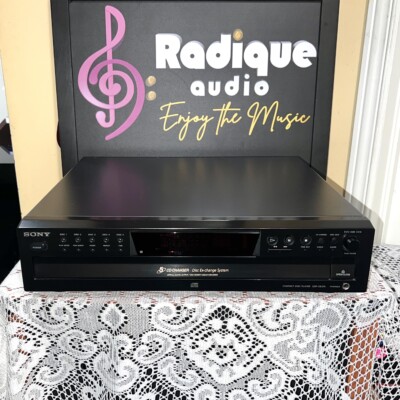
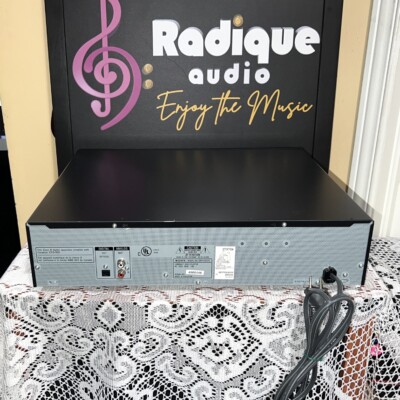
Sony CDP-CE375 5-Disc CD Changer — Optical Out | Play & Exchange
A five-disc carousel using Sony's Play 1/Exchange 4 mechanism — you can swap four discs while the fifth keeps playing. Hybrid Pulse D/A conversion, 0.0045% distortion, better than 102 dB signal-to-noise, and a Toslink optical output for an outboard DAC or receiver. Reads CD-R and CD-RW. A third-party universal remote comes with it, covering the key functions but not all of the original ones.
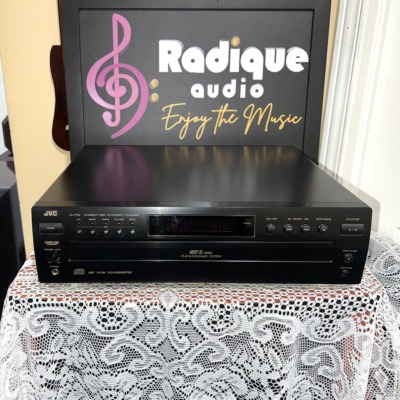
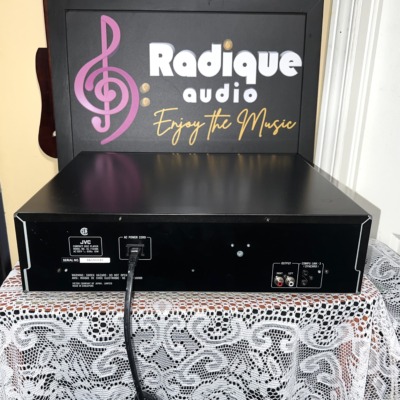
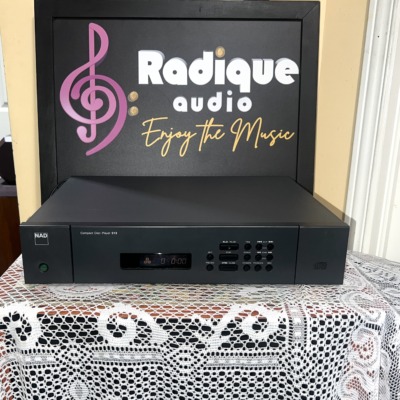
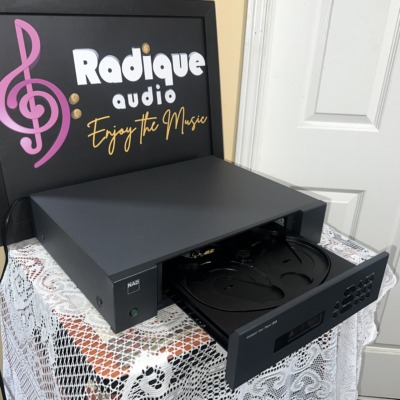
NAD 513 3-Disc CD Changer – Original Remote, Serviced
A 1995 NAD 513 three-disc CD changer hidden in a slim, minimalist case, with a 1-bit MASH converter, CD-R playback and NAD's original remote.
✔️ Serviced on our bench
✔️ Original remote included
✔️ Very good condition
✔️ Covered by Radique Warranty
✔️ Includes Perpetual Trade-Back Program eligibility
✔️ Expertly packed for safe shipping
