


JVC XL-F152 5-Disc CD Changer with CD-R Playback
$125.00
Out of stock
Get first dibs on the next one
JVC XL-F152 5-Disc CD Changer with CD-R Playback
This JVC XL-F152 is a front-loading 5-disc CD changer that delivers smooth, reliable playback of standard CDs and CD-Rs, making it a great way to add flexible multi-disc listening to a modern or vintage stereo system.
The XL-F152 uses JVC’s 1-bit P.E.M. D.D. converter with VANS (JVC Advanced Noise Shaper) and an 8x oversampling digital filter, giving it a clean, detailed sound with low noise and good resolution of subtle musical detail. The front-loading carousel holds five discs and supports 32-step program play across all five trays, plus repeat, random, and intro-scan functions for easy all-evening listening. This example has been confirmed to play CD-Rs reliably in addition to pressed discs, and is in good cosmetic condition with typical light wear from normal use but no damage that affects operation or front-panel legibility.
Specifications:
Type: 5-disc carousel CD auto changer (front-loading)
DAC / processing: 1-bit P.E.M. D.D. converter with VANS, 8x oversampling digital filter
CD mechanism: JVC OPTIMA-5S
Frequency response: 2 Hz – 20 kHz
Programming and playback: Up to 32-step program play across 5 discs, repeat, random, intro-scan
Disc compatibility: Audio CD and CD-R (confirmed playing CD-Rs on this unit)
Outputs: Stereo analog RCA line output; front-panel headphone jack
Dimensions: (Width x Height x Depth) 17.1 x 5.0 x 15.2 inches (435 x 128 x 386 mm)
Weight: 11.3 lbs (5.1 kg)
This JVC XL-F152 is a practical, good-sounding 5-disc CD changer with confirmed CD-R support, ideal for casual multi-disc listening in a bedroom, office, or secondary system. Backed by Radique Audio’s 90-day warranty and our perpetual trade-back policy, you can purchase with confidence.
| Weight | 13.3 lbs |
|---|---|
| Dimensions | 19.2 × 21.1 × 9 in |
JVC was founded in Yokohama, Japan, in 1927 as the Japanese arm of America's Victor Talking Machine Company, first making phonographs and records. We carry JVC stereo receivers and AV receivers, cassette decks, CD players, turntables and speakers. We've had more than 90 JVC listings so far, covering more than 80 different models. Every AV receiver we list is tested input by input on our bench: each HDMI input and output, the analog, optical and coaxial inputs, the subwoofer outputs and the wireless features where it has them. Every used JVC here is inspected, tested and serviced as required, then photographed in-house and covered by our Bumper-to-Bumper Warranty and Perpetual Trade-Back Program. Don't see the model you want? Tell us on First Dibs and we'll email you when one arrives.
JVC models we've sold more than once include the RX-7000VBK and RX-8000VBK AV receivers.
The JVC story, 1927 to today
JVC began in 1927 as the Japanese subsidiary of the Victor Talking Machine Company, making phonographs and records, and built a large plant in Yokohama in 1930. RCA bought Victor in 1929, and in the late 1930s JVC passed to Japanese owners.
Stereo, quad and video. JVC joined the Matsushita (Panasonic) group in the early 1950s. It developed the CD-4 discrete four-channel record system in the early 1970s and the SEA graphic equalizer built into its receivers, and in 1976 its video division introduced VHS.
Hi-fi highlights. The late 1970s and early 1980s brought the JR-S receivers, whose SEA sliders replaced the tone controls, the Super-A amplifiers and the QL quartz-lock turntables, and around 1990 the XL-Z CD players with JVC's K2 Interface.
Today. JVC merged with Kenwood between 2008 and 2011, and JVCKENWOOD Corporation now owns the brand. JVC has had its own Canadian distribution since the 1970s, and JVCKENWOOD Canada is based in Mississauga, Ontario.
Which JVC is which?
1970s receivers: early four-channel models with CD-4 demodulators, and the JR-S series of 1976 to 1977, with built-in SEA equalizers.
Super-A amplifiers and receivers (1979 to the early 1980s): such as the A-X5 and A-X9 amplifiers and the R-S33 receiver.
Turntables: QL quartz-lock direct-drive models such as the QL-A7 and QL-Y5F, and belt-drive automatics such as the JL-A1.
Cassette decks and CD players: KD and CD-S decks from the 1970s, TD-W dual-well decks, and XL-Z CD players and XL changers.
AV receivers (2000 to 2004): the RX-x000V, RX-x010V and RX-x020V families, including the RX-7000VBK, RX-8000VBK and RX-6020VBK, and the RX-8040B.
Buying used JVC: what to check
SEA sliders. On JR-S and R-S receivers, work every equalizer slider through its range and listen for crackle or a channel dropping out.
FM muting. Stereo Review found the JR-S600's muting could thump when tuning on or off a station, so turn the volume down before tuning.
AV receivers. Run every channel, centre and surrounds included, at moderate volume. Owners report overload shutdowns on some 2000s models, which can come from a short in the speaker wiring.
Turntables. On QL servo turntables, check that the tracking-force and damping dials respond and that the arm finds the lead-in at both record sizes. Older JL automatics often need old grease cleaned out and a new belt.
Cassette decks. Treat belts and pinch rollers on any 1970s to 1990s deck as service items.
Everything we list is inspected, tested and serviced as required here, and comes with our warranty.
Related Products
Sony CDP-CE375 5-Disc CD Changer — Optical Out | Play & Exchange
A five-disc carousel using Sony's Play 1/Exchange 4 mechanism — you can swap four discs while the fifth keeps playing. Hybrid Pulse D/A conversion, 0.0045% distortion, better than 102 dB signal-to-noise, and a Toslink optical output for an outboard DAC or receiver. Reads CD-R and CD-RW. A third-party universal remote comes with it, covering the key functions but not all of the original ones.
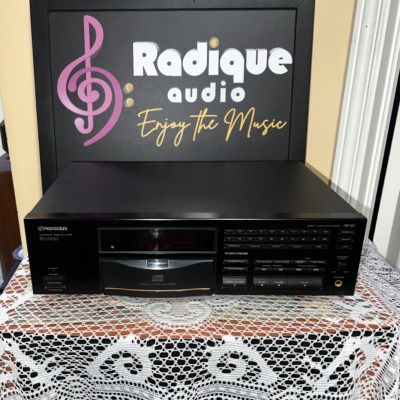
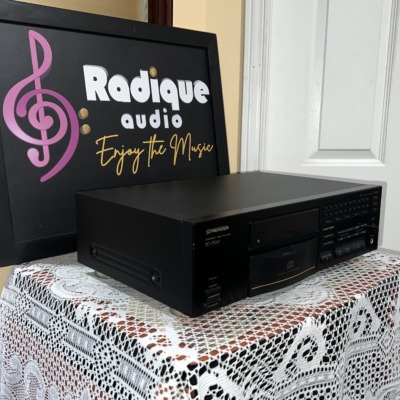
Pioneer PD-7700 Stable Platter CD Player – Made in Japan, CD-R
An early-nineties Pioneer CD player in black, made in Japan and built around Pioneer's Stable Platter Mechanism, in very good condition, with a 1-bit DAC, an optical digital output and CD-R playback.
✔️ Very good condition — free of significant marks
✔️ Pioneer's Stable Platter Mechanism and 1-bit DAC, made in Japan
✔️ Optical digital out, headphone jack, CD-R playback; universal remote included
✔️ Covered by Radique Warranty
✔️ Includes Perpetual Trade-Back Program eligibility
✔️ Expertly packed for safe shipping
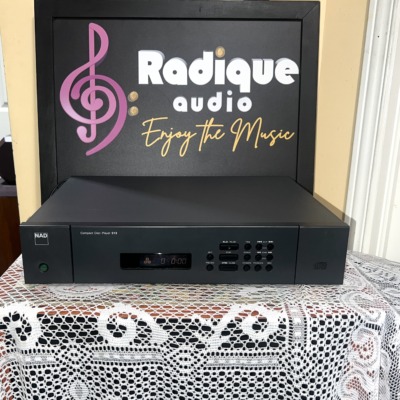
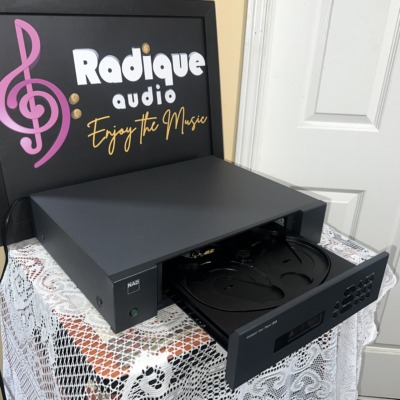
NAD 513 3-Disc CD Changer – Original Remote, Serviced
A 1995 NAD 513 three-disc CD changer hidden in a slim, minimalist case, with a 1-bit MASH converter, CD-R playback and NAD's original remote.
✔️ Serviced on our bench
✔️ Original remote included
✔️ Very good condition
✔️ Covered by Radique Warranty
✔️ Includes Perpetual Trade-Back Program eligibility
✔️ Expertly packed for safe shipping
