
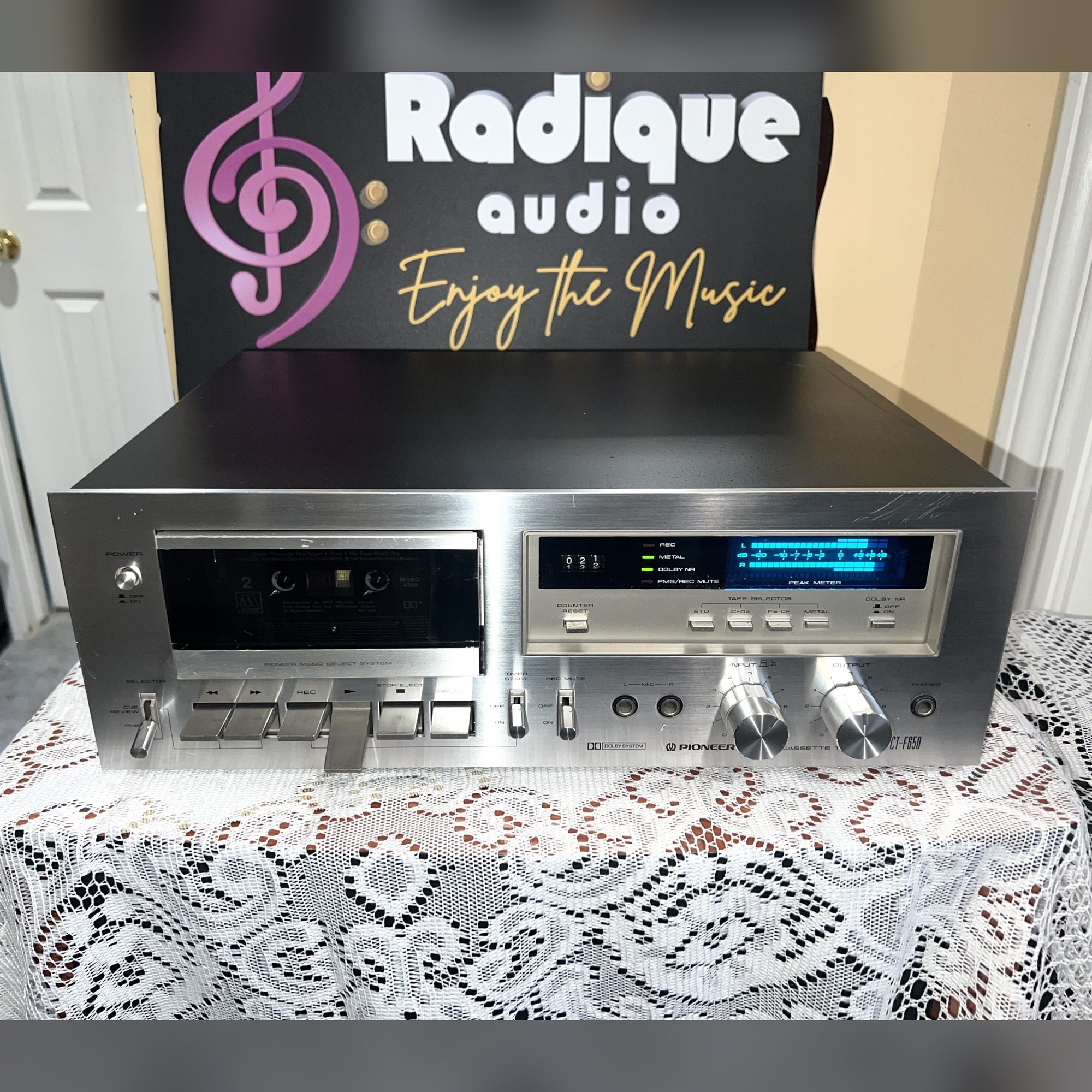
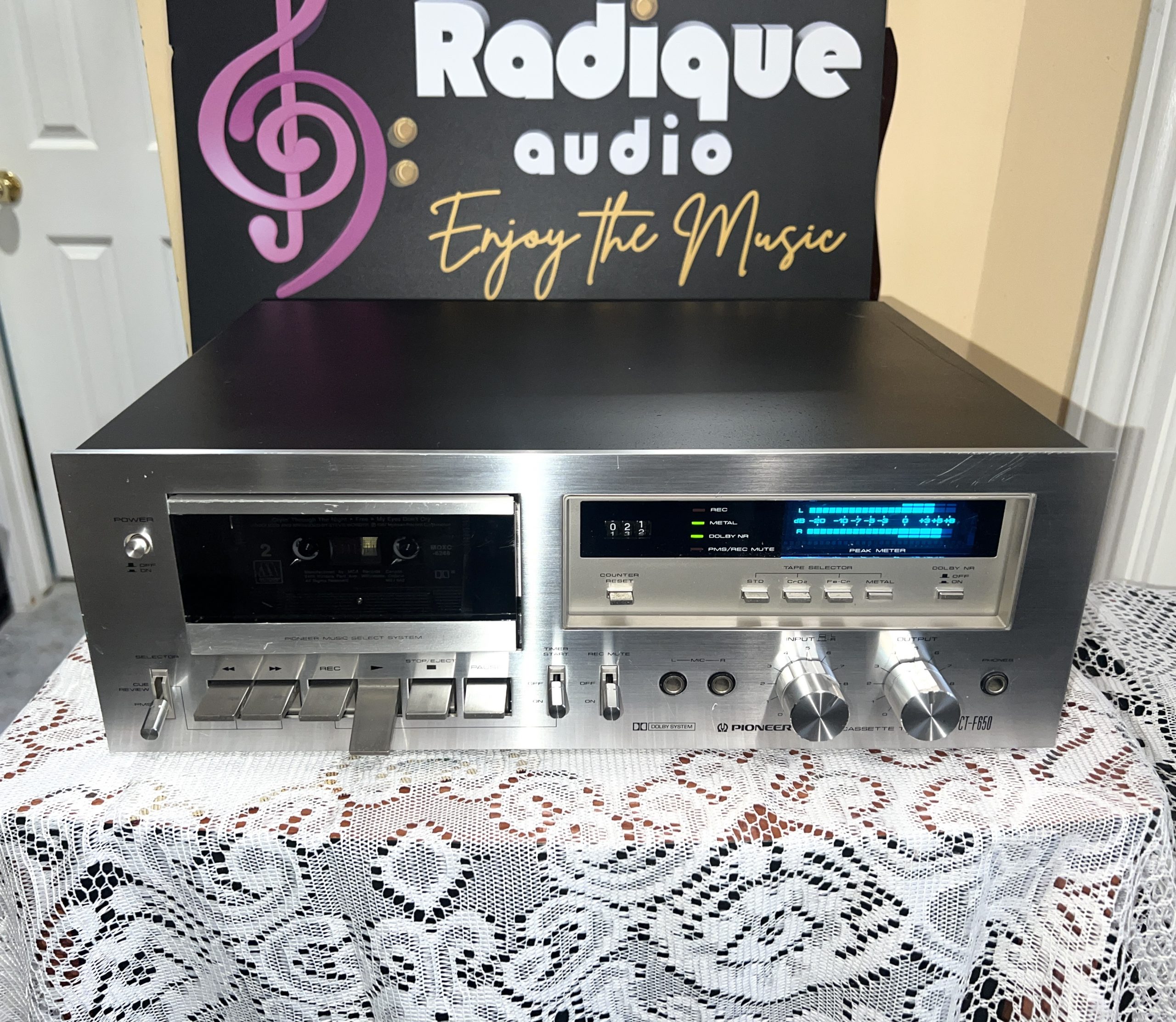
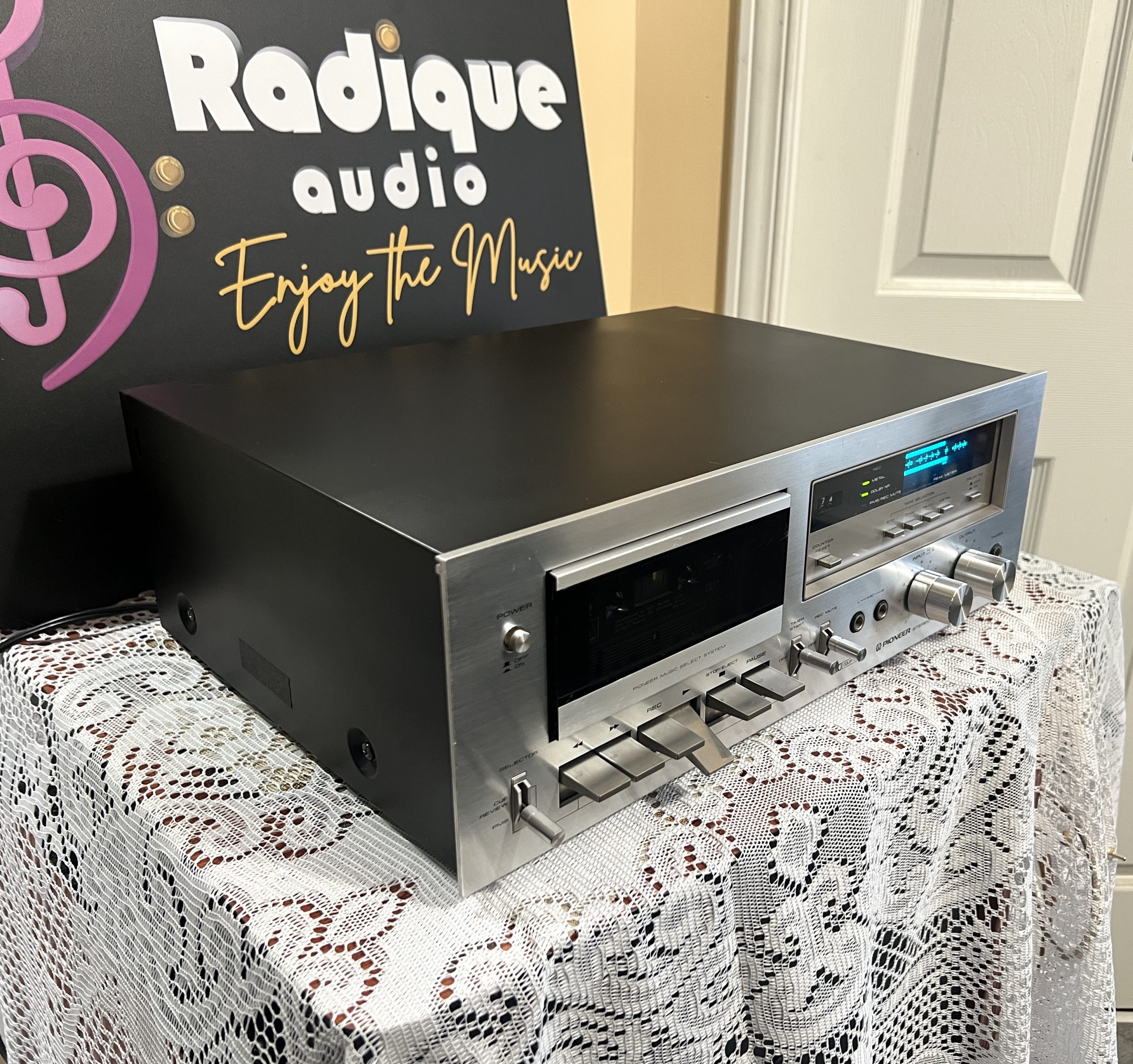
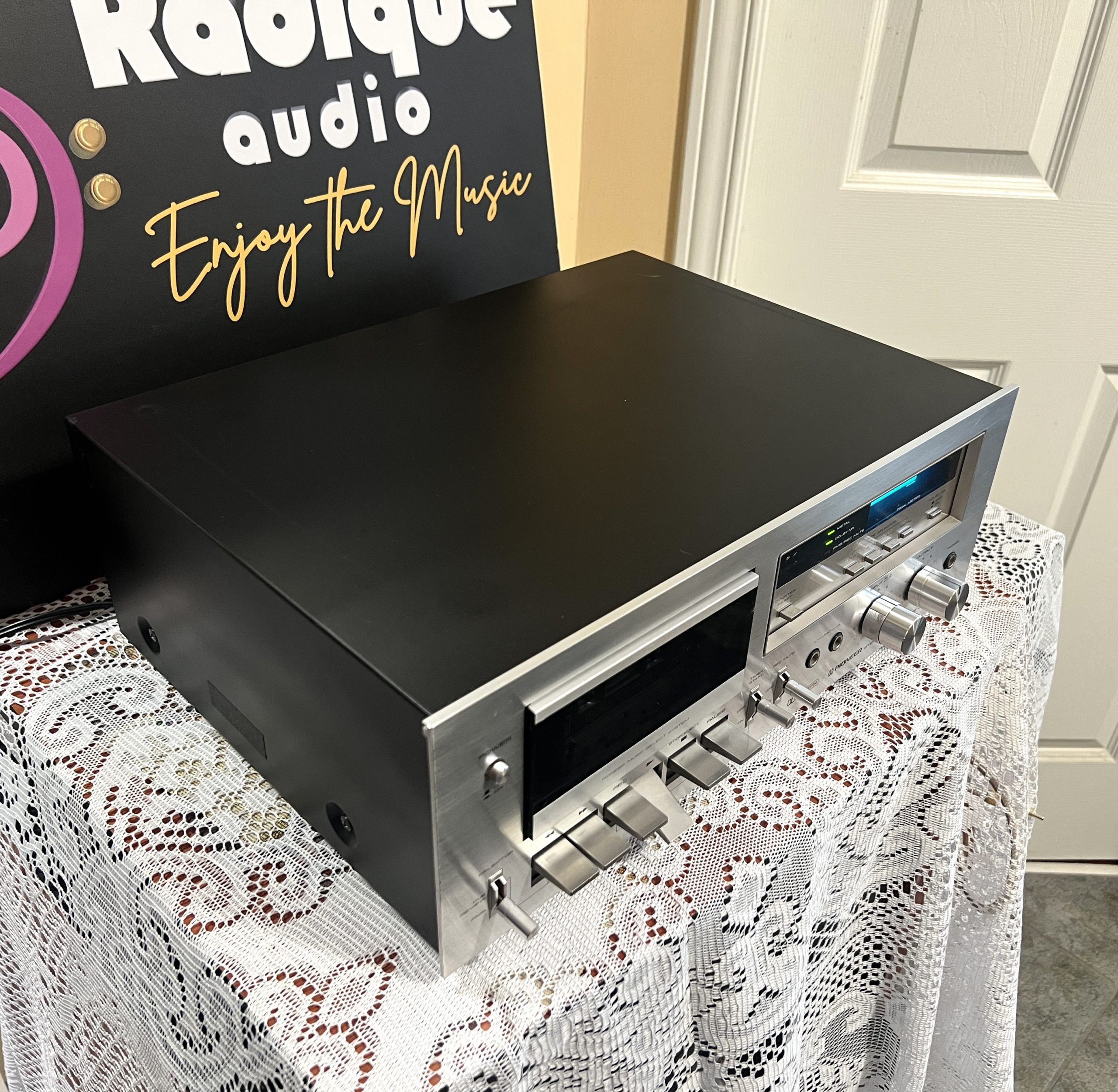



Pioneer CT-F650 Stereo Cassette Deck Metal Tape Made in Japan
$595.00
1 in stock
Pioneer CT-F650 Stereo Cassette Deck Metal Tape Made in Japan
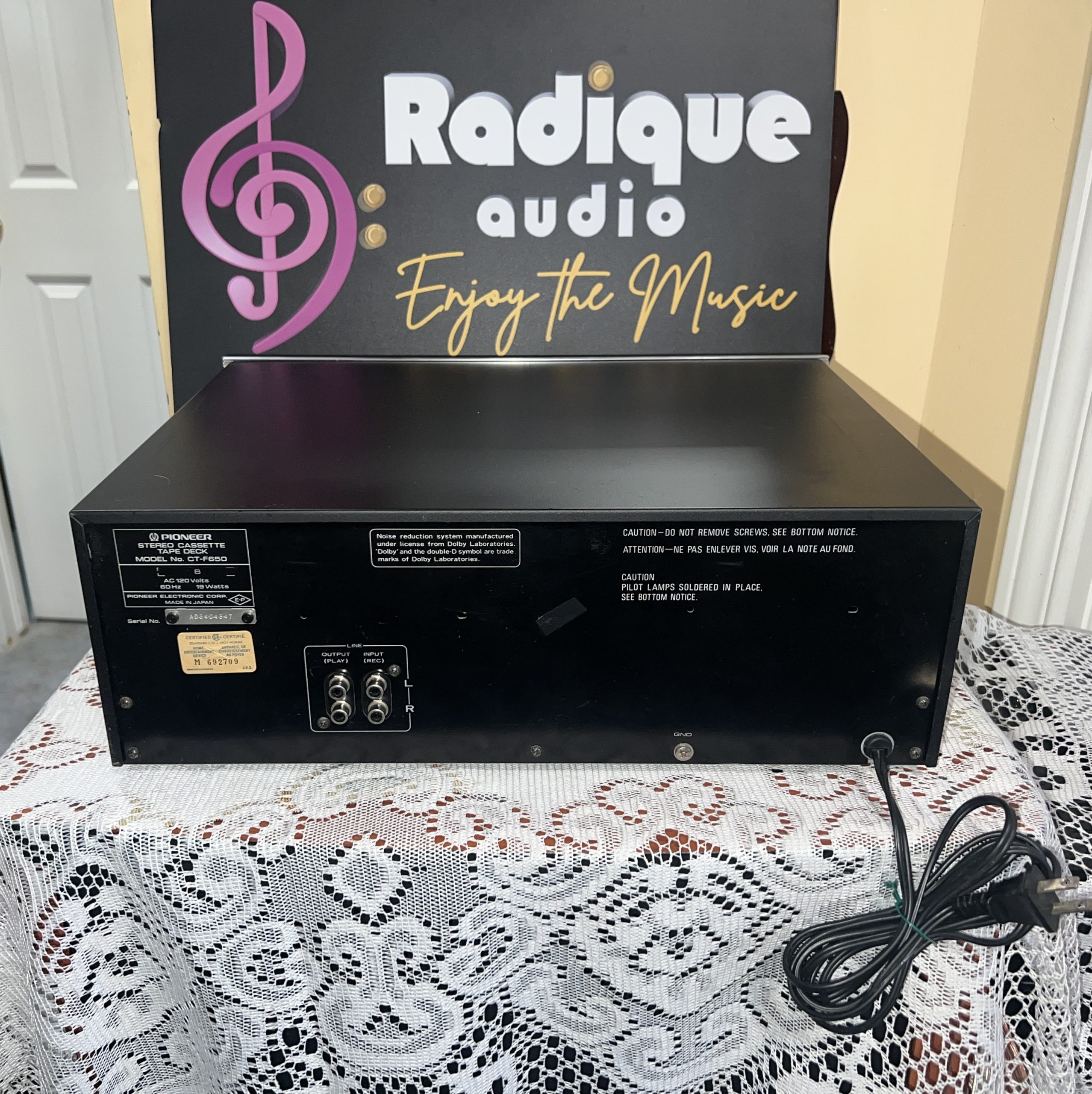
A clean, capable, and well-specified front-loading cassette deck from Pioneer’s respected CT-F series, the CT-F650 offers metal tape compatibility, Dolby B noise reduction, and Pioneer’s PMS track search system in a solid, attractive silver chassis — made in Japan, level one serviced with new belts, in very good condition.
The Pioneer CT-F650 sits in the middle of Pioneer’s late-1970s CT-F lineup and represents an excellent combination of features and build quality for its era. Full compatibility with all four tape formulations — Type I (normal), CrO2 (chrome), FeCr (ferro-chrome), and Metal — means it handles the full range of vintage and new-old-stock cassettes with appropriate bias and equalization settings for each, extracting the best possible performance from any tape you put in it. The 0.05% wow and flutter rating is excellent for its class, ensuring pitch-stable, smooth playback that holds up well to critical listening. Dolby B noise reduction delivers a meaningful 10 dB improvement in high-frequency signal-to-noise ratio, bringing the effective SNR up to 69 dB — respectable performance for analogue tape at any era. The Pioneer Music Select System (PMS) provides convenient automatic track search, allowing you to skip forward or backward through recorded tracks without manual fast-forward and rewind.
The front-loading cassette well positions the tape horizontally on the left side of the faceplate, giving the CT-F650 its distinctive asymmetric layout with transport controls and level meters arranged on the right. Two-colour peak-reading meters provide clear, intuitive recording and playback level monitoring. The solid, all-metal chassis construction and DC servo-controlled capstan motor reflect Pioneer’s commitment to build quality in this era, contributing directly to the deck’s stable transport and consistent tape handling.
This example has undergone our Level One service and testing which should ensure many more years of reliable performance ahead. New drive belts have been installed, and all transport functions — play, record, fast-forward, rewind, and pause — have been verified operating correctly. The deck is performing exactly as it should and is ready for immediate use.
Key Specifications
Type: 2-head, single compact cassette deck
Track system: 4-track, 2-channel stereo
Tape speed: 4.75 cm/s
Heads: 1 × record/playback, 1 × erase
Motor: 1 × DC servo
Tape compatibility: Type I, CrO2, FeCr, Metal
Noise reduction: Dolby B
Frequency response: 25 – 14,000 Hz (Type I); 25 – 16,000 Hz (CrO2/FeCr); 25 – 17,000 Hz (Metal)
Signal-to-noise ratio: 59 dB (Dolby off); 69 dB (Dolby B on)
Wow and flutter: 0.05% WRMS
THD: 1.3% (0 dB)
Special features: Pioneer Music Select System (PMS) auto track search, two-colour peak level meters, manual/auto tape type selection
Service: Level One serviced, new drive belts installed, all transport functions verified
Years of manufacture: 1979 – 1981
Country of manufacture: Japan
Finish: Silver
Condition: Very good cosmetic condition, fully tested and working
Dimensions: (Width x Height x Depth) 420 x 150 x 335 mm (16.5 x 5.9 x 13.2 inches)
Weight: 7.1 kg (15.6 lbs)
Made in Japan, this Pioneer CT-F650 is a solid, well-specified cassette deck from one of the golden era’s most respected manufacturers — metal tape capable, Dolby B equipped, freshly serviced with new belts, and built to a standard that makes it a pleasure to use for both playback of vintage tape collections and recording on quality cassette stock.
Backed by Radique Audio’s Bumper-to-Bumper Warranty and our Perpetual Trade-Back Program, you can purchase with confidence.
⭐ Don’t Just Take Our Word For It
Radique Audio holds over 600 customer ratings averaging 4.97 stars across six public platforms — Facebook Marketplace, Kijiji, Canuck Audio Mart, Google and others. Every rating lives somewhere we don’t control, so you can read the originals yourself, including the less flattering ones. See what our customers say. 👉
| Weight | 17.6 lbs |
|---|---|
| Dimensions | 17.2 × 20.5 × 9.9 in |
| Cassette Wells | Single Well |
| Noise Reduction | Dolby B |
Pioneer began in Tokyo in January 1938, when Nozomu Matsumoto set up shop around the A-8 speaker he had built the year before. By the late 1970s its SX receivers were at the heart of the hi-fi power race. We carry Pioneer stereo receivers and AV receivers, CD players, cassette decks, tuners and equalizers. We've had more than 240 Pioneer listings so far, covering 140 different models. Every used Pioneer here is inspected, tested and serviced as required, then photographed in-house and covered by our Bumper-to-Bumper Warranty and Perpetual Trade-Back Program. Don't see the model you want? Tell us on First Dibs and we'll email you when one arrives.
Pioneer is one of our two top-selling brands of vintage amps and receivers, along with Marantz. Our five best-selling Pioneer models so far: the SX-650, SX-750, SX-580, SX-780 and SX-680, all vintage stereo receivers from the 1976 and 1978 SX families. We also offer our custom cherry cabinets for these vintage Pioneers, hand-made from all-natural Ottawa Valley cherry, and we've upgraded dozens of Pioneers with them so far.
The Pioneer story, 1938 to today
Nozomu Matsumoto developed the A-8 speaker in 1937, and in January 1938 he set up Fukuin Shokai Denki Seisakusho in Tokyo. "Pioneer" was first the name of that speaker. Some histories give 1936 in Osaka as the start, but Pioneer dates itself to January 1938 in Tokyo. The company was incorporated in 1947 and renamed Pioneer Electronic Corporation in 1961.
Stereo and the US. In 1962 Pioneer introduced the PSC-5A, which it calls the first stereo with separate speaker cabinets, and its first PL turntables. Pioneer Electronics U.S.A. was founded in New York in 1966.
The power race. After a 1974 US Federal Trade Commission rule tightened how amplifier power was rated, receiver makers competed on watts. Pioneer's SX-1250 of 1976 was rated at 160 watts per channel, and the SX-1980 of 1978 to 1980 at 270.
CD and Elite. The P-D1 of 1982 was Pioneer's first CD player, and Elite-branded components were on sale by 1985.
Today. Pioneer sold its home audio business to Onkyo in 2015, keeping its car and DJ businesses, and Pioneer-branded home theatre gear was later made under licence. In December 2025 CarUX, part of Taiwan's Innolux, completed its purchase of Pioneer Corporation, which now focuses on in-car products.
Which Pioneer is which?
Early-1970s SX receivers: models such as the SX-424 to SX-828, rated at about 15 to 50 watts per channel.
The 1976 "x50" SX receivers: from the SX-450 at 15 watts per channel up to the SX-1250 at 160. Our best-selling SX-650 and SX-750 come from this family.
The 1978 "x80" SX receivers: including the SX-580, SX-680 and SX-780 we sell most, up to the SX-1980 flagship with quartz-lock tuning, which weighs more than 35 kg.
Spec and Exclusive separates: higher-end amplifiers such as the Spec-1 preamplifier (1976 to 1980) and the Exclusive C3/M3 pair (1974).
Elite: Pioneer's upper line from the mid-1980s, for example the PD-9010X CD player.
PL turntables, CT cassette decks and CD players: PL turntables from 1962, such as the PL-12 and the linear-tracking PL-L1; CT decks such as the three-head CT-F1000; and CD players from the 1982 P-D1 to magazine-loading changers such as the PD-M6.
Buying used Pioneer: what to check
Controls and switches. Crackle when you turn a control or work a switch usually means dirt, and restorers clean every pot and switch.
Capacitors. Electrolytic capacitors in 1970s receivers are often past their best, and full restorations replace them.
Big SX models. Owners and restorers report heat stress on the power-supply board of large receivers such as the SX-1250. Ask what has been done.
Relay, lamps and bias. The protection relay is a common replacement, dial lamps burn out and are often converted to LED, and restorers set the bias and DC offset.
Cassette decks. Check the heads, fast-forward and rewind, Dolby and every button. Belts age even when the deck looks perfect.
Everything we list is inspected, tested and serviced as required here, and comes with our warranty.
Related Products
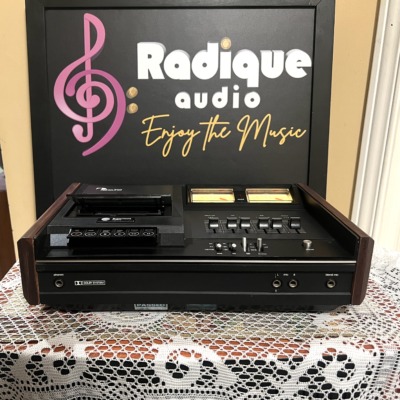
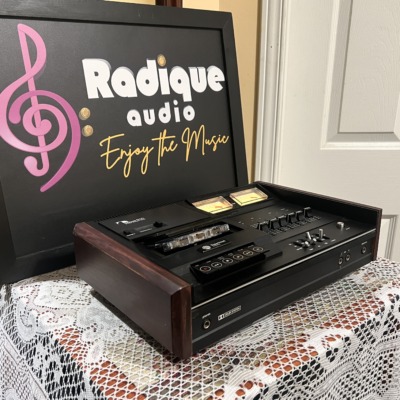
Nakamichi 500 Dual-Tracer Cassette Deck – Walnut, Made in Japan
Nakamichi's mid-seventies top-loading deck with walnut side panels, serviced on our bench and playing as it should.
✔️ Good condition — honest general wear for a fifty-year-old deck, and no damage
✔️ Serviced on our bench — our standard cassette deck service before it was listed
✔️ Walnut side panels fitted, with the original white side panels included
✔️ Covered by Radique Warranty
✔️ Includes Perpetual Trade-Back Program eligibility
✔️ Expertly packed for safe shipping
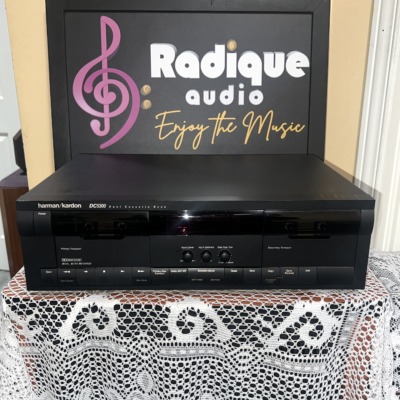
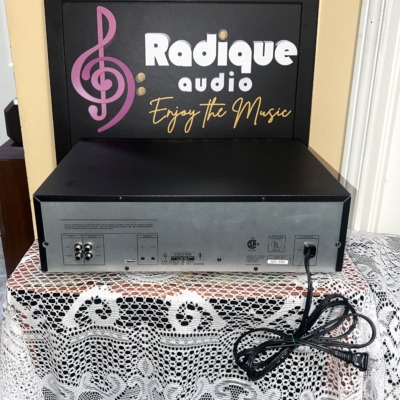
Harman Kardon DC5300 Dual Cassette Deck – Serviced, Japan
A Japanese-built Harman Kardon dual cassette deck from the early nineties, serviced on our bench and in very good condition.
✔️ Very Good condition — faceplate, cassette doors and display window present cleanly
✔️ Serviced on our bench — our standard cassette deck service before it was listed
✔️ Two auto-reverse decks with Dolby B and C, made in Japan
✔️ Covered by Radique Warranty
✔️ Includes Perpetual Trade-Back Program eligibility
✔️ Expertly packed for safe shipping
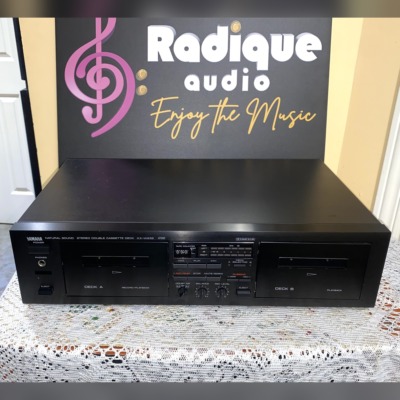
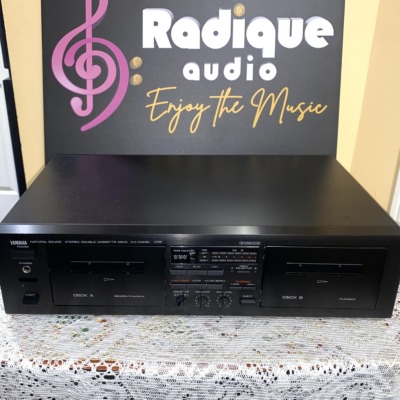
Yamaha KX-W232 Dual Cassette Deck – Dolby B & C, Made in Japan
A Japanese-built Yamaha dual cassette deck from the early nineties, tested on our bench and in good condition, priced to reflect one door quirk we describe below.
✔️ Good condition — a rear-panel crack and a Deck A door quirk, both explained below
✔️ Tested on our bench and working as it should
✔️ Two decks with Dolby B and C — made in Japan
✔️ Covered by Radique Warranty
✔️ Includes Perpetual Trade-Back Program eligibility
✔️ Expertly packed for safe shipping
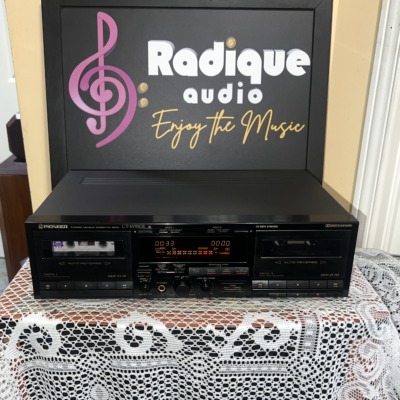
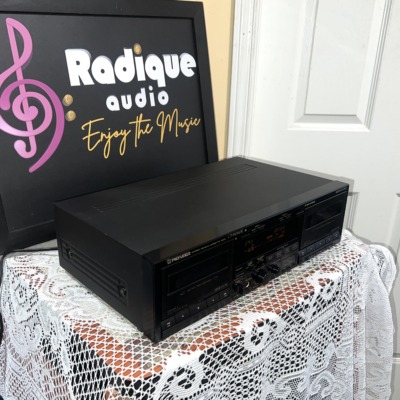
Pioneer CT-W550R Dual Cassette Deck – Dolby B/C, HX Pro, Japan
A 1991 Pioneer CT-W550R twin cassette deck, made in Japan, with auto-reverse on both decks, Dolby B and C and Dolby HX Pro.
✔️ Serviced on our bench
✔️ Very good condition
✔️ High-speed dubbing, CD synchro recording, music search
✔️ Covered by Radique Warranty
✔️ Includes Perpetual Trade-Back Program eligibility
✔️ Expertly packed for safe shipping
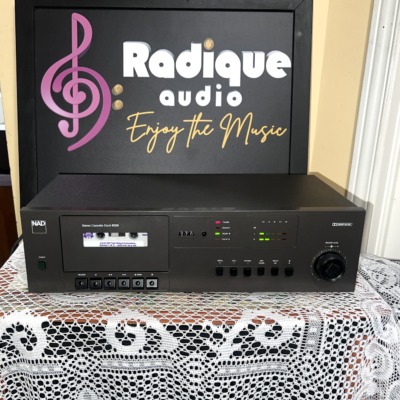
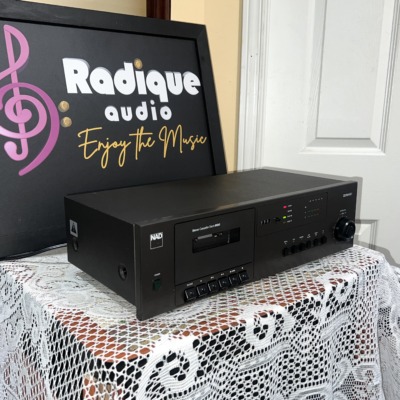
NAD 6130 Stereo Cassette Deck – Dolby B/C, Serviced, Japan
A mid-1980s NAD 6130 cassette deck, made in Japan, with Dolby B and C, a hard permalloy head and a belt-driven flywheel transport.
✔️ Serviced on our bench
✔️ Very good condition
✔️ Covered by Radique Warranty
✔️ Includes Perpetual Trade-Back Program eligibility
✔️ Expertly packed for safe shipping
