


Polk Audio PSW350 10″ Front-Firing Powered Subwoofer 260W
$225.00
A 10-inch front-firing Dynamic Balance woofer on a 100-watt RMS amplifier — 260 watts dynamic — in a dual-rear-ported cabinet good for 25 to 180 Hz. Speaker-level in and out, stereo line inputs and an unfiltered LFE jack, with a variable 60 to 160 Hz low-pass and a phase switch. 37 lbs, black matte. Very good cosmetic condition.
1 in stock
Polk Audio PSW350 10″ Front-Firing Powered Subwoofer 260W
The Polk Audio PSW350 is a compact, full-featured powered subwoofer designed to add clean, high-impact bass to music and home theater systems without dominating your room visually.
At its heart, the PSW350 uses a 10″ front-firing Dynamic Balance woofer driven by a high-current 100-watt RMS amplifier (260 watts dynamic), giving it enough headroom to deliver punchy, room-filling bass in small to medium spaces. The enclosure is a direct-radiating, vented design with dual rear-firing ports to extend low-frequency response while keeping distortion low. Overall frequency response is rated from 25 Hz to 180 Hz, with a -3 dB range of 38–160 Hz, making it a capable match for bookshelf and tower speakers alike.
On the back panel you’ll find flexible connection and control options: speaker-level inputs and outputs, stereo line-level inputs, and a dedicated unfiltered LFE input for use with modern AV receivers that provide their own bass management. A continuously variable low-pass crossover (60–160 Hz), phase switch, and level control make it straightforward to blend the PSW350 with your mains. The auto on/off feature powers the subwoofer up when it senses signal and puts it into standby after a period of silence, adding convenience in daily use.
This unit has been thoroughly inspected and tested to confirm full functionality.
Key Specifications — Polk Audio PSW350
- Driver: 1 x 10″ (254 mm) front-firing Dynamic Balance woofer
- Amplifier power: 100 watts RMS; 260 watts dynamic
- Enclosure type: Direct-radiating, vented with dual rear-firing bass ports
- Overall frequency response: 25 Hz – 180 Hz
- -3 dB frequency response: 38 Hz – 160 Hz
- Low-pass crossover: Continuously variable 60–160 Hz (bypassed when using LFE input)
- Phase control: 0° / 180° switch
- Connections: Speaker-level inputs and outputs (spring clips); stereo line-level inputs (RCA); LFE/sub mono RCA input (unfiltered, receiver-managed)
- Auto on/off: Yes, plus manual On and Off positions
- Finish: Black matte
Dimensions: (Width x Height x Depth) 13.5 x 15 x 18.5 inches (343 x 381 x 470 mm)
Weight: 37 lbs (16.8 kg)
This PSW350 is in very good cosmetic condition. The black matte cabinet shows light, honest signs of use but no significant dents, chips, or deep scratches, and the front grille and driver are clean and intact. Controls and connections on the rear panel are in good shape.
A well-regarded Polk 10″ powered subwoofer with 260W dynamic power, flexible connectivity, and a compact, easy-to-place cabinet — ideal for adding solid low-end foundation to a vintage or modern surround system.
Backed by Radique Audio’s 90-day limited subwoofer warranty and our Perpetual Trade-Back Program, you can purchase with confidence.
| Weight | 40 lbs |
|---|---|
| Dimensions | 22.5 × 17.5 × 19 in |
- Hard-to-beat pricing
- Free shipping across Canada
- Manufacturer's warranty
- Get a quote on new Polk
Polk Audio began in Baltimore in 1972, founded by Matthew Polk, George Klopfer and Sandy Gross. Its SDA speakers of the 1980s used a cable between the left and right speakers to widen the stereo image. We carry Polk towers, bookshelf speakers, centre channels and subwoofers. We've had more than 180 Polk listings so far, covering more than 80 different models. Every used Polk here is inspected, tested and serviced as required, then photographed in-house and covered by our Bumper-to-Bumper Warranty and Perpetual Trade-Back Program. Looking for new Polk? We also quote new Polk Audio direct from the Canadian distributor, with free shipping within Canada: request a quote below. Don't see the model you want? Tell us on First Dibs and we'll email you when one arrives.
Our five best-selling Polk models so far: the RTi10 towers, the PSW10 and PSW125 subwoofers, the RTi4 bookshelf speakers and the CSi3 centre.
The Polk story, 1972 to today
Matthew Polk, George Klopfer and Sandy Gross, graduates of Johns Hopkins, founded Polk Audio in Baltimore, Maryland, in 1972. The Monitor 7 of 1974 was their first model to succeed, and the Monitor 10 followed in 1976.
SDA. In 1984 Polk introduced SDA (Stereo Dimensional Array). A cable between the left and right speakers lets each one cancel the sound that crosses over to the wrong ear, for a wider stereo image.
Growth. Polk went public in 1986 and moved to new premises in Baltimore. It began moving manufacturing to Tijuana, Mexico, in 1988, and by 2012 Stereophile reported that Polk designed in the US and built in China.
New owners. Directed Electronics agreed to buy Polk in 2006. Polk later became part of Sound United, Masimo bought Sound United in 2022, and in September 2025 HARMAN, a Samsung company, completed its purchase of Sound United. The 2018 Legend series brought SDA back.
Which Polk is which?
Monitor (1970s to early 1990s): the Monitor 4, 5, 7, 10 and 12, with A, B and C revisions.
SDA (1984 to about 1991): the SDA-1 and SDA-2 families, CRS, SRS and the later "TL" models.
RTA (1979 to 1992): towers such as the RTA 11t, with two woofers and two passive radiators.
RT and RTi (2001 onward): Polk's lower-priced lines. Our best-selling RTi10 towers and RTi4 bookshelf speakers come from here.
CSi centres and PSW subwoofers: the CSi3 centre and the PSW10 and PSW125 subwoofers are among the Polks we sell most.
LSi (about 2001 to 2010) and LSiM (2011): Polk's flagship lines of that decade, followed by Signature (2016), Legend (2018) and Reserve (2021).
Buying used Polk: what to check
SDA cable. SDA speakers need the interconnect cable between them for the SDA effect, and early SDA models need a common-ground amplifier. Make sure the cable comes with the pair.
Tweeters. Owners report that some SL3000 tweeters on the 1989 to 1991 SDA TL models leaked their ferrofluid and failed, and that Monitor-series pairs may carry mismatched factory or replacement tweeters. Check that every tweeter plays.
Surrounds. Some early Polks used foam surrounds, which rot with age; later models such as the RTA 11t and LSiM use rubber. Press gently on each woofer surround.
Everything we list is inspected, tested and serviced as required here, and comes with our warranty.
You may also like…


IsoAcoustics Aperta Sub XL Subwoofer Isolation Stand
- ✔️ Genuine IsoAcoustics Aperta Sub XL, brand new in box
- ✔️ Low-profile isolation stand for front-firing and side-firing subwoofers up to 160 lbs (72.6 kg)
- ✔️ Includes 1 stand plus 4 carpet discs for carpeted surfaces
- ✔️ Helps reduce energy transfer, room rattle, and muddy bass smear for tighter low-frequency performance
- ✔️ Backed by a 2-year manufacturer’s warranty in Canada
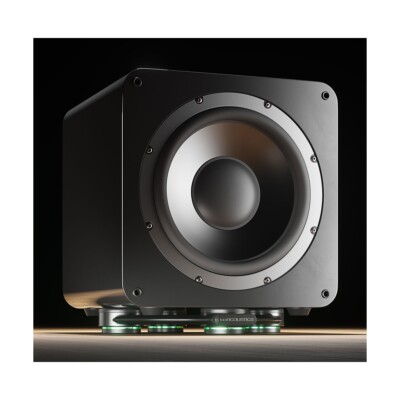
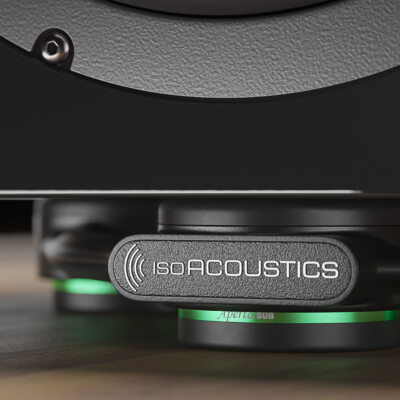
IsoAcoustics Aperta Sub Subwoofer Isolation Stand
- ✔️ Genuine IsoAcoustics Aperta Sub, brand new in box
- ✔️ Low-profile isolation stand for front-firing and side-firing subwoofers up to 80 lbs (36.3 kg)
- ✔️ Includes 1 stand plus 4 carpet discs for carpeted surfaces
- ✔️ Helps reduce energy transfer, room rattle, and muddy bass smear for tighter low-frequency performance
- ✔️ Backed by a 2-year manufacturer’s warranty in Canada
Related Products
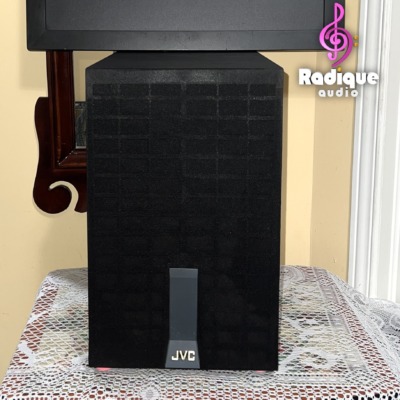
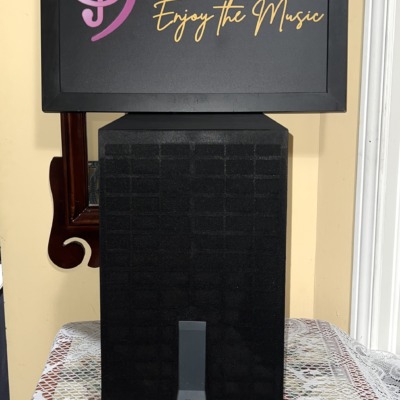
JVC SX-PW33 Slim Tower Subwoofer — 6.5in, 100W, High-Pass Out
A tall, narrow bass column meant to stand beside a cabinet rather than in front of it — 8.25 inches across the front and unusually deep at 17, which is the trade: the depth buys back the internal volume the narrow baffle gives away, so a 6.5 inch woofer is properly loaded in a strip of floor barely wider than a hardcover book. Driven by an integrated 100 watt amplifier, with speaker-level inputs and high-pass outputs so it works with an amplifier that has no subwoofer output at all. Good condition.
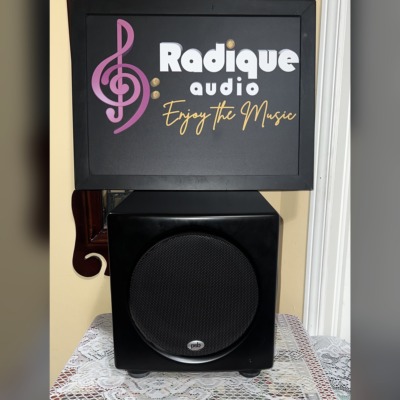
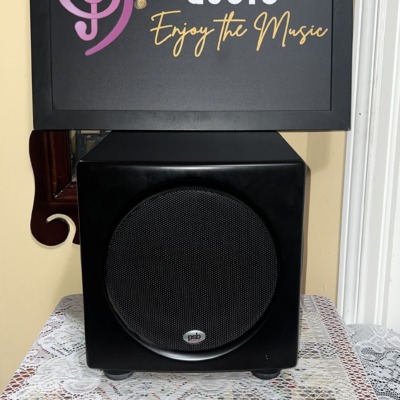
PSB SubSeries HD10 10″ Powered Subwoofer — 750W, 2000W Peak!
A serious subwoofer in about a square foot of floor, from one of the most respected names in Canadian loudspeaker design, with deep, powerful bass for home theatre and most music.
✔️ Good condition — light scuffs on the top, and a little vibration when played loud (details below)
✔️ 10-inch driver, two passive radiators and a 750 W Class H amplifier
✔️ Line-level and high-level inputs — works even with a receiver that has no sub out
✔️ Covered by Radique Warranty
✔️ Includes Perpetual Trade-Back Program eligibility
✔️ Expertly packed for safe shipping
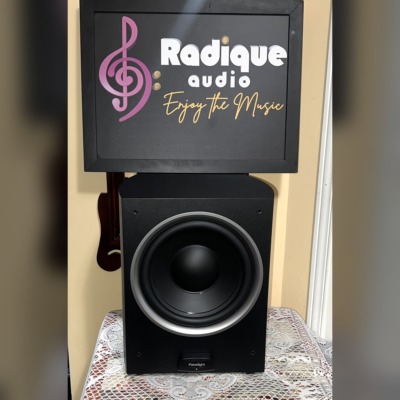
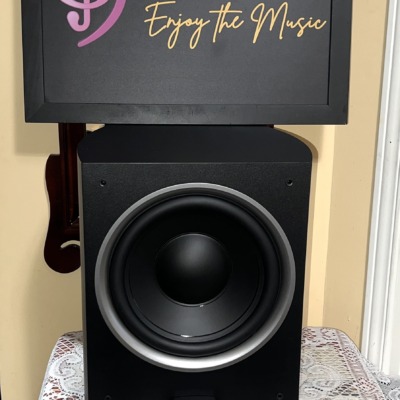
Paradigm PDR-10 v.4 10″ Powered Subwoofer – 300W Peak, Serviced
A black Paradigm PDR-10 v.4 powered subwoofer, with a 10-inch forward-firing driver and 100 watts RMS (300 watts dynamic peak) on board, serviced on our bench and in very good condition.
✔️ Very good condition — free of significant marks
✔️ Serviced on our bench and tested before listing
✔️ 10-inch forward-firing driver, 100 W RMS and 300 W dynamic peak
✔️ Covered by Radique Warranty
✔️ Includes Perpetual Trade-Back Program eligibility
✔️ Expertly packed for safe shipping
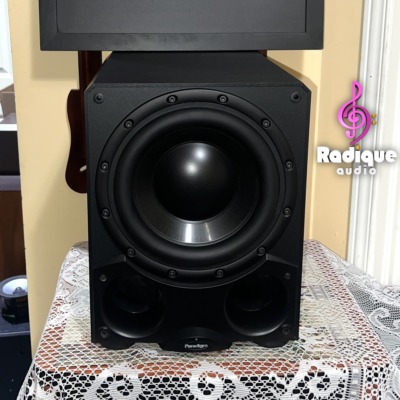
Paradigm DSP-3100 v.2 10″ Subwoofer – 600W Peak, Made in Canada
A black Paradigm DSP-3100 v.2 powered subwoofer, made in Canada, with a 10-inch front-firing driver and 200 watts RMS (600 watts dynamic peak) on board. It has been tested on our bench and is in very good condition.
✔️ Very good condition — removable black cloth grille included
✔️ 10-inch front-firing driver, 200 W RMS / 600 W peak Class-D
✔️ Front ports for hidden installs — made in Canada
✔️ Covered by Radique Warranty
✔️ Includes Perpetual Trade-Back Program eligibility
✔️ Expertly packed for safe shipping
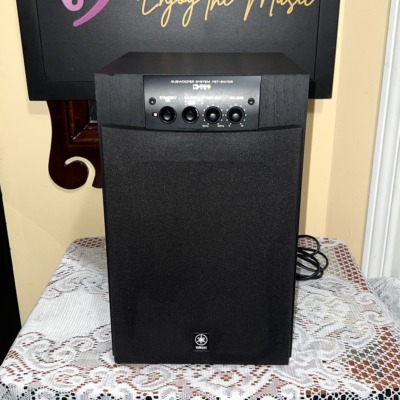
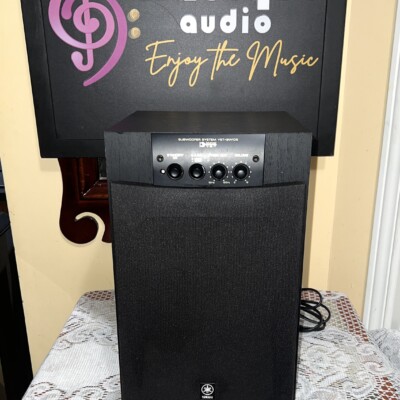
Yamaha YST-SW105 Active Servo Subwoofer — Compact 100W
An 8-inch front-firing paper cone on Yamaha's Advanced Active Servo amplifier — 100 watts into 5 ohms, down to 30 Hz, from a cabinet small enough to tuck beside a bookshelf pair. Continuously variable high-cut from 50 to 150 Hz, a Music/Movie voicing switch, RCA and speaker-level inputs plus full-range pass-through outputs. Very good condition.
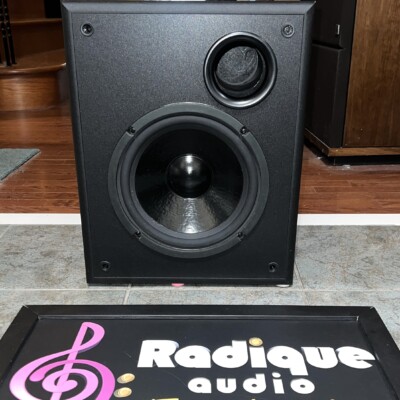
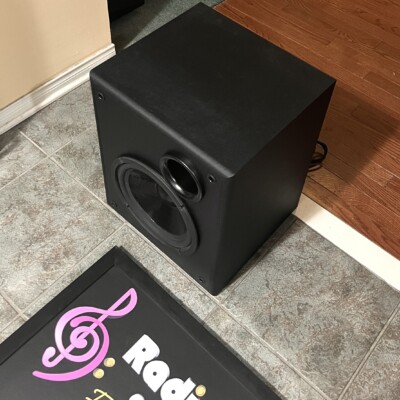
Yamaha SW-3 Active Servo Subwoofer — 10″ Woofer | Air Woofer Tec
Yamaha’s Active Servo Technology couples a negative-impedance drive amplifier to a Helmholtz resonator port — the Air Woofer opening — so the amplifier corrects the driver’s motion as it works. 100 watts into a 25 cm cone, rated down to 25 Hz, with a continuously variable 50–150 Hz high-cut at 24 dB per octave. Speaker-level and line inputs both. Very good condition.
