

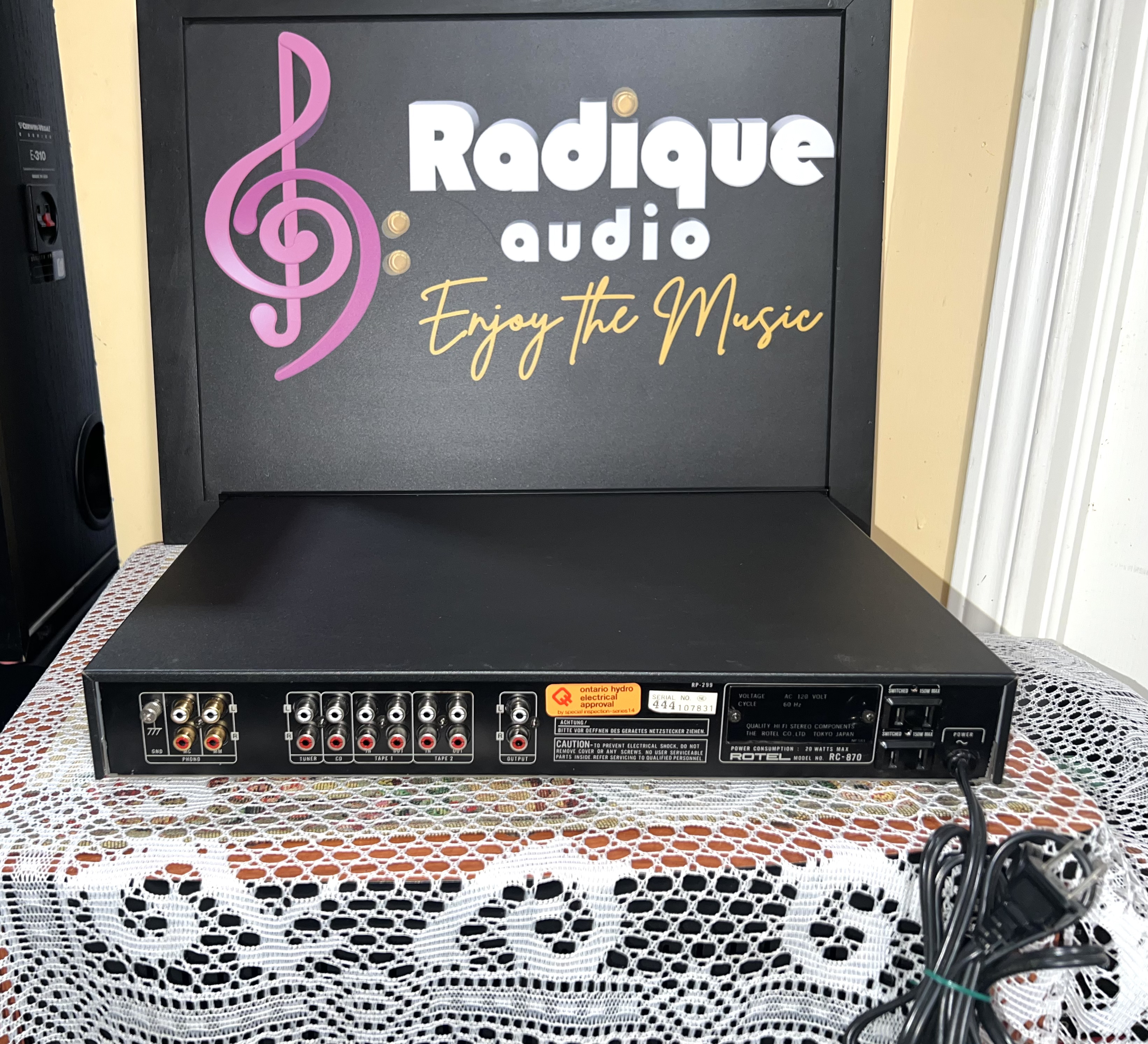

Rotel RC-870 Preamplifier – MM/MC Phono, Made in Japan, 1985
$395.00
Rotel called this a stereo control amplifier rather than a preamp, and it earns the name — no tone controls, no filters, no loudness, just four line inputs and two tape loops with dubbing either way. The phono stage runs moving magnet and moving coil through separate buffers, and line distortion is no greater than 0.004%. Stamped Tokyo, Japan on the rear panel. Excellent cosmetic condition.
1 in stock
Rotel RC-870 — Slim, Simple and Pure, Made in Japan
Rotel RC-870 Stereo Control Amplifier – Made in Japan, Moving Magnet and Moving Coil Phono, Four Line Inputs, Excellent Condition
Rotel’s own description of this preamplifier was “slim, simple and pure,” and forty years later that is still the most accurate thing anyone has written about it.
There are no tone controls. No high-cut or low-cut filters. No loudness contour. Rotel called it a stereo control amplifier rather than a preamp, and the design philosophy is exactly what the name suggests — the shortest possible path between your source and your power amplifier, with nothing in the way. Everything the money would have gone into on tone controls went into the parts that carry the signal instead.
This one is stamped Tokyo, Japan on the rear panel, which is worth pointing out. Rotel’s manufacturing moved around considerably over the years, and a good deal of well-regarded eighties Rotel was built elsewhere. This is a Japanese-built example.
The phono stage is where the design philosophy shows most clearly. It handles both moving magnet and moving coil cartridges, and it does so properly: an input buffer isolates the cartridge from a shunt-feedback RIAA equalisation stage, and moving coil cartridges get their own entirely independent buffer amplifier, optimised for the job and providing the extra gain they need. That is a real two-stage phono section rather than a switch that simply adds gain, and it is a large part of why these still get bought by people with turntables.
The numbers back it up. Line-stage distortion is no more than 0.004 percent, signal to noise on the line inputs is 95dB, and the line frequency response runs from 4Hz to 100kHz. Phono response holds to RIAA within ±0.2dB from 40Hz to 100kHz, with 78dB signal to noise on moving magnet and 64dB on moving coil.
Four line inputs cover CD, tuner and two tape loops, with dubbing between the tapes in either direction. There is a mode switch for stereo, mono and mute, a headphone socket that will drive 4 to 16 ohm loads, and that is the whole of it — which is the point.
Condition
Cosmetically this is in excellent condition. We looked it over closely under bright light before grading it, and it is a genuinely clean example of a forty-year-old component.
It has been thoroughly inspected and tested to confirm full functionality.
Features: Made in Japan Full MM and MC phono stage with independent moving-coil buffer Line-stage distortion no greater than 0.004% 95dB signal to noise on line inputs Four line inputs with two tape loops and bidirectional dubbing Stereo / mono / mute mode switch Headphone output, 4 to 16 ohm loads No tone controls, filters or loudness — a deliberately direct signal path
Rotel RC-870 Specifications
- Model: RC-870
- Type: Stereo control amplifier (preamplifier)
- Year: 1985
- Frequency Response (line): 4Hz – 100kHz, +0 / -3dB
- Frequency Response (phono): 40Hz – 100kHz, ±0.2dB RIAA
- Total Harmonic Distortion (line): no more than 0.004%
- Intermodulation Distortion (line): no more than 0.004%
- Signal to Noise: 95dB line, 78dB MM phono, 64dB MC phono
- Input Sensitivity: 2.5mV MM phono, 350µV MC phono, 450mV CD, 150mV tuner and tape
- Output: 1.0V into 1.2k ohms
- Headphone Load Impedance: 4 – 16 ohms
- Power Consumption: 20 watts
- Country of Manufacture: Japan
- Dimensions: (Width x Height x Depth) 430 x 66 x 317 mm (16.9 x 2.6 x 12.5 inches)
- Weight: 5.2 kg (11.4 lbs)
⚠️ Important Information for International Buyers
This unit is configured for North American 110/120V power. Buyers outside North America will require a step-down transformer and appropriate plug adapter.
✅ Buy With Confidence — The Radique Promise
Backed by Radique Audio’s Bumper-to-Bumper Warranty and our Perpetual Trade-Back Program. When you’re ready to move on, we’ll take it back. That’s the Radique difference.
📦 Watch how we protect your gear — our unboxing video.
📺 Curious about our business? Check out our YouTube channel for behind-the-scenes videos and more!
📞 Questions? Use the Ask a Question button above, or call us at 613-416-9995.
| Weight | 13.4 lbs |
|---|---|
| Dimensions | 16.5 × 20.9 × 6.6 in |
Rotel began in Tokyo in the late 1950s, founded by Tomoki Tachikawa, and the Rotel name dates from 1961. The Tachikawa family still owns it, and Kevro International of Pickering, Ontario, distributes it in Canada. We carry Rotel power amplifiers, preamplifiers, integrated amps, CD players and AV receivers and processors. We've had nearly 50 Rotel listings so far, covering about 40 different models. Every used Rotel here is inspected, tested and serviced as required, then photographed in-house and covered by our Bumper-to-Bumper Warranty and Perpetual Trade-Back Program. Don't see the model you want? Tell us on First Dibs and we'll email you when one arrives.
The Rotel models we've sold most often include the RSP-1068 surround processor, the RMB-1075 five-channel amplifier and the RTC-965 tuner-preamplifier.
The Rotel story
Tomoki Tachikawa started the company in Tokyo in the late 1950s. Rotel says it first distributed Sylvania televisions in Japan, then reorganized in 1961, left the TV business and went on to design and build electronics for other brands. The Rotel name dates from 1961.
Value hi-fi. Rotel says it refocused in 1979 on no-frills components that put musical accuracy and build quality ahead of features. Its RA-820 integrated amplifiers of the early 1980s were developed with engineers in England, and Rotel says the RA-820B won its first What Hi-Fi? Product of the Year in 1982.
B&W and home theatre. Rotel's partnership with Bowers & Wilkins began in 1981, and the two later shared manufacturing in Zhuhai, China. Rotel added surround processors and receivers in the 1990s and its first DVD player in 2000.
Today. Production moved from Japan to Taiwan and then to China, where Rotel builds in its own factory in Zhuhai. The family relaunched its high-end Michi line in 2019, and Peter Kao, a third-generation member of the family, runs the company. Kevro International, which first carried Rotel in Canada in 1984, has been its Canadian distributor again since 2019.
Which Rotel is which?
1970s receivers: the RX series, such as the RX-402 and the RX-603 to RX-1603, with matching RT tuners.
BX separates and integrated amps (1980s to 1990s): the RA-820 family, the RTC-850 tuner-preamplifier (1988 to 1991) and the RB-960BX to RB-990BX power amps of the 1990s.
Home theatre (1990s to 2000s): the RSX-965 surround receiver, the RTC-965 tuner-preamplifier (1999 to 2000), the RSP-1066 and RSP-1068 processors, the RMB-1075 five-channel amp (2001) and the RDV-995 DVD player.
The 10 and 15 Series: stereo power amps such as the RB-1070 and RB-1080, the RCC-1055 CD changer, and the 15 Series of 2009, including the RC-1550 preamp and RB-1552 power amp.
Diamond Series and Michi (2019 on): today's flagships, such as the RA-6000 integrated amplifier.
Buying used Rotel: what to check
Processors stuck in standby. Owners report RSP-1066 and RSP-1068 processors that show the red standby light but won't wake. Both rear software-update switches must be off, and a factory reset fixes some.
Power amps. The RB-1070 and RB-1080 have no output relays, so some make a noise a few seconds after switching off: turn the volume down first. Owners also report early RB-1080s blowing a left-channel fuse, which Rotel fixed in production.
Protection lights and loads. On the RMB-1075, check that no protection light stays on, and use speakers of 4 ohms or more. The RB-960BX needs 8 ohms or more when bridged.
Digital inputs. If DTS sounds harsh through an RSX-965, check that the player is sending a raw bitstream before blaming the receiver.
Trays. Cycle the tray several times, and on the RCC-1055 every disc position. A worn tray belt makes it slow or noisy.
Everything we list is inspected, tested and serviced as required here, and comes with our warranty.
You may also like…
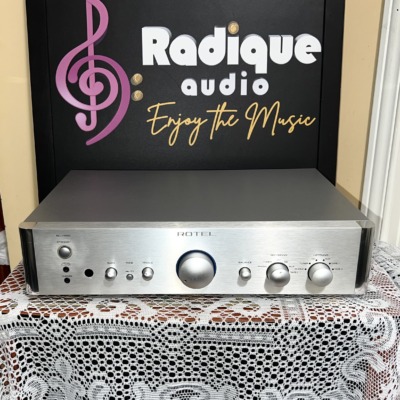

Rotel RC-1550 Stereo Preamplifier – Silver, Remote, MM Phono
A modern-era Rotel preamplifier in silver, with its remote, built around a proper power supply.
✔️ Condition: Very Good — silver facia clean, presents beautifully
✔️ Covered by Radique Warranty
✔️ Includes Perpetual Trade-Back Program eligibility
✔️ Expertly packed for safe shipping
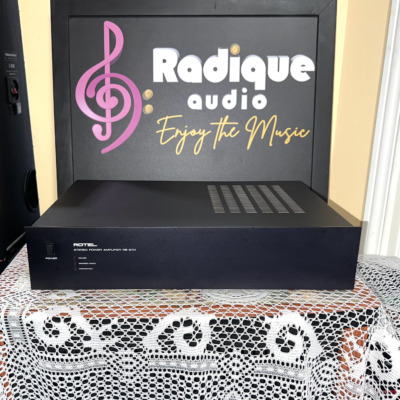
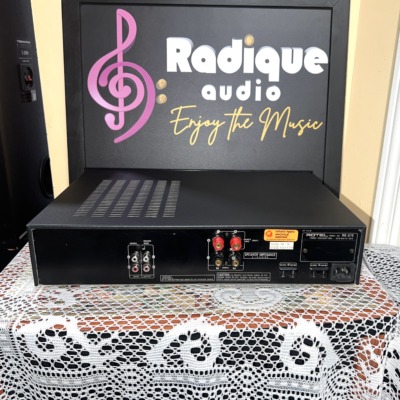
Rotel RB-870 Stereo Power Amplifier – 60 WPC, Bridgeable
Sixty watts a channel into 8 ohms at 0.03% distortion, a damping factor of 280, and response running out to 120kHz. A rear-panel switch bridges the two channels into a single 120-watt mono amplifier, so a second one later gives you monoblocks. The speaker terminals clamp bare wire or spades only — no bananas. Very good condition, inspected and tested.
Related Products
- ✔️ Marantz Model 3800 preamplifier — precision built in the USA, 1976–78
- ✔️ 5Hz–60kHz, THD 0.25%, S/N 100dB line and 82dB MM phono
- ✔️ Built-in Dolby encoder/decoder with calibration metering and 400Hz tone generator
- ✔️ Independent L/R bass, mid and treble sliders, turnover selectors, three filters, tone defeat
- ✔️ Dual preamp outputs for bi-amping · four switched AC outlets · Level 1 serviced
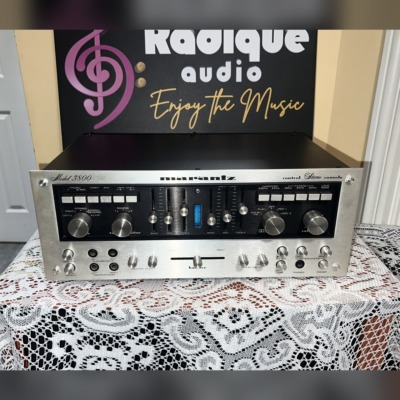
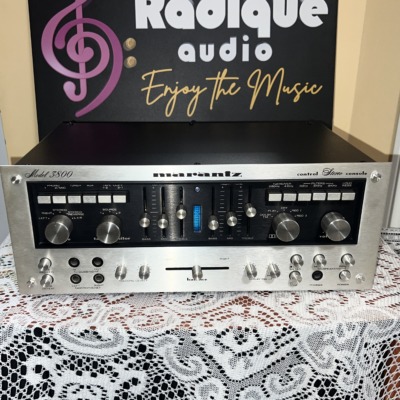
Marantz 3800 Audiophile Preamp – Made in USA
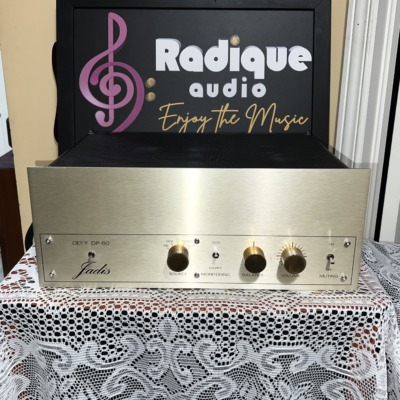
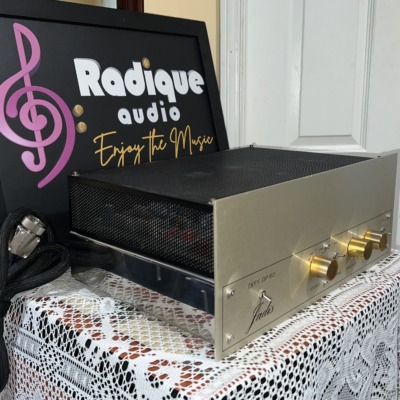
Jadis Defy DP-60 Tube Preamplifier — MM/MC Phono, Outboard PSU
A full-function valve preamplifier — line stage and a moving-magnet/moving-coil phono section, valves throughout, with the power supply in its own separate chassis. Hand-built in the south of France, in excellent condition, and it comes with the original factory cartons including the shaped foam box for the supply.
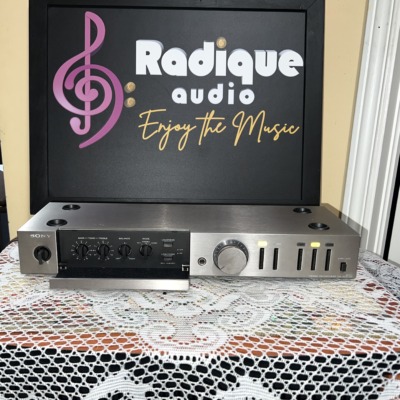
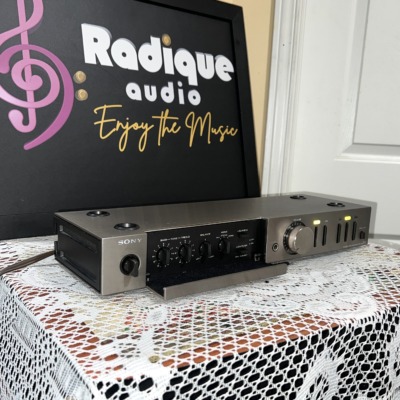
Sony TAE-20FB Falcon Preamplifier — Bronze, MM/MC Phono, Japan
The control amplifier from Sony's short-lived Falcon range — made in Japan for barely two years and rarely seen on this side of the Pacific. Bronze-anodised aluminium case, a real moving-coil phono input alongside moving-magnet, and a signal path that has been freshly recapped. A couple of light marks on the casework, otherwise Very Good. Ships from Kanata, ON.
Rotel RC-1550 Stereo Preamplifier – Silver, Remote, MM Phono
A modern-era Rotel preamplifier in silver, with its remote, built around a proper power supply.
✔️ Condition: Very Good — silver facia clean, presents beautifully
✔️ Covered by Radique Warranty
✔️ Includes Perpetual Trade-Back Program eligibility
✔️ Expertly packed for safe shipping
