


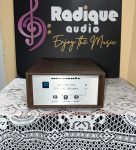
TOTL B&W 683 4-driver, 3-way Floor-Standers
$1,495.00
Out of stock
Get first dibs on the next one
B&W 683 Floorstanders – Top 600 Series Kevlar Towers
Radique’s take: Mark is a big fan of both BMW vehicles and B&W speakers, and La-Donna enjoys teasing him when he occasionally confuses the two similar names.
Great sounding B&W 4-driver, 3-way vented-box floor-standers; top of the 600 Series model line.
Founded in Worthing, England in 1966 by the late John Bowers, B&W (more formally known as Bowers & Wilkins) is now one of the best-known names in the loudspeaker industry. While the average person might think of the German car maker when they hear “B&W” spoken quickly, it is one of the first names that comes to an audiophile if asked to list the top speaker companies in the business. Unlike many of its competitors, B&W has focused its resources primarily on loudspeakers, and the 600 Series was created to deliver trickle-down technology from the company’s flagship ranges at more attainable prices.
The floor-standing 683 stands on a slightly wider base that gives the narrow cabinet better stability, and this particular pair includes the optional removable plinths for even greater stability and visual presence—an extra that adds real value over a bare cabinet. On the back of each speaker are two pairs of good, five-way input terminals; they are normally strapped together but can be separated for bi-amping or bi-wiring when partnering electronics allow.
On the front, the 683 employs B&W’s Flowport, a dimpled and flared port designed to minimize air turbulence and reduce port noise at higher playback levels. The front-mounted port location helps make these relatively deep, heavy towers easier to position in real rooms by reducing sensitivity to rear-wall distance, which is especially helpful in typical living rooms and multi-use spaces.
B&W is one of the few loudspeaker manufacturers with the scale and engineering capability to design and build its own drivers in-house, and it was an early adopter of stiffened woven Kevlar for midrange cones. The familiar yellow Kevlar FST 6″ midrange unit in the 683 is closely related to those used in the company’s higher-end 800 Series designs, giving these speakers their open, articulate midband and strong vocal presence.
The two 6.5″ bass drivers in the 683 are unique within the 600 Series, using a composite “mushroom” structure with bonded layers of aluminum, paper, and Kevlar to achieve high stiffness with controlled breakup behavior. This construction supports deep, tuneful bass that stays composed at realistic listening levels, complementing the midrange unit without sounding thick or sluggish.
The aluminum-dome tweeter in the 683 incorporates a tube-loaded rear chamber derived from B&W’s more expensive designs. The long, tapered, damped tube behind the dome absorbs rearward energy and pushes the main resonance well above the audible range, with rated response extending to 50kHz; even if ultra-sonic extension is of limited practical value, shifting breakup modes out of band helps maintain a smoother, more relaxed treble within the 20kHz range humans actually hear.
Key Features & Specifications:
4-driver, 3-way vented-box floorstanding speaker design
1″ aluminum dome tweeter with tube-loading chamber
6″ woven Kevlar FST midrange driver
2 x 6.5″ aluminum/paper/Kevlar composite cone bass drivers unique to the 683
Front-mounted Flowport with dimpled, flared profile to reduce turbulence
Dual 5-way binding posts for bi-amping or bi-wiring
Frequency range: -6dB at 30Hz and 50kHz
Frequency response: 38Hz–22kHz ±3dB on reference axis
Harmonic distortion (2nd/3rd, 90dB, 1m): <1% 90Hz–20kHz; <0.5% 120Hz–20kHz
Nominal impedance: 8Ω (minimum 3Ω)
Crossover frequencies: 350Hz, 4kHz
Recommended amplifier power: 25W–200W into 8Ω, unclipped
Sensitivity: 90dB (2.83V, 1m)
Optional removable plinths included for added stability and footprint
Finish: Black Ash with black grilles
Dimensions: (Height x Width x Depth) 985 x 198 x 340 mm (38.8 x 7.8 x 13.4 inches)
Weight: 26 kg (57.3 lbs) each
This attractive and great-sounding pair of B&W 683s in Black Ash is in excellent condition, with the optional plinths enhancing both stability and visual stance in a serious two-channel or home-theatre system.
Backed by Radique Audio’s 90-day warranty and our perpetual trade-back policy, you can purchase with confidence.
Asking $1,495 CAD.
| Weight | 120 lbs |
|---|---|
| Dimensions | 17.4 × 22 × 43 in |
Bowers & Wilkins began in Worthing, England, in 1966, founded by John Bowers. The name comes from the Worthing electrical shop he ran with Roy Wilkins. Its 800 Series monitors have been used at Abbey Road Studios since 1980, Abbey Road says. We carry B&W towers, bookshelf speakers, centre channels and stands. We've had more than 200 B&W listings so far. Every used B&W here is inspected, tested and serviced as required, then photographed in-house and covered by our Bumper-to-Bumper Warranty and Perpetual Trade-Back Program. Don't see the model you want? Tell us on First Dibs and we'll email you when one arrives.
The Bowers & Wilkins story, 1966 to today
John Bowers founded B&W in Worthing, England, in 1966, after hand-assembling speakers at the electrical shop he ran with Roy Wilkins. Its first speaker, the P1, used B&W's own cabinet and crossover with bought-in drivers, and the DM1 and DM3 "Domestic Monitors" followed in 1968.
Kevlar and the 801. B&W identified Kevlar as a cone material in 1974, and the DM6 of the mid-1970s used Kevlar cones. The original 801 monitor of 1979 to 1980 made its name in recording studios: Abbey Road says it was the first studio to use it, in 1980, and has used the 800 Series ever since.
Matrix and Nautilus. The Matrix cabinet bracing arrived in the mid-to-late 1980s. John Bowers started the project that became the Nautilus, the spiral-shell flagship, before he died in 1987, and it launched in 1993. The first 600 Series followed in 1995, and diamond-dome tweeters arrived in 2005.
New owners. EVA Automation bought B&W in 2016, Sound United in 2020 and Masimo in 2022, and in September 2025 HARMAN, a Samsung company, completed its purchase of Sound United. The 800 Series Diamond D5, unveiled in June 2026, is built in Worthing.
A Canadian connection. Classé Audio of Montreal was part of the B&W Group from 2001 until B&W closed its Montreal headquarters in 2017.
Which B&W is which?
DM (Domestic Monitor), 1968 onward: from the DM1 and DM3 to models such as the DM6 and DM7. The DM prefix carried into early 600 Series names.
600 Series (1995 to today): B&W's entry hi-fi line; the 2020 Anniversary Edition was its seventh generation. The 606 belongs here.
CDM (mid-1990s to about 2003): such as the CDM 1, with a metal-dome tweeter and a Kevlar cone.
700 Series (about 2003 to 2006): Nautilus technology at mainstream prices, such as the 703 and 705.
CM Series (2006 to 2017): such as the CM1 and the CM4 towers, replaced by the 700 Series S2 in 2017.
800 Series (from 1979 to 1980): from the original 801 through the Matrix, Nautilus 800, Diamond, D3, D4 and D5 generations.
Nautilus (1993): the spiral-shell flagship, still made in small numbers.
Buying used B&W: what to check
Tweeter domes. B&W used metal-dome tweeters in the CDM, 600 and CM lines, and owners report squashed domes. Inspect each dome closely.
Original tweeters. Some CDM-era tweeters are discontinued, and rebuilt or substitute tweeters change the sound. Ask whether the originals are fitted.
Woofer surrounds. Owners report rubber surrounds that have hardened with age. Press each surround gently: it should feel supple.
1970s DM models. Expect crossover capacitors in a 40-year-old DM to need replacing.
Where it was made. The 800 Series is built in Worthing; the 600 and 700 Series are made in China. Check the label before calling a B&W "made in England".
Everything we list is inspected, tested and serviced as required here, and comes with our warranty.
You may also like…


IsoAcoustics GAIA II Speaker Isolators (Set of 4)
- ✔️ Genuine IsoAcoustics, brand new, from an authorized Canadian dealer
- ✔️ A set of 4 isolators for one floor-standing speaker or subwoofer up to 120 lb (54 kg)
- ✔️ Screws in place of your spikes: M6-1.0, M8-1.25 and 1/4″-20 adaptors included
- ✔️ Machined stainless steel, dark chrome, 2 × 1.7 in (51 × 43 mm) per isolator
- ✔️ Pick up in Kanata by appointment, or shipped across Canada and internationally


IsoAcoustics GAIA III Speaker Isolators (Set of 4)
- ✔️ Genuine IsoAcoustics, brand new, from an authorized Canadian dealer
- ✔️ A set of 4 isolators for one floor-standing speaker or subwoofer up to 70 lb (32 kg)
- ✔️ Screws in place of your spikes: M6-1.0, M8-1.25 and 1/4″-20 adaptors included
- ✔️ Stainless steel, 1.7 × 1.5 in (43 × 39 mm) per isolator
- ✔️ Pick up in Kanata by appointment, or shipped across Canada and internationally
Related Products
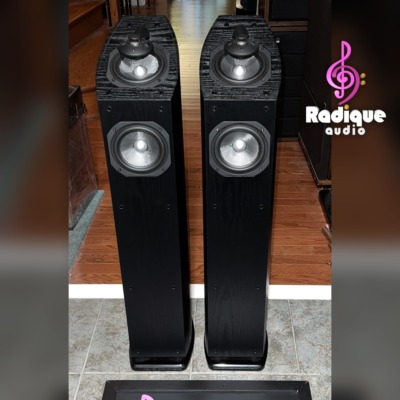
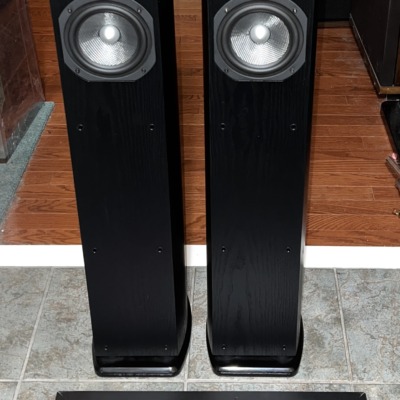
Mirage OMNI 350 Omnipolar Towers – Designed in Canada, Black Ash
A pair of slim Mirage towers built around the company's Omnipolar design, in very good condition, that fill a room with sound instead of aiming it at one chair.
✔️ Very Good condition — black ash cabinets, drivers and grilles present cleanly
✔️ Designed and engineered in Canada around Mirage's room-filling Omnipolar sound
✔️ Covered by Radique Warranty
✔️ Includes Perpetual Trade-Back Program eligibility
✔️ Expertly packed for safe shipping
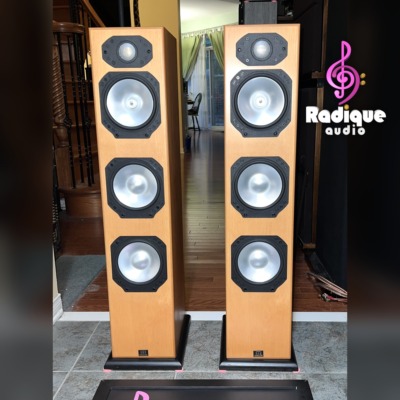
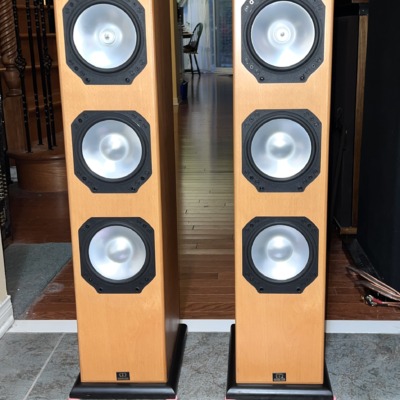
Monitor Audio Silver S8 Towers – Made in England, Warm Beech
A pair of three-way Monitor Audio towers from the Silver S range, in very good condition, with a metal driver in every position and a warm beech veneer that suits almost any room.
✔️ Very good condition — free of significant marks, in Warm Beech real wood veneer
✔️ Made in England, with Monitor Audio's C-CAM metal drivers throughout
✔️ Bi-wire and bi-amp ready — two pairs of 5-way binding posts per speaker
✔️ Covered by Radique Warranty
✔️ Includes Perpetual Trade-Back Program eligibility
✔️ Expertly packed for safe shipping
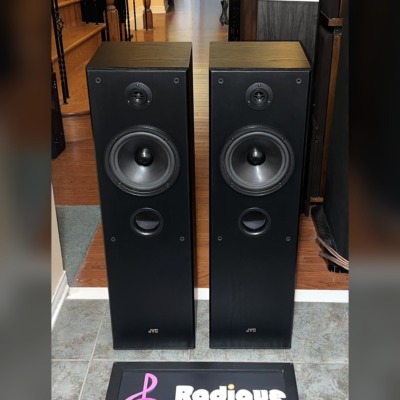
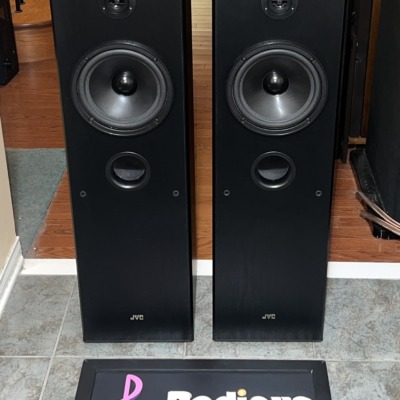
JVC Theatre Series SP-5500 Tower Speakers, Pair – 8-inch Woofers
A pair of JVC Theatre Series SP-5500 two-way tower speakers in black woodgrain, with front-ported bass-reflex cabinets, tested on our bench and in very good condition.
✔️ Very good condition — free of significant marks, grilles included
✔️ 8-inch woofers in front-ported Theatre Series towers
✔️ Built-in circuit breaker protects the tweeters
✔️ Covered by Radique Warranty
✔️ Includes Perpetual Trade-Back Program eligibility
✔️ Expertly packed for safe shipping
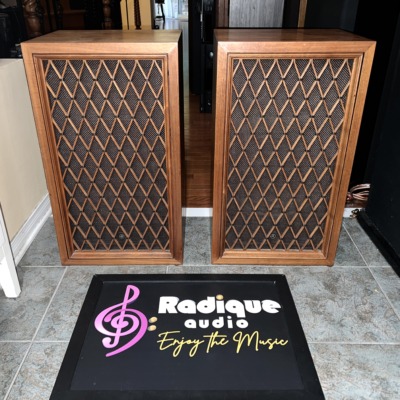
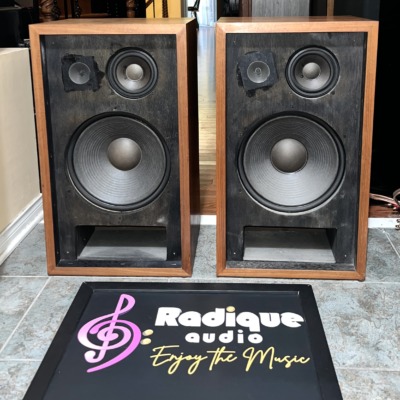
Vintage Pioneer CS-77 12″ 3-Way Speakers, Pair – Made in Japan
A pair of late-1960s Pioneer CS-77 three-way speakers, made in Japan, in walnut veneer cabinets with their wooden diamond-lattice grilles. Their High Level controls have been freshly serviced, they have been tested on our bench, and they are in good condition.
✔️ Good condition — walnut veneer, wooden lattice grilles included
✔️ High Level controls freshly serviced, tested on our bench
✔️ 12-inch woofer, three-way design — made in Japan, late 1960s
✔️ Covered by Radique Warranty
✔️ Includes Perpetual Trade-Back Program eligibility
✔️ Expertly packed for safe shipping
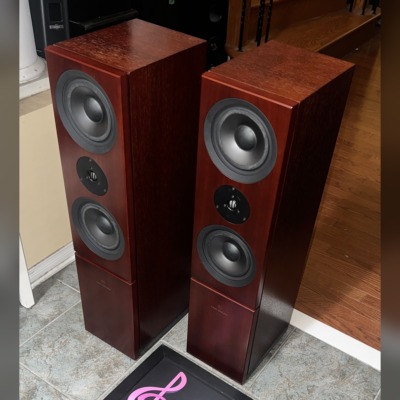
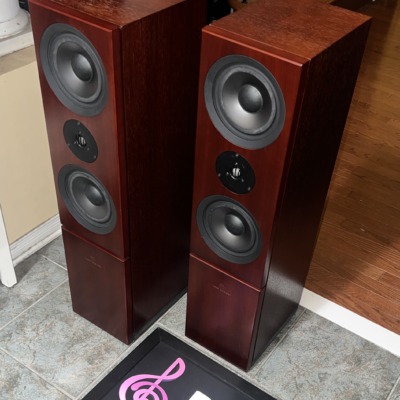
Linn Keilidh Floorstanding Speakers, Pair – Made in Scotland
A pair of Linn Keilidh floorstanding speakers, built in Glasgow, Scotland, in Linn's deep red Rosenut veneer, set up for bi-wiring.
✔️ Tested on our bench
✔️ Very good condition
✔️ Bi-wire ready: build your cable with our Cable Builder
✔️ Covered by Radique Warranty
✔️ Includes Perpetual Trade-Back Program eligibility
✔️ Expertly packed for safe shipping
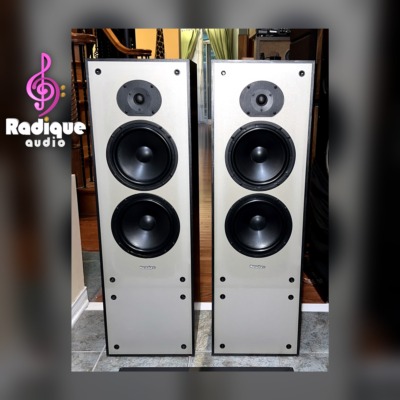
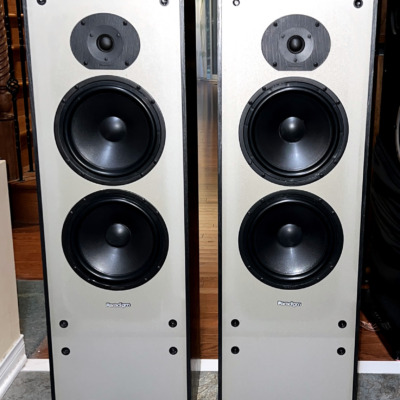
Paradigm 11se Mk II Towers, Pair — Dual 8″, Made in Canada
Built in Canada by Paradigm, and the largest speaker in the SE range — the one the rest of the series was working up to.
✔️ Condition: Good — cabinets touched up; repaired and working correctly
✔️ Covered by Radique Warranty
✔️ Includes Perpetual Trade-Back Program eligibility
✔️ Curbside delivery, local collection or freight within Canada
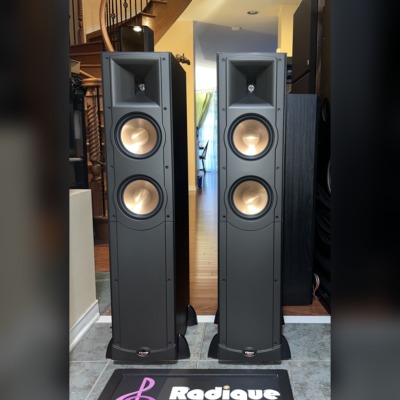
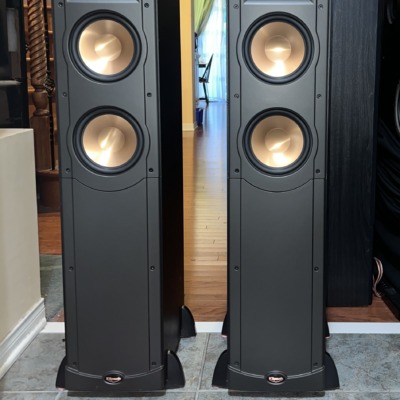
Klipsch RF-62 Reference IV Floorstanding Speakers, Pair — 97dB
The RF-62 is the tower that made Klipsch's Reference line the default answer for anyone who wanted a big, unforced sound without buying a big, expensive amplifier to get it.
✔️ Condition: Good — cabinets carry touched-up wear; drivers Very Good throughout
✔️ Covered by Radique Warranty
✔️ Includes Perpetual Trade-Back Program eligibility
✔️ Curbside delivery, local collection or freight within Canada
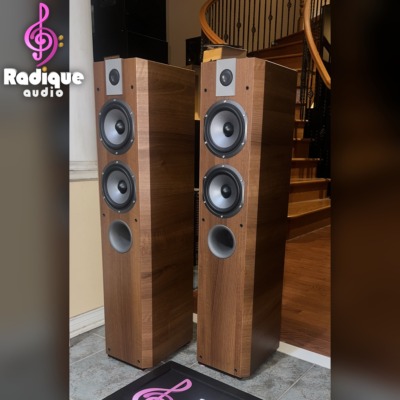
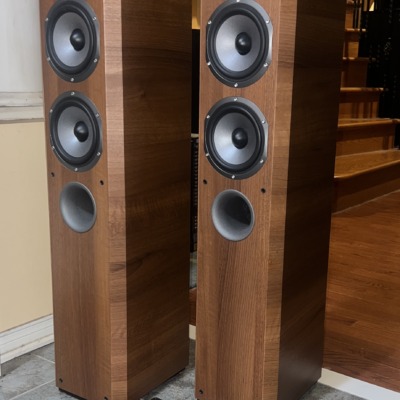
Focal Chorus 714V Floorstanders, Pair — Light Walnut, France
A pair of Focal Chorus 714V floorstanding loudspeakers in Light Walnut, made in France.
✔️ Condition: Very Good — thoroughly inspected and tested
✔️ Covered by Radique Warranty
✔️ Includes Perpetual Trade-Back Program eligibility
✔️ Expertly packed for safe shipping
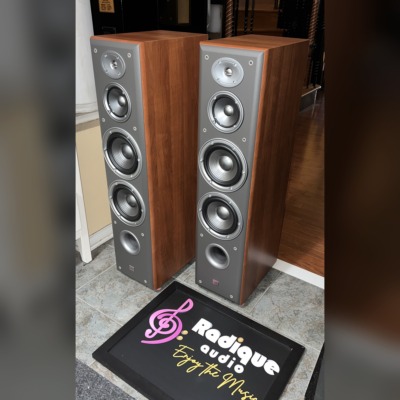
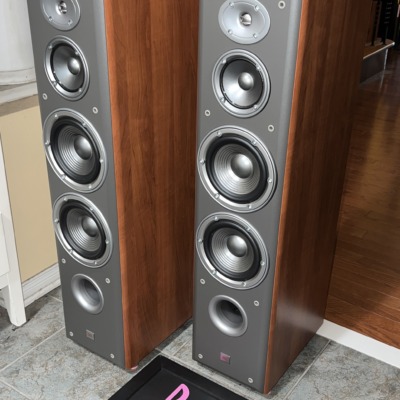
JBL Northridge E80 3-Way Towers – Cherry, Bi-Wirable, Pair
A four-driver JBL tower in the Cherry finish, with a genuine bi-amp panel.
✔️ Condition: Very Good — cabinets present well, working properly
✔️ Covered by Radique Warranty
✔️ Includes Perpetual Trade-Back Program eligibility
✔️ Expertly packed for safe shipping
