


JVC JR-S201 Vintage Stereo Receiver – 35 WPC, SEA EQ, Japan
$395.00
Thirty-five watts a channel at 0.01% distortion with a damping factor of 70 — numbers most larger receivers of 1978 could not reach. A five-band S.E.A. graphic equalizer sits on the front panel at 40, 250, 1k, 5k and 15kHz, alongside MM phono, two tape loops and push-button speaker terminals. Made in Japan, arrived professionally serviced; cosmetically graded Excellent.
1 in stock
JVC JR-S201 — A DC-Era Flagship in Genuinely Excellent Condition
A big, serious 1978 receiver from JVC’s DC amplifier era, serviced and in genuinely excellent condition, with a five-band graphic equalizer built in and a specification sheet that embarrasses most of what it competed against.
What the Numbers Actually Say
Thirty-five watts per channel does not sound like much until you read the rest of the numbers. Total harmonic distortion of 0.01%. Frequency response from 5 Hz to 40,000 Hz. A damping factor of 70. Those are figures that plenty of far more powerful receivers from the period could not approach, and they are the product of JVC’s DC amplifier design rather than marketing. Power ratings sell receivers; distortion figures and damping are what you actually hear, and this is where the JR-S201 spends its money.
Where It Sat in the Range
JVC’s own literature was refreshingly honest about where this model sat: same styling and same reliable performance as the more expensive models in the range, with lower power output and a correspondingly lower price. It was never a stripped-down receiver. It was the same engineering with a smaller output stage.
The S.E.A. Graphic Equalizer
The headline feature is the S.E.A. graphic equalizer — five bands at 40, 250, 1,000, 5,000 and 15,000 Hz, built into the front panel. This is not a bass-and-treble tone stack with ambitions. It is real room correction, and it is genuinely useful: it lets you tame a boomy corner, lift a dull room, or match a pair of speakers that are not quite voiced the way you would like. Very few receivers of any era offer this, and fewer still put it where you can reach it while the music is playing.
Connections and Features
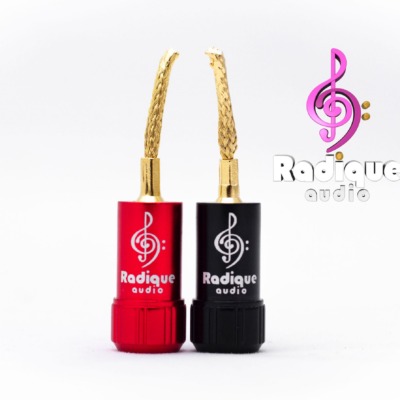
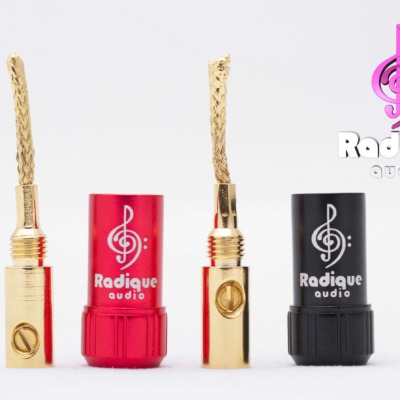
The speaker terminals deserve a mention of their own, because they are not what you expect at this level. Rather than the flimsy lever-action clips fitted to most receivers of the era — the ones that go slack with age and never grip properly again — JVC specified proper push-button terminals with gated openings. Press, insert, release, and the connection is firm and stays firm. They take bare wire beautifully, and they are an ideal match for our Radique Audio Gold Plated Pin Connectors, which slide straight in and give you a clean, solid, repeatable connection without the fuss of stripping and twisting every time you move something.
Beyond that: switchable A and B speaker outputs, a proper magnetic phono stage for a turntable, two tape loops with dubbing between them, a subsonic filter, and loudness compensation. Large signal and tuning meters light up green across a full-width dial. The chassis is nearly twenty inches wide, stamped Made in Japan, and built like industrial equipment from the period when JVC was building for the long term — there is an access panel under the top cover because the company expected it to be serviced rather than discarded.
This is where it becomes genuinely rare. This example arrived professionally serviced, and has been thoroughly inspected and tested in-house to confirm full functionality. Cosmetically it is graded Excellent, and we don’t hand that rating out lightly — on a receiver approaching fifty years old it is close to unheard of. It presents beautifully.
Radique’s Take
Mark’s first stereo was a JVC — a ghetto blaster earned by selling magazine subscriptions for a school fundraiser, and he has rarely been prouder of anything since. JVC never built the collector following that Pioneer and Marantz enjoy, which strikes us as a question of fashion rather than engineering. A receiver measuring 0.01% distortion is not a lesser thing because its badge is out of favour. It simply costs less, and that is the buyer’s good fortune rather than ours.
Finding any receiver of this age in excellent cosmetic condition is difficult. Finding one that has already been through a proper service, with a five-band equalizer, proper speaker terminals and a distortion figure of 0.01%, is a good deal harder than that. It will drive a real pair of speakers properly and look superb doing it.
JVC JR-S201 Specifications
- Design: AM/FM DC integrated stereo receiver with S.E.A. graphic equalizer
- Power output: 35 watts per channel into 8 ohms
- Total harmonic distortion: 0.01%
- Frequency response: 5Hz-40kHz
- Damping factor: 70
- Signal to noise ratio: 75dB (magnetic phono), 95dB (line)
- Input sensitivity: 2.5mV (magnetic phono), 150mV (line)
- Speaker load impedance: 4 to 16 ohms
- Equalizer: Five-band S.E.A. – 40, 250, 1,000, 5,000, 15,000 Hz
- Speaker terminals: Push-button gated spring terminals – bare wire or pin connectors; pairs ideally with Radique Audio Gold Plated Pin Connectors
- Inputs: Phono (MM), Aux, Tape 1, Tape 2
- Features: A/B speaker switching, tape dubbing, subsonic filter, loudness
- Power consumption: 380 watts
- Year of introduction: 1978
- Original manufacturer: JVC, Victor Company of Japan – Made in Japan
- Dimensions: (Width x Height x Depth) 19.7 x 6.5 x 14.9 inches (500 x 166 x 378 mm)
- Weight: 23.4 lbs (10.6 kg)
⚠️ Important Information for International Buyers
This unit is configured for North American 110/120V power. Buyers outside North America will require a step-down transformer and appropriate plug adapter.
✅ Buy With Confidence — The Radique Promise
Backed by Radique Audio’s Bumper-to-Bumper Warranty and our Perpetual Trade-Back Program. When you’re ready to move on, we’ll take it back. That’s the Radique difference.
📦 Watch how we protect your gear — our unboxing video.
📺 Curious about our business? Check out our YouTube channel for behind-the-scenes videos and more!
📞 Questions? Use the Ask a Question button above, or call us at 613-416-9995.
| Weight | 25.4 lbs |
|---|---|
| Dimensions | 19.9 × 23.7 × 10.5 in |
JVC was founded in Yokohama, Japan, in 1927 as the Japanese arm of America's Victor Talking Machine Company, first making phonographs and records. We carry JVC stereo receivers and AV receivers, cassette decks, CD players, turntables and speakers. We've had more than 90 JVC listings so far, covering more than 80 different models. Every AV receiver we list is tested input by input on our bench: each HDMI input and output, the analog, optical and coaxial inputs, the subwoofer outputs and the wireless features where it has them. Every used JVC here is inspected, tested and serviced as required, then photographed in-house and covered by our Bumper-to-Bumper Warranty and Perpetual Trade-Back Program. Don't see the model you want? Tell us on First Dibs and we'll email you when one arrives.
JVC models we've sold more than once include the RX-7000VBK and RX-8000VBK AV receivers.
The JVC story, 1927 to today
JVC began in 1927 as the Japanese subsidiary of the Victor Talking Machine Company, making phonographs and records, and built a large plant in Yokohama in 1930. RCA bought Victor in 1929, and in the late 1930s JVC passed to Japanese owners.
Stereo, quad and video. JVC joined the Matsushita (Panasonic) group in the early 1950s. It developed the CD-4 discrete four-channel record system in the early 1970s and the SEA graphic equalizer built into its receivers, and in 1976 its video division introduced VHS.
Hi-fi highlights. The late 1970s and early 1980s brought the JR-S receivers, whose SEA sliders replaced the tone controls, the Super-A amplifiers and the QL quartz-lock turntables, and around 1990 the XL-Z CD players with JVC's K2 Interface.
Today. JVC merged with Kenwood between 2008 and 2011, and JVCKENWOOD Corporation now owns the brand. JVC has had its own Canadian distribution since the 1970s, and JVCKENWOOD Canada is based in Mississauga, Ontario.
Which JVC is which?
1970s receivers: early four-channel models with CD-4 demodulators, and the JR-S series of 1976 to 1977, with built-in SEA equalizers.
Super-A amplifiers and receivers (1979 to the early 1980s): such as the A-X5 and A-X9 amplifiers and the R-S33 receiver.
Turntables: QL quartz-lock direct-drive models such as the QL-A7 and QL-Y5F, and belt-drive automatics such as the JL-A1.
Cassette decks and CD players: KD and CD-S decks from the 1970s, TD-W dual-well decks, and XL-Z CD players and XL changers.
AV receivers (2000 to 2004): the RX-x000V, RX-x010V and RX-x020V families, including the RX-7000VBK, RX-8000VBK and RX-6020VBK, and the RX-8040B.
Buying used JVC: what to check
SEA sliders. On JR-S and R-S receivers, work every equalizer slider through its range and listen for crackle or a channel dropping out.
FM muting. Stereo Review found the JR-S600's muting could thump when tuning on or off a station, so turn the volume down before tuning.
AV receivers. Run every channel, centre and surrounds included, at moderate volume. Owners report overload shutdowns on some 2000s models, which can come from a short in the speaker wiring.
Turntables. On QL servo turntables, check that the tracking-force and damping dials respond and that the arm finds the lead-in at both record sizes. Older JL automatics often need old grease cleaned out and a new belt.
Cassette decks. Treat belts and pinch rollers on any 1970s to 1990s deck as service items.
Everything we list is inspected, tested and serviced as required here, and comes with our warranty.
You may also like…
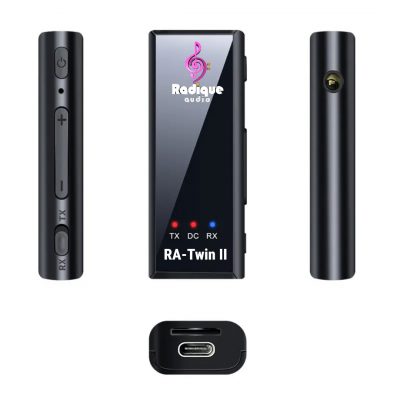
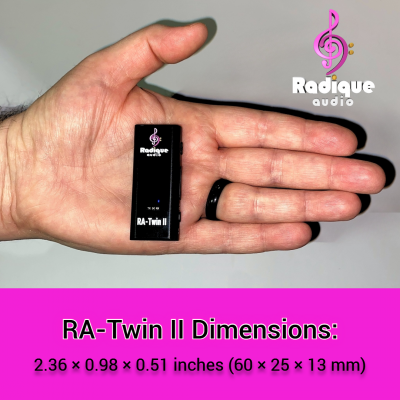
RA-Twin II Bluetooth Adapter for Vintage Stereo – Receiver & Transmitter
Add Bluetooth to any vintage stereo, amplifier or car stereo, or send your TV or stereo to Bluetooth headphones. Tiny but mighty, and set up in minutes.
- RX, TX and Mobile (microSD) modes
- Bluetooth 5.4, up to 10 m range
- Up to 10 hours per charge, USB-C
- Clear online manual in English & French
- 1-year warranty, Ottawa-based support
Related Products
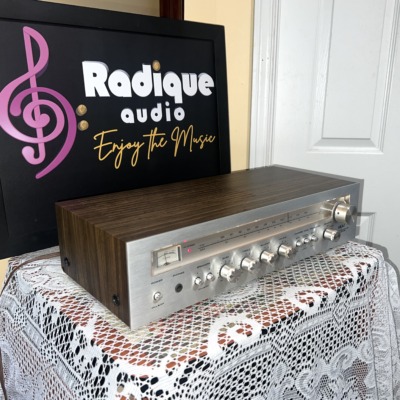
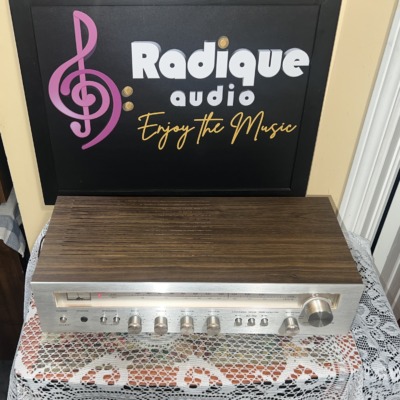
Akai AA-1115 Vintage Stereo Receiver – 15 WPC, Made in Japan
A slim late-1970s Akai AA-1115 AM/FM stereo receiver, made in Japan, silver face in its original woodgrain cabinet.
✔️ Tested on our bench, every input, output and control
✔️ Very good condition
✔️ MM phono, PLL FM tuner, speakers A and B
✔️ Covered by Radique Warranty
✔️ Includes Perpetual Trade-Back Program eligibility
✔️ Expertly packed for safe shipping
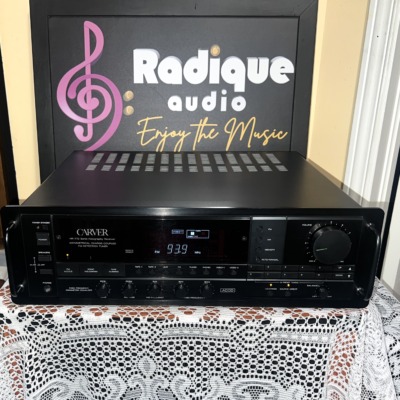
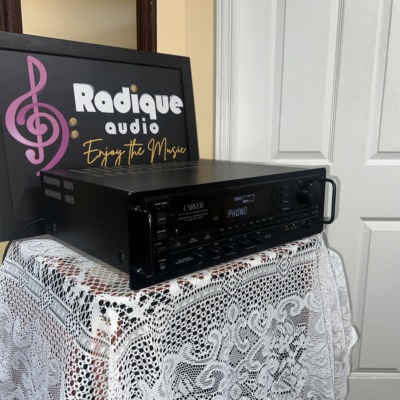
Carver HR-772 Sonic Holography Receiver – 140 WPC, Rack Ears
A Carver HR-772 stereo receiver, Carver's early-1990s flagship: 140 watts per channel, Sonic Holography, and rack ears with front handles.
✔️ Tested on our bench, Sonic Holography included
✔️ Very good condition
✔️ 140 WPC, stable to 2 ohms, MM phono, five-band EQ
✔️ Rack ears and handles for a 19-inch rack
✔️ Covered by Radique Warranty
✔️ Includes Perpetual Trade-Back Program eligibility
✔️ Expertly packed for safe shipping
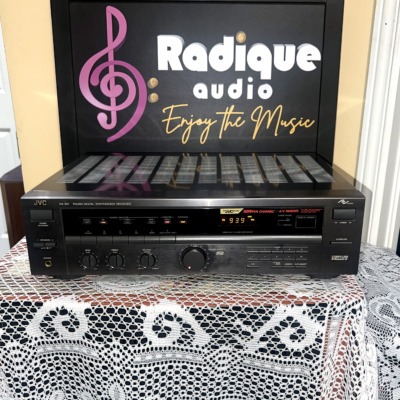
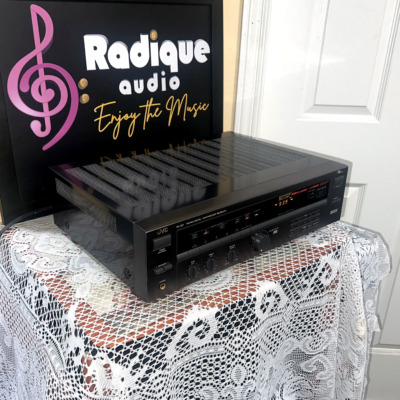
JVC RX-307 Stereo Receiver – 80 WPC, Original Remote & Manual
Eighty watts a side, a proper phono input, and the two things these almost never come with any more: the original remote and the printed manual.
✔️ Condition: Very Good
✔️ Covered by Radique Warranty
✔️ Includes Perpetual Trade-Back Program eligibility
✔️ Expertly packed for safe shipping
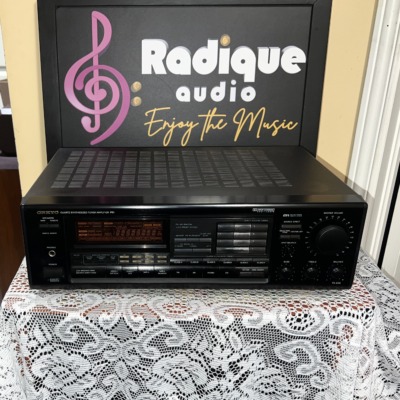
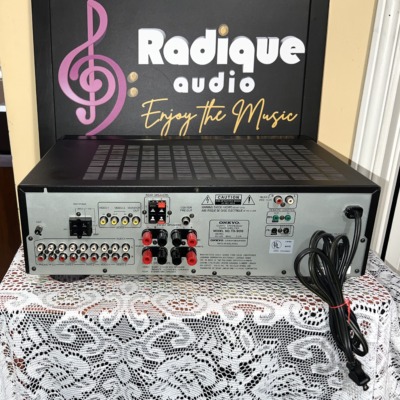
Onkyo TX-906 Stereo Receiver – 80 WPC, Dolby Pro Logic
An early-nineties Onkyo receiver with real power behind it and a phono input for your turntable, through our Level 1 service and playing as it should.
✔️ Good condition — works as it should; the black cabinet and faceplate present well
✔️ Through our Level 1 service — cleaned, deoxidized, checked and thoroughly tested on our bench
✔️ Phono input for your turntable, plus CD and two tape inputs
✔️ Covered by Radique Warranty
✔️ Includes Perpetual Trade-Back Program eligibility
✔️ Expertly packed for safe shipping
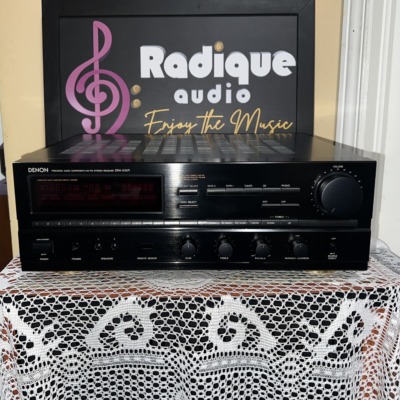
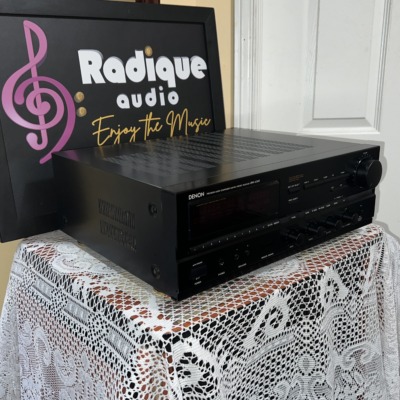
Denon DRA-835R Vintage Stereo Receiver – 100 WPC, Made in Japan
The second-from-the-top model in Denon's early-nineties stereo receiver range, made in Japan and in very good condition, with 100 watts per channel, a phono stage, motorized volume and its original remote.
✔️ Very good condition — free of significant marks
✔️ 100 WPC, MM phono and motorized volume — made in Japan
✔️ Original Denon remote included
✔️ Covered by Radique Warranty
✔️ Includes Perpetual Trade-Back Program eligibility
✔️ Expertly packed for safe shipping
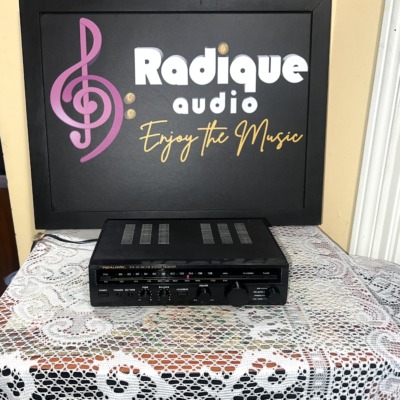
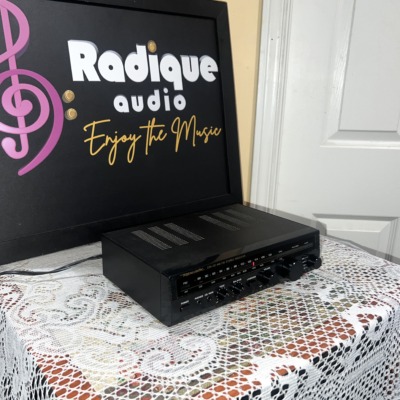
Realistic STA-20 Compact AM/FM Stereo Receiver – 5 WPC, Serviced
Radio Shack's smallest AM/FM stereo receiver of the 1990s, the Realistic STA-20: 5 watts per channel, a rear EQ switch made for mini-speakers, a phono input and a front jack for a phone.
✔️ Serviced on our bench to our Level 1 standard
✔️ Very good condition
✔️ Covered by Radique Warranty
✔️ Includes Perpetual Trade-Back Program eligibility
✔️ Expertly packed for safe shipping
