


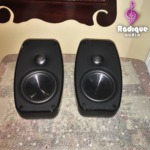
Klipsch SW-112 12″ Front-Firing Powered Subwoofer 600W Peak
$545.00
Out of stock
Get first dibs on the next one
Klipsch SW-112 12″ Front-Firing Powered Subwoofer 600W Peak
This Klipsch SW-112 front-firing 12-inch powered subwoofer delivers tight, musical bass and serious low-frequency impact, making it an excellent upgrade for a mid-to-upper level home theatre or stereo system in very good condition.
The SW-112 is the larger sibling of the SW-110, and it brings meaningful upgrades in every dimension: a 12-inch active non-resonant woven fiberglass driver in place of the SW-110’s 10-inch unit, a more powerful BASH digital hybrid amplifier rated at 300 watts continuous and 600 watts dynamic, and a noticeably larger and heavier cabinet that pays real audible dividends in the bottom octave. The result is a subwoofer that goes deeper, plays louder, and stays cleaner under demanding source material than the smaller models in Klipsch’s Reference subwoofer line.
The active 12-inch driver works in concert with an advanced front slot port to produce tight, articulate bass with very low audible distortion, while the front-firing/front-ported configuration offers genuine placement flexibility — this sub will work effectively close to walls, in entertainment furniture, or in cabinets where rear-ported designs typically struggle. The maximum acoustic output is rated at 116 dB at 30 Hz, a figure that comfortably exceeds the SW-110 and gives the SW-112 the headroom to anchor a serious living room or dedicated theatre. Connectivity is generous, with line-level/LFE RCA inputs, high-level speaker binding posts, and a dedicated WA port for the optional Klipsch WA-2 wireless subwoofer kit, allowing easy integration into both modern AV receivers and legacy two-channel systems.
This unit is in very good condition with only light cosmetic wear, presenting cleanly in a typical living room or dedicated theatre. The cabinet is finished in Klipsch’s signature black pica vinyl with the classic Reference series styling cues, and the substantial 46-pound build weight reflects audio-first engineering — bracing, baffle thickness, and driver mass all working together to suppress cabinet colouration and deliver bass you feel as well as hear.
Key features and specifications:
12-inch front-firing active non-resonant woven fiberglass driver
BASH digital hybrid internal amplifier, 300 watts FTC continuous, 600 watts dynamic peak
Bass-reflex enclosure with advanced front slot port for deep, tight bass and flexible placement
Frequency response: 26 Hz – 120 Hz (±3 dB)
Maximum acoustic output: 116 dB @ 30 Hz (1/8 space, 1 m)
Sensitivity: 106 dB @ 40 Hz
Variable low-pass crossover with phase switch and level control for seamless integration with main speakers
Inputs: L/R line-level RCA jacks (including LFE), L/R high-level speaker binding posts, WA wireless port
Outputs: none (analog subwoofer connections only)
Auto on/off with front-panel status LED
Auto-voltage switching 100–120 V / 220–240 V, 1 W standby
Finish: black pica vinyl, Klipsch Reference styling
Built from: 2010
Dimensions and weight:
Dimensions: (Width x Height x Depth) 14.5 x 16 x 19 inches (368 x 406 x 483 mm)
Weight: 46 lbs (20.9 kg)
At 46 lbs with a substantial cabinet, large 12-inch driver, and high-output front slot port, the SW-112 has the mass, headroom, and engineering depth to anchor a serious living room or dedicated theatre — a meaningful step up from the SW-110 in extension, output, and authority on demanding film and music material.
Backed by Radique Audio’s 90-day warranty and our perpetual trade-back policy, you can purchase with confidence.
🚚 Shipping Note for This Item
Due to its size, weight, or fragility, this product cannot be shipped by standard courier — but we’ve got you covered. We offer two great alternatives:
Personal delivery — We deliver in-person anywhere along the Windsor–Québec City corridor, carefully and on your schedule.
Freight shipping — We ship skid-mounted via freight carrier to anywhere in Canada, and we stand behind it — if something arrives damaged, we make it right.
Full details on both options are on our Curbside Delivery page. 👈
Ready to make it yours? To hold the item and avoid missing out, go ahead and purchase using Local Pickup at checkout — then contact us to arrange delivery or freight for an additional fee. We’ll take it from there!
| Weight | 48 lbs |
|---|---|
| Dimensions | 23 × 18.5 × 20 in |
Klipsch began in Hope, Arkansas, in 1946, when Paul W. Klipsch started building his corner-horn Klipschorn, and its Heritage speakers are still built by hand in Hope. We carry Klipsch towers, centre channels, bookshelf speakers and subwoofers. We've had more than 160 Klipsch listings so far. Every used Klipsch here is inspected, tested and serviced as required, then photographed in-house and covered by our Bumper-to-Bumper Warranty and Perpetual Trade-Back Program. Don't see the model you want? Tell us on First Dibs and we'll email you when one arrives.
The Klipsch story, 1946 to today
Paul W. Klipsch was posted to Hope, Arkansas, in 1941 as an Army officer. He patented his corner-horn design in the mid-1940s and founded Klipsch in Hope in 1946; Klipsch says its first speaker was built by hand there that year, with the horn made in a tin shed. He hired his first employee in 1948.
The Heritage line. The Klipschorn of 1946 was followed by the Heresy (1957), designed as a centre speaker to sit between a pair of Klipschorns, the Cornwall (1959), the La Scala (1963) and the Forte (1985).
A new generation. Fred Klipsch bought the company from Paul Klipsch in 1989, and headquarters later moved to Indianapolis. Paul Klipsch died in 2002 at 98. The Reference Series arrived in 1999.
A Canadian connection. In 2006 Klipsch bought Audio Products International of Toronto, with its Energy and Mirage brands. Audiovox, later VOXX, bought Klipsch in 2011, and Gentex bought VOXX in 2025.
Which Klipsch is which?
Heritage: the Klipschorn, Heresy, Cornwall, La Scala and Forte, built to order by hand in Hope. Drivers change between generations, so identify the version.
KG series (mid-1980s to early 1990s): lower-priced horn-tweeter floorstanders such as the KG 4 (1985 to 1992) and KG 5.5.
Reference (1999 onward): horn-tweeter towers, bookshelf speakers and centres, from the RB-5 and RF-7 to the later RF, RB and RC models.
Synergy (late 1990s and 2000s): such as the KSF 8.5 and the SF-1.
Subwoofers: powered models such as the RPW-10.
Buying used Klipsch: what to check
Horn diaphragms. The compression drivers in older Klipsch speakers age; owners report tired midrange diaphragms on Heritage models and raspy tweeters on some KG pairs. Listen to each horn on its own at a moderate level.
Reference tweeters. A crackling tweeter can be a loose connection, and owners say these tweeters can fail if played very loud.
Crossovers and passive radiators. Many Heritage and KG owners recap their crossovers, and KG passive radiators can have cracked surrounds.
Modifications. Aftermarket diaphragms and crossovers are common upgrades on Heritage and KG models. Ask what has been changed.
Where it was made. Heritage models are built in Hope. Check the label before calling any other Klipsch "made in USA".
Everything we list is inspected, tested and serviced as required here, and comes with our warranty.
You may also like…


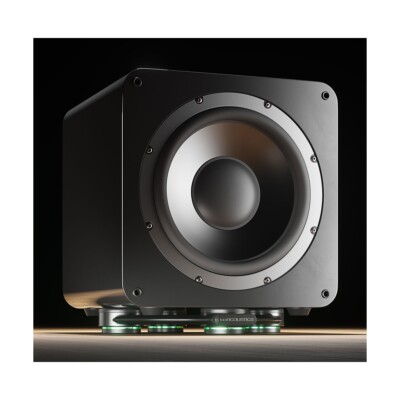
IsoAcoustics Aperta Sub XL Subwoofer Isolation Stand
- ✔️ Genuine IsoAcoustics Aperta Sub XL, brand new in box
- ✔️ Low-profile isolation stand for front-firing and side-firing subwoofers up to 160 lbs (72.6 kg)
- ✔️ Includes 1 stand plus 4 carpet discs for carpeted surfaces
- ✔️ Helps reduce energy transfer, room rattle, and muddy bass smear for tighter low-frequency performance
- ✔️ Backed by a 2-year manufacturer’s warranty in Canada
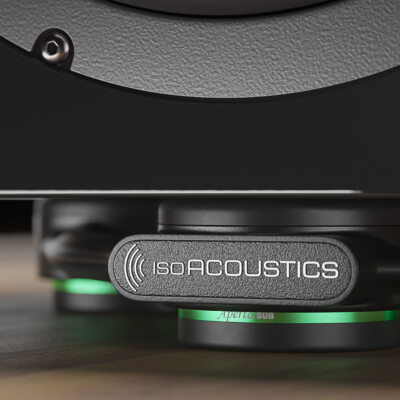
IsoAcoustics Aperta Sub Subwoofer Isolation Stand
- ✔️ Genuine IsoAcoustics Aperta Sub, brand new in box
- ✔️ Low-profile isolation stand for front-firing and side-firing subwoofers up to 80 lbs (36.3 kg)
- ✔️ Includes 1 stand plus 4 carpet discs for carpeted surfaces
- ✔️ Helps reduce energy transfer, room rattle, and muddy bass smear for tighter low-frequency performance
- ✔️ Backed by a 2-year manufacturer’s warranty in Canada
Related Products
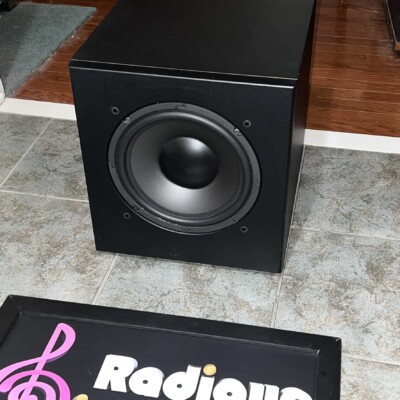
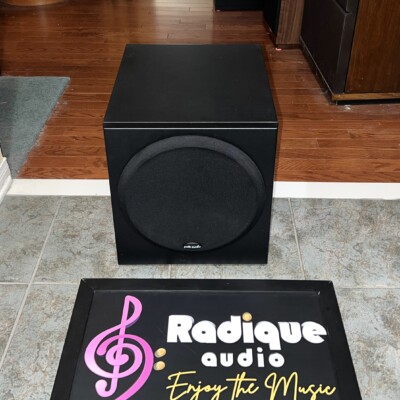
Polk Audio PSW350 10″ Front-Firing Powered Subwoofer 260W
A 10-inch front-firing Dynamic Balance woofer on a 100-watt RMS amplifier — 260 watts dynamic — in a dual-rear-ported cabinet good for 25 to 180 Hz. Speaker-level in and out, stereo line inputs and an unfiltered LFE jack, with a variable 60 to 160 Hz low-pass and a phase switch. 37 lbs, black matte. Very good cosmetic condition.
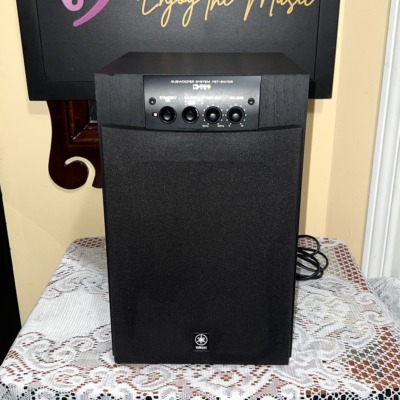
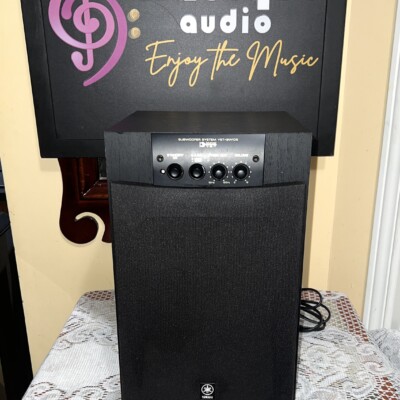
Yamaha YST-SW105 Active Servo Subwoofer — Compact 100W
An 8-inch front-firing paper cone on Yamaha's Advanced Active Servo amplifier — 100 watts into 5 ohms, down to 30 Hz, from a cabinet small enough to tuck beside a bookshelf pair. Continuously variable high-cut from 50 to 150 Hz, a Music/Movie voicing switch, RCA and speaker-level inputs plus full-range pass-through outputs. Very good condition.
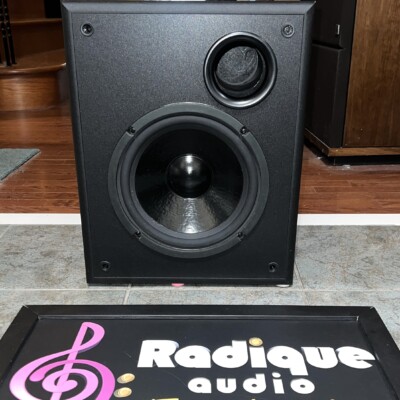
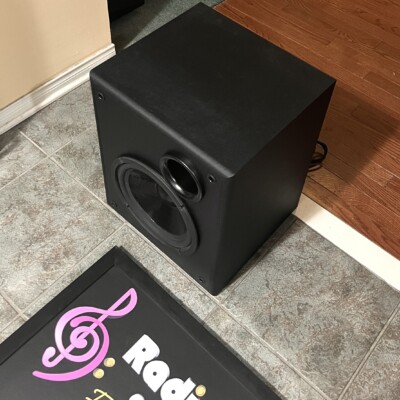
Yamaha SW-3 Active Servo Subwoofer — 10″ Woofer | Air Woofer Tec
Yamaha’s Active Servo Technology couples a negative-impedance drive amplifier to a Helmholtz resonator port — the Air Woofer opening — so the amplifier corrects the driver’s motion as it works. 100 watts into a 25 cm cone, rated down to 25 Hz, with a continuously variable 50–150 Hz high-cut at 24 dB per octave. Speaker-level and line inputs both. Very good condition.
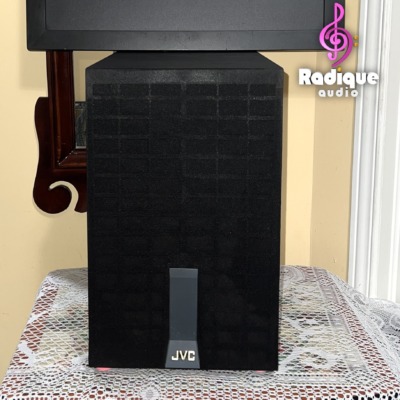
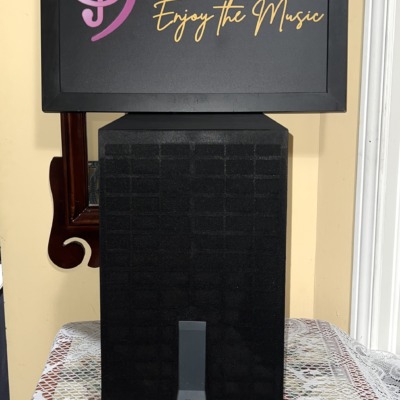
JVC SX-PW33 Slim Tower Subwoofer — 6.5in, 100W, High-Pass Out
A tall, narrow bass column meant to stand beside a cabinet rather than in front of it — 8.25 inches across the front and unusually deep at 17, which is the trade: the depth buys back the internal volume the narrow baffle gives away, so a 6.5 inch woofer is properly loaded in a strip of floor barely wider than a hardcover book. Driven by an integrated 100 watt amplifier, with speaker-level inputs and high-pass outputs so it works with an amplifier that has no subwoofer output at all. Good condition.
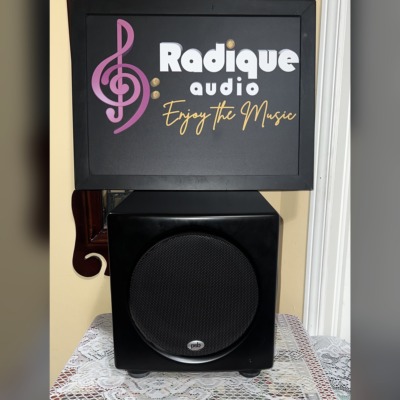
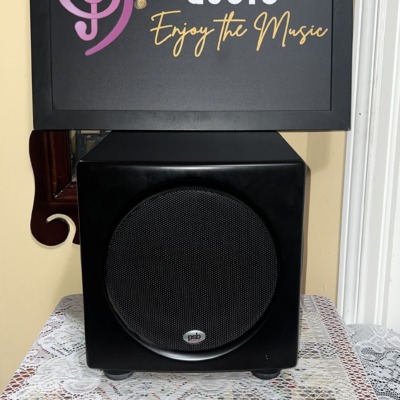
PSB SubSeries HD10 10″ Powered Subwoofer — 750W, 2000W Peak!
A serious subwoofer in about a square foot of floor, from one of the most respected names in Canadian loudspeaker design, with deep, powerful bass for home theatre and most music.
✔️ Good condition — light scuffs on the top, and a little vibration when played loud (details below)
✔️ 10-inch driver, two passive radiators and a 750 W Class H amplifier
✔️ Line-level and high-level inputs — works even with a receiver that has no sub out
✔️ Covered by Radique Warranty
✔️ Includes Perpetual Trade-Back Program eligibility
✔️ Expertly packed for safe shipping
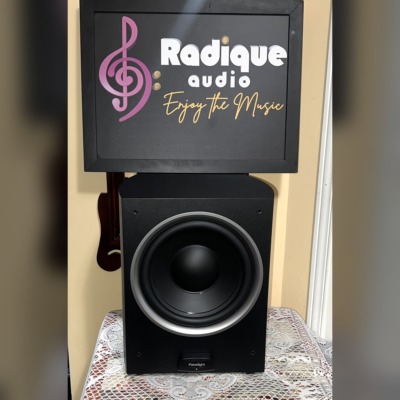
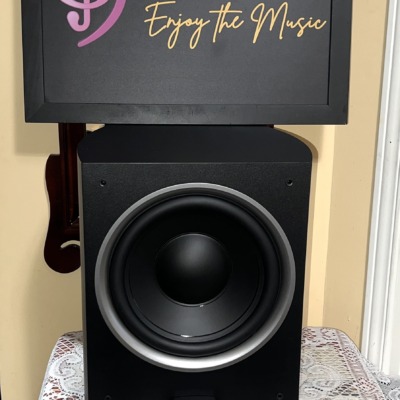
Paradigm PDR-10 v.4 10″ Powered Subwoofer – 300W Peak, Serviced
A black Paradigm PDR-10 v.4 powered subwoofer, with a 10-inch forward-firing driver and 100 watts RMS (300 watts dynamic peak) on board, serviced on our bench and in very good condition.
✔️ Very good condition — free of significant marks
✔️ Serviced on our bench and tested before listing
✔️ 10-inch forward-firing driver, 100 W RMS and 300 W dynamic peak
✔️ Covered by Radique Warranty
✔️ Includes Perpetual Trade-Back Program eligibility
✔️ Expertly packed for safe shipping
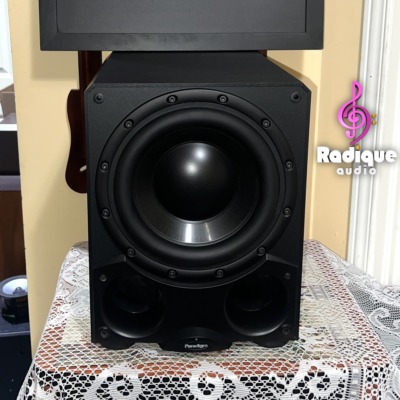
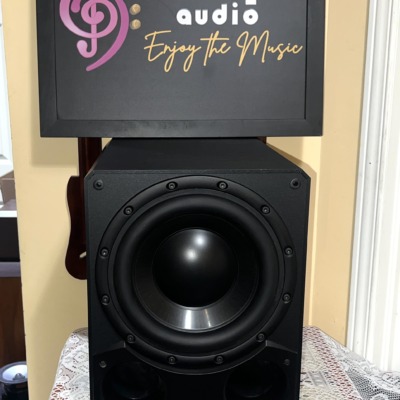
Paradigm DSP-3100 v.2 10″ Subwoofer – 600W Peak, Made in Canada
A black Paradigm DSP-3100 v.2 powered subwoofer, made in Canada, with a 10-inch front-firing driver and 200 watts RMS (600 watts dynamic peak) on board. It has been tested on our bench and is in very good condition.
✔️ Very good condition — removable black cloth grille included
✔️ 10-inch front-firing driver, 200 W RMS / 600 W peak Class-D
✔️ Front ports for hidden installs — made in Canada
✔️ Covered by Radique Warranty
✔️ Includes Perpetual Trade-Back Program eligibility
✔️ Expertly packed for safe shipping
