


Mirage Omnisat OS 1PB-1 Omnipolar Satellite – Made in Canada
$195.00
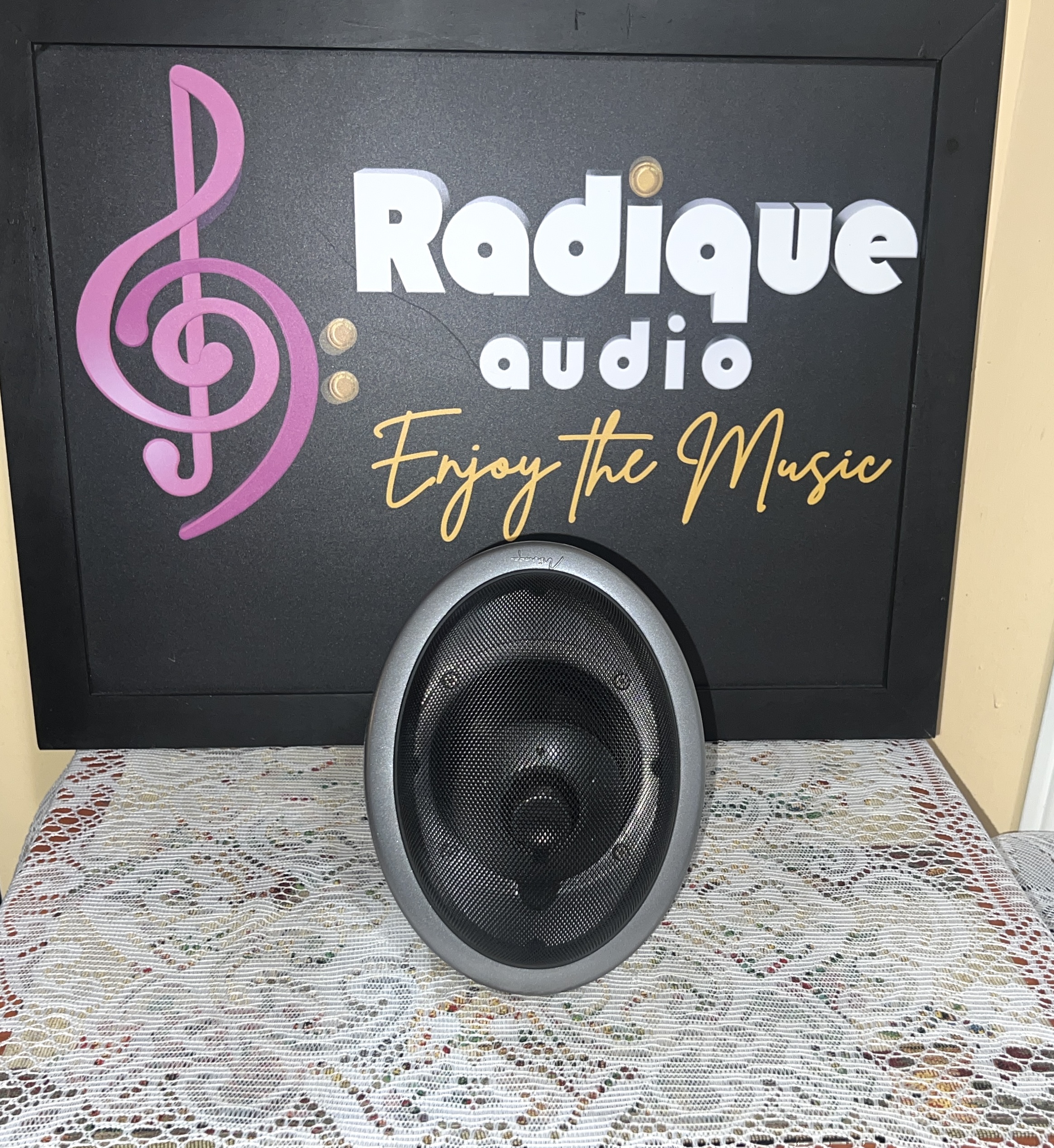
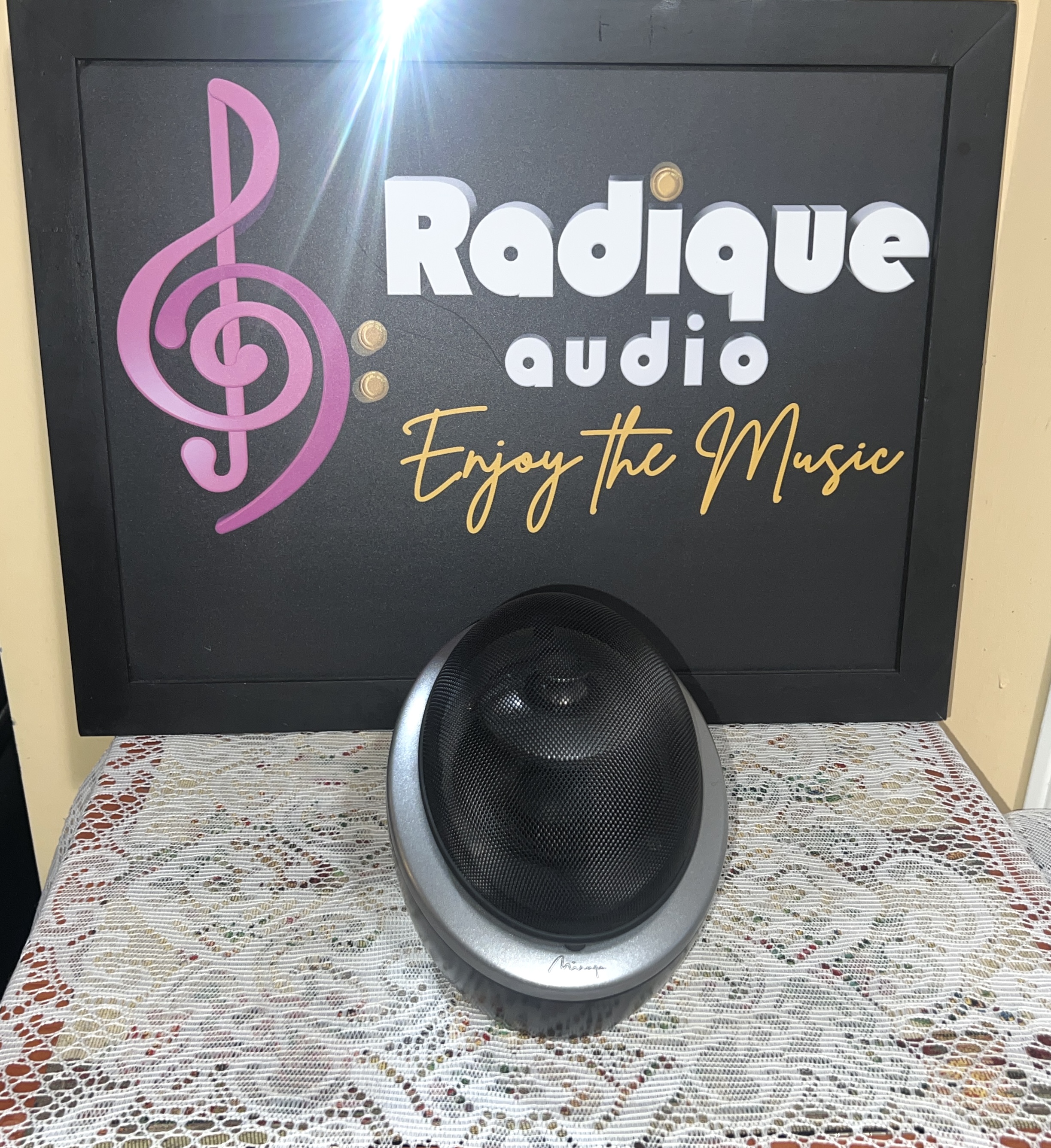
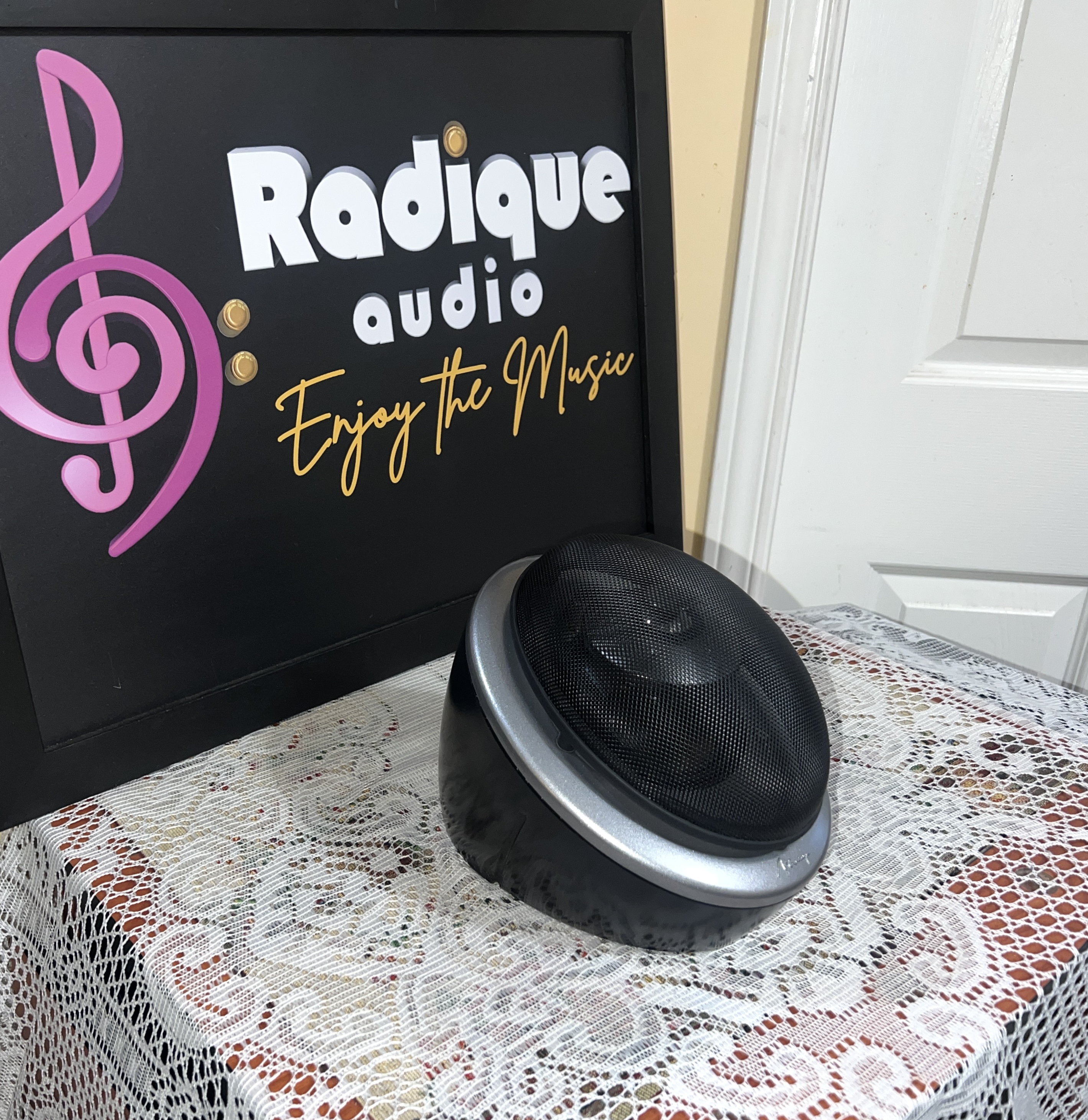
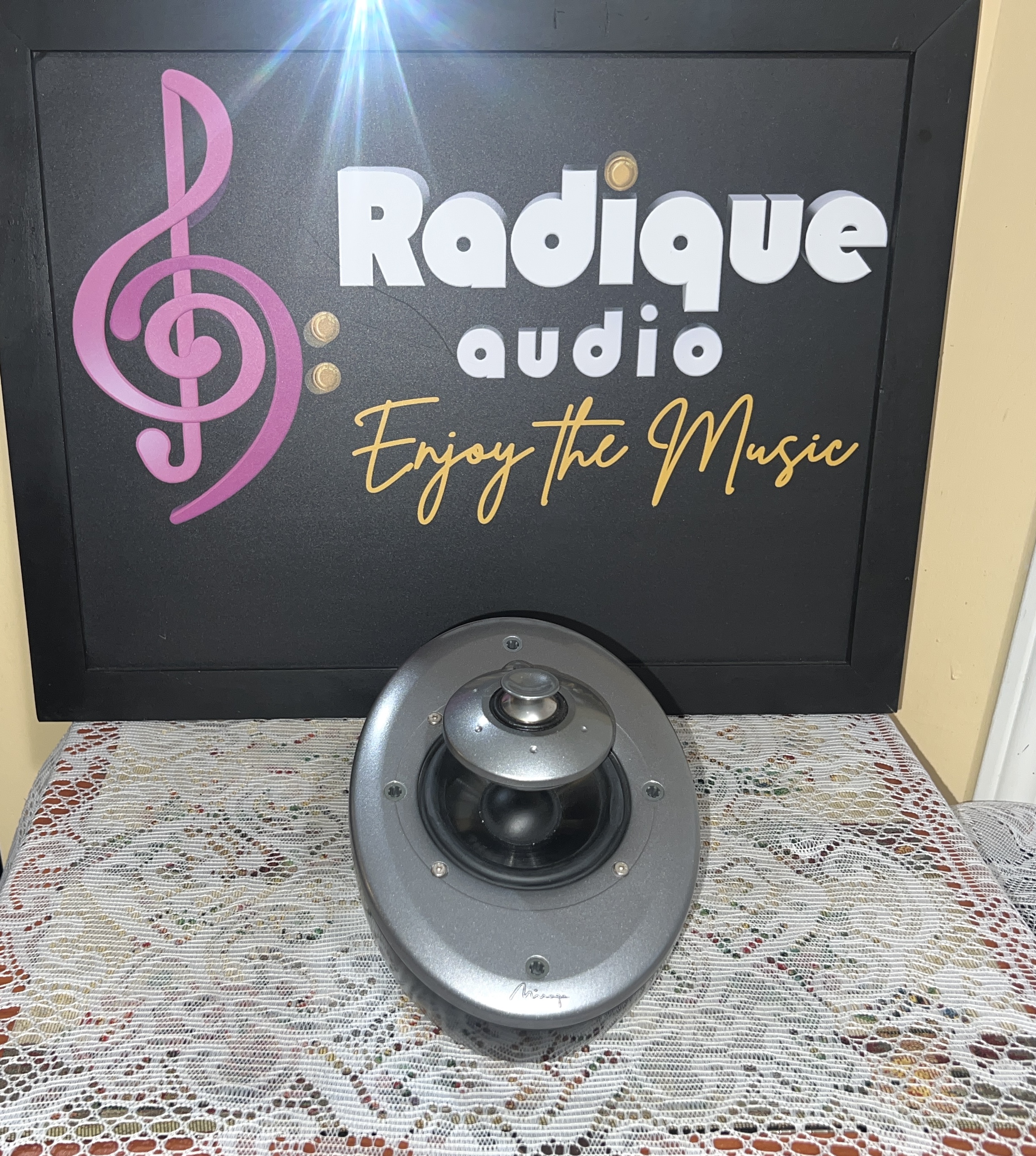
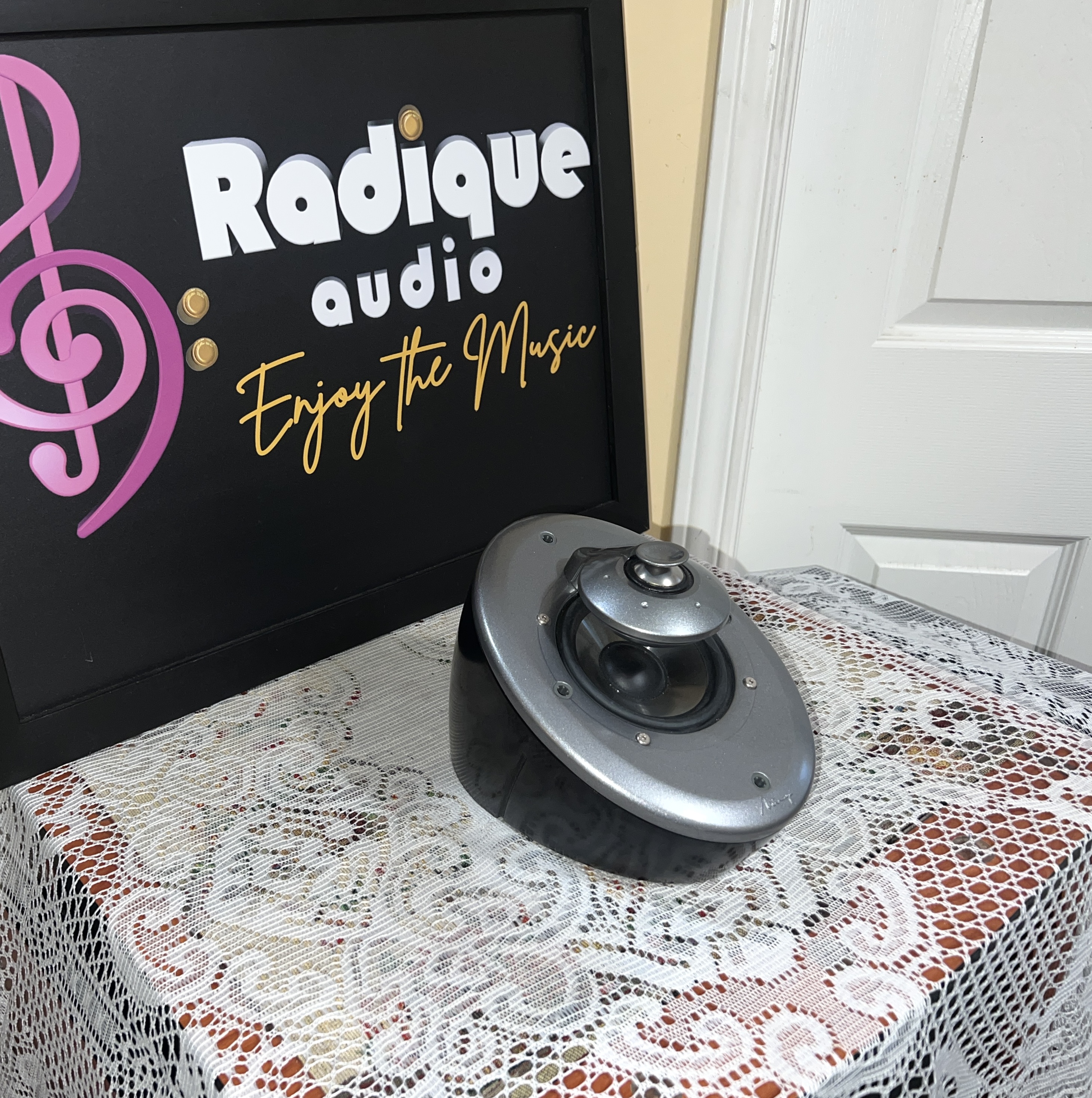
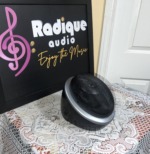
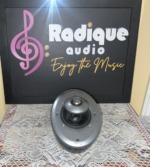
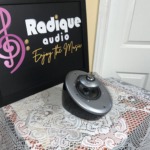
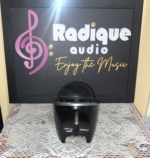
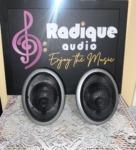
Both drivers fire upward into spoon-shaped reflectors Mirage calls OMNIGUIDEs, throwing sound through a full 360 degrees with a deliberate bias toward the front — which is what takes the sweet spot off a single chair. This is the original version at a genuine 7 lbs each, with a cast aluminium baffle and butyl rubber surrounds rather than foam. Built in Canada; condition very good.
5 in stock
Mirage Omnisat OS 1PB-1 — Omnipolar Dispersion, Made in Canada
Mirage Omnisat OS 1PB-1 Omnipolar Satellite Speaker – Made in Canada, Award Winner, 7 lb Build, Very Good Condition
Made in Canada, and one of the genuinely original loudspeaker designs of its era. Winner of the Home Theater Sound “Product of the Year” award, and the speaker that created an entirely new class.
Mirage’s starting point was an observation about how we actually hear. In a real room, roughly thirty percent of what reaches your ears is direct sound and the other seventy percent is reflected — sound that has bounced off a wall, a ceiling, a floor before arriving. Most loudspeakers ignore this entirely and fire everything straight at you. Mirage’s Omnipolar designs try to reproduce the real balance instead.
The Omnisat is head designer Andrew Welker’s answer, and it is a genuinely clever piece of engineering. Both drivers fire upward rather than forward. Above the 4.5-inch woofer sits a spoon-like metal reflector — Mirage calls it an OMNIGUIDE — which disperses its output through a full 360 degrees. The OMNIGUIDE also houses the one-inch Pure Titanium Hybrid tweeter, which likewise fires upward into a second OMNIGUIDE above it.
The subtlety is in the geometry. Those reflectors are not centred over the drivers. They sit fractionally rearward and are angled slightly away, and the drivers themselves are tilted rather than firing straight up. The result is 360-degree dispersion with a deliberate bias toward the front. Welker’s contention is that pushing a little more energy forward than back is what makes the sound launch into a room naturally rather than merely diffusely — and in practice, he was right.
What that does is remove the speaker from the equation. The soundstage detaches from the cabinets and fills the room, and the sweet spot stops being a single chair. For surround duty in particular it is difficult to better, because ambience arrives from everywhere rather than from two obvious points on the wall.
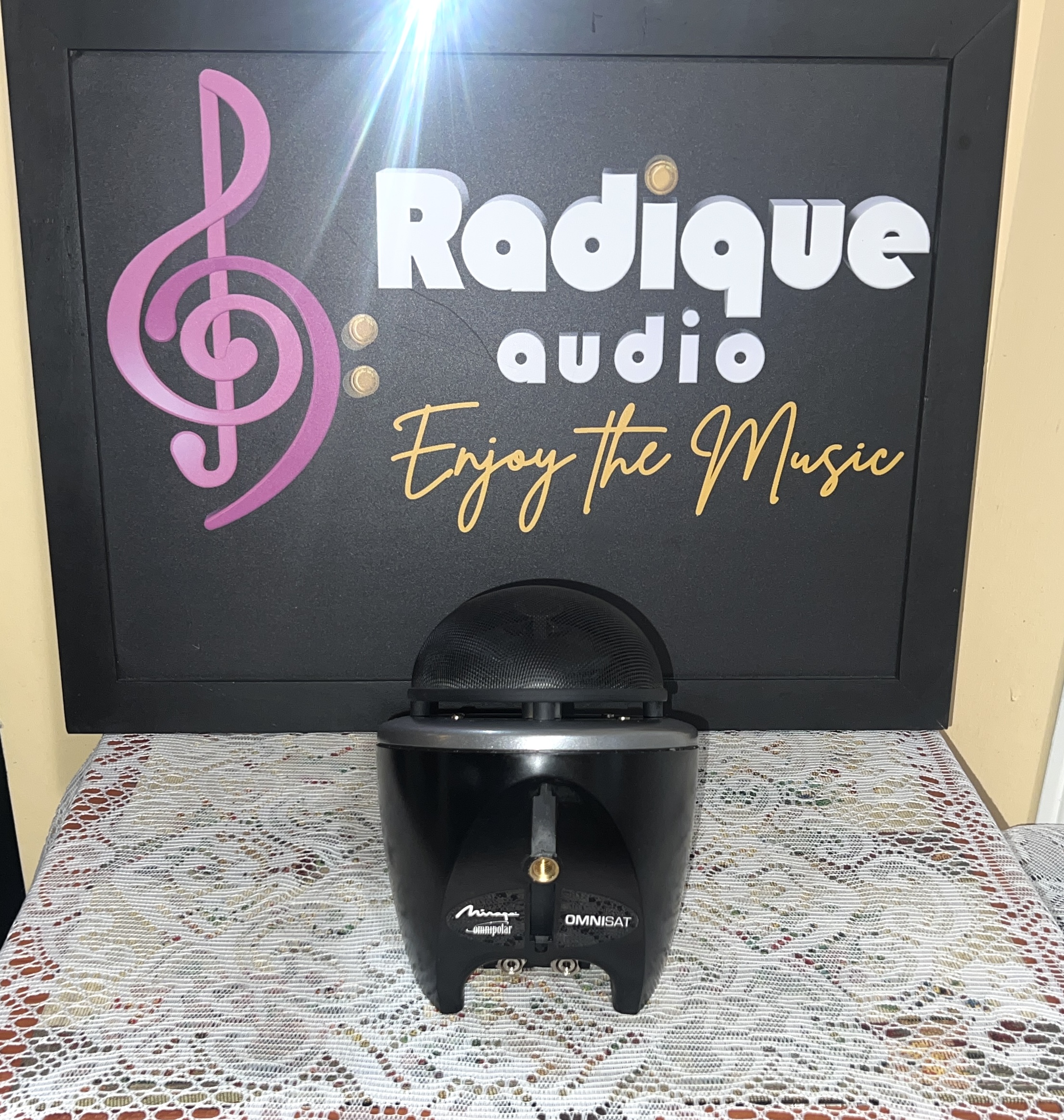
This is the original Omnisat, and it is worth understanding what that means. Each one weighs a genuine 7 lbs, where the later revised versions come in at well under five. That difference is not packaging. It is the thick-walled plastic enclosure, fortified with a foaming agent and finished in an almost suede-like texture — knock on it and there is nothing to hear. It is the cast aluminum baffle the woofer sits on, strong and heavy and handsome, at a size and price where nobody else was doing it. The woofer also runs butyl rubber surrounds rather than foam, which is why these are still playing properly two decades on instead of waiting for a refoam. You can feel where the money went the moment you pick one up.
Mounting is well thought out. There is one large threaded insert at the rear for stand or bracket mounting, and moulded slots in the base for flush wall mounting — the wall plate screws to the wall first, and the speaker slides down onto it and seats under its own weight. We have the correct original Mirage flush wall mounts available separately.
The removable rounded wire-mesh grille is present, straight and unmarked.
Condition
Cosmetically this is in very good condition. The enclosure is clean with no cracks or stress marks, and the cast aluminum baffle has kept its finish.
It has been thoroughly inspected and tested to confirm full functionality.
Features: Omnipolar 360-degree dispersion with deliberate forward bias Twin OMNIGUIDE reflectors, upward-firing drivers 1″ PTH Pure Titanium Hybrid tweeter, Mirage-made 4.5″ Polypropylene Titanium Deposit Hybrid woofer with butyl surrounds Cast aluminum woofer baffle Thick-walled, foam-fortified enclosure with suede-like finish — acoustically inert Substantial 7 lb build, considerably heavier than the later revisions Magnetically shielded High quality 5-way binding posts Removable wire-mesh grille Large threaded insert at rear for stand or bracket mounting Moulded slots in base for flush wall mounting
Built in Canada, award winning, and increasingly hard to find in this condition. These retailed new at $250 USD each — around $770 Canadian for a pair with tax.
Mirage Omnisat OS 1PB-1 Specifications
- Model: OS 1PB-1
- System Type: Magnetically Shielded Omnipolar Satellite
- Configuration: Two-way
- Frequency Response: 70Hz – 20kHz (±3dB)
- Crossover Point: 2.2kHz
- Room Efficiency: 89dB
- Impedance: 8 ohms nominal, 4 ohms minimum
- Power Handling: 150 watts
- Recommended Amplifier Power: 10 – 150 watts RMS per channel
- Tweeter: 1″ PTH Pure Titanium Hybrid
- Woofer: 4.5″ Polypropylene Titanium Deposit Hybrid, butyl surround
- Inputs: 5-way binding posts
- Country of Manufacture: Canada
- Dimensions: (Width x Height x Depth) 6.25 x 8 x 8 inches (159 x 203 x 203 mm)
- Weight: 7 lbs (3.2 kg) each
✅ Buy With Confidence — The Radique Promise
Backed by Radique Audio’s Bumper-to-Bumper Warranty and our Perpetual Trade-Back Program. When you’re ready to move on, we’ll take it back. That’s the Radique difference.
📦 Watch how we protect your gear — our unboxing video.
📺 Curious about our business? Check out our YouTube channel for behind-the-scenes videos and more!
📞 Questions? Use the Ask a Question button above, or call us at 613-416-9995.
🔌 Need Cable to Match?
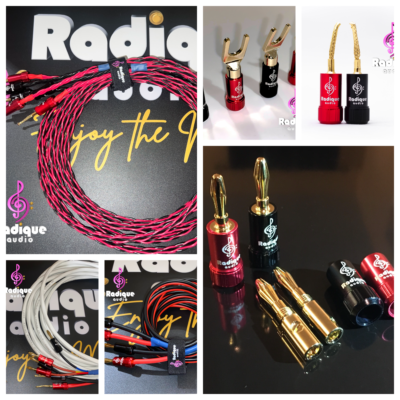
We build speaker cable to order in our own shop — your choice of length and cable, finished with our own gold-plated Radique Audio Banana Plugs or Spade Connectors to suit these binding posts exactly. Build your custom speaker cable. 👉
>
| Weight | 8 lbs |
|---|---|
| Dimensions | 12 × 10.25 × 12 in |
| Impedance | 8 Ω |
| Power Handling | 101–200 W |
| Sensitivity | 86–89 dB |
| Woofer Size | 5″ and under |
Mirage is a Canadian speaker brand, founded in Toronto in the late 1970s and later built by Audio Products International in Scarborough, in the same factory as Energy. Its bipolar and Omnipolar designs send sound in more than one direction. We carry Mirage towers, satellites, centre channels and subwoofers. We've had more than 110 Mirage listings so far. Every used Mirage here is inspected, tested and serviced as required, then photographed in-house and covered by our Bumper-to-Bumper Warranty and Perpetual Trade-Back Program. Don't see the model you want? Tell us on First Dibs and we'll email you when one arrives.
The Mirage story
Jeff Percy, Jeff Soltysek and Patrick Dempster founded Mirage in Toronto in the late 1970s (1979, according to Stereophile). Kevin Voecks, later of Snell and Revel, did the original designs. Audio Products International of Scarborough, which already assembled Mirage speakers, took the company over in the mid-1980s.
Bipolar. The M-1 of 1987, begun by Voecks and completed by API's Ian Paisley, fired identical drivers forward and backward, in phase. Mirage's engineers worked with the National Research Council's loudspeaker research here in Ottawa.
Omnipolar. The OM-6 of 1997 was the first commercial version of Mirage's Omnipolar idea, and the Omnisat satellite system followed in 2002.
New owners. Klipsch bought API in 2006, and VOXX bought Klipsch in 2011. Later models were made in China; the 2007 OMD-28 was "designed by API in Canada and built in China". Around the end of 2022, Oscar Bernardo, a former API executive, bought the Mirage brand himself to relaunch it.
Which Mirage is which?
Early two-ways (1980s to early 1990s): models owners discuss include the SM-1, 190, 290, M-360 and M-460.
M-series bipolar (1987 to late 1990s): the M-1, M-3, and the "si" models such as the M-1si, M-3si and M-7si.
OM-series Omnipolar (1997 to early 2000s): the OM-6, OM-7 and OM-9, and the OM-5 subwoofer.
Home theatre: FRx (2001), Omnisat and Nanosat satellites (2002 to 2005), OMD (2007) and MX (2009), plus the OMNI towers and Uni-Theater.
Subwoofers: the BPS bipolar subs, the LF-150 and MM-6, and the Nano subwoofers.
Buying used Mirage: what to check
Surrounds. Materials vary by model: some M-series midranges use foam surrounds that turn brittle, while many woofers use rubber. Check the rear-firing drivers too.
Tweeters. Owners report that original M-1 tweeters become fragile and have been unavailable for years. Check that every tweeter plays, front and rear.
Powered woofers and subwoofers. Test the built-in amplifier at volume; owners report failed sub amplifiers with no replacement available.
Finish and pairs. M-series panels are lacquered and some clip off plastic fasteners, so look for damage. The M-1si was built in mirror-image pairs.
Placement. Omnipolar and bipolar speakers sound best well out from the wall.
Everything we list is inspected, tested and serviced as required here, and comes with our warranty.
You may also like…
Mirage Omnisat OS 1PB-1 Omnipolar Satellite (Pair) – Made in Canada
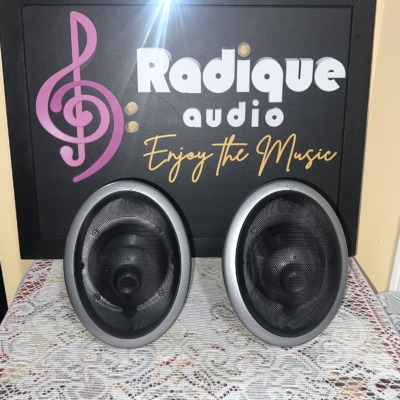
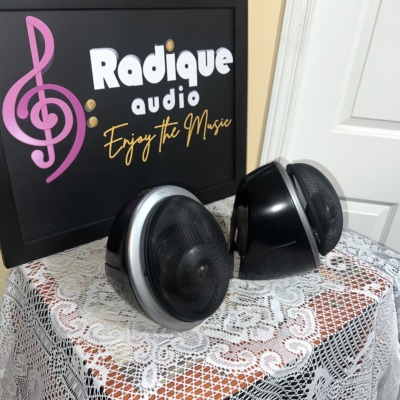
Both drivers fire upward into spoon-shaped OMNIGUIDE reflectors, giving 360-degree dispersion with a deliberate forward bias. 70 Hz to 20 kHz, 89 dB, cast aluminum woofer baffle and butyl surrounds rather than foam. These are the original 7 lb version; the later revisions come in under five. Very good condition.
Mirage Omnisat Wall & Ceiling Mount Clip – Original Factory Part
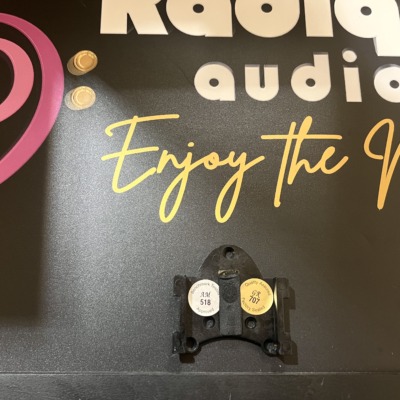
The factory clip supplied with the first-generation Omnisat, and the part its moulded base was shaped to accept. The clip goes on the wall or ceiling first and the speaker slides down onto it under its own weight — a one-person job, and the speaker lifts off again in seconds. Three-quarters of an inch of profile. Not the v2 bracket; the two do not interchange. Very good condition.
Custom Speaker Cable Builder
Your specs, your cable: choose the cable, the length and each connector, with live pricing.
- House CCA, House OFC, House Quad, Kimber 4PR or Kimber 4TC
- Banana, spade, pin, small spade or bare wire, chosen for each end
- Bi-wire on Kimber 4PR, Kimber 4TC and House Quad
- Hand-assembled, heat-shrink reinforced and colour-coordinated
- 1-year warranty
Related Products


KEF HTS1001 Uni-Q Satellite Speakers Black Pair
KEF’s Uni-Q array puts a 0.6-inch aluminium dome at the acoustic centre of a 3-inch mid-bass cone, so the pair behaves as a single source and the tonal balance holds across the room rather than in one chair. Sealed cast aluminium enclosures, 120 Hz to 22 kHz, 86 dB, magnetically shielded. Very good cosmetic condition.
Mirage Omnisat OS 1PB-1 Omnipolar Satellite (Pair) – Made in Canada
Both drivers fire upward into spoon-shaped OMNIGUIDE reflectors, giving 360-degree dispersion with a deliberate forward bias. 70 Hz to 20 kHz, 89 dB, cast aluminum woofer baffle and butyl surrounds rather than foam. These are the original 7 lb version; the later revisions come in under five. Very good condition.
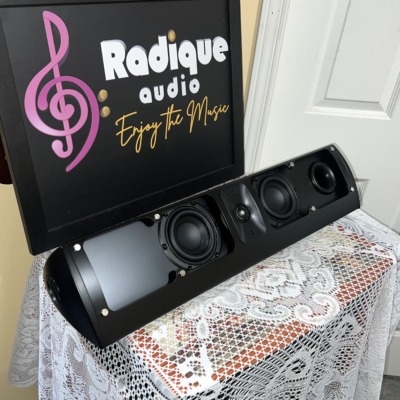
PSB VisionSound VS300 Aluminum On-Wall Speaker
An on-wall speaker engineered as one rather than adapted into one. It shares the tweeter, terminals and crossover of PSB's VS400 floorstander, but the port was moved to the front so the cabinet can sit flat to a wall without the wall changing what it does — and a rear switch selects NORMAL or ON-WALL, filling the 400 to 500 Hz dip that hard mounting creates. Extruded aluminium, built in Pickering, Ontario. Graded Excellent or Very Good; the only thing separating the two is a single Tic Tac-sized hole at the extreme edge of one grille frame.
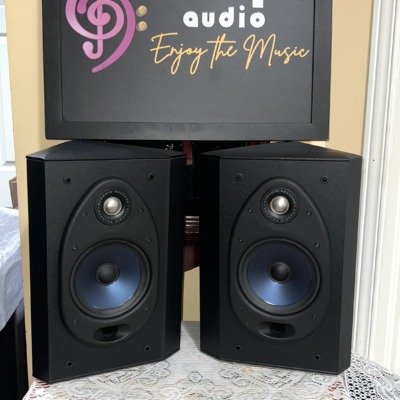
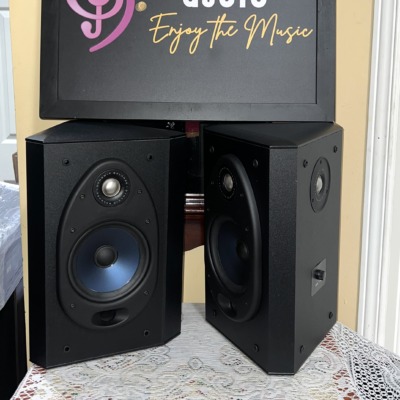
Polk Audio f/x 500i Bipole/Dipole Surrounds — Made in USA, Pair
A genuine mirror-imaged pair, labelled LC and RC, with two driver arrays set 45 degrees apart and a rear-panel switch that flips them between bipole and dipole — locatable effects on the wall behind you, a diffuse field on the side walls, same speakers either way. 19.4 lbs each, half again the weight of the FXi A6 that replaced them, and 2 dB more sensitive. Built in the United States, with keyhole mounts moulded into the cabinet. Very Good condition.
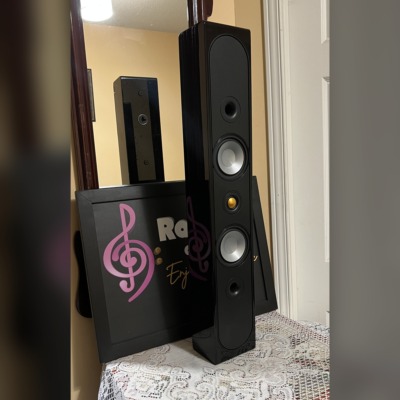
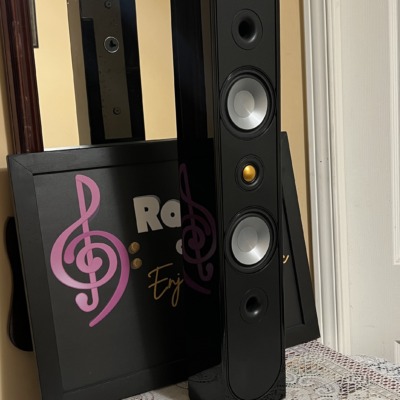
Monitor Audio Radius 250HD LCR Speaker – Gloss Black, Wall-Mount
A slim gloss black Monitor Audio speaker from the Radius HD range, in good condition, built to work as a left, center, right or rear speaker, standing upright, lying flat or hung on a wall.
✔️ Good condition — light scratches visible under bright light; grille included
✔️ One slim speaker for left, center, right or rear duty
✔️ Two rear keyhole slots; the matching wall bracket is listed separately
✔️ Covered by Radique Warranty
✔️ Includes Perpetual Trade-Back Program eligibility
✔️ Expertly packed for safe shipping
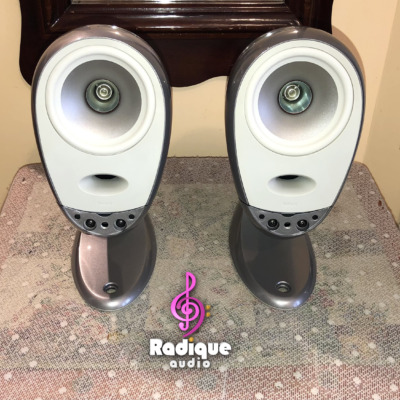
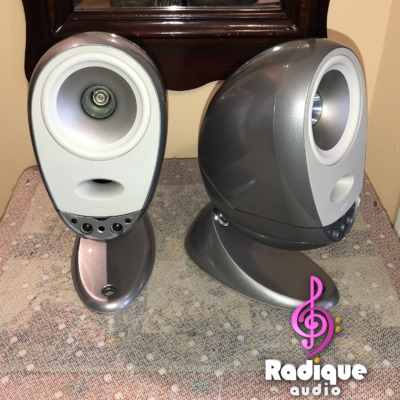
Tannoy Arena Satellites, Pair – Dual Concentric, Four Finishes
Tannoy's die-cast aluminum Arena satellites, in very good condition, offered by the pair in four gloss finishes (white, gloss black, bronze and silver), with or without their matching cast bases.
✔️ Very good condition — the lacquered aluminum shells present well
✔️ Tannoy Dual Concentric drivers in cast aluminum, magnetically shielded
✔️ Four gloss finishes; matching cast bases on the silver, black and bronze pairs
✔️ Covered by Radique Warranty
✔️ Includes Perpetual Trade-Back Program eligibility
✔️ Expertly packed for safe shipping
Monitor Audio Radius 250HD LCR Speakers, Pair – Gloss Black
A matched pair of slim gloss black Monitor Audio speakers from the Radius HD range, in good condition, each built to work as a left, center, right or rear speaker, standing upright, lying flat or hung on a wall.
✔️ Good condition — light scratches visible under bright light; grilles included
✔️ Two slim speakers for a stereo pair, left and right of a center, or a set of rears
✔️ Two rear keyhole slots on each; the matching wall bracket is listed separately
✔️ Covered by Radique Warranty
✔️ Includes Perpetual Trade-Back Program eligibility
✔️ Expertly packed for safe shipping


KEF HTS1001 Uni-Q Satellite Speakers Black (Single)
KEF's Uni-Q array puts a 0.6-inch aluminium dome at the acoustic centre of the 3-inch mid-bass, so dispersion stays even off-axis and the far seat hears what the middle seat does. Sealed cast aluminium cabinet in high-gloss black, magnetically shielded, 120 Hz to 22 kHz, 86 dB, 10 to 100 watts. Terminals take bare wire or pin connectors. Very good cosmetic condition.
