
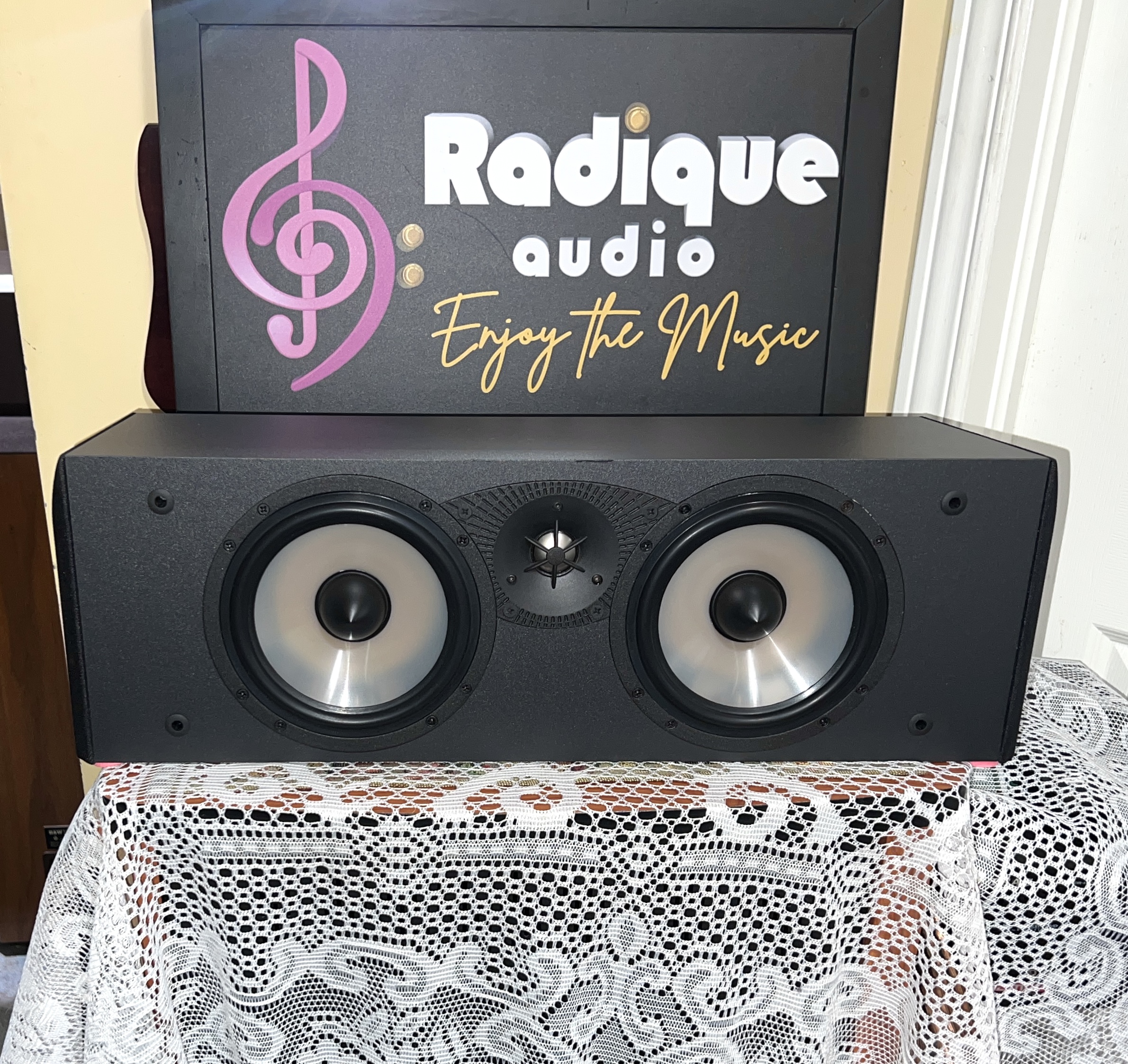
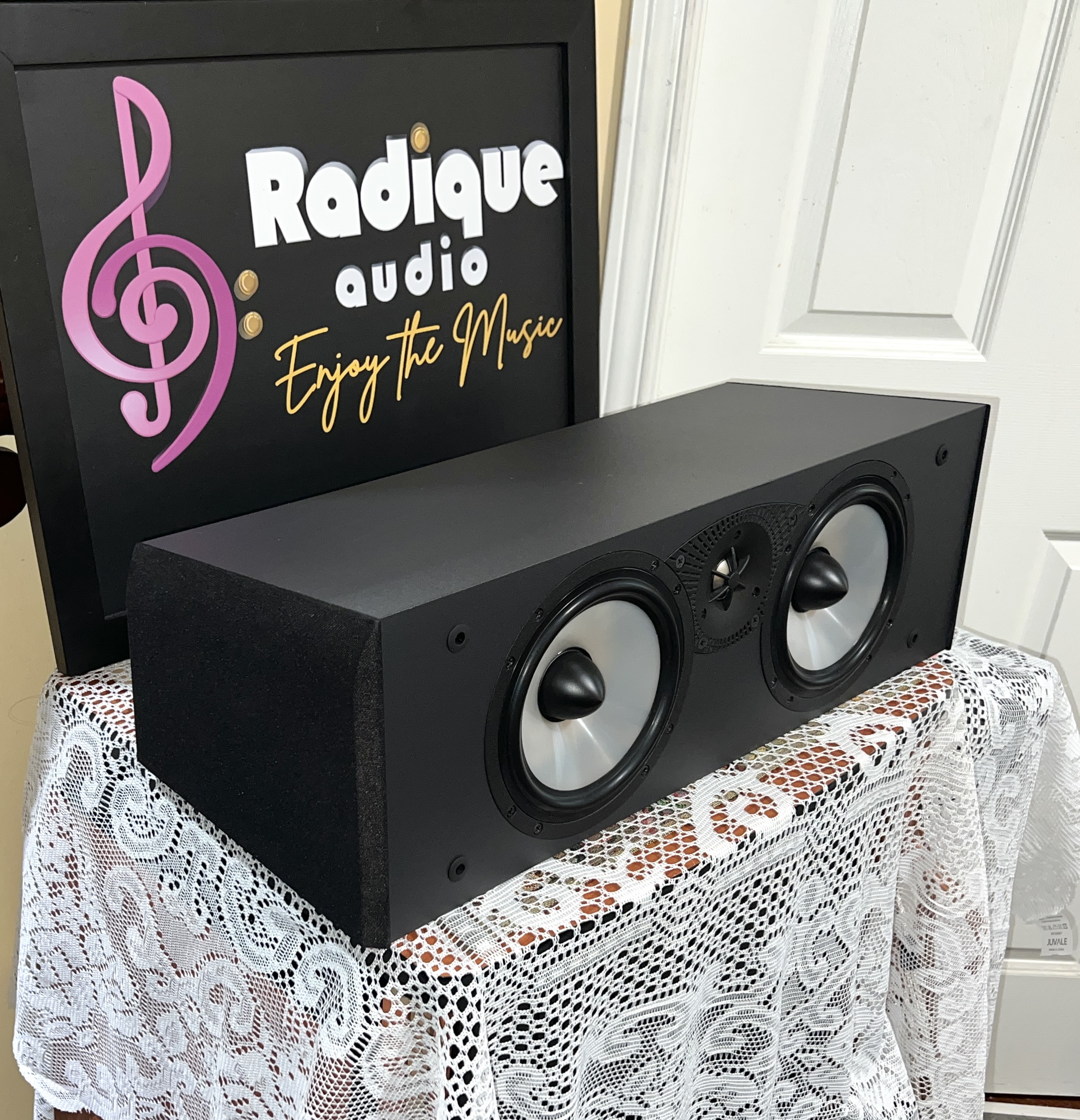
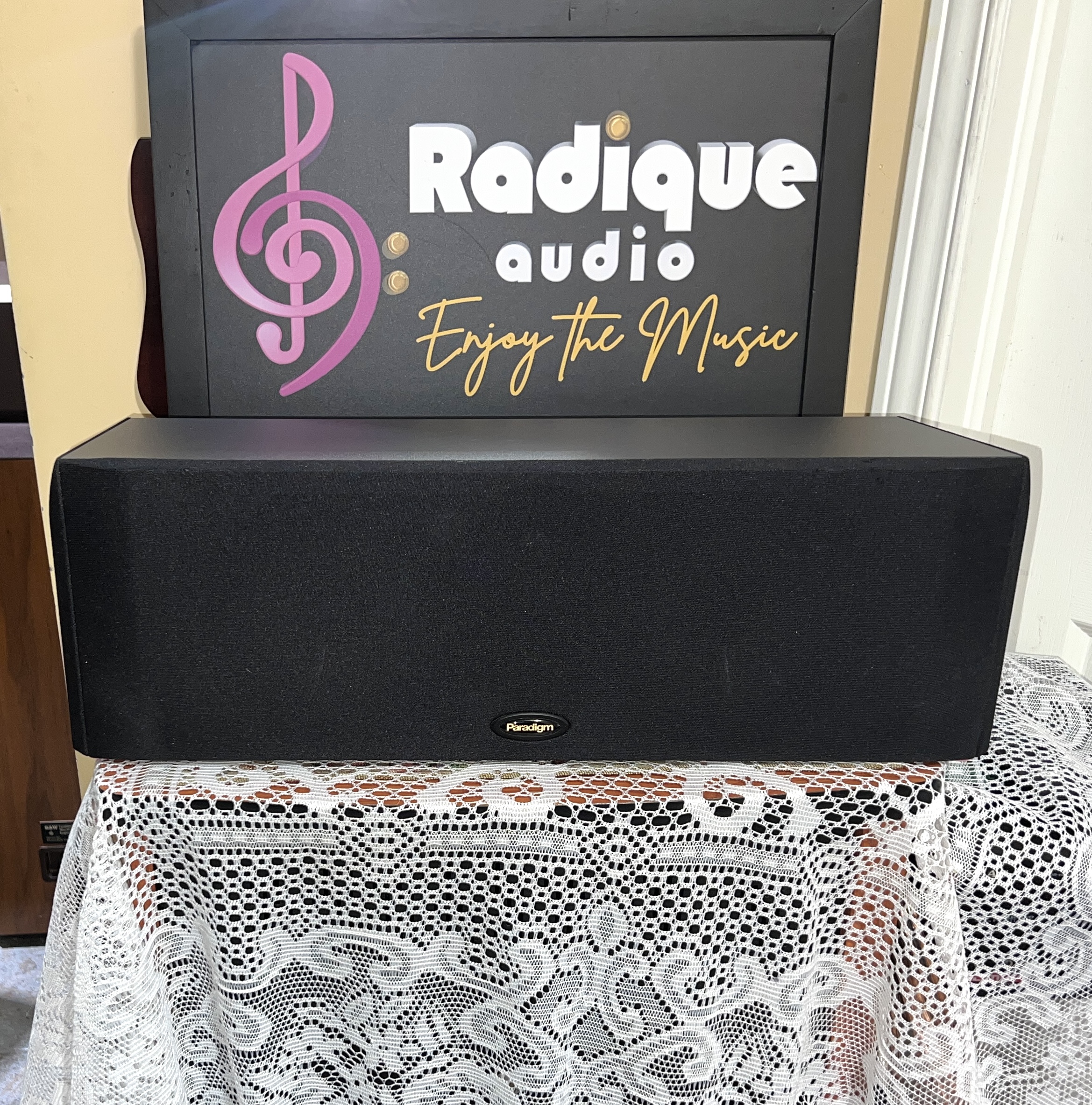
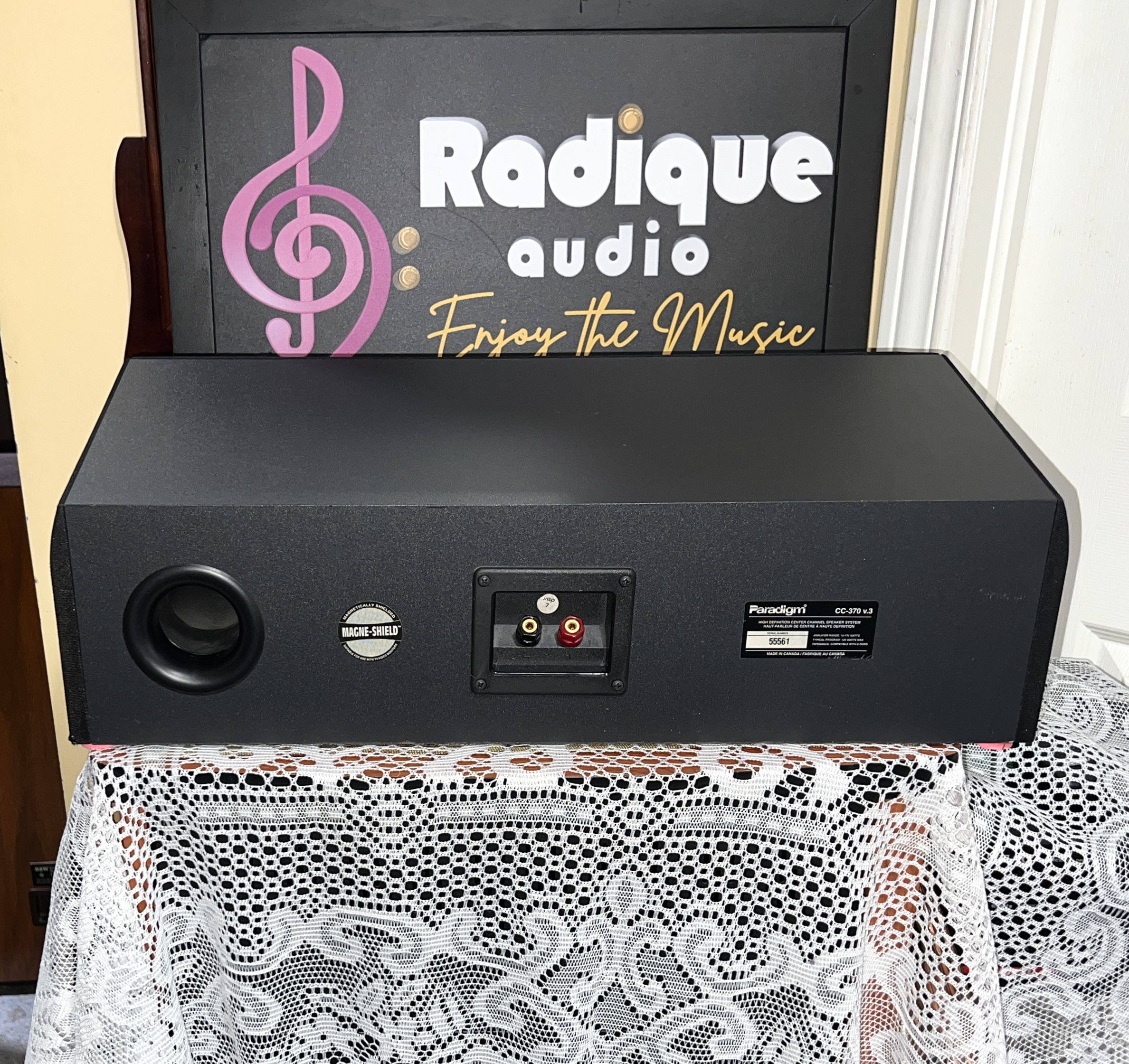
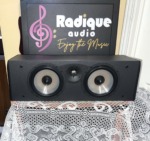


Paradigm CC-370 v3 Centre Channel – 3-Driver, 93dB, Canada
$295.00
Out of stock
Get first dibs on the next one
Paradigm CC-370 v3 Centre Channel Speaker – Three-Driver Two-Way, Dual 6.5-Inch ICP Cones, MagneShield, Made in Canada
A large three-driver centre channel from Paradigm’s Canadian-built era, aimed squarely at dialogue in a room that needs filling.
Why a Big Centre Matters
Centre channels are where home theatre systems are usually let down, because the centre carries most of the dialogue and most people buy a small one. The CC-370 is not a small one. Two 165-mm ICP mid/bass cones on die-cast chassis sit either side of a 25-mm PTD pure-titanium dome, and the cabinet is nearly 23 inches across. That is real cone area and real excursion, which is what turns muddled dialogue into speech you can follow at low volume without reaching for the remote.
The Crossover
The third-order electro-acoustic crossover at 2.0 kHz keeps the handoff to the tweeter clean, and low frequency extension to 57 Hz (DIN) means the CC-370 covers the bottom of the vocal range under its own power before passing anything lower to a subwoofer. Most owners run these crossed over at 80 Hz and leave them there.
Amplifier Matching
It is also easy to drive. Room sensitivity is 93 dB, the load is compatible with 8 ohms, and Paradigm rates the speaker from 15 to 175 watts with a maximum input of 120. There is no receiver on the market this will embarrass, and the high sensitivity means it keeps up with efficient main speakers rather than needing the centre channel trimmed up to match.
MagneShield
MagneShield magnetic shielding is fitted, so the speaker can sit directly above or below a television without any concern about what it is doing to the picture.
Measure Your Shelf First
One practical note worth making before you buy: at 22-3/4 inches wide this is a full-size centre. Measure the shelf or the space under the television first, because it is a genuinely large cabinet and that is the whole point of it.
Condition
This one is in very good condition.
Why This One
A centre channel that was built to anchor a full-size system rather than to tuck discreetly out of the way, from the years when Paradigm was still making them in Ontario.
Features
- Three-driver, two-way centre channel
- Two 165-mm (6.5 in) ICP cones on die-cast chassis
- 25-mm (1 in) PTD pure-titanium dome tweeter
- MagneShield magnetic shielding — safe beside a television
- 93 dB room sensitivity — works with any receiver
- Third-order electro-acoustic crossover at 2.0 kHz
- Made in Canada
Paradigm CC-370 v3 Centre Channel Speaker Specifications
- Model: CC-370 v3
- Design: 3-driver, 2-way centre, MagneShield
- Crossover: Third-order electro-acoustic at 2.0 kHz
- High Frequency Driver: 25-mm (1 in) PTD dome
- Mid/Bass Drivers: Two 165-mm (6.5 in) ICP cones, die-cast chassis
- Low Frequency Extension: 57 Hz (DIN)
- Frequency Response On-Axis: ±2 dB from 100 Hz to 20 kHz
- Sensitivity Room / Anechoic: 93 dB / 90 dB
- Impedance: Compatible with 8 ohms
- Suitable Amplifier Power Range: 15 to 175 watts
- Maximum Input Power: 120 watts
- Internal Volume: 17.7 litres (0.62 cu ft)
- Dimensions: (Width x Height x Depth) 22.75 x 7.5 x 10.25 inches (578 x 191 x 261 mm)
- Weight: 25 lbs (11.4 kg)
🔌 Speaker Cable, Built on Our Own Bench
The speaker terminals here take banana plugs — the quickest and tidiest connection there is, and the one you want if anything ever gets moved. We hand-build speaker cable here in any length you need on our Custom Speaker Cable Builder, terminated with our own gold-plated banana plugs. If you already have cable you are happy with, we sell the plugs on their own. 👉
✅ Buy With Confidence — The Radique Promise
Backed by Radique Audio’s Bumper-to-Bumper Warranty and our Perpetual Trade-Back Program. When you’re ready to move on, we’ll take it back. That’s the Radique difference.
📦 Watch how we protect your gear — our unboxing video.
📺 Curious about our business? Check out our YouTube channel for behind-the-scenes videos and more!
📞 Questions? Use the Ask a Question button above, or call us at 613-416-9995.
| Weight | 27 lbs |
|---|---|
| Dimensions | 14.25 × 26.75 × 11.5 in |
Paradigm has designed loudspeakers in the Toronto area since 1982, with engineering roots that run through Ottawa: it took part in the National Research Council's loudspeaker research here, and its research lab has been in Ottawa since 1993. We've had more than 600 Paradigm listings so far, covering 193 different models, more than any other brand. Every used Paradigm here is inspected, tested and photographed in-house, then covered by our Bumper-to-Bumper Warranty and Perpetual Trade-Back Program. Don't see the model you want? Tell us on First Dibs and we'll email you when one arrives.
The Paradigm story, 1982 to today
Jerry VanderMarel and Scott Bagby founded Paradigm in 1982 in the Toronto area, VanderMarel running sales and marketing and Bagby design and manufacturing. Their first speakers made their debut at a Toronto audio show that year, and Paradigm says 12 dealers signed on.
The Ottawa years. In the 1980s almost every major Canadian speaker maker measured its designs in the National Research Council's anechoic chamber here in Ottawa, and Paradigm took part in the research Dr. Floyd Toole led at the NRC, which paired chamber measurements with blind listening tests. Paradigm built its own anechoic chamber in 1988, sparing its engineers the five-hour drive to Ottawa. In the late 1980s and early 1990s it was one of several Canadian companies in the NRC's Athena project, which studied speakers that adapt to the room. NRC scientists Peter Schuck and Marc Bonneville then joined Paradigm, which says it opened its Ottawa research centre, PARC, for them in 1993. That lab went on to design Anthem's electronics and its room-correction system. A 1990s Paradigm Titan is now part of the collection at Ingenium, Canada's science and technology museums, here in Ottawa.
Growth. Paradigm moved into the US market in the mid-1980s, added its first in-wall speaker in 1989 and launched the Monitor series in 1990. The Titan was a hit by 1991, the Atom followed in 1992, and the PS-1000 of 1994 was its first powered subwoofer. By 1992 Stereophile counted about 256 Paradigm dealers in the US.
Reference and the new factory. The Reference line, with its Studio speakers, arrived in the mid-1990s; Stereophile reviewed the Studio/100 in 1997. In 1998 Paradigm bought Sonic Frontiers, which brought Anthem into the family. In 2001 it moved into a new Mississauga factory with what it calls the hemisphere's largest privately owned anechoic chamber, at 33,000 cubic feet. A tour that year found the plant finishing 1,500 speakers a day, with driver frames cast, cones moulded and voice coils wound in-house.
Changes of hands. Co-founder Jerry VanderMarel left in 2005, when the private-equity firm ShoreView Industries became Scott Bagby's partner; together they went on to buy MartinLogan. Compact lines such as Cinema were built overseas from the start, and from the 2010s Monitor was too, while Prestige (2014), Persona (2016) and Founder (2021) have been built in Mississauga. In 2019 Scott Bagby and his son John bought Paradigm, Anthem and MartinLogan back from ShoreView, and their company, PML Sound International, added GoldenEar at the start of 2025.
Which Paradigm is which?
Performance Series (1990s to 2006): the entry line, with the Atom, Titan, Focus, Esprit and Phantom. A 1990s Titan's label reads "Performance Series … Made in Canada". At the end of 2006 the Atom and Titan moved into the Monitor line.
Monitor (from 1990): the step-up line, and from 2006 the entry line; today's version is Monitor SE. In the early 1990s it was topped by the Studio Monitor tower, in real wood veneer.
Reference Studio (mid-1990s to mid-2010s): the Studio/20, 40, 60, 80 and 100 plus matching centres, with die-cast aluminium driver chassis and aluminium-dome tweeters, made in numbered versions. From the v.2 generation of 1999 the sides came in laminate or, for a little more, real wood veneer. A favourite here is the Studio/80 v.2, a slim 2.5-way tower from about 1999 to 2003; the pairs with real wood sides are the ones to find.
Signature (2004–2016): the flagship of its day, part of the Reference family.
Cinema (from about 2000): compact home-theatre satellites and centres in polymer cabinets, designed to be used with a subwoofer, later sold as Cinema CT packages.
Millenia (from 2006): slim aluminium-cabinet speakers made to suit flat-panel TVs. The little MilleniaOne was Sound & Vision's 2011 Product of the Year.
Stylus (from 1999): weatherproof outdoor speakers.
Today's lines: Monitor SE, Premier (2018), Prestige (2014), Founder (2021) and the Persona flagship (2016).
Subwoofers: from the PS-1000 (1994) and Servo-15 (1996) through the PS and PW series to Defiance (2018).
Buying used Paradigm: what to check
The rear label. Where a Paradigm was built depends on the line and the year, and some names were reused (the Atom and Titan moved from Performance to Monitor, and the Esprit name appeared in more than one line), so the label tells you exactly what you have.
Veneer or laminate. On Reference Studio models from 1999 on, real wood veneer sides were an option; look closely at the sides before you assume.
Woofer surrounds. Owners report foam surrounds needing replacement on some older models, including early Titans. Press gently around each one.
Powered subwoofers. The amplifier is the part most likely to have aged. Run a used sub at volume and check that auto-on still works.
Everything we list is inspected, tested and photographed here first, and comes with our warranty.
You may also like…
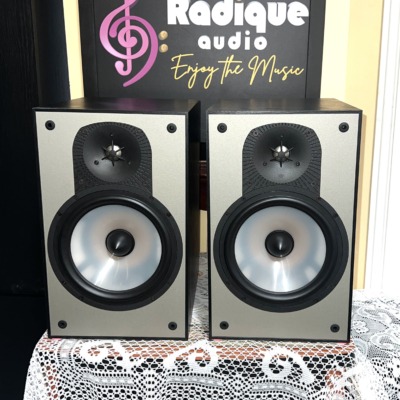
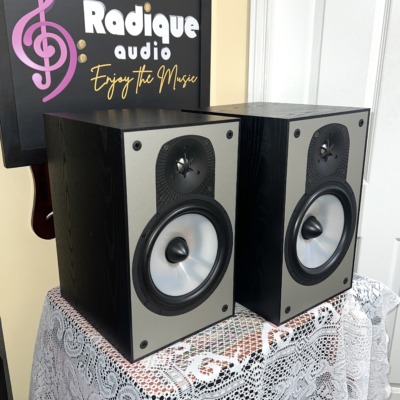
Paradigm Monitor 3 v3 Bookshelf Speakers – 8″ Woofer, Canada
An 8-inch woofer in a cabinet small enough to sit on a stand — a 210 mm ICP cone on a die-cast chassis, with a third-generation titanium dome on the Studio-series waveguide faceplate, crossed at 2.0 kHz. Low frequency extension to 38 Hz and 91 dB room sensitivity, so 15 watts drives them and 150 is just headroom. Built in Canada, in Black Ash. Very good condition.
Related Products
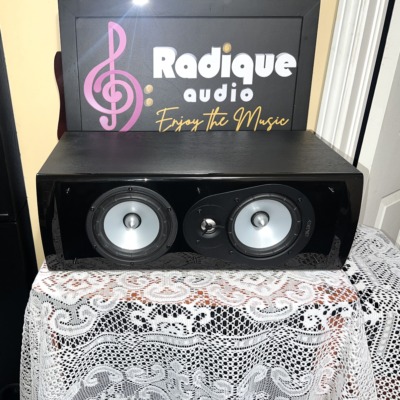
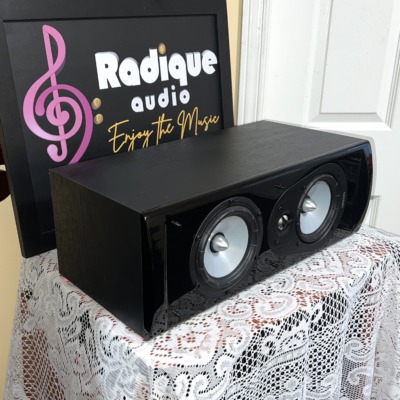
Energy Connoisseur CC-10 Centre Channel – 92dB, 200W
Tweeter and woofers sit as close together as physically possible — Energy's Convergent Source Module — so they behave as one source and hold the balance across a wide seating area rather than one chair. Dual 5.5-inch woofers on the patented Ribbed Elliptical Surround, a 1-inch hyperbolic aluminium dome, 92 dB and up to 200 watts, rear-ported to 60 Hz. The grille is not included. Condition very good.
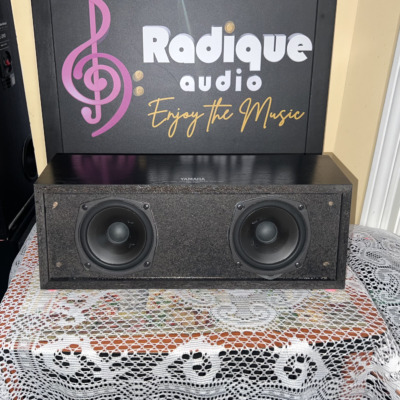
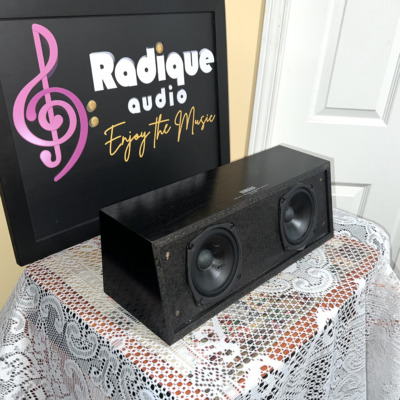
Yamaha NS-C90 Center Speaker – Dual-Angle Tilt, Made in Japan
The cabinet is asymmetrical on purpose: flip it over and it tilts the other way, aiming up at you from a low shelf or down at you from the top of a cabinet. Sealed rather than ported, so it needs no rear clearance. Two full-range drivers, nothing crossing in the vocal band. 6 ohms, 50 watts nominal. Built in Japan; very good condition.
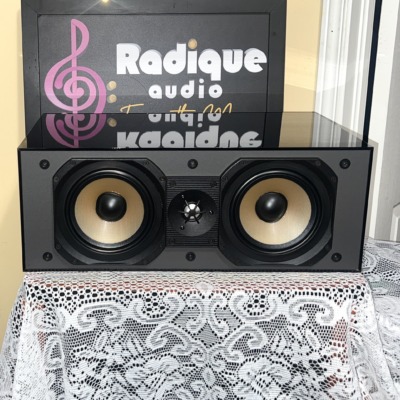
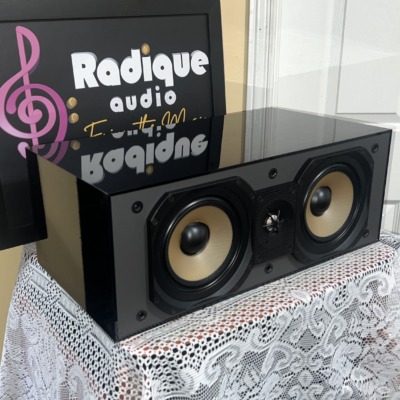
Paradigm Reference LCR-450 — Made in Canada, High Gloss Black
A Canadian-built Reference monitor in a high gloss black we have not had this model in before — the line of this era usually turns up in black, light cherry or dark rosenut. Sealed MTM design with Paradigm's pure-aluminium dome tweeter, and it works as a centre or as a left or right. Excellent, with its original box.
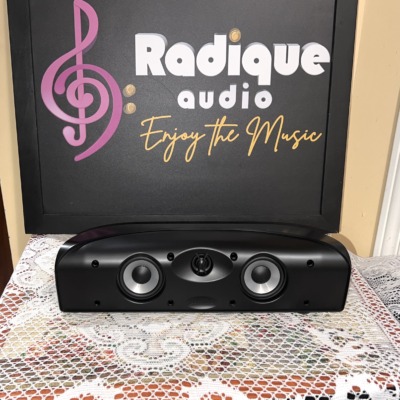
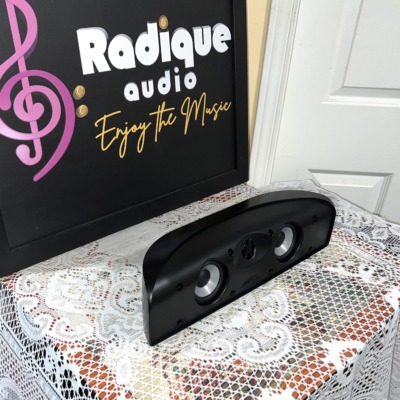
Polk Audio Blackstone TL1 Center Channel Speaker – Gloss Black
A slim, wall-mountable center channel from Polk Audio's Blackstone series, in very good condition, that gives movie dialogue the clarity and presence it deserves.
✔️ Very Good condition — cabinet, baffle and drivers present cleanly; grille included
✔️ Slim and wall-mountable — keyhole slots and a threaded insert on the back
✔️ Covered by Radique Warranty
✔️ Includes Perpetual Trade-Back Program eligibility
✔️ Expertly packed for safe shipping
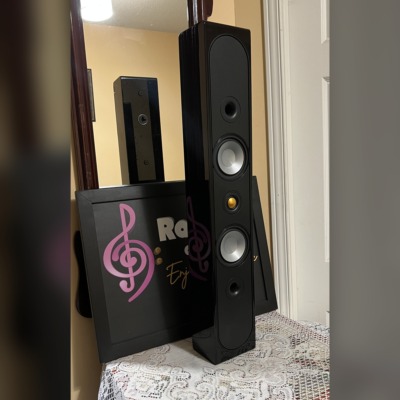
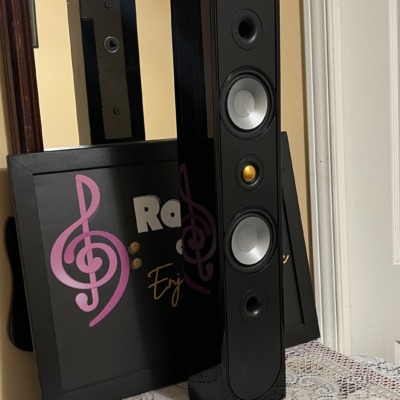
Monitor Audio Radius 250HD LCR Speaker – Gloss Black, Wall-Mount
A slim gloss black Monitor Audio speaker from the Radius HD range, in good condition, built to work as a left, center, right or rear speaker, standing upright, lying flat or hung on a wall.
✔️ Good condition — light scratches visible under bright light; grille included
✔️ One slim speaker for left, center, right or rear duty
✔️ Two rear keyhole slots; the matching wall bracket is listed separately
✔️ Covered by Radique Warranty
✔️ Includes Perpetual Trade-Back Program eligibility
✔️ Expertly packed for safe shipping
Monitor Audio Radius 250HD LCR Speakers, Pair – Gloss Black
A matched pair of slim gloss black Monitor Audio speakers from the Radius HD range, in good condition, each built to work as a left, center, right or rear speaker, standing upright, lying flat or hung on a wall.
✔️ Good condition — light scratches visible under bright light; grilles included
✔️ Two slim speakers for a stereo pair, left and right of a center, or a set of rears
✔️ Two rear keyhole slots on each; the matching wall bracket is listed separately
✔️ Covered by Radique Warranty
✔️ Includes Perpetual Trade-Back Program eligibility
✔️ Expertly packed for safe shipping
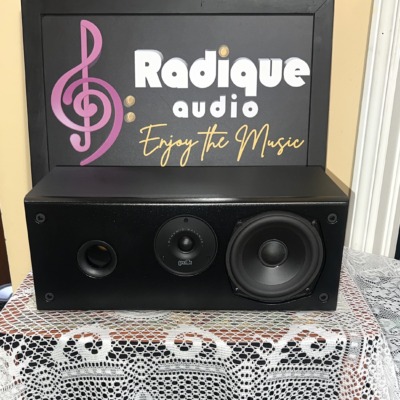
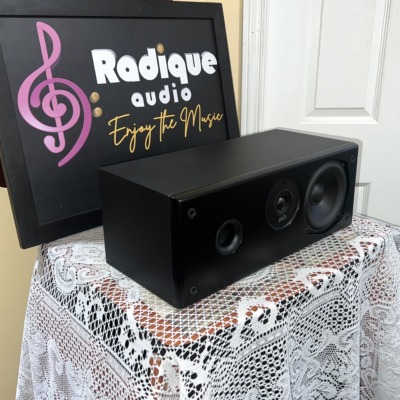
Polk Audio CS175 Center Channel Speaker – Front-Ported, Black
A Polk Audio CS175 two-way center channel speaker in black, a solidly built cabinet at nearly 14 pounds, with a front port and proper 5-way binding posts, fully tested on our bench and in very good condition.
✔️ Very good condition — free of significant marks, grille included
✔️ Front-ported two-way center with 5-way binding posts
✔️ Solidly built, at nearly 14 pounds
✔️ Covered by Radique Warranty
✔️ Includes Perpetual Trade-Back Program eligibility
✔️ Expertly packed for safe shipping
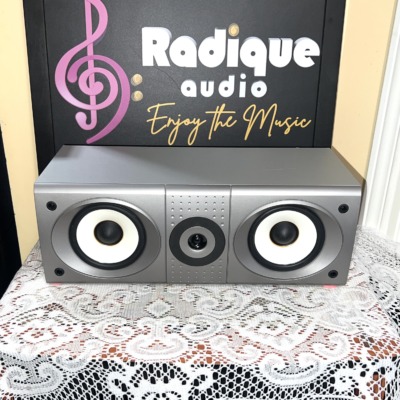
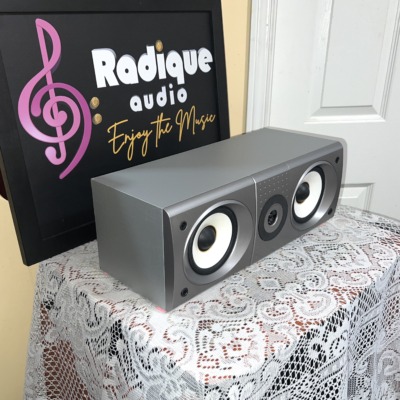
Onkyo SKC-540C Center Speaker – Dual 5″ Woofers, 130W, Silver
Two 5-inch OMF cone woofers either side of a 1-inch balanced dome, crossed at 4.5 kHz — well above where voices sit, so speech stays on one driver instead of being handed between two. Seventeen inches wide and 8.4 lbs, magnetically shielded, response 55 Hz to 50 kHz. From Onkyo's SKS-HT540 series, in the less common silver with a matching grille. Graded Good.
