


Pioneer SX-980 Vintage Stereo Receiver – 80 WPC, Cherry Cabinet
$2,195.00
A fully Level 2 serviced Pioneer SX-980 stereo receiver — third-from-the-top of Pioneer’s legendary 1978–79 SX-x80 flagship line — rehoused in a brand-new custom cabinet of laminated Baltic birch and genuine Ottawa Valley cherry veneer. 80 watts per channel of warm, effortless Golden Age power; restored to factory specification; one-of-a-kind craftsmanship. Backed by Radique Audio’s 90-day warranty and perpetual trade-back policy.
Out of stock
Get first dibs on the next one
Pioneer SX-980 — A Golden Age Flagship, Restored and Re-Cabineted in Ottawa
A truly stunning example of Pioneer’s late-1970s engineering at its finest — the Pioneer SX-980 stereo receiver, fully Level 2 serviced and tested, and fitted with a brand-new custom cabinet hand-built from laminated Baltic birch and finished in genuine Ottawa Valley cherry veneer. A Golden Age icon, restored and re-housed to a standard that genuinely transcends its already-considerable original quality. Made in Japan, 1978.
Where the SX-980 Sits in Pioneer’s Flagship Line
The SX-980 sits near the top of Pioneer’s celebrated SX-x80 line of 1978–1979, third in the lineup behind only the SX-1080 and SX-1280. Rated at a conservative 80 watts per channel into 8 ohms with 0.05% THD from 20 Hz to 20 kHz — and routinely measuring closer to 94 watts per channel on the bench — it delivers the kind of authoritative, effortless drive that has made Pioneer’s late-70s flagship receivers some of the most sought-after vintage audio components in the world. The amplifier section uses a constant-current-loaded two-stage differential input, direct-coupled two-stage Darlington single push-pull DC output stage, and the company’s renowned over-built linear power supply — engineering that translates directly into the warm, sweet, room-filling sound the SX-x80 series is famous for.
Design and Controls
Visually, the SX-980 is one of the most beautiful receivers Pioneer ever built. The brushed silver faceplate is covered in heavy, satisfying knobs and switches; the centre features Pioneer’s iconic blackout dial — dark when powered off, glowing with backlit cyan and white markings when switched on — with a smooth flywheel-weighted tuning knob; and the unit is anchored by a pair of mirrored, brilliantly illuminated power output meters that move with every musical transient.
The control set is genuinely deep: separate bass and treble with selectable turnover frequencies (200 Hz / 400 Hz bass, 5 kHz / 25 kHz treble), tone defeat, low and high filters (15 Hz and 8 kHz), FM muting, two complete tape monitor loops with duplication, two MM phono inputs, an aux input, mic input with muting, mode switch, loudness compensation, dual signal-strength and tuning meters, and outputs for two pairs of speakers. Pre-out / main-in jacks on the rear allow the SX-980 to be split into separate preamp and power amplifier sections, or paired with an outboard equalizer or processor.
Level 2 Service — What’s Been Done
This particular SX-980 has undergone our Level 2 service and testing — a comprehensive electronic restoration that addresses the components most prone to drift and degradation in a 47-year-old receiver, and brings the unit back to factory specification both electrically and operationally. The result is a Pioneer SX-980 that performs as it did when it left the Tokyo factory in 1978, with the kind of reliability and sonic confidence that only a properly serviced flagship can offer, and which should ensure many more years of reliable performance ahead.
The Custom Cherry Cabinet
The original Pioneer wooden case has been replaced with a brand-new custom cabinet, hand-built in our Ottawa shop from laminated 3/8-inch Baltic birch plywood, milled to the original Pioneer cabinet’s exact dimensions and profile detail, and then veneered with genuine Ottawa Valley cherry. Baltic birch is the gold standard for fine cabinetry — void-free, dimensionally stable, and dramatically stronger and more rigid than the particleboard Pioneer used in the original case — and the result is a receiver enclosure that is both visually stunning and mechanically superior to the factory original.
The Ottawa Valley cherry veneer is solid, locally sourced, and finished to show off the wood’s warm reddish-gold grain to its fullest. Cherry is unique among furniture woods in that it darkens and deepens beautifully with age and exposure to light, so this cabinet will only become more striking with the years. The match between the warm, organic cherry and the cool brushed-silver faceplate is genuinely stunning in person — our photos cannot do justice to the result, which has to be seen and handled to be fully appreciated. This is a one-of-a-kind piece of audio furniture as much as it is a high-performance receiver.
🌳 Caring for Your Cherrywood Cabinet
Each custom cherry cabinet is sanded to a silky 320-grit smoothness and hand-finished with boiled linseed oil and a final beeswax polish — no stains, no polyurethane, no synthetics. For tips on keeping it looking its best for decades, including safe cleaners, what to avoid, and how to manage sunlight exposure, see our Cherrywood Cabinet Care Guide. 👉
Pioneer SX-980 Specifications
- Tuning range: FM, MW (AM)
- Continuous power output: 80 W/ch into 8 ohms, 95 W/ch into 4 ohms (20 Hz – 20 kHz, 0.05% THD)
- Dynamic power output: 160 W/ch into 8 ohms, 190 W/ch into 4 ohms
- Frequency response: 5 Hz – 100 kHz
- Total harmonic distortion: 0.05%
- Damping factor: 30
- Input sensitivity: 7.5 mV (mic), 2.5 mV (MM phono), 150 mV (DIN), 150 mV (line)
- Signal-to-noise ratio: 76 dB (MM), 90 dB (line)
- Outputs: 150 mV (line), 30 mV (DIN), 1 V (pre-out)
- Speaker load impedance: 4 ohms minimum, two pairs supported
- Tone controls: Bass with 200 Hz / 400 Hz turnover, treble with 5 kHz / 25 kHz turnover, tone defeat, 15 Hz subsonic and 8 kHz high-cut filters
- Phono inputs: 2 x MM
- Tape loops: 2 with duplication
- Pre-out / main-in: Yes (split-amp capable)
- Semiconductors: 3 x FET, 8 x IC, 35 x transistors, 45 x diodes
- Power consumption: 800 W maximum
- Year of introduction: 1978
- Country of manufacture: Japan
- Dimensions (W × H × D): 20.7 × 6.9 × 17.3 inches (526 × 176 × 440 mm)
- Weight: approx. 41.5 lbs (18.8 kg)
- Cabinet: Brand-new custom build, laminated 3/8″ Baltic birch plywood milled to the original Pioneer cabinet’s dimensions and profile detail, veneered with genuine Ottawa Valley cherry
Why This SX-980 Stands Apart
A Golden Age Pioneer flagship receiver, properly serviced to factory specification and re-housed in a one-of-a-kind cabinet of laminated Baltic birch and Ottawa Valley cherry — a genuinely special piece that combines audiophile vintage performance with a level of craftsmanship and visual presence that no production receiver from any era has ever matched. Made in Japan, restored and re-cabineted in Ottawa.
⚠️ Important Information for International Buyers
This receiver is configured for North American 110/120V power. Buyers outside North America will require a step-down transformer and appropriate plug adapter.
✅ Buy With Confidence — The Radique Promise
Backed by Radique’s 90-day warranty and our Perpetual Trade-Back Program. When you’re ready to move on, we’ll take it back. That’s the Radique difference.
📦 Watch how we protect your gear — our unboxing video.
📺 Curious about our business? Check out our YouTube channel for behind-the-scenes videos and more!
📞 Questions? Use the Ask a Question button above, or call us at 613-416-9995.
| Weight | 44 lbs |
|---|---|
| Dimensions | 21.3 × 24.7 × 10.9 in |
Pioneer began in Tokyo in January 1938, when Nozomu Matsumoto set up shop around the A-8 speaker he had built the year before. By the late 1970s its SX receivers were at the heart of the hi-fi power race. We carry Pioneer stereo receivers and AV receivers, CD players, cassette decks, tuners and equalizers. We've had more than 240 Pioneer listings so far, covering 140 different models. Every used Pioneer here is inspected, tested and serviced as required, then photographed in-house and covered by our Bumper-to-Bumper Warranty and Perpetual Trade-Back Program. Don't see the model you want? Tell us on First Dibs and we'll email you when one arrives.
Pioneer is one of our two top-selling brands of vintage amps and receivers, along with Marantz. Our five best-selling Pioneer models so far: the SX-650, SX-750, SX-580, SX-780 and SX-680, all vintage stereo receivers from the 1976 and 1978 SX families. We also offer our custom cherry cabinets for these vintage Pioneers, hand-made from all-natural Ottawa Valley cherry, and we've upgraded dozens of Pioneers with them so far.
The Pioneer story, 1938 to today
Nozomu Matsumoto developed the A-8 speaker in 1937, and in January 1938 he set up Fukuin Shokai Denki Seisakusho in Tokyo. "Pioneer" was first the name of that speaker. Some histories give 1936 in Osaka as the start, but Pioneer dates itself to January 1938 in Tokyo. The company was incorporated in 1947 and renamed Pioneer Electronic Corporation in 1961.
Stereo and the US. In 1962 Pioneer introduced the PSC-5A, which it calls the first stereo with separate speaker cabinets, and its first PL turntables. Pioneer Electronics U.S.A. was founded in New York in 1966.
The power race. After a 1974 US Federal Trade Commission rule tightened how amplifier power was rated, receiver makers competed on watts. Pioneer's SX-1250 of 1976 was rated at 160 watts per channel, and the SX-1980 of 1978 to 1980 at 270.
CD and Elite. The P-D1 of 1982 was Pioneer's first CD player, and Elite-branded components were on sale by 1985.
Today. Pioneer sold its home audio business to Onkyo in 2015, keeping its car and DJ businesses, and Pioneer-branded home theatre gear was later made under licence. In December 2025 CarUX, part of Taiwan's Innolux, completed its purchase of Pioneer Corporation, which now focuses on in-car products.
Which Pioneer is which?
Early-1970s SX receivers: models such as the SX-424 to SX-828, rated at about 15 to 50 watts per channel.
The 1976 "x50" SX receivers: from the SX-450 at 15 watts per channel up to the SX-1250 at 160. Our best-selling SX-650 and SX-750 come from this family.
The 1978 "x80" SX receivers: including the SX-580, SX-680 and SX-780 we sell most, up to the SX-1980 flagship with quartz-lock tuning, which weighs more than 35 kg.
Spec and Exclusive separates: higher-end amplifiers such as the Spec-1 preamplifier (1976 to 1980) and the Exclusive C3/M3 pair (1974).
Elite: Pioneer's upper line from the mid-1980s, for example the PD-9010X CD player.
PL turntables, CT cassette decks and CD players: PL turntables from 1962, such as the PL-12 and the linear-tracking PL-L1; CT decks such as the three-head CT-F1000; and CD players from the 1982 P-D1 to magazine-loading changers such as the PD-M6.
Buying used Pioneer: what to check
Controls and switches. Crackle when you turn a control or work a switch usually means dirt, and restorers clean every pot and switch.
Capacitors. Electrolytic capacitors in 1970s receivers are often past their best, and full restorations replace them.
Big SX models. Owners and restorers report heat stress on the power-supply board of large receivers such as the SX-1250. Ask what has been done.
Relay, lamps and bias. The protection relay is a common replacement, dial lamps burn out and are often converted to LED, and restorers set the bias and DC offset.
Cassette decks. Check the heads, fast-forward and rewind, Dolby and every button. Belts age even when the deck looks perfect.
Everything we list is inspected, tested and serviced as required here, and comes with our warranty.
You may also like…
RA-Twin II Gold Series TX Bundle
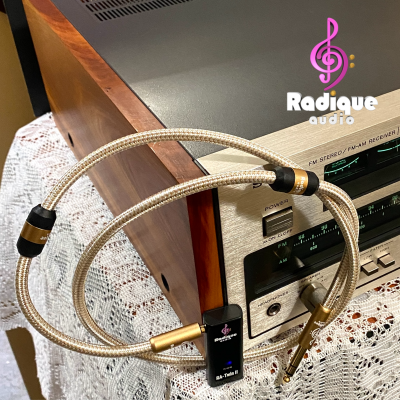
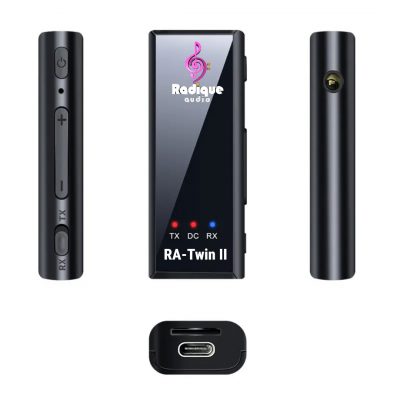
The RA-Twin II plus our shielded Gold Series ¼" to ⅛" TRS cable: send your vintage amp's headphone output to Bluetooth headphones or a speaker, for less than buying the two separately.
- RA-Twin II Bluetooth 5.4 adapter (TX, RX and Mobile modes)
- Gold Series ¼" to ⅛" TRS cable, shielded and gold-plated
- Perfect for late-night listening
- Clear online manual in English & French
- 1-year warranty, Ottawa-based support
RA-Twin II Gold Series RX Bundle
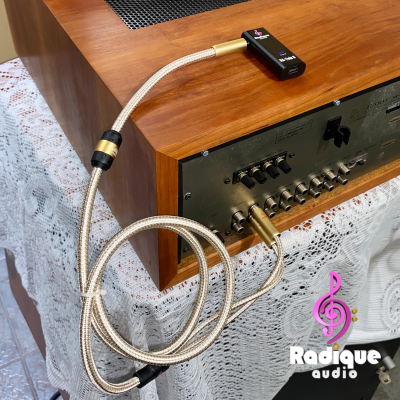
The RA-Twin II plus our shielded Gold Series 3.5 mm to dual RCA cable: stream from your phone to any vintage receiver, amplifier or powered speakers, for less than buying the two separately.
- RA-Twin II Bluetooth 5.4 adapter (RX, TX and Mobile modes)
- Gold Series 3.5 mm to dual RCA cable, shielded and gold-plated
- No noise after streaming stops
- Clear online manual in English & French
- 1-year warranty, Ottawa-based support
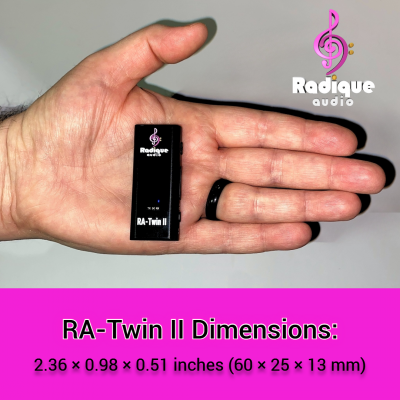
RA-Twin II Bluetooth Adapter for Vintage Stereo – Receiver & Transmitter
Add Bluetooth to any vintage stereo, amplifier or car stereo, or send your TV or stereo to Bluetooth headphones. Tiny but mighty, and set up in minutes.
- RX, TX and Mobile (microSD) modes
- Bluetooth 5.4, up to 10 m range
- Up to 10 hours per charge, USB-C
- Clear online manual in English & French
- 1-year warranty, Ottawa-based support


RA-USB Multi-Port USB Fast Charger – 50W, USB-C PD & QC 3.0
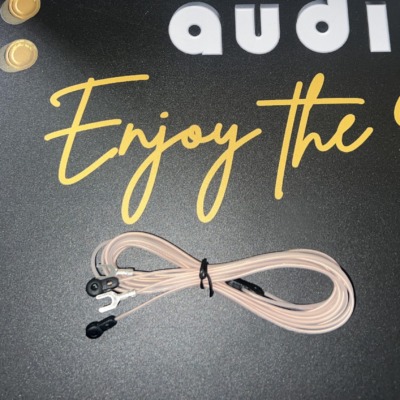
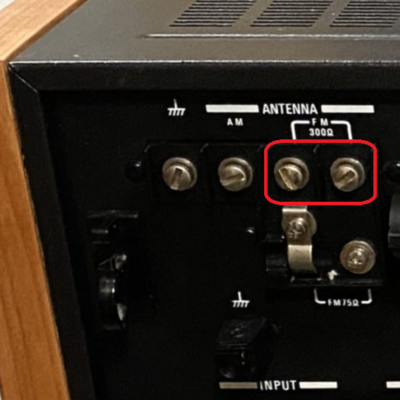
Tiny but mighty: charge four devices at once from one outlet, whether that's the wall or the accessory outlet on the back of your vintage amp.
- 50 W total: 20 W USB-C Power Delivery + three USB-A ports
- Quick Charge 3.0 for compatible Android phones
- Keeps your RA-Twin II charged right at the stereo
- Overvoltage, overcurrent, short-circuit and heat protection
- 1-year warranty, Ottawa-based support
Related Products
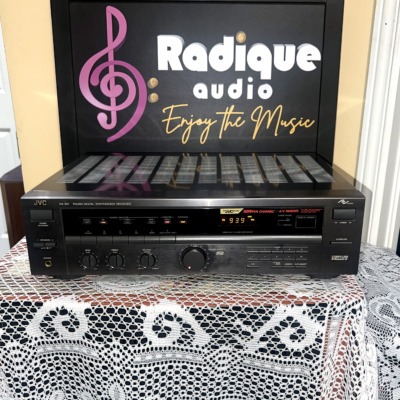
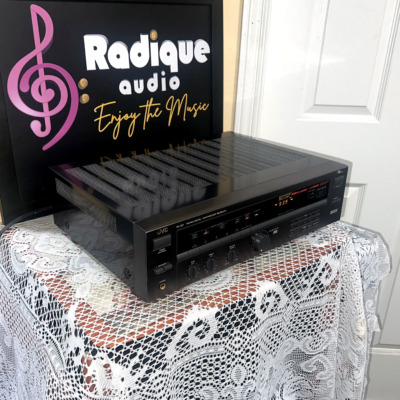
JVC RX-307 Stereo Receiver – 80 WPC, Original Remote & Manual
Eighty watts a side, a proper phono input, and the two things these almost never come with any more: the original remote and the printed manual.
✔️ Condition: Very Good
✔️ Covered by Radique Warranty
✔️ Includes Perpetual Trade-Back Program eligibility
✔️ Expertly packed for safe shipping
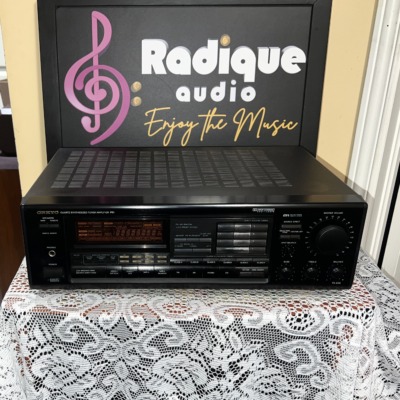
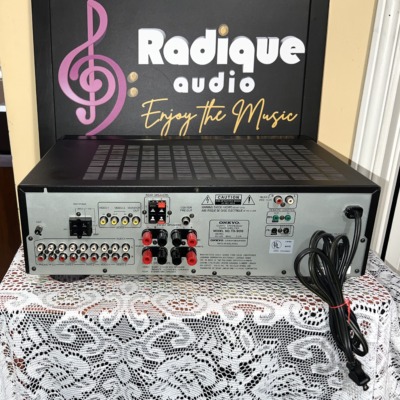
Onkyo TX-906 Stereo Receiver – 80 WPC, Dolby Pro Logic
An early-nineties Onkyo receiver with real power behind it and a phono input for your turntable, through our Level 1 service and playing as it should.
✔️ Good condition — works as it should; the black cabinet and faceplate present well
✔️ Through our Level 1 service — cleaned, deoxidized, checked and thoroughly tested on our bench
✔️ Phono input for your turntable, plus CD and two tape inputs
✔️ Covered by Radique Warranty
✔️ Includes Perpetual Trade-Back Program eligibility
✔️ Expertly packed for safe shipping
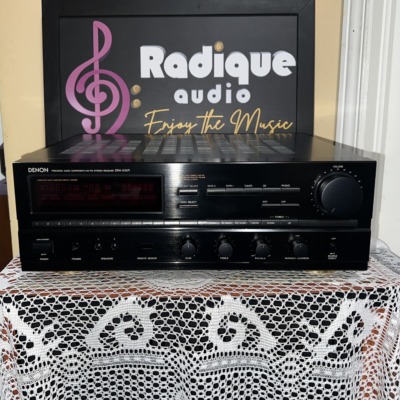
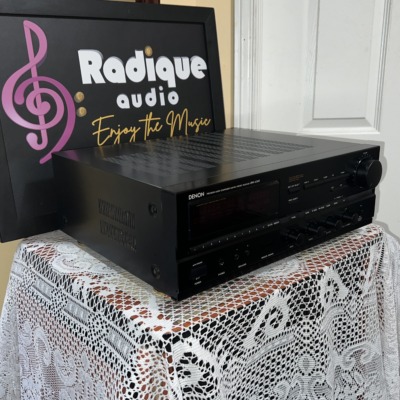
Denon DRA-835R Vintage Stereo Receiver – 100 WPC, Made in Japan
The second-from-the-top model in Denon's early-nineties stereo receiver range, made in Japan and in very good condition, with 100 watts per channel, a phono stage, motorized volume and its original remote.
✔️ Very good condition — free of significant marks
✔️ 100 WPC, MM phono and motorized volume — made in Japan
✔️ Original Denon remote included
✔️ Covered by Radique Warranty
✔️ Includes Perpetual Trade-Back Program eligibility
✔️ Expertly packed for safe shipping
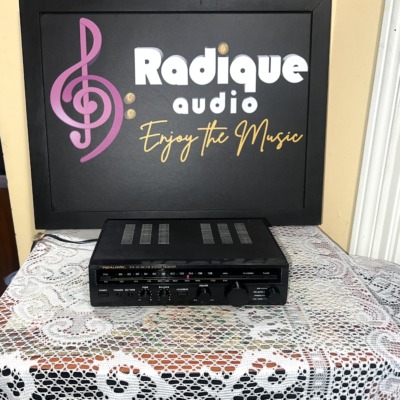
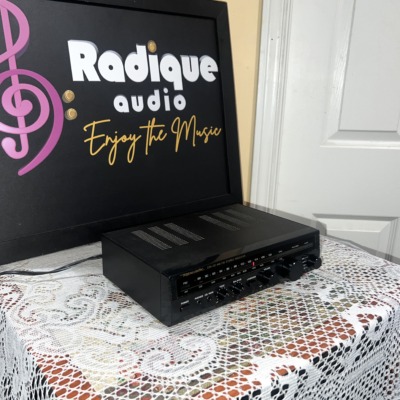
Realistic STA-20 Compact AM/FM Stereo Receiver – 5 WPC, Serviced
Radio Shack's smallest AM/FM stereo receiver of the 1990s, the Realistic STA-20: 5 watts per channel, a rear EQ switch made for mini-speakers, a phono input and a front jack for a phone.
✔️ Serviced on our bench to our Level 1 standard
✔️ Very good condition
✔️ Covered by Radique Warranty
✔️ Includes Perpetual Trade-Back Program eligibility
✔️ Expertly packed for safe shipping
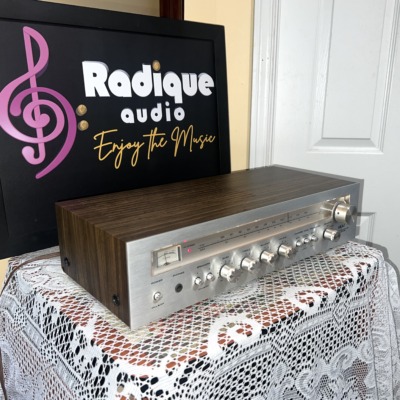
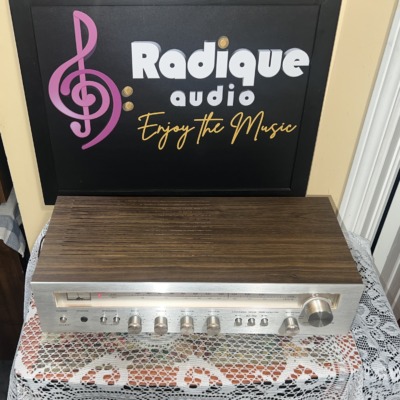
Akai AA-1115 Vintage Stereo Receiver – 15 WPC, Made in Japan
A slim late-1970s Akai AA-1115 AM/FM stereo receiver, made in Japan, silver face in its original woodgrain cabinet.
✔️ Tested on our bench, every input, output and control
✔️ Very good condition
✔️ MM phono, PLL FM tuner, speakers A and B
✔️ Covered by Radique Warranty
✔️ Includes Perpetual Trade-Back Program eligibility
✔️ Expertly packed for safe shipping
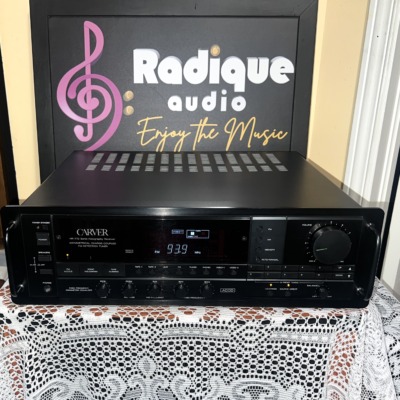
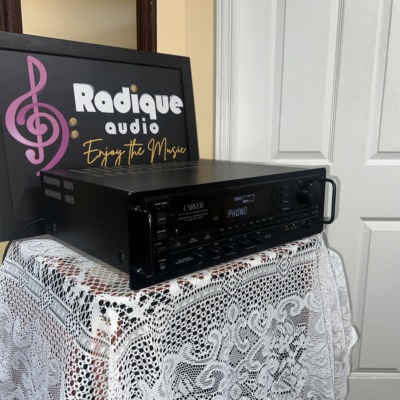
Carver HR-772 Sonic Holography Receiver – 140 WPC, Rack Ears
A Carver HR-772 stereo receiver, Carver's early-1990s flagship: 140 watts per channel, Sonic Holography, and rack ears with front handles.
✔️ Tested on our bench, Sonic Holography included
✔️ Very good condition
✔️ 140 WPC, stable to 2 ohms, MM phono, five-band EQ
✔️ Rack ears and handles for a 19-inch rack
✔️ Covered by Radique Warranty
✔️ Includes Perpetual Trade-Back Program eligibility
✔️ Expertly packed for safe shipping
