
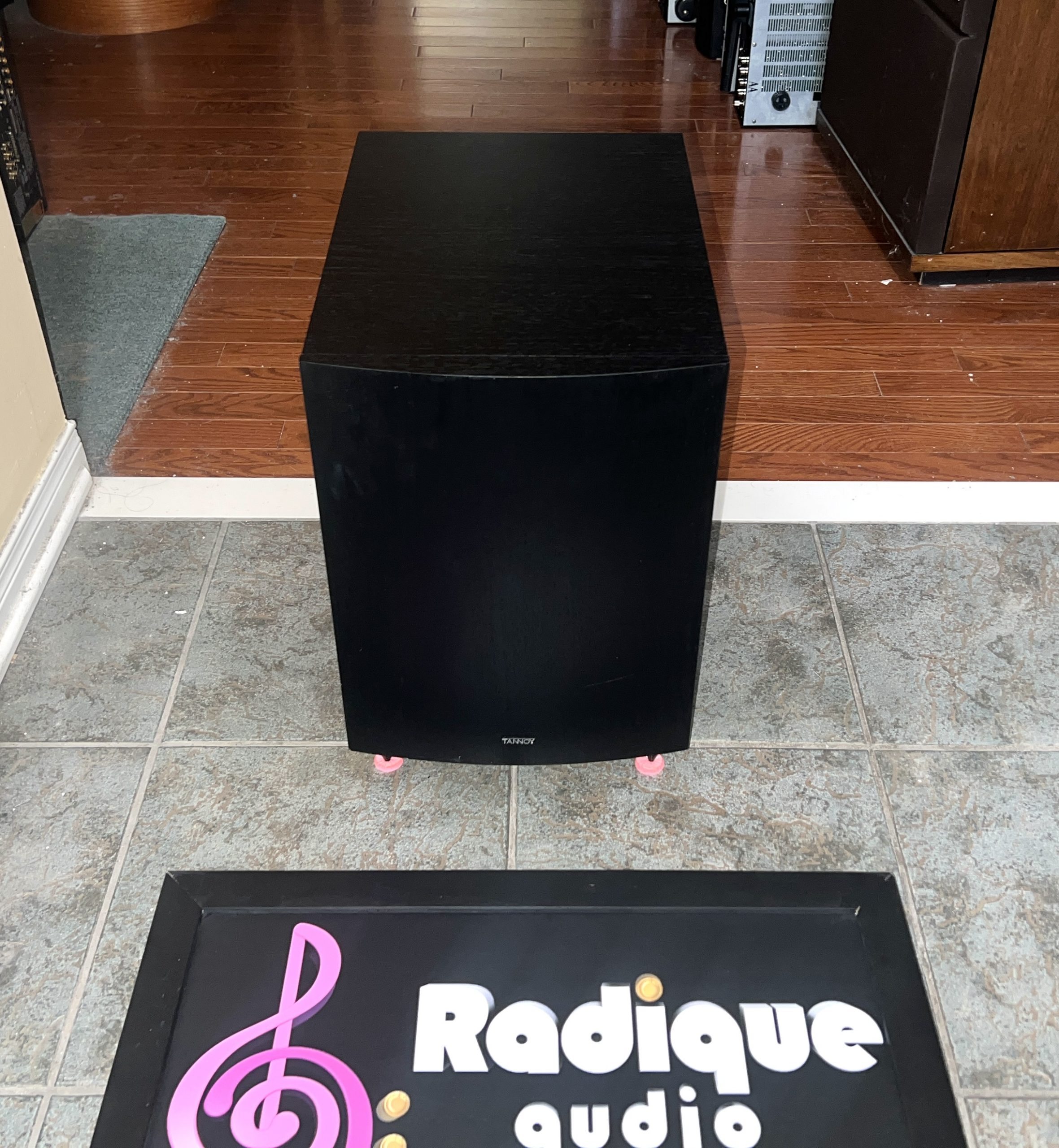
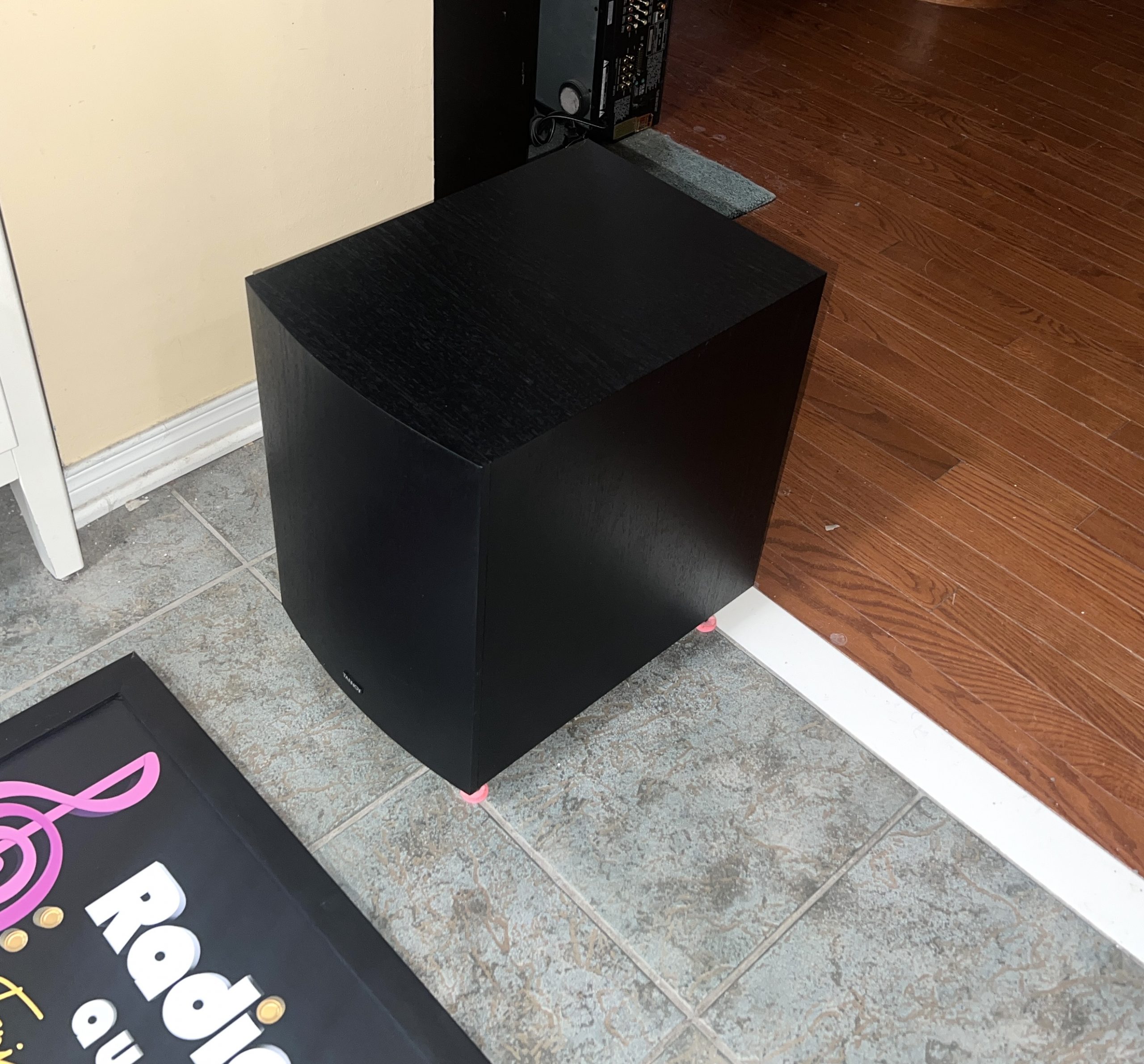
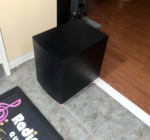
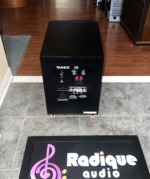

Tannoy HTS200 Powered Subwoofer 100W — 8″ Down-Firing
$245.00
Out of stock
Get first dibs on the next one
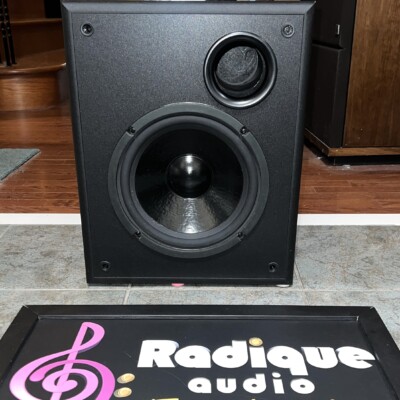
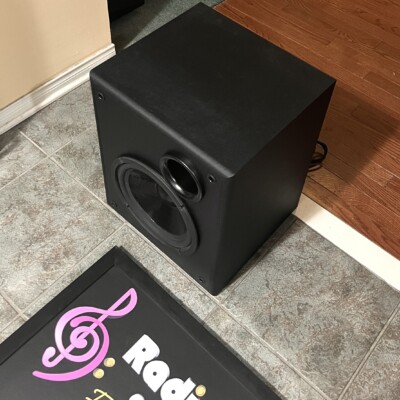
Tannoy HTS200 Powered Subwoofer 100W — 8″ Woofer, Downward-Firing
A compact, well-built powered subwoofer from Tannoy’s HTS 200 home cinema range, featuring a 200mm long-throw paper cone driver and 100-watt RMS amplifier in a black ash finish.
The HTS200 subwoofer delivers surprisingly deep bass from a modest enclosure, with a rated frequency response reaching down to 29 Hz — low enough to reproduce the foundation of movie soundtracks and bass-heavy music with genuine authority. The 200mm long-throw paper cone driver provides clean, articulate bass output without the boomy, one-note character that plagues many compact subwoofers.
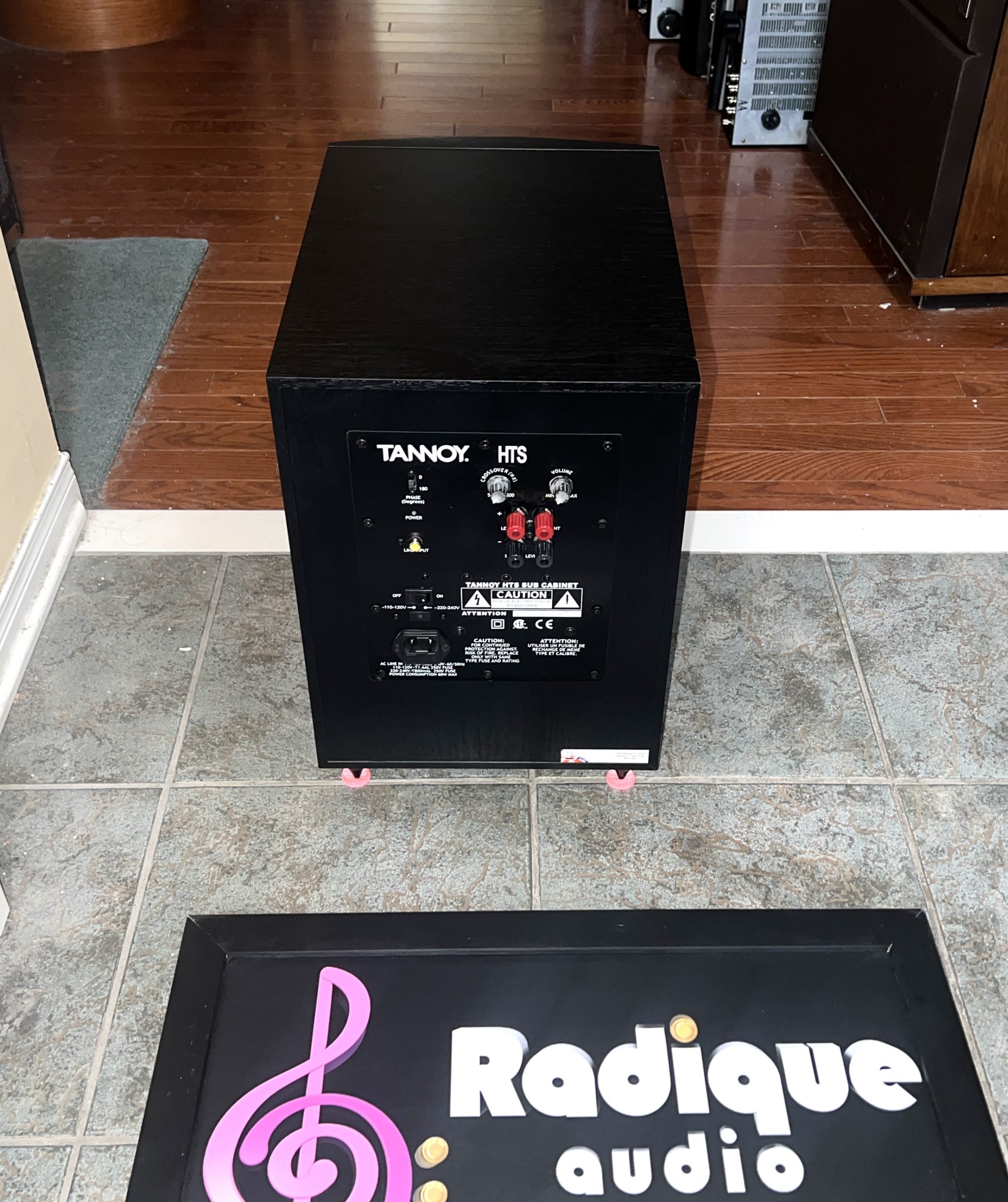
The rear panel provides a practical set of controls and connectivity options. A variable crossover control adjustable from 50 Hz to 200 Hz allows seamless integration with a wide range of satellite and bookshelf speakers. Both line-level LFE input (single RCA) and stereo speaker-level inputs ensure compatibility with virtually any amplifier or receiver, whether it has a dedicated subwoofer output or not. A switchable phase control (0 or 180 degrees) helps time-align the subwoofer output with the main speakers for the smoothest possible bass integration. Volume control and an energy-saving auto power function round out the feature set — the subwoofer powers on automatically when it detects a signal and returns to standby when the signal stops.
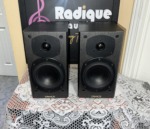
This subwoofer pairs naturally with the Tannoy HTS200 tower speakers also available from Radique Audio, though it integrates well with any compact speaker system in need of extended bass support.
Specifications:
Type: powered (active) subwoofer
Driver: 200mm (8 inch) long-throw paper cone
Amplifier power: 100 watts RMS
Frequency response: 29 Hz – 200 Hz
Variable crossover: 50 Hz – 200 Hz
Phase switch: 0 / 180 degrees
Inputs: line-level LFE (single RCA), stereo speaker-level inputs
Volume control
Auto power on/standby
Finish: black ash
Dimensions: (Width x Height x Depth) 10.8 x 16.5 x 16 inches (275 x 420 x 405 mm)
Weight: 22.5 lbs (10.2 kg)
A capable and compact powered subwoofer from Tannoy that adds genuine low-frequency foundation to any home theater or stereo system.
Backed by Radique Audio’s 90-day warranty and our perpetual trade-back policy, you can purchase with confidence
| Weight | 25 lbs |
|---|---|
| Dimensions | 20 × 14.8 × 20.5 in |
Tannoy began in London in 1926, and since the late 1940s it has been known for its Dual Concentric driver, with the tweeter set in the centre of the woofer. We carry Tannoy towers, bookshelf speakers, centre channels and subwoofers. We've had more than 210 Tannoy listings so far, covering more than 65 different models. Every used Tannoy here is inspected, tested and serviced as required, then photographed in-house and covered by our Bumper-to-Bumper Warranty and Perpetual Trade-Back Program. Don't see the model you want? Tell us on First Dibs and we'll email you when one arrives.
Our five best-selling Tannoy models so far: the Mercury mx3 towers, the Mercury mx2 and mx1 bookshelf speakers, the PS 110 subwoofer and the Mercury mxC centre.
The Tannoy story, 1926 to today
Guy R. Fountain founded the company in London in 1926 as the Tulsemere Manufacturing Company, making rectifiers and battery chargers for radio sets. It became Tannoy in 1928, a name taken from the tantalum alloy in his rectifier.
The Dual Concentric. Ronnie Rackham's Dual Concentric driver first appeared as the "Monitor Black" in 1947 or 1948 (sources differ). The Monitor Silver, Red and Gold generations followed through the 1950s and 1960s, then the HPD in 1974.
Scotland. Harman International bought Tannoy in 1974, and production moved from London to Coatbridge, Scotland, in 1976. Managers bought the business in 1981, Tannoy merged with Goodmans in the mid-1980s and joined Denmark's TC Group in 2002.
Today. Music Group, later Music Tribe, bought TC Group in 2015. From 2016 the lower-priced ranges, such as Mercury, were made in China, while Prestige stayed in Scotland, where Tannoy's headquarters and assembly are now in Hamilton.
Which Tannoy is which?
1970s HPD cabinets: the Arden, Berkeley, Cheviot, Devon and Eaton, all with Dual Concentric drivers. The Arden, Cheviot and Eaton were reissued as the "Legacy" series in 2017.
Mercury (early 1980s onward): the entry range, through many generations. Our best-selling mx3, mx2, mx1 and mxC come from this family.
Profile (1991 to 1994) and Sensys DC (about 2004): Dual Concentric ranges between Mercury and Prestige.
Revolution (1998 onward): cherry-veneered models such as the R1, R2 and R3.
Prestige (1980s onward): the traditional-styled Dual Concentric range, such as the Westminster and Stirling, later in Gold Reference versions.
Definition (2009): birch-ply Dual Concentric models built in Scotland, such as the DC8 and DC10T.
Buying used Tannoy: what to check
HPD-era surrounds. The surrounds on 1970s drivers rot with age, and many have been replaced. Ask what was replaced and with what.
Dating the drivers. Frame colour alone is not a reliable guide to a Dual Concentric's age; construction details date it better.
Reused names. An Arden, Cheviot or Eaton may be a 1970s original or a 2017 Legacy reissue.
Origin label. From 2016, Mercury and Revolution models were made in China and Prestige in Scotland. Check the label if it matters to you.
Everything we list is inspected, tested and serviced as required here, and comes with our warranty.
You may also like…


IsoAcoustics Aperta Sub XL Subwoofer Isolation Stand
- ✔️ Genuine IsoAcoustics Aperta Sub XL, brand new in box
- ✔️ Low-profile isolation stand for front-firing and side-firing subwoofers up to 160 lbs (72.6 kg)
- ✔️ Includes 1 stand plus 4 carpet discs for carpeted surfaces
- ✔️ Helps reduce energy transfer, room rattle, and muddy bass smear for tighter low-frequency performance
- ✔️ Backed by a 2-year manufacturer’s warranty in Canada
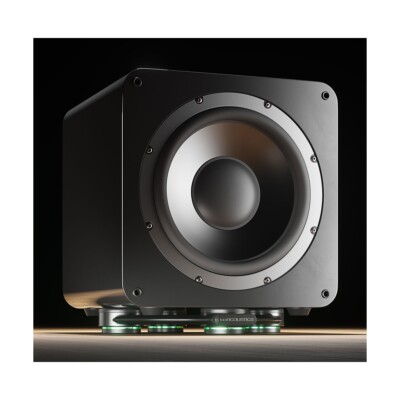
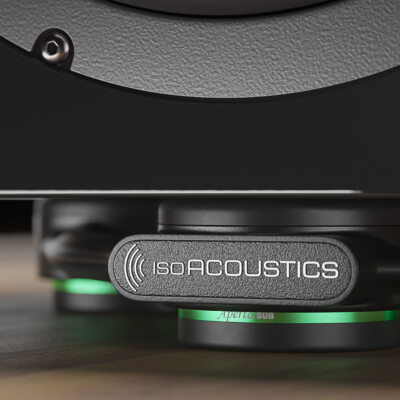
IsoAcoustics Aperta Sub Subwoofer Isolation Stand
- ✔️ Genuine IsoAcoustics Aperta Sub, brand new in box
- ✔️ Low-profile isolation stand for front-firing and side-firing subwoofers up to 80 lbs (36.3 kg)
- ✔️ Includes 1 stand plus 4 carpet discs for carpeted surfaces
- ✔️ Helps reduce energy transfer, room rattle, and muddy bass smear for tighter low-frequency performance
- ✔️ Backed by a 2-year manufacturer’s warranty in Canada

Related Products
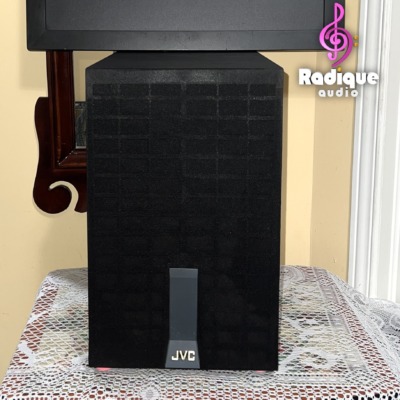
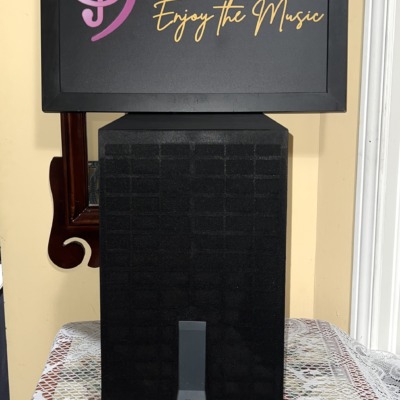
JVC SX-PW33 Slim Tower Subwoofer — 6.5in, 100W, High-Pass Out
A tall, narrow bass column meant to stand beside a cabinet rather than in front of it — 8.25 inches across the front and unusually deep at 17, which is the trade: the depth buys back the internal volume the narrow baffle gives away, so a 6.5 inch woofer is properly loaded in a strip of floor barely wider than a hardcover book. Driven by an integrated 100 watt amplifier, with speaker-level inputs and high-pass outputs so it works with an amplifier that has no subwoofer output at all. Good condition.
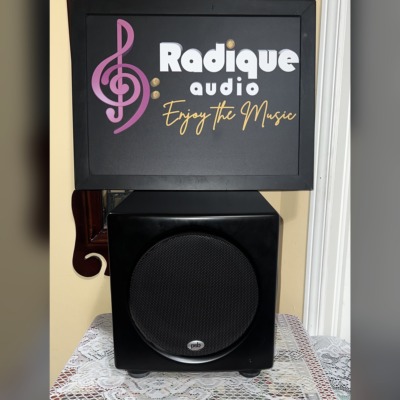
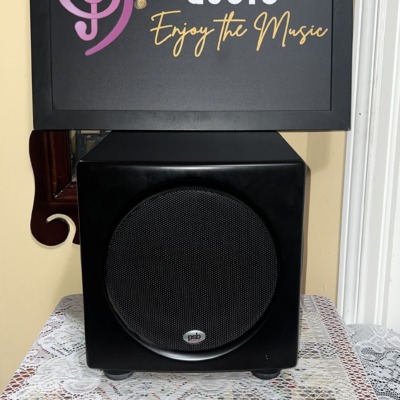
PSB SubSeries HD10 10″ Powered Subwoofer — 750W, 2000W Peak!
A serious subwoofer in about a square foot of floor, from one of the most respected names in Canadian loudspeaker design, with deep, powerful bass for home theatre and most music.
✔️ Good condition — light scuffs on the top, and a little vibration when played loud (details below)
✔️ 10-inch driver, two passive radiators and a 750 W Class H amplifier
✔️ Line-level and high-level inputs — works even with a receiver that has no sub out
✔️ Covered by Radique Warranty
✔️ Includes Perpetual Trade-Back Program eligibility
✔️ Expertly packed for safe shipping
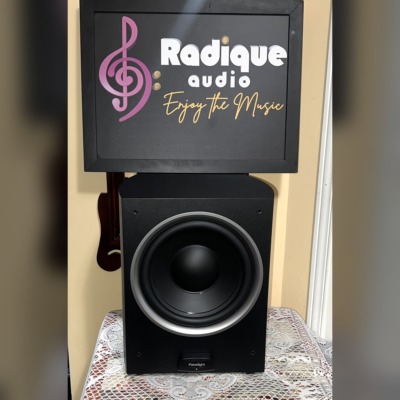
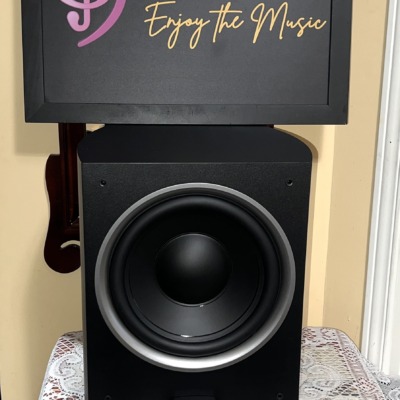
Paradigm PDR-10 v.4 10″ Powered Subwoofer – 300W Peak, Serviced
A black Paradigm PDR-10 v.4 powered subwoofer, with a 10-inch forward-firing driver and 100 watts RMS (300 watts dynamic peak) on board, serviced on our bench and in very good condition.
✔️ Very good condition — free of significant marks
✔️ Serviced on our bench and tested before listing
✔️ 10-inch forward-firing driver, 100 W RMS and 300 W dynamic peak
✔️ Covered by Radique Warranty
✔️ Includes Perpetual Trade-Back Program eligibility
✔️ Expertly packed for safe shipping
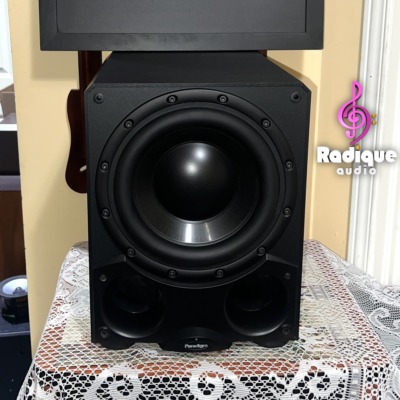
Paradigm DSP-3100 v.2 10″ Subwoofer – 600W Peak, Made in Canada
A black Paradigm DSP-3100 v.2 powered subwoofer, made in Canada, with a 10-inch front-firing driver and 200 watts RMS (600 watts dynamic peak) on board. It has been tested on our bench and is in very good condition.
✔️ Very good condition — removable black cloth grille included
✔️ 10-inch front-firing driver, 200 W RMS / 600 W peak Class-D
✔️ Front ports for hidden installs — made in Canada
✔️ Covered by Radique Warranty
✔️ Includes Perpetual Trade-Back Program eligibility
✔️ Expertly packed for safe shipping
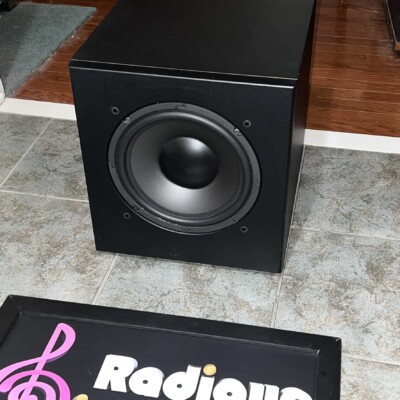
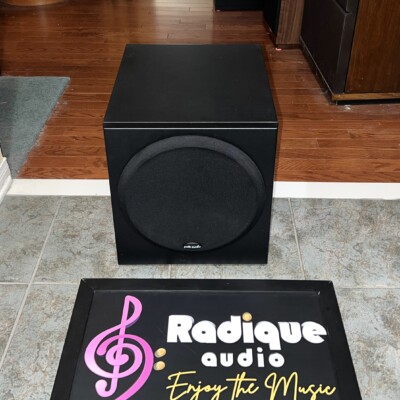
Polk Audio PSW350 10″ Front-Firing Powered Subwoofer 260W
A 10-inch front-firing Dynamic Balance woofer on a 100-watt RMS amplifier — 260 watts dynamic — in a dual-rear-ported cabinet good for 25 to 180 Hz. Speaker-level in and out, stereo line inputs and an unfiltered LFE jack, with a variable 60 to 160 Hz low-pass and a phase switch. 37 lbs, black matte. Very good cosmetic condition.
Yamaha SW-3 Active Servo Subwoofer — 10″ Woofer | Air Woofer Tec
Yamaha’s Active Servo Technology couples a negative-impedance drive amplifier to a Helmholtz resonator port — the Air Woofer opening — so the amplifier corrects the driver’s motion as it works. 100 watts into a 25 cm cone, rated down to 25 Hz, with a continuously variable 50–150 Hz high-cut at 24 dB per octave. Speaker-level and line inputs both. Very good condition.
