
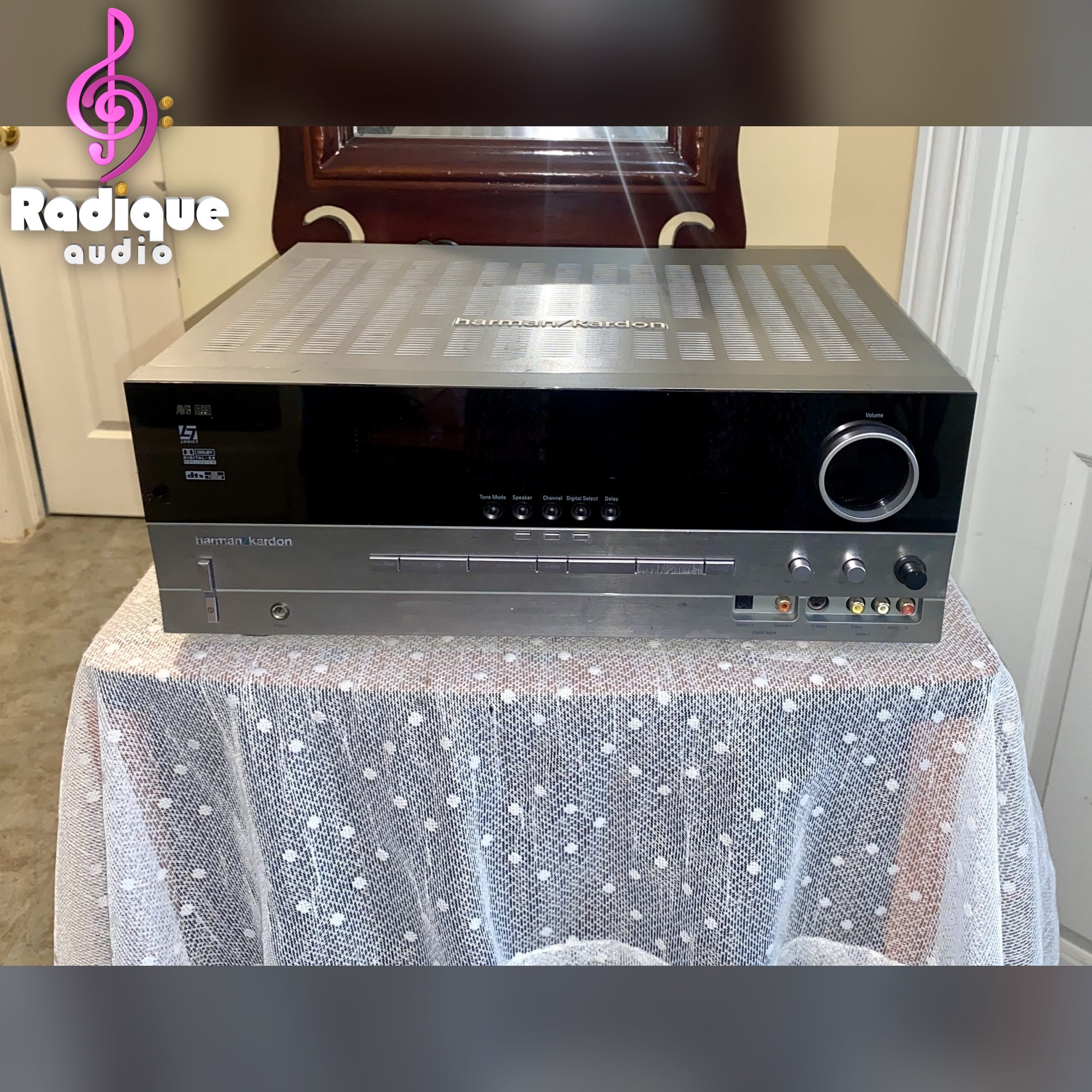




Harman Kardon 240 Watt 6.1 AVR w/ Remote AVR 135
$175.00
Six discrete channels rated a conservative 40 watts each into 8 ohms from 20 Hz to 20 kHz at under 0.07% distortion, fed by 192 kHz/24-bit converters and a Cirrus 32-bit DSP. Dolby Digital, DTS-ES Discrete and Matrix, Neo:6, and Harman’s own Logic 7. Triple-crossover bass management, automatic digital input polling, 30 tuner presets. Harman Kardon remote included.
1 in stock
Harman Kardon’s attractive AVR 135 6.1 audio/video surround receiver decodes an array of 5.1- and 6.1-channel surround formats, bringing you great sound from many sources. The AVR 135 features a discrete-output amplifier that pumps 6 channels of high-current (+/-25 amps), ultrawide-bandwidth power: (conservatively rated) 6 x 40 watts into 8 ohms, 20 to 20,000 Hz with less than 0.07 percent THD. The receiver uses state-of-the-art 192 kHz/24-bit audio digital-to-analog converters and a high-power Cirrus 32-bit DSP processor for clear, dynamic presentations from music and movies.
Surround sound features include traditional Dolby Pro Logic, Dolby Digital 5.1, and DTS surround, including 6.1 DTS-ES Discrete, DTS-ES Matrix, and DTS Neo:6 (Cinema 6.1/5.1 and Music 6.1/5.1). You also get Harman’s proprietary Logic 7 audio for enhanced multichannel reproduction from both matrix-encoded and 2-channel recordings.
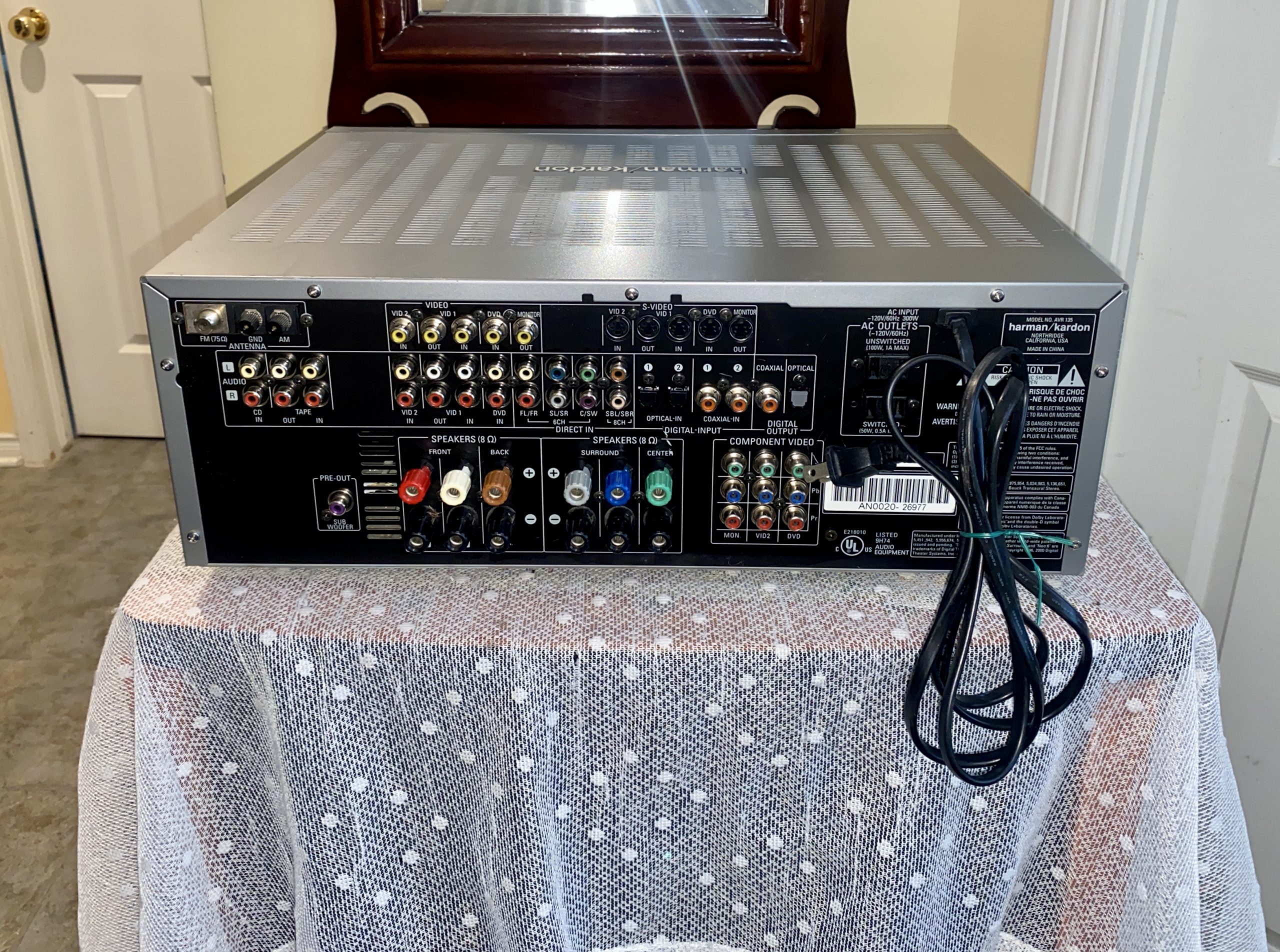
As part of its broad video hookup options, the receiver offers wide-bandwidth, HDTV-compatible component-video inputs and an array of digital and analog audio connections, including three coaxial and two optical digital audio inputs and 1 of each type of digital output. It sports both analog and digital front-panel inputs, and 6-channel direct audio inputs to accommodate a DVD-Video, DVD-Audio, SACD, or universal player.
The AVR 135’s cutting-edge technologies also include triple-crossover bass management and automatic digital input polling. Digital input polling is a Harman Kardon feature that detects whether the selected audio source is digital or analog in nature and automatically configures the receiver to provide the required audio output. This means you won’t have to manually switch the receiver’s input from digital to analog when changing from, say, an SACD-capable DVD player’s coaxial digital output (for Dolby/DTS) and its multichannel analog outputs (to appreciate the SACD audio). You can switch the feature off when desired. (Awesome Feature!)
Triple-crossover bass-management system lets you choose from multiple crossover frequencies for the front L/R, center, surround L/R, and surround back L/R speakers. Most receivers and DVD players have far more limited crossover filtering or none at all. Moreover, you can set different speaker-size configurations for different AVR 135 input sources according to your needs.
You get a high-quality FM/AM tuner with 30 station presets and a Listener Preference System that lets you specify a surround mode according to the program source. You can also set speaker-channel levels for each program source and DSP format (for example, the sub-woofer level can be set differently for multichannel movie viewing and 2-channel CD music listening).
Measures 17.3 x 6.3 x 15 inches (W x H x D)
Includes Harman Kardon Remote, and soft copy of manual in PDF.
| Weight | 34 lbs |
|---|---|
| Dimensions | 19 × 21.3 × 10.3 in |
Harman Kardon began in New York in 1953, founded by Sidney Harman, who was born in Montreal, and Bernard Kardon. Harman Kardon calls its 1954 Festival D1000 the first hi-fi receiver. We carry Harman Kardon stereo receivers, AV receivers, integrated amplifiers, cassette decks and CD players. We've had more than 130 Harman Kardon listings so far. Every used Harman Kardon here is inspected, tested and serviced as required, then photographed in-house and covered by our Bumper-to-Bumper Warranty and Perpetual Trade-Back Program. Every AV receiver we list is tested input by input on our bench: each HDMI input and output, the analog, optical and coaxial inputs, the subwoofer outputs and the wireless features where it has them. Don't see the model you want? Tell us on First Dibs and we'll email you when one arrives.
The Harman Kardon story, 1953 to today
Sidney Harman and Bernard Kardon left the David Bogen Company, where Kardon was chief engineer, and founded Harman Kardon in New York in 1953. Harman was born in Montreal in 1918 and grew up in New York. Kardon retired in the 1950s.
Receivers first. Harman Kardon calls the Festival D1000 of 1954 the first hi-fi receiver and the Festival TA230 of 1958 the first stereo receiver. The Citation II tube power amplifier of 1959, designed by Stu Hegeman, sold as a kit or ready-built.
Cassette and the 1970s. Harman Kardon says its CAD-5 of 1970 was the first hi-fi cassette recorder with Dolby noise reduction. Its "Twin Powered" receivers of the 1970s, such as the 430 and 730, gave each channel its own power supply.
Owners. Sidney Harman sold the company to Beatrice Foods in the late 1970s, when he became US Deputy Secretary of Commerce. He formed Harman International in 1980 and bought Harman Kardon back in 1985. Samsung bought HARMAN in 2017, and Harman Kardon remains one of its brands.
Which Harman Kardon is which?
Tube era (1950s and 1960s): Festival receivers, and Citation kits and factory-built units such as the Citation I preamplifier and II amplifier.
1970s receivers: the 330 series, the Twin Powered 630, 930, 430 and 730, and the HK670.
1980s receivers: the "i" models such as the hk690i, advertised for its high current capability, and the 330i.
Citation separates: solid-state Citation amplifiers and preamplifiers from 1970 to the 1990s, including the Citation XX of the early 1980s.
Cassette decks: from the CAD-4 and CAD-5 to the 1980s decks numbered CD91 to CD491. Those "CD" models are cassette decks, not CD players; Harman Kardon CD players carry "HD" names.
AV receivers (late 1990s on) and later stereo: the AVR line, such as the AVR 3600, and stereo models such as the HK 3700 and HK 990.
Buying used Harman Kardon: what to check
Dial and meter lamps. Owners report dead or flickering lamps on 1970s receivers such as the 930, 430 and 330C; many are replaced with LEDs.
Capacitors. Expect a 1970s receiver that hasn't been recapped to need it.
Output stage. Owners report blown output transistors on the 730 and 430, often caused by a failed part nearby. Both channels should play cleanly at a realistic level.
Switches. Owners say the 1980s "i" receivers are prone to dirty switches that make channels cut out. Try every input and the balance control.
AV receivers. HDMI is usually the first thing to fail on a modern AV receiver. We test every HDMI input and output before listing.
Everything we list is inspected, tested and serviced as required here, and comes with our warranty.
You may also like…
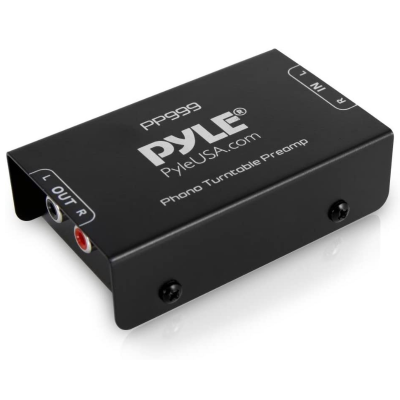
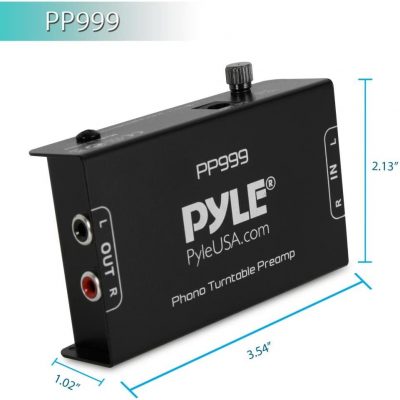
Pyle PP999 Phono Preamp — Turntable to Line Level, New in Box
Puts a turntable back into a system that has no phono input. Turntable in, receiver out, on ordinary RCA cables — the signal arrives at line level ready for any AUX or CD socket on a modern amplifier.
Rear ground terminal for the turntable's ground wire, and the 12 volt power adapter is included. Metal alloy housing, 70 dB signal-to-noise, 20 Hz to 20 kHz ±2 dB. New and unopened in retail packaging.
Related Products
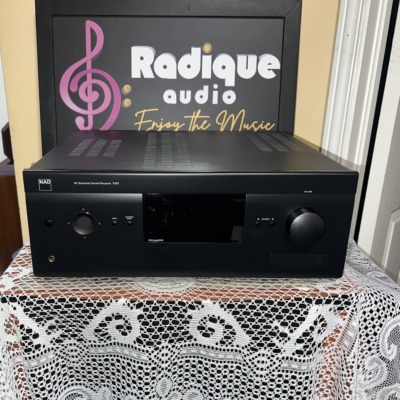
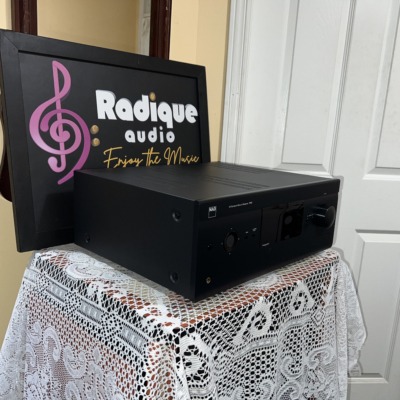
NAD T 757 7.1 AV Receiver – 7 x 60W, 7 Digital Inputs, Remote
A 7.1-channel NAD surround receiver in very good condition, rated at 60 watts per channel with all seven channels driven, with seven digital audio inputs, NAD's modular design and a remote.
✔️ Very good condition — free of significant marks; remote included
✔️ 7 x 60 W, all channels driven — Dolby TrueHD and DTS-HD Master Audio
✔️ Seven digital audio inputs and four HDMI inputs (1080p and 3D)
✔️ Covered by Radique Warranty
✔️ Includes Perpetual Trade-Back Program eligibility
✔️ Expertly packed for safe shipping
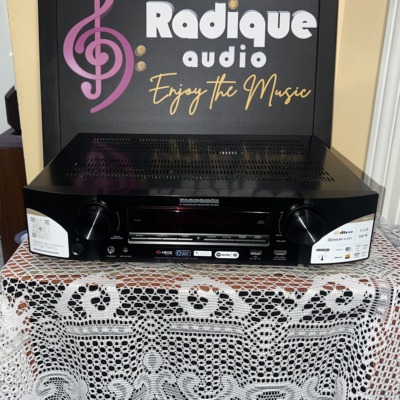
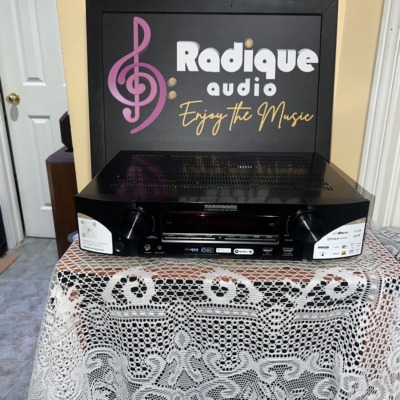
Marantz NR1510 Slim 5.2 AV Receiver – 4K, Wi-Fi, Phono, Remote
A slim Marantz NR1510 5.2-channel AV receiver, just over 4 inches tall, with 4K HDR video switching, HEOS streaming over Wi-Fi, Bluetooth and AirPlay 2, and a phono input for your turntable. It is in excellent condition, comes with its original Marantz remote, and has been thoroughly tested on our bench.
✔️ Excellent condition, with the original Marantz RC040SR remote
✔️ 4K HDR with Dolby Vision and eARC, HEOS, Wi-Fi, Bluetooth and AirPlay 2
✔️ Phono input and two subwoofer outputs — thoroughly tested on our bench
✔️ Covered by Radique Warranty
✔️ Includes Perpetual Trade-Back Program eligibility
✔️ Expertly packed for safe shipping
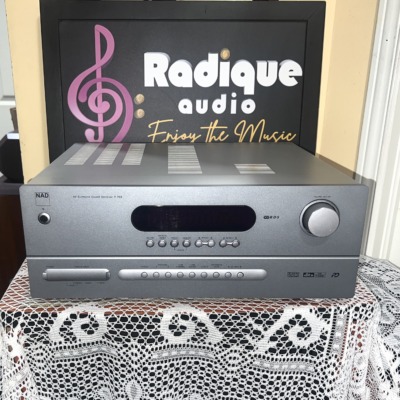
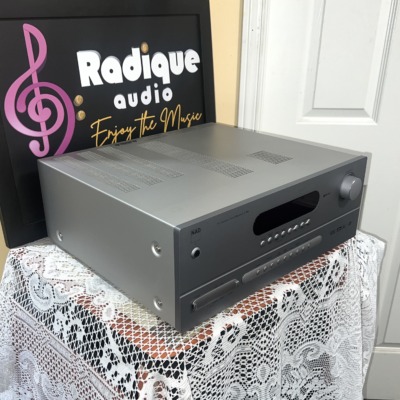
NAD T 753 6.1 AV Receiver – 70 WPC, 6 Digital Inputs, Remote
A NAD T 753 6.1-channel AV receiver in NAD's matte grey, designed and engineered in Canada, rated at 70 watts per channel, with six digital inputs, Soft Clipping and a pre-programmed remote. It has been thoroughly tested on our bench and is in very good condition.
✔️ Very good condition, with a pre-programmed remote and a power cable
✔️ 70 WPC conservatively rated — Sound & Vision measured 93.7 W, five channels
✔️ Six digital inputs, 7.1 pre-outs, Soft Clipping — thoroughly tested
✔️ Covered by Radique Warranty
✔️ Includes Perpetual Trade-Back Program eligibility
✔️ Curbside delivery, local collection or freight within Canada
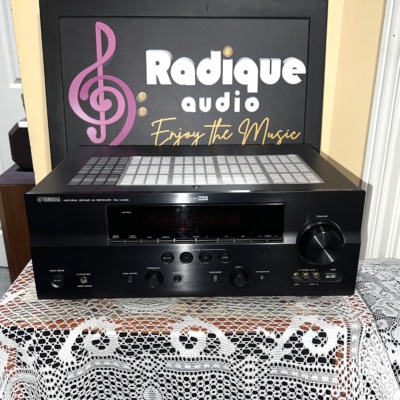
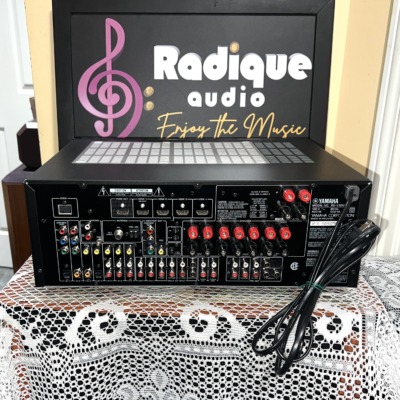
Yamaha RX-V1065 7.2 AV Receiver – 105 WPC, Phono, Zone 2, Remote
A Yamaha RX-V1065 7.2-channel AV receiver, 105 watts per channel, with four HDMI inputs, a phono input and Zone 2, plus its original remote and manual.
✔️ Tested on our bench, every input and output
✔️ Very good condition
✔️ Original Yamaha remote and printed owner's manual
✔️ 4 HDMI in, 1080p, YPAO, MM phono, Zone 2
✔️ Covered by Radique Warranty
✔️ Includes Perpetual Trade-Back Program eligibility
✔️ Expertly packed for safe shipping
SLS QG-500AVR 5.1 AV Receiver – Q-Line Gold, 100 WPC
An SLS QG-500AVR 5.1-channel AV receiver, the receiver from SLS and Quincy Jones's Q-Line Gold home theater system, with every function on the front panel.
✔️ Tested on our bench, all five channels and the sub out
✔️ Very good condition
✔️ Dolby Digital, DTS, Pro Logic II, AM/FM with 30 presets
✔️ Covered by Radique Warranty
✔️ Includes Perpetual Trade-Back Program eligibility
✔️ Expertly packed for safe shipping
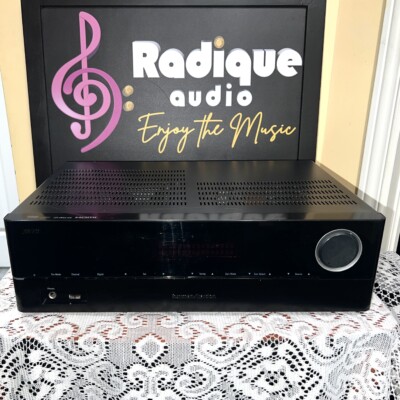
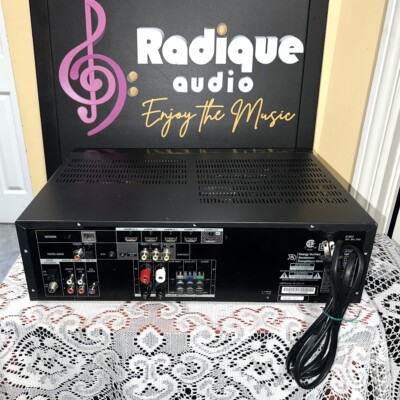
Harman Kardon AVR 1510S 375W 5.1 Receiver – 4K HDMI, Spotify
Seventy-five watts to each of five channels, four 3D-ready HDMI inputs with 4K pass-through, and one HDMI output with ARC. Spotify Connect, vTuner and DLNA over Ethernet, front-panel USB, optical and coaxial digital in. A digital supply keeps the whole thing to ten pounds. Level 1 serviced here; cosmetically graded Good.
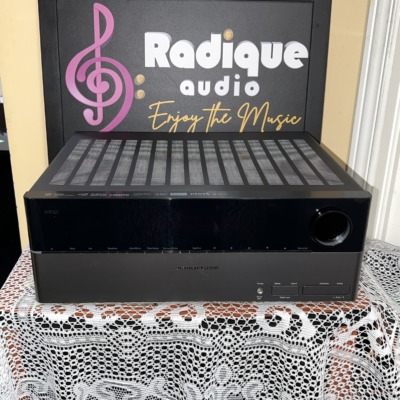
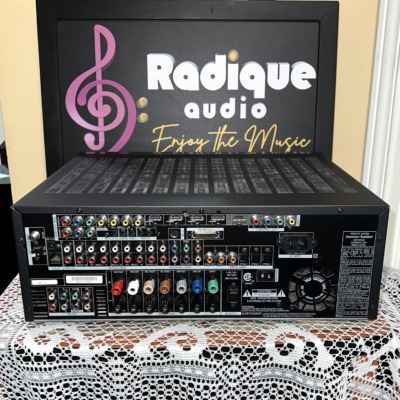
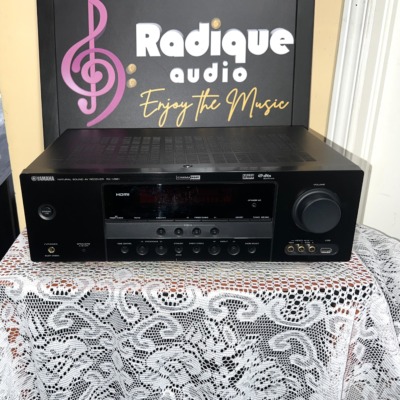
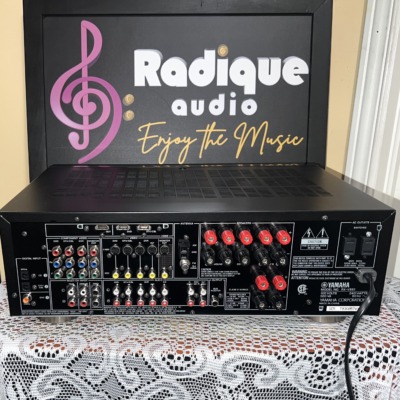
Yamaha RX-V561 5.1 AVR 500W — 2x HDMI, 3 Digital In, Remote
100 watts minimum RMS on every one of the five channels into 8 ohms, and dynamic power that climbs to 110, 130, 160 and 180 watts into 8, 6, 4 and 2 ohms — a receiver that keeps increasing output as the load gets harder has a supply with something in reserve. Where it earns its keep is bass management: a crossover selectable across nine points from 40 Hz to 200 Hz with a 12 dB per octave high-pass on front, centre and surround. Two HDMI inputs, three digital, remote included. Very good condition.
