
JVC RX-664V A/V Receiver — 100W x 5, Phono, SEA EQ, Sub Out
$145.00
1 in stock
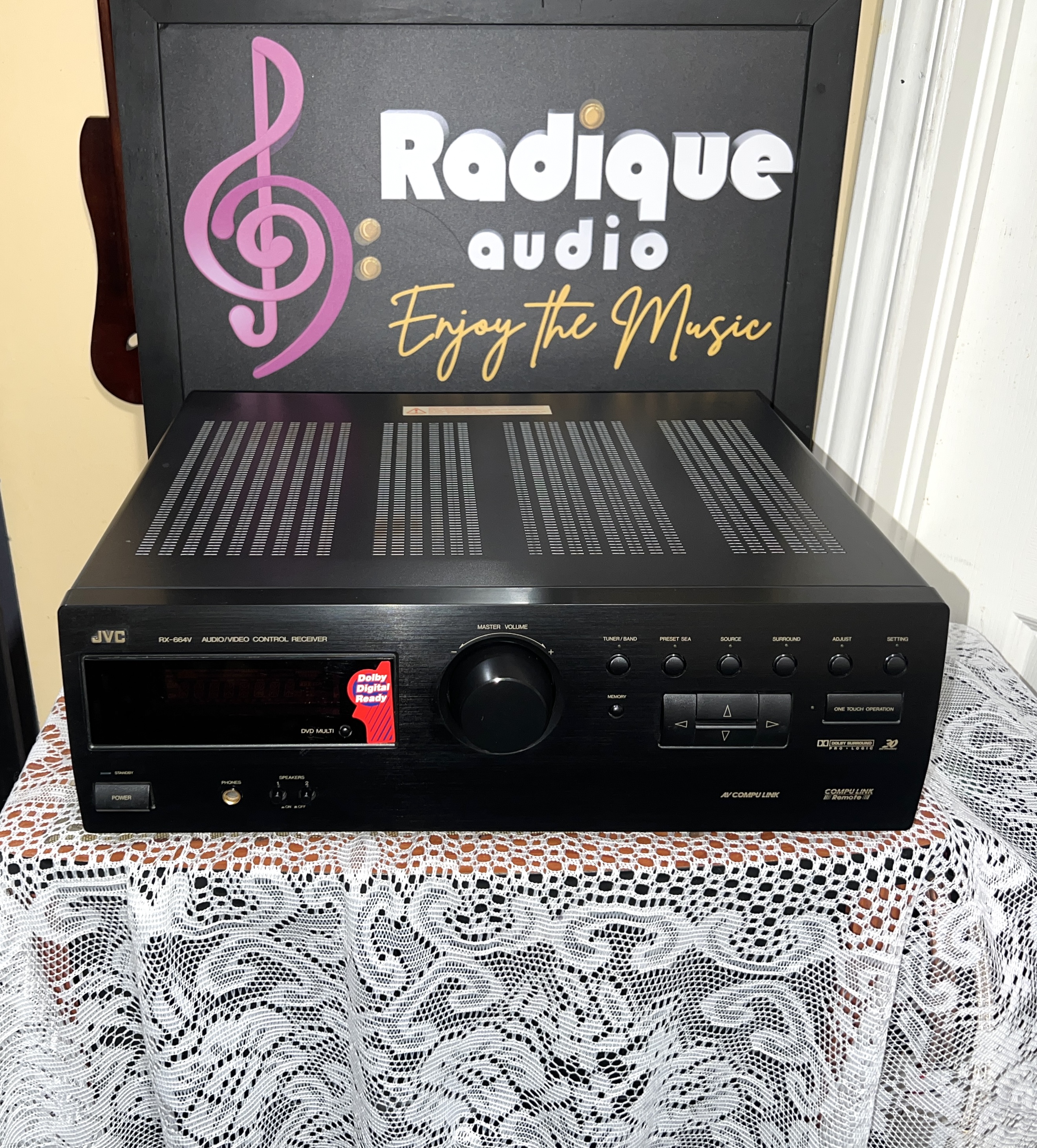
JVC RX-664V — A Hundred Watts on Five Channels, a Real Phono Stage and JVC’s SEA Equaliser, from 1998
A 1998 audio-video receiver with a hundred watts on every one of its five channels, a proper moving-magnet phono stage, and JVC’s own three-band equalisation.
The Late-1990s Sweet Spot
The RX-664V sits in the useful middle of the home-theatre era — late enough to have five real amplifier channels and a subwoofer output, early enough to still take a turntable seriously. The phono input is a genuine moving-magnet stage rather than a line input with a label on it, which is worth saying because it disappeared from receivers at almost exactly this point. If you want one box that runs a record player, a pair of speakers and a five-channel system without compromise on the first of those, this is the era to shop in.
What the Badge Actually Means
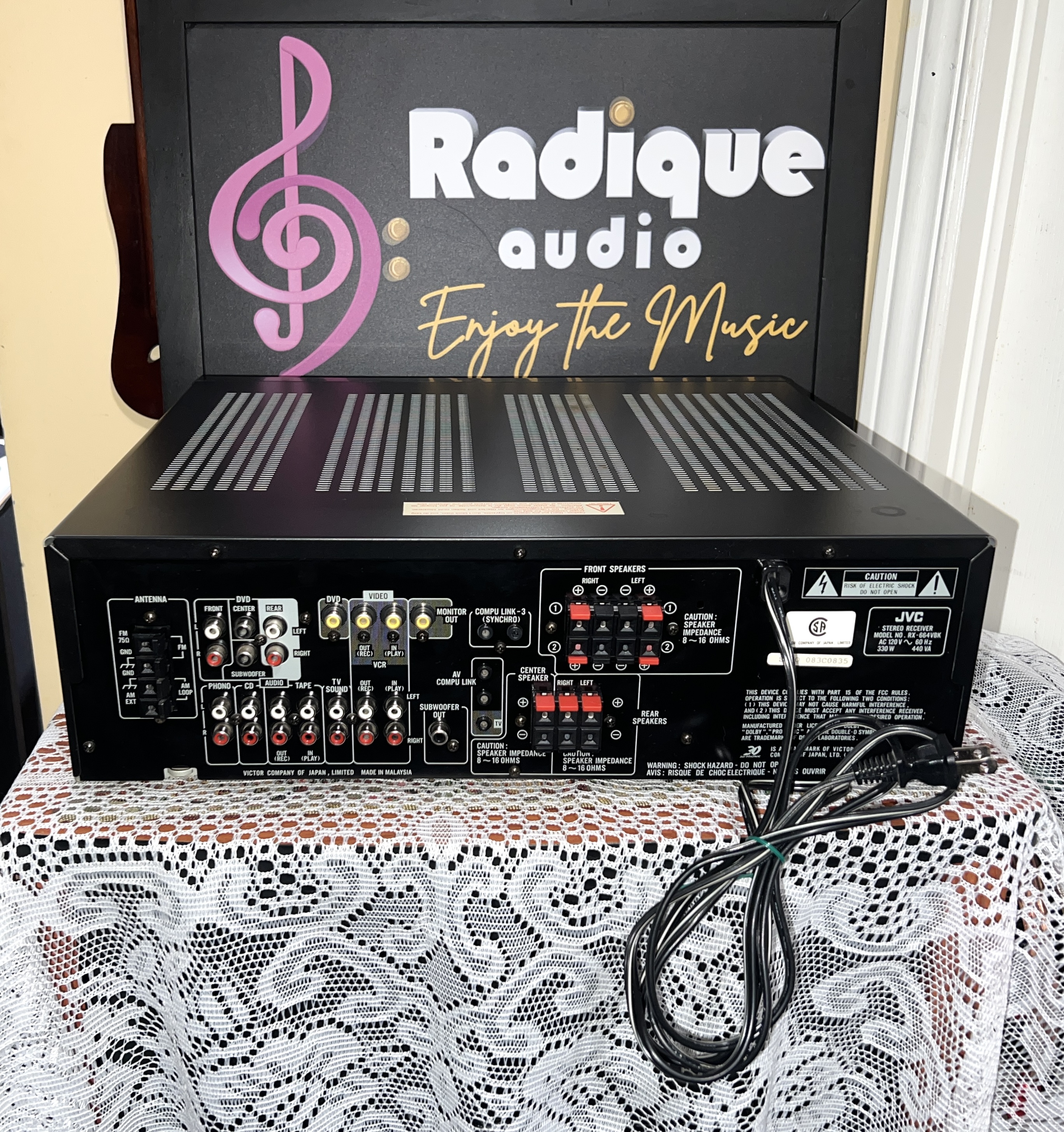
Worth being precise about the surround decoding, because the badge on receivers of this vintage can mislead. Dolby Pro Logic is built in and works from any stereo source. Dolby Digital is not decoded inside the receiver — instead there is a 5.1-channel analogue input feeding five discrete amplifiers, so a DVD player or outboard processor that does its own decoding connects straight in and uses all five channels. JVC’s 3D-Phonic virtual surround is also on board, which throws a convincing soundstage from just the two front speakers when you do not want a full set.
SEA Equaliser
The tone controls are the JVC signature. Rather than a bass and treble pair, there is three-band electronic S.E.A. equalisation with fourteen presets, which gives you far more room to fit the sound to a room than a conventional tone stage does. A loudness switch, balance, and a velocity-sensitive rotary volume encoder round out the front panel, and there are forty AM and FM station memories behind it.
Connections
Connection is generous: two sets of main speaker terminals for an A and B pair, a line-level subwoofer output, composite video switching, and JVC’s COMPU LINK system for one-touch operation across matching JVC components.
Remote
A universal remote is included with this receiver. It covers the everyday controls but does not reach the on-screen menu system — the menu is fully operable from the front panel, so nothing is out of reach.
Condition
Tested here and working properly. Cosmetically this example is graded Very Good — it presents well, with only the standard signs of use.
A few relevant specifications:
A capable five-channel receiver from the last moment when home theatre still made room for a record player.
Available for pickup in Kanata, or shipped across Canada and internationally — we have sent equipment to fifteen countries in the past year, each piece packed in-house in 275 lb test double-wall boxes. Live shipping rates for your address are calculated at checkout. Backed by Radique Audio’s Bumper-to-Bumper Warranty and our Perpetual Trade-Back Program. Available for audition by appointment in Kanata.
JVC RX-664V Specifications
- 100 watts per channel into 8 ohms, stereo, 40 Hz to 20 kHz at no more than 0.8% THD
- 100 watts on each of five channels into 8 ohms
- Dolby Pro Logic and 3D-Phonic virtual surround; 5.1-channel analogue input for an external Dolby Digital decoder
- Moving-magnet phono input, 2.7 mV sensitivity
- Three-band electronic S.E.A. equalisation with 14 presets
- Line-level subwoofer output; composite video switching
- Two main speaker terminal pairs; 40 AM and FM presets
- COMPU LINK system control; fluorescent display
- Introduced in 1998
- Dimensions: (Width x Height x Depth) 17.1 x 5.7 x 15.9 inches (435 x 146 x 403 mm)
- Weight: 20.7 lbs (9.4 kg)
🔌 Speaker Cable, Built on Our Own Bench
We hand-build speaker cable here in any length you need — pick the gauge and the terminations on our Custom Speaker Cable Builder. We also make our own gold-plated banana plugs, spades and pin connectors if you would rather terminate cable you already have. 👉
⚠️ Important Information for International Buyers
This unit is configured for North American 110/120V power. Buyers outside North America will require a step-down transformer and appropriate plug adapter.
✅ Buy With Confidence — The Radique Promise
Backed by Radique Audio’s Bumper-to-Bumper Warranty and our Perpetual Trade-Back Program. When you’re ready to move on, we’ll take it back. That’s the Radique difference.
📦 Watch how we protect your gear — our unboxing video.
📺 Curious about our business? Check out our YouTube channel for behind-the-scenes videos and more!
📞 Questions? Use the Ask a Question button above, or call us at 613-416-9995.
| Weight | 22.7 lbs |
|---|---|
| Dimensions | 19.9 × 21.1 × 9.7 in |
JVC was founded in Yokohama, Japan, in 1927 as the Japanese arm of America's Victor Talking Machine Company, first making phonographs and records. We carry JVC stereo receivers and AV receivers, cassette decks, CD players, turntables and speakers. We've had more than 90 JVC listings so far, covering more than 80 different models. Every AV receiver we list is tested input by input on our bench: each HDMI input and output, the analog, optical and coaxial inputs, the subwoofer outputs and the wireless features where it has them. Every used JVC here is inspected, tested and serviced as required, then photographed in-house and covered by our Bumper-to-Bumper Warranty and Perpetual Trade-Back Program. Don't see the model you want? Tell us on First Dibs and we'll email you when one arrives.
JVC models we've sold more than once include the RX-7000VBK and RX-8000VBK AV receivers.
The JVC story, 1927 to today
JVC began in 1927 as the Japanese subsidiary of the Victor Talking Machine Company, making phonographs and records, and built a large plant in Yokohama in 1930. RCA bought Victor in 1929, and in the late 1930s JVC passed to Japanese owners.
Stereo, quad and video. JVC joined the Matsushita (Panasonic) group in the early 1950s. It developed the CD-4 discrete four-channel record system in the early 1970s and the SEA graphic equalizer built into its receivers, and in 1976 its video division introduced VHS.
Hi-fi highlights. The late 1970s and early 1980s brought the JR-S receivers, whose SEA sliders replaced the tone controls, the Super-A amplifiers and the QL quartz-lock turntables, and around 1990 the XL-Z CD players with JVC's K2 Interface.
Today. JVC merged with Kenwood between 2008 and 2011, and JVCKENWOOD Corporation now owns the brand. JVC has had its own Canadian distribution since the 1970s, and JVCKENWOOD Canada is based in Mississauga, Ontario.
Which JVC is which?
1970s receivers: early four-channel models with CD-4 demodulators, and the JR-S series of 1976 to 1977, with built-in SEA equalizers.
Super-A amplifiers and receivers (1979 to the early 1980s): such as the A-X5 and A-X9 amplifiers and the R-S33 receiver.
Turntables: QL quartz-lock direct-drive models such as the QL-A7 and QL-Y5F, and belt-drive automatics such as the JL-A1.
Cassette decks and CD players: KD and CD-S decks from the 1970s, TD-W dual-well decks, and XL-Z CD players and XL changers.
AV receivers (2000 to 2004): the RX-x000V, RX-x010V and RX-x020V families, including the RX-7000VBK, RX-8000VBK and RX-6020VBK, and the RX-8040B.
Buying used JVC: what to check
SEA sliders. On JR-S and R-S receivers, work every equalizer slider through its range and listen for crackle or a channel dropping out.
FM muting. Stereo Review found the JR-S600's muting could thump when tuning on or off a station, so turn the volume down before tuning.
AV receivers. Run every channel, centre and surrounds included, at moderate volume. Owners report overload shutdowns on some 2000s models, which can come from a short in the speaker wiring.
Turntables. On QL servo turntables, check that the tracking-force and damping dials respond and that the arm finds the lead-in at both record sizes. Older JL automatics often need old grease cleaned out and a new belt.
Cassette decks. Treat belts and pinch rollers on any 1970s to 1990s deck as service items.
Everything we list is inspected, tested and serviced as required here, and comes with our warranty.
You may also like…
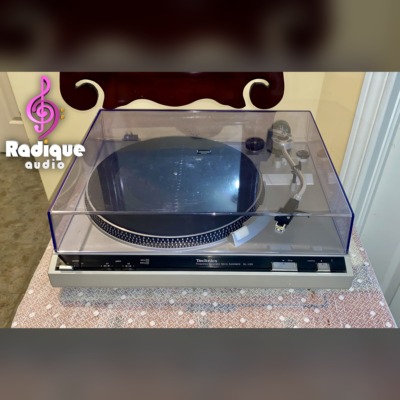
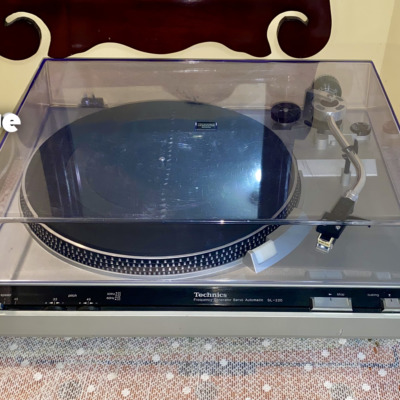
Technics SL-220 FG Servo Belt-Drive Turntable – Made in Japan
A late-1970s, made in Japan belt-drive Technics with a frequency-generator servo motor and an S-shaped arm, the quiet alternative to the direct-drive Technics everyone else buys. Choose a version for each deck's details.
✔️ Covered by Radique Warranty
✔️ Includes Perpetual Trade-Back Program eligibility
✔️ Curbside delivery along the Windsor–Québec City corridor, or pickup in Kanata
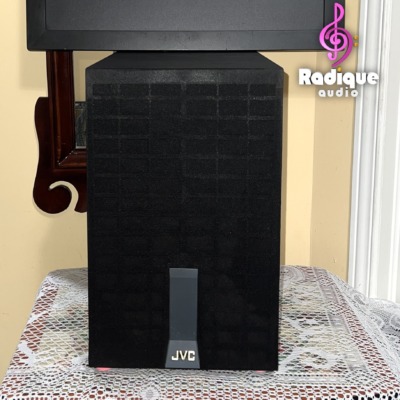
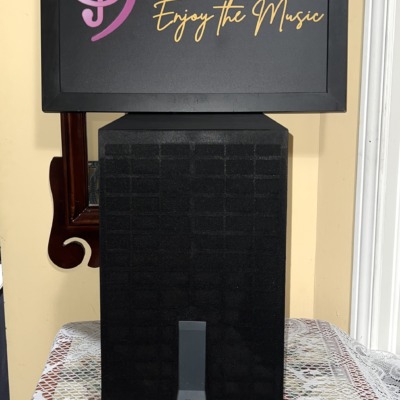
JVC SX-PW33 Slim Tower Subwoofer — 6.5in, 100W, High-Pass Out
A tall, narrow bass column meant to stand beside a cabinet rather than in front of it — 8.25 inches across the front and unusually deep at 17, which is the trade: the depth buys back the internal volume the narrow baffle gives away, so a 6.5 inch woofer is properly loaded in a strip of floor barely wider than a hardcover book. Driven by an integrated 100 watt amplifier, with speaker-level inputs and high-pass outputs so it works with an amplifier that has no subwoofer output at all. Good condition.
Related Products
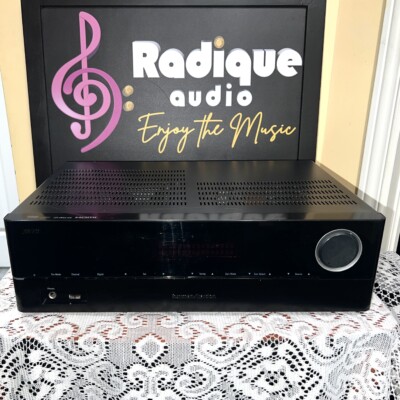
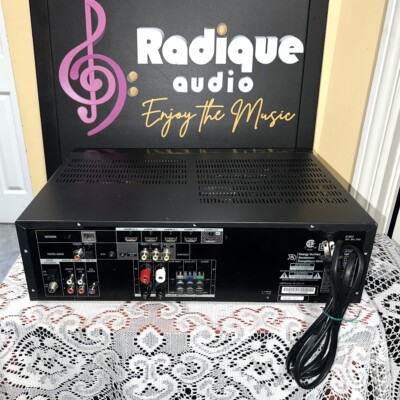
Harman Kardon AVR 1510S 375W 5.1 Receiver – 4K HDMI, Spotify
Seventy-five watts to each of five channels, four 3D-ready HDMI inputs with 4K pass-through, and one HDMI output with ARC. Spotify Connect, vTuner and DLNA over Ethernet, front-panel USB, optical and coaxial digital in. A digital supply keeps the whole thing to ten pounds. Level 1 serviced here; cosmetically graded Good.
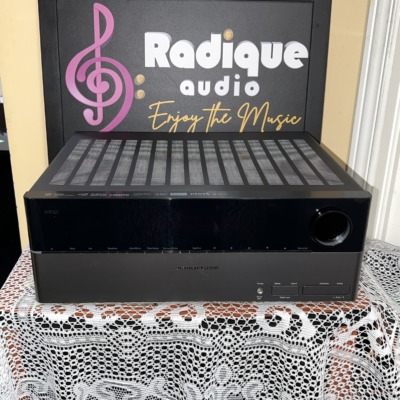
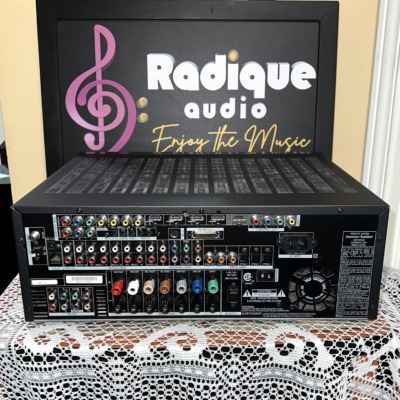
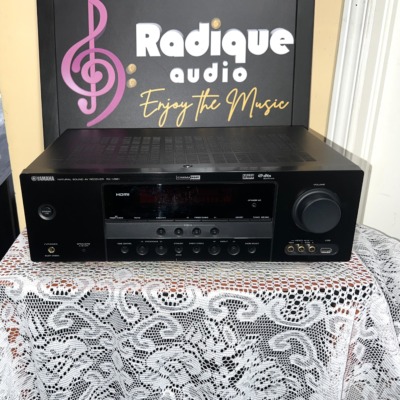
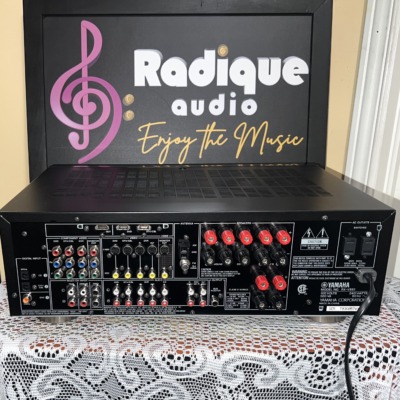
Yamaha RX-V561 5.1 AVR 500W — 2x HDMI, 3 Digital In, Remote
100 watts minimum RMS on every one of the five channels into 8 ohms, and dynamic power that climbs to 110, 130, 160 and 180 watts into 8, 6, 4 and 2 ohms — a receiver that keeps increasing output as the load gets harder has a supply with something in reserve. Where it earns its keep is bass management: a crossover selectable across nine points from 40 Hz to 200 Hz with a 12 dB per octave high-pass on front, centre and surround. Two HDMI inputs, three digital, remote included. Very good condition.
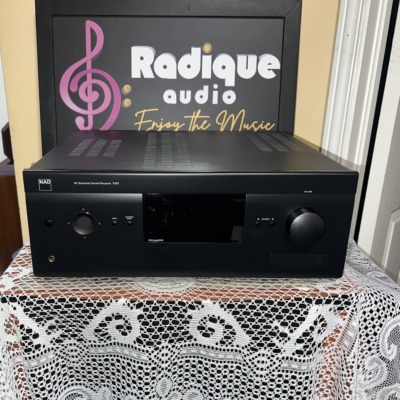
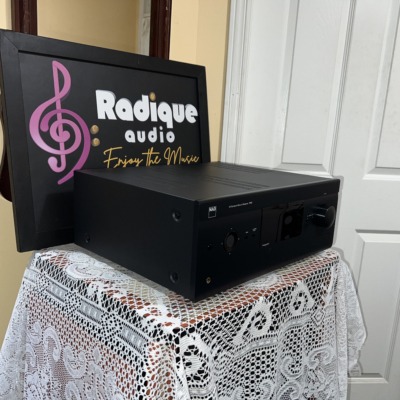
NAD T 757 7.1 AV Receiver – 7 x 60W, 7 Digital Inputs, Remote
A 7.1-channel NAD surround receiver in very good condition, rated at 60 watts per channel with all seven channels driven, with seven digital audio inputs, NAD's modular design and a remote.
✔️ Very good condition — free of significant marks; remote included
✔️ 7 x 60 W, all channels driven — Dolby TrueHD and DTS-HD Master Audio
✔️ Seven digital audio inputs and four HDMI inputs (1080p and 3D)
✔️ Covered by Radique Warranty
✔️ Includes Perpetual Trade-Back Program eligibility
✔️ Expertly packed for safe shipping
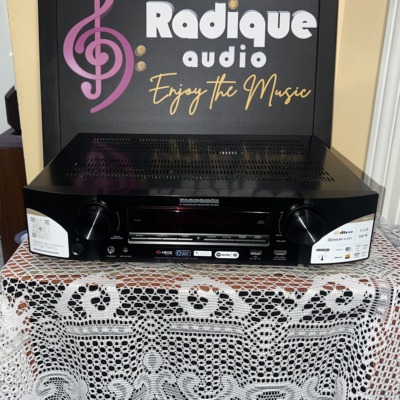
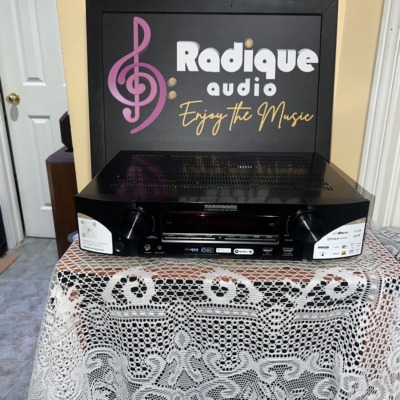
Marantz NR1510 Slim 5.2 AV Receiver – 4K, Wi-Fi, Phono, Remote
A slim Marantz NR1510 5.2-channel AV receiver, just over 4 inches tall, with 4K HDR video switching, HEOS streaming over Wi-Fi, Bluetooth and AirPlay 2, and a phono input for your turntable. It is in excellent condition, comes with its original Marantz remote, and has been thoroughly tested on our bench.
✔️ Excellent condition, with the original Marantz RC040SR remote
✔️ 4K HDR with Dolby Vision and eARC, HEOS, Wi-Fi, Bluetooth and AirPlay 2
✔️ Phono input and two subwoofer outputs — thoroughly tested on our bench
✔️ Covered by Radique Warranty
✔️ Includes Perpetual Trade-Back Program eligibility
✔️ Expertly packed for safe shipping
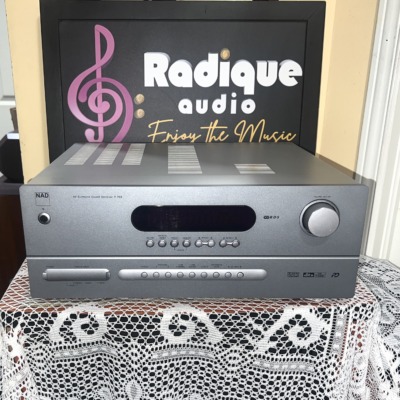
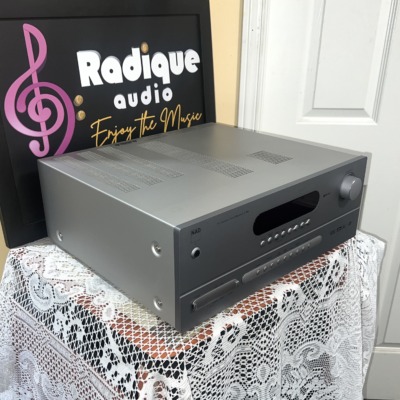
NAD T 753 6.1 AV Receiver – 70 WPC, 6 Digital Inputs, Remote
A NAD T 753 6.1-channel AV receiver in NAD's matte grey, designed and engineered in Canada, rated at 70 watts per channel, with six digital inputs, Soft Clipping and a pre-programmed remote. It has been thoroughly tested on our bench and is in very good condition.
✔️ Very good condition, with a pre-programmed remote and a power cable
✔️ 70 WPC conservatively rated — Sound & Vision measured 93.7 W, five channels
✔️ Six digital inputs, 7.1 pre-outs, Soft Clipping — thoroughly tested
✔️ Covered by Radique Warranty
✔️ Includes Perpetual Trade-Back Program eligibility
✔️ Curbside delivery, local collection or freight within Canada
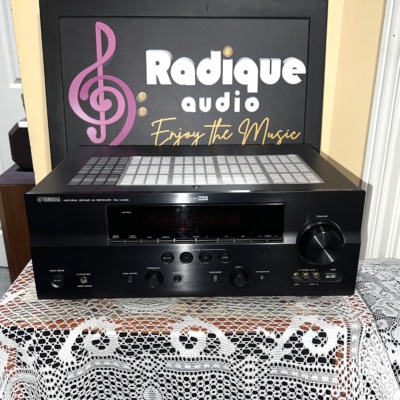
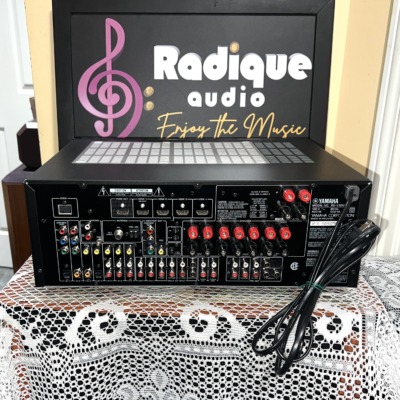
Yamaha RX-V1065 7.2 AV Receiver – 105 WPC, Phono, Zone 2, Remote
A Yamaha RX-V1065 7.2-channel AV receiver, 105 watts per channel, with four HDMI inputs, a phono input and Zone 2, plus its original remote and manual.
✔️ Tested on our bench, every input and output
✔️ Very good condition
✔️ Original Yamaha remote and printed owner's manual
✔️ 4 HDMI in, 1080p, YPAO, MM phono, Zone 2
✔️ Covered by Radique Warranty
✔️ Includes Perpetual Trade-Back Program eligibility
✔️ Expertly packed for safe shipping
SLS QG-500AVR 5.1 AV Receiver – Q-Line Gold, 100 WPC
An SLS QG-500AVR 5.1-channel AV receiver, the receiver from SLS and Quincy Jones's Q-Line Gold home theater system, with every function on the front panel.
✔️ Tested on our bench, all five channels and the sub out
✔️ Very good condition
✔️ Dolby Digital, DTS, Pro Logic II, AM/FM with 30 presets
✔️ Covered by Radique Warranty
✔️ Includes Perpetual Trade-Back Program eligibility
✔️ Expertly packed for safe shipping
