


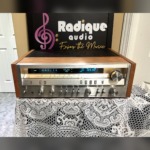

High Performance Mirage Omnisat v2 Satellite Speaker
$195.00
Out of stock
Get first dibs on the next one
High Performance Mirage Omnisat v2 Satellite Speaker
Like the excellent Mirage Nanosats only moreso, the Omnisat v2’s are simply incredible speakers. With an even broader frequency response, higher sensitivity, and more power handling, Omnisats will not fail to impress.
Use Mirage’s versatile v2 satellite speakers, sold individually, in your home theater or music system and enjoy dynamic, high-impact sound. Mirage’s sophisticated speaker technology creates an impressively large, spacious soundstage. And the tiny-but-mighty v2’s elegant lines make it a stylish addition to any room.
Innovative design for expansive, lifelike sound
The key to this speaker’s open, true-to-life sound is Mirage’s exclusive Omnipolar® technology. Thanks to the saucer-shaped Omniguide mounted above its drivers (see “Photos” tab above), this satellite can disperse sound evenly in a 360° pattern. The result: a deeper, wider, taller soundstage that transforms your entire listening space into a “sweet spot.” Mirage’s approach delivers a combination of direct and reflected sound that’s more like what we hear in real life. And you won’t have to anchor yourself to one primary seat — you’ll experience warm, natural audio throughout the room.
Because of the way they radiate sound, they’re more forgiving than direct-firing speakers. For example, you can place them high up near the ceiling for a cleaner look.
Product highlights:
Sold individually
Frequency response 70-20,000 Hz (±3dB)
Omnipolar technology creates a larger, more realistic soundstage
1″ PTH™ tweeter
4-1/2″ Titanium Deposit Hybrid polypropylene woofer
8-ohm impedance
Sensitivity 89 dB
Handles up to 150 watts
Binding posts
Dimensions: 5-9/16″W x 8-1/8″H x 5-15/16″D
Retailed new for $250 USD each ~ $360 Canadian each with HST.
| Weight | 6 lbs |
|---|---|
| Dimensions | 10 × 10 × 12.1 in |
Mirage is a Canadian speaker brand, founded in Toronto in the late 1970s and later built by Audio Products International in Scarborough, in the same factory as Energy. Its bipolar and Omnipolar designs send sound in more than one direction. We carry Mirage towers, satellites, centre channels and subwoofers. We've had more than 110 Mirage listings so far. Every used Mirage here is inspected, tested and serviced as required, then photographed in-house and covered by our Bumper-to-Bumper Warranty and Perpetual Trade-Back Program. Don't see the model you want? Tell us on First Dibs and we'll email you when one arrives.
The Mirage story
Jeff Percy, Jeff Soltysek and Patrick Dempster founded Mirage in Toronto in the late 1970s (1979, according to Stereophile). Kevin Voecks, later of Snell and Revel, did the original designs. Audio Products International of Scarborough, which already assembled Mirage speakers, took the company over in the mid-1980s.
Bipolar. The M-1 of 1987, begun by Voecks and completed by API's Ian Paisley, fired identical drivers forward and backward, in phase. Mirage's engineers worked with the National Research Council's loudspeaker research here in Ottawa.
Omnipolar. The OM-6 of 1997 was the first commercial version of Mirage's Omnipolar idea, and the Omnisat satellite system followed in 2002.
New owners. Klipsch bought API in 2006, and VOXX bought Klipsch in 2011. Later models were made in China; the 2007 OMD-28 was "designed by API in Canada and built in China". Around the end of 2022, Oscar Bernardo, a former API executive, bought the Mirage brand himself to relaunch it.
Which Mirage is which?
Early two-ways (1980s to early 1990s): models owners discuss include the SM-1, 190, 290, M-360 and M-460.
M-series bipolar (1987 to late 1990s): the M-1, M-3, and the "si" models such as the M-1si, M-3si and M-7si.
OM-series Omnipolar (1997 to early 2000s): the OM-6, OM-7 and OM-9, and the OM-5 subwoofer.
Home theatre: FRx (2001), Omnisat and Nanosat satellites (2002 to 2005), OMD (2007) and MX (2009), plus the OMNI towers and Uni-Theater.
Subwoofers: the BPS bipolar subs, the LF-150 and MM-6, and the Nano subwoofers.
Buying used Mirage: what to check
Surrounds. Materials vary by model: some M-series midranges use foam surrounds that turn brittle, while many woofers use rubber. Check the rear-firing drivers too.
Tweeters. Owners report that original M-1 tweeters become fragile and have been unavailable for years. Check that every tweeter plays, front and rear.
Powered woofers and subwoofers. Test the built-in amplifier at volume; owners report failed sub amplifiers with no replacement available.
Finish and pairs. M-series panels are lacquered and some clip off plastic fasteners, so look for damage. The M-1si was built in mirror-image pairs.
Placement. Omnipolar and bipolar speakers sound best well out from the wall.
Everything we list is inspected, tested and serviced as required here, and comes with our warranty.
You may also like…
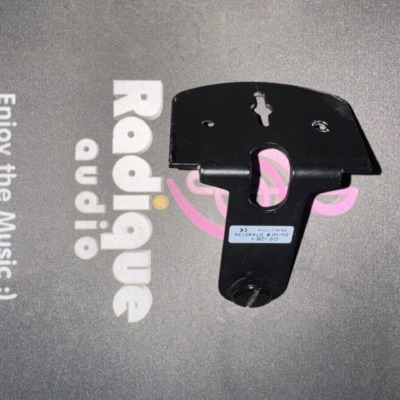
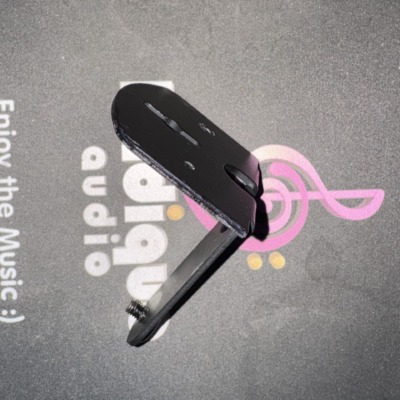
Mirage Omnisat V2 Wall/Ceiling Mount Bracket (OS v2B-1)
The factory bracket for the Omnisat v2, model OS v2B-1, for wall or ceiling. A single bolt threads into the base of the speaker and the plate anchors to the surface, keeping the satellite close in and correctly aimed — tidier and safer than a universal mount. The screw is included. Some paint transfer on the wall-facing side; the hardware itself is very good.
Related Products

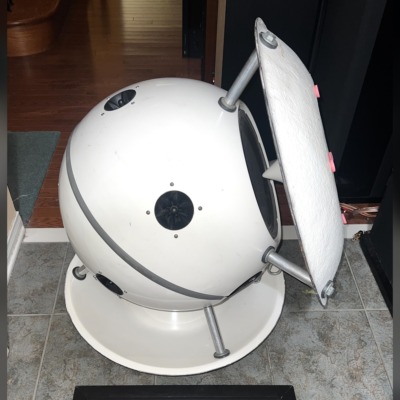
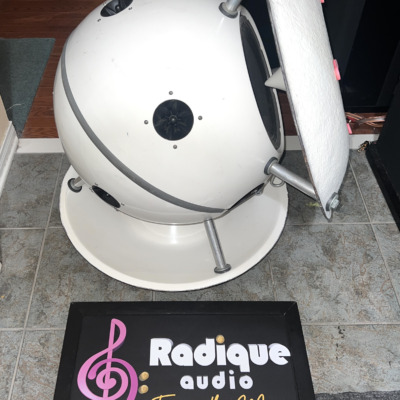
SoundSphere 2212-2 Omnidirectional Speaker – 400 W, Made in USA
A single SoundSphere 2212-2, the big two-reflector model, made in the USA: two 12-inch woofers, six tweeters and 400 watts, sending sound through 360 degrees.
✔️ Tested on our bench, both woofers and all six tweeters
✔️ Good condition, wear from use
✔️ Two reflectors, 400 W RMS, 4 ohms, 1/4-inch input
✔️ Covered by Radique Warranty
✔️ Includes Perpetual Trade-Back Program eligibility
✔️ Curbside delivery, local collection or freight within Canada
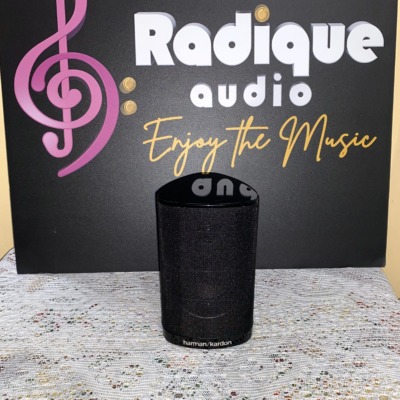
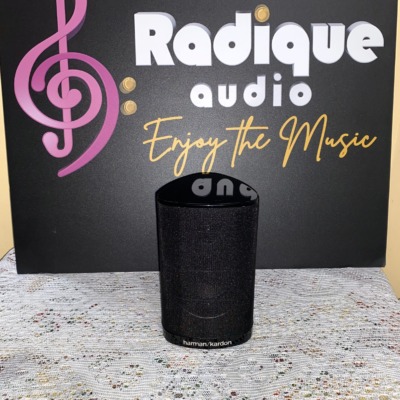
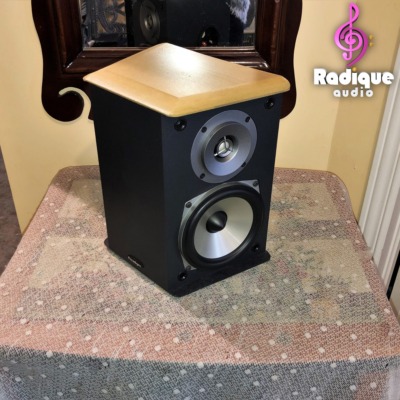
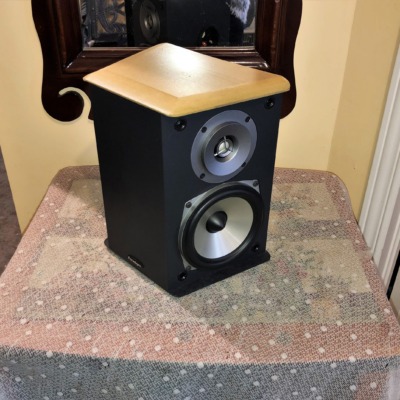
Single Paradigm 4-Driver, 2-Way Dipole Speaker ADP-170 v4
One speaker, not a pair. Four drivers on two angled baffles — two 19 mm CMC domes and two 140 mm MPC cones on die-cast chassis — running out of phase above the 2 kHz crossover and in phase below it. That is what Paradigm meant by adapted dipole: a diffuse surround field without giving up the bass. The upper piece of vinyl cladding has been removed, so the top wants painting or a spot out of sight.
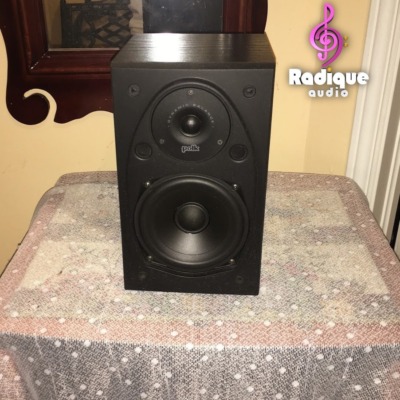

Single Polk Bookshelf Speaker RT-15
One speaker, not a pair — a 5.25-inch Dynamic Balance driver under a 3/4-inch Dynamic Balance silk dome. 63 Hz to 24 kHz overall, 89 dB into 8 ohms, on 20 to 100 watts a channel. Five-way binding posts, integrated keyhole slots for wall mounting, and it accepts an Omnimount articulating bracket. Great condition.
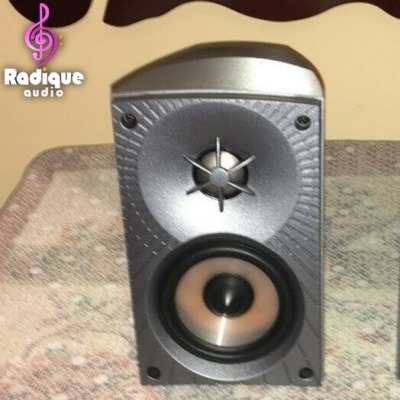

Single Paradigm Satellite Speaker Cinema 70 v3
A two-way sealed box — acoustic suspension, which is uncommon now — holding a 3.5-inch polypropylene woofer and a 0.63-inch polymer composite dome in a mineral-filled polymer shell. Sealed makes it far less fussy about placement than a ported satellite: jammed in a cabinet or hard against a wall, it still behaves. 15 to 80 watts at 8 ohms. Single speaker; wall mount available for $10.
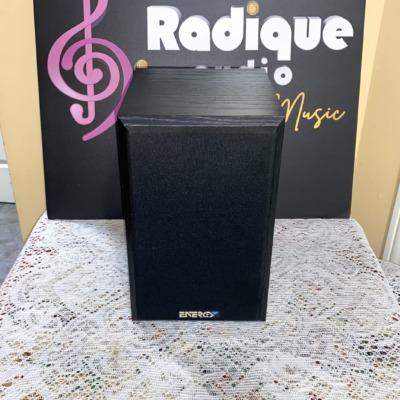
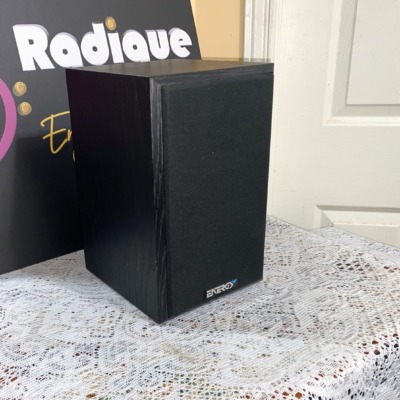
Canadian Made Energy Compact Speaker Pro Series .5 SINGLE ONLY
One speaker, not a pair. A vented two-way built in Canada: a half-inch flared dome tweeter over a 5.25-inch injection-moulded woofer, crossed at 3 kHz, 60 Hz to 20 kHz within 3 dB, 86.5 dB anechoic into 8 ohms and rated to 80 watts. Rear-ported, on 5-way binding posts that take banana plugs, and 10.5 inches tall.
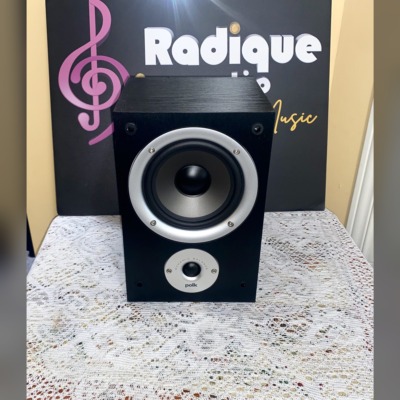
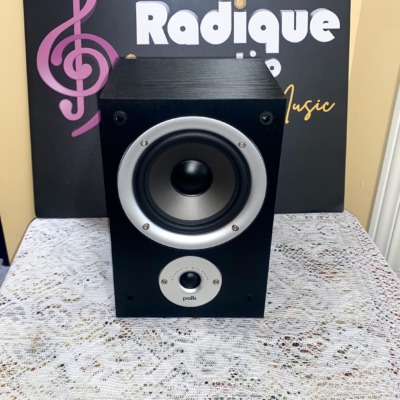
Single Great Sounding Budget Speaker from Polk Audio R150
A 5.25-inch Dynamic Balance woofer on a butyl surround under a 3/4-inch neodymium tweeter, ported, 65 Hz to 20 kHz at 89 dB into 8 ohms and rated to 100 watts. Video-shielded, and on 5-way binding posts rather than spring clips. This is a single speaker; a pair of the same model is listed separately.
