
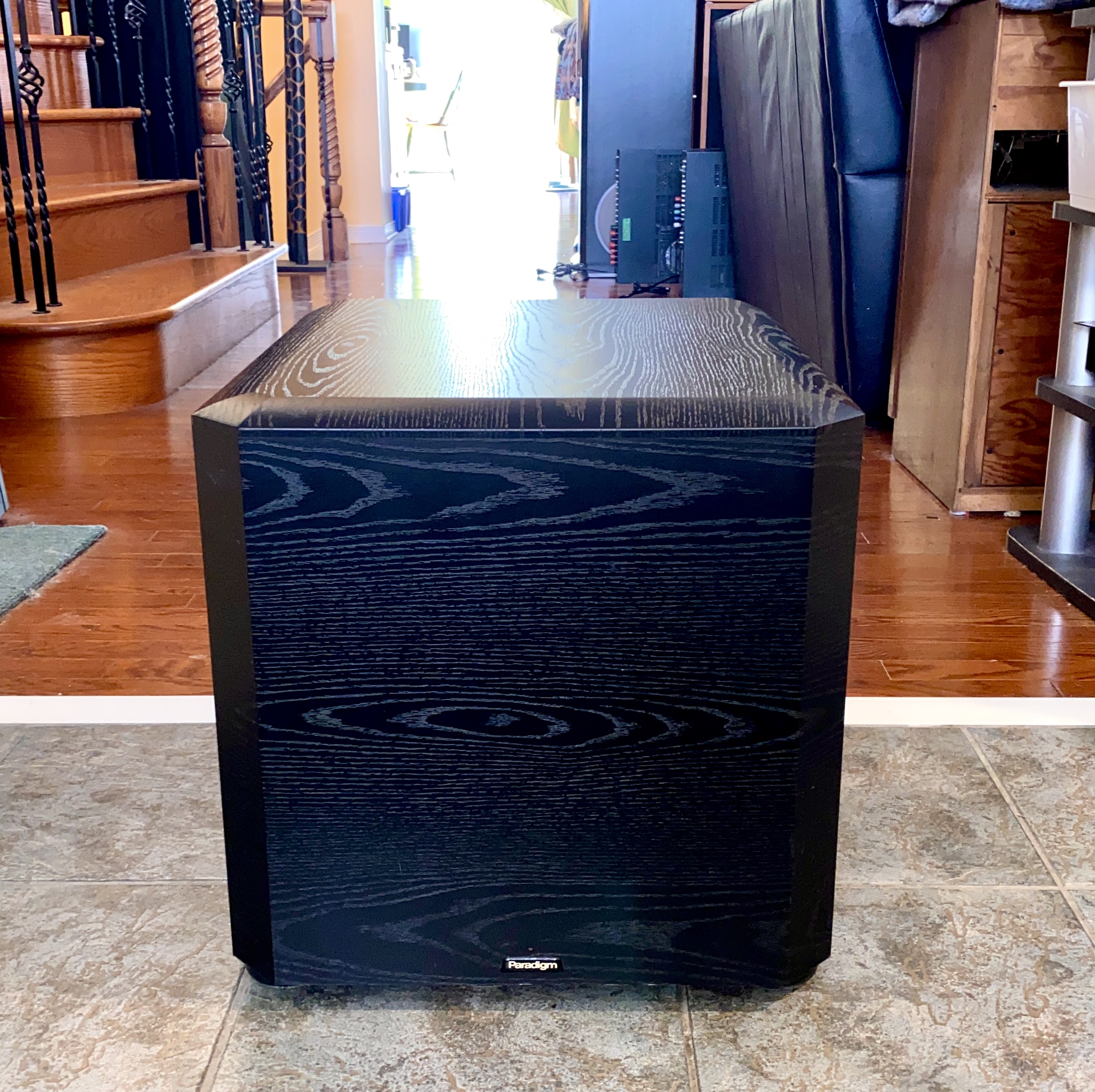
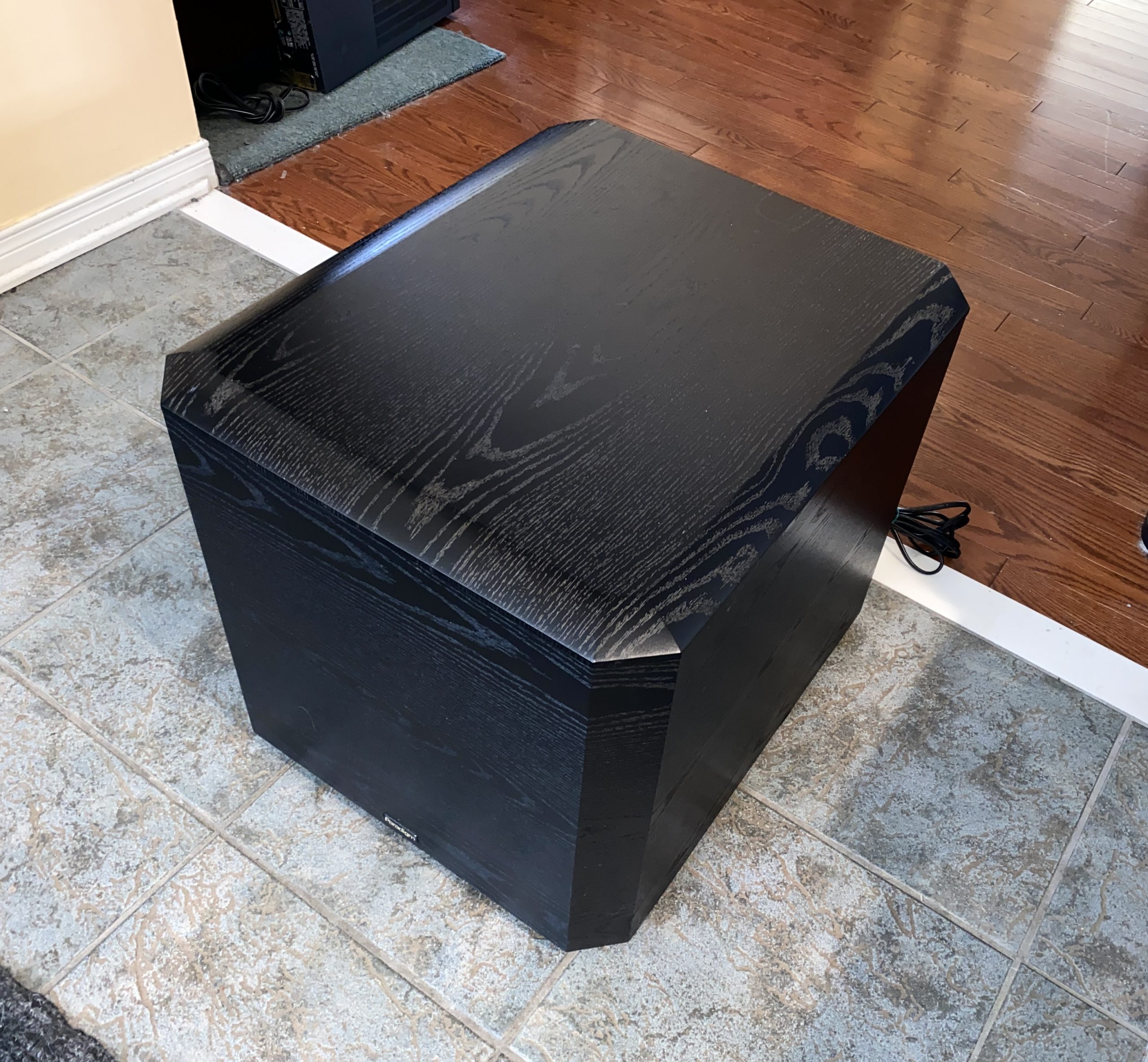
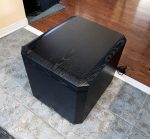
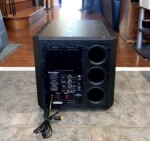
Paradigm PS-1000 v3 Powered Subwoofer – Made in Canada
$495.00
Out of stock
This one has sold. Want first dibs on the next one?
We take these in regularly. Leave your name and email, and we’ll email you the moment one is listed, so you hear first. No cost, no obligation.
Email me when one is listed
Audiophile quality without the audiophile price. Gold Series Subwoofer Cable, from $39.00 →
Other subwoofers we have in stock now
3 in stock · $295.00–$595.00 · all ship
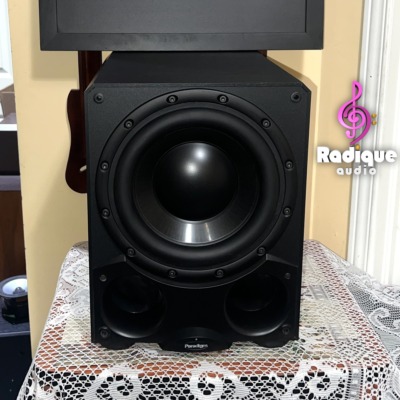 Paradigm DSP-3100 v.2 10″ Subwoofer – 600W Peak, Made in Canada$595.00Ships
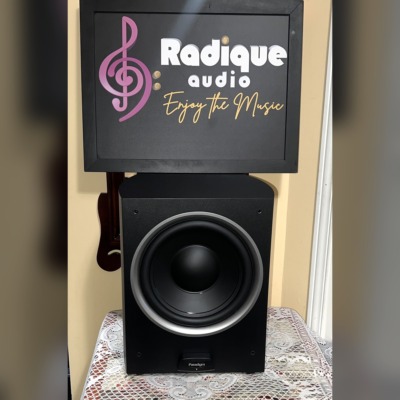 Paradigm PDR-10 v.4 10″ Powered Subwoofer – 300W Peak, Serviced$295.00Ships
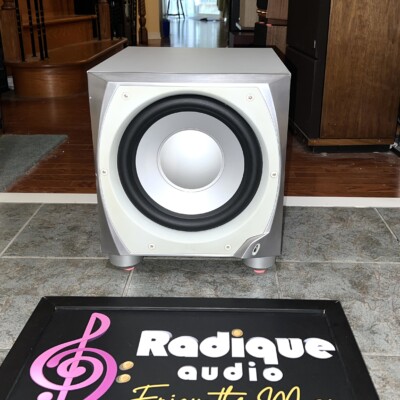 Infinity Modulus MSW-II 12" Powered Subwoofer – 600W Peak$495.00Ships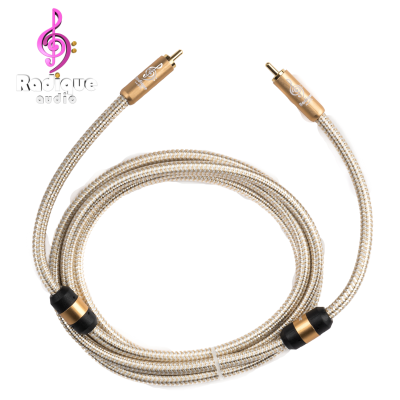
Audiophile quality without the audiophile price.
Our own Gold Series subwoofer cable: gold-plated corrosion-resistant connectors, heavy shielding, and slim plug jackets that fit behind a sub pushed against a wall. Four stock lengths, 2 to 10 metres, so the run from your amplifier to wherever the sub really sits is one cable.
Gold Series Subwoofer Cable, from $39.00 →Paradigm PS1000 v3 Powered Subwoofer – Canadian Designed and Manufactured 525 Watt Peak with DCBS Bandpass Technology
The Paradigm PS1000 v3 represents one of Paradigm’s most sophisticated subwoofer designs from the company’s golden era of Canadian manufacturing, employing the proprietary DCBS (Dual-Cavity Bass-Shaping) bandpass enclosure that delivers exceptional efficiency and deep, controlled bass extension down to 25Hz. Unlike conventional ported or sealed designs, the DCBS bandpass system conceals the 10-inch driver between two sealed chambers with high-velocity resistive ports tuning the output for maximum low-frequency impact with minimal distortion. The result is explosive dynamics for home theater applications combined with tight, musical bass for critical music playback—all from a relatively compact enclosure that belies its substantial output capability.
The engineering excellence of the PS1000 v3 begins with its 130-watt RMS discrete output amplifier, delivering 525 watts of peak power when demanded by demanding soundtrack passages or musical transients. The high-current design employs discrete output stages rather than integrated circuits, providing superior current delivery into the 10-inch polypropylene driver with its robust 1.5-inch voice coil and die-cast chassis. Paradigm’s PowerSaver auto-on/standby circuitry monitors the input signal and powers the amplifier on when music or cinema content is present, then returns to standby mode during silent periods to conserve energy. Soft clipping protection prevents amplifier overload during extreme passages, ensuring long-term reliability while maintaining clean output even when pushed to maximum capability.
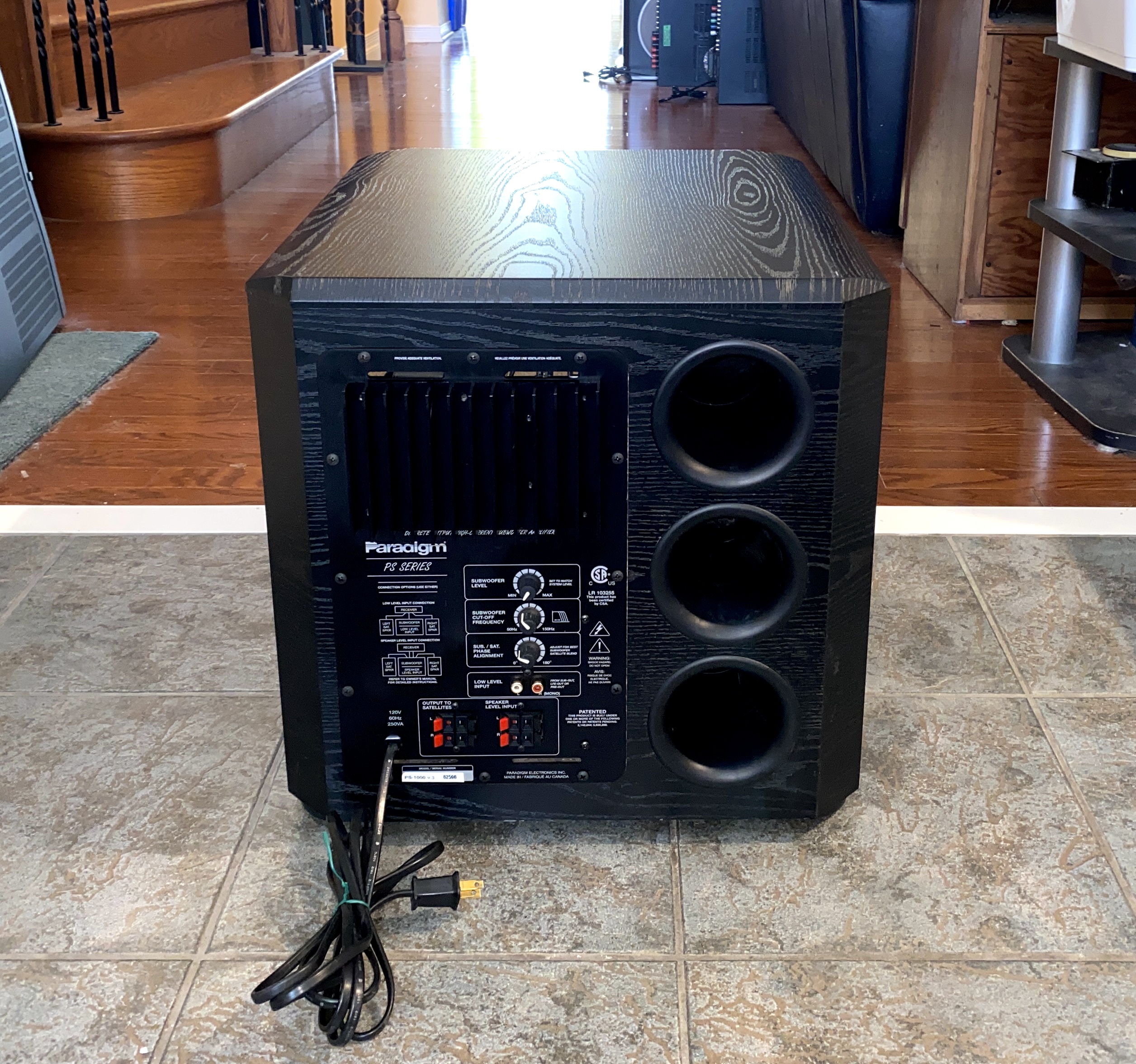
The PS1000 v3’s flexible connectivity accommodates virtually any system configuration. Line-level stereo or mono inputs accept signals from AV receivers, processors, or stereo preamps with adjustable sensitivity from 100mV (stereo) to 200mV (mono), while speaker-level inputs enable direct connection from amplifier or receiver speaker terminals for systems lacking dedicated subwoofer outputs. The continuously variable crossover frequency (50Hz-150Hz) allows precise integration with main speakers, while phase and level controls ensure seamless blending regardless of room acoustics or speaker placement. This flexibility makes the PS1000 v3 equally at home in dedicated home theaters, stereo music systems, or hybrid installations where both cinema and music performance matter.
Features and Capabilities:
DCBS (Dual-Cavity Bass-Shaping) bandpass enclosure with concealed driver
High-velocity resistive ports for extended, controlled bass output
130-watt RMS / 525-watt peak discrete output amplifier with high-current design
PowerSaver auto-on/standby for energy efficiency
Soft clipping protection prevents amplifier overload
Variable crossover frequency: 50Hz-150Hz
Line-level inputs: stereo or mono (100mV / 200mV sensitivity)
Speaker-level inputs: direct connection from amplifier/receiver terminals
Phase and level controls for precise integration
Designed, engineered, and manufactured in Canada
Technical Specifications:
Design: Single driver, DCBS bandpass system with high-velocity resistive ports and built-in amplifier
Amplifier: High-current discrete output: 130W RMS / 525W peak
Amplifier Design Features: PowerSaver auto-on/standby, soft clipping protection
Bass Driver: 254mm (10 in) polypropylene cone, 38mm (1.5 in) voice coil, die-cast chassis
Low Frequency Extension: 25Hz (DIN)
Subwoofer Cutoff Frequency: Variable 50Hz-150Hz
Line Level Input Sensitivity: 100mV stereo; 200mV mono
Line Level Input Impedance: 50k ohms
Speaker Level Input Sensitivity: 1.5V stereo
Internal Volume: 57L / 2.0 cu ft
Dimensions: 43 x 44 x 49 cm (16.75 x 17 x 19 inches)
Weight: 26.5 kg (58 lbs)
Cosmetically, this subwoofer presents in very good condition with clean cabinet surfaces showing minimal wear consistent with careful home use. The Black Ash finish is intact, the control panel is clean and fully functional, and all ports and connections are in excellent condition. Functionally, this PS1000 v3 has been thoroughly tested and performs beautifully—deep, tight bass with exceptional impact for both music and cinema applications. The DCBS bandpass design delivers the explosive dynamics and room-shaking output that make Paradigm subwoofers legendary among home theater enthusiasts, while maintaining the control and musicality that serious music listeners demand.
The Paradigm PS1000 v3 represents exceptional value for home theater builders and music enthusiasts seeking genuine low-frequency extension with Canadian build quality and engineering excellence. Made in Paradigm’s Mississauga facility during the company’s peak years of domestic manufacturing, this subwoofer delivers performance that modern budget subwoofers cannot match.
Purchase with Confidence:
Includes Radique Audio “Bumper to Bumper” Warranty
Perpetual Trade-Back Policy—upgrade or swap with peace of mind
Canadian-engineered and manufactured in Paradigm’s Mississauga facility; asking $495.
| Weight | 65 lbs |
|---|---|
| Dimensions | 22 × 22 × 24 in |
Paradigm has designed loudspeakers in the Toronto area since 1982, with engineering roots that run through Ottawa: it took part in the National Research Council's loudspeaker research here, and its research lab has been in Ottawa since 1993. We've had more than 600 Paradigm listings so far, covering 193 different models, more than any other brand we resell. Every used Paradigm here is inspected, tested and serviced as required, then photographed in-house and covered by our Bumper-to-Bumper Warranty and Perpetual Trade-Back Program. Don't see the model you want? Tell us on First Dibs and we'll email you when one arrives.
Our five best-selling Paradigm models so far: the Cinema 330 v.3 on-wall speakers, the Mini Monitor bookshelf speakers, the Monitor 7 towers, and the PS-1000 and PDR-10 subwoofers.
The Paradigm story, 1982 to today
Jerry VanderMarel and Scott Bagby founded Paradigm in 1982 in the Toronto area, VanderMarel running sales and marketing and Bagby design and manufacturing. Their first speakers made their debut at a Toronto audio show that year, and Paradigm says 12 dealers signed on.
The Ottawa years. In the 1980s almost every major Canadian speaker maker measured its designs in the National Research Council's anechoic chamber here in Ottawa, and Paradigm took part in the research Dr. Floyd Toole led at the NRC, which paired chamber measurements with blind listening tests. Paradigm built its own anechoic chamber in 1988, sparing its engineers the five-hour drive to Ottawa. In the late 1980s and early 1990s it was one of several Canadian companies in the NRC's Athena project, which studied speakers that adapt to the room. NRC scientists Peter Schuck and Marc Bonneville then joined Paradigm, which says it opened its Ottawa research centre, PARC, for them in 1993. That lab went on to design Anthem's electronics and its room-correction system. A 1990s Paradigm Titan is now part of the collection at Ingenium, Canada's science and technology museums, here in Ottawa.
Growth. Paradigm moved into the US market in the mid-1980s, added its first in-wall speaker in 1989 and launched the Monitor series in 1990. The Titan was a hit by 1991, the Atom followed in 1992, and the PS-1000 of 1994 was its first powered subwoofer. By 1992 Stereophile counted about 256 Paradigm dealers in the US.
Reference and the new factory. The Reference line, with its Studio speakers, arrived in the mid-1990s; Stereophile reviewed the Studio/100 in 1997. In 1998 Paradigm bought Sonic Frontiers, which brought Anthem into the family. In 2001 it moved into a new Mississauga factory with what it calls the hemisphere's largest privately owned anechoic chamber, at 33,000 cubic feet. A tour that year found the plant finishing 1,500 speakers a day, with driver frames cast, cones moulded and voice coils wound in-house.
Changes of hands. Co-founder Jerry VanderMarel left in 2005, when the private-equity firm ShoreView Industries became Scott Bagby's partner; together they went on to buy MartinLogan. Compact lines such as Cinema were built overseas from the start, and from the 2010s Monitor was too, while Prestige (2014), Persona (2016) and Founder (2021) have been built in Mississauga. In 2019 Scott Bagby and his son John bought Paradigm, Anthem and MartinLogan back from ShoreView, and their company, PML Sound International, added GoldenEar at the start of 2025.
Which Paradigm is which?
Performance Series (1990s to 2006): the entry line, with the Atom, Titan, Focus, Esprit and Phantom. A 1990s Titan's label reads "Performance Series … Made in Canada". At the end of 2006 the Atom and Titan moved into the Monitor line.
Monitor (from 1990): the step-up line, and from 2006 the entry line; today's version is Monitor SE. In the early 1990s it was topped by the Studio Monitor tower, in real wood veneer.
Reference Studio (mid-1990s to mid-2010s): the Studio/20, 40, 60, 80 and 100 plus matching centres, with die-cast aluminium driver chassis and aluminium-dome tweeters, made in numbered versions. From the v.2 generation of 1999 the sides came in laminate or, for a little more, real wood veneer. A favourite here is the Studio/80 v.2, a slim 2.5-way tower from about 1999 to 2003; the pairs with real wood sides are the ones to find.
Signature (2004–2016): the flagship of its day, part of the Reference family.
Cinema (from about 2000): compact home-theatre satellites and centres in polymer cabinets, designed to be used with a subwoofer, later sold as Cinema CT packages.
Millenia (from 2006): slim aluminium-cabinet speakers made to suit flat-panel TVs. The little MilleniaOne was Sound & Vision's 2011 Product of the Year.
Stylus (from 1999): weatherproof outdoor speakers.
Today's lines: Monitor SE, Premier (2018), Prestige (2014), Founder (2021) and the Persona flagship (2016).
Subwoofers: from the PS-1000 (1994) and Servo-15 (1996) through the PS and PW series to Defiance (2018).
Buying used Paradigm: what to check
The rear label. Where a Paradigm was built depends on the line and the year, and some names were reused (the Atom and Titan moved from Performance to Monitor, and the Esprit name appeared in more than one line), so the label tells you exactly what you have.
Veneer or laminate. On Reference Studio models from 1999 on, real wood veneer sides were an option; look closely at the sides before you assume.
Woofer surrounds. Owners report foam surrounds needing replacement on some older models, including early Titans. Press gently around each one.
Powered subwoofers. The amplifier is the part most likely to have aged. Run a used sub at volume and check that auto-on still works.
Everything we list is inspected, tested and serviced as required here, and comes with our warranty.
Related Products
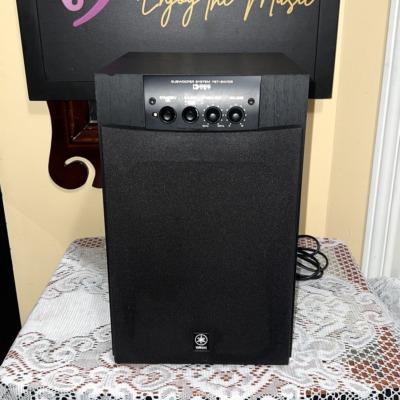
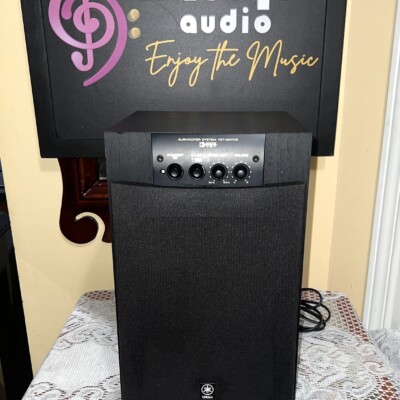
Yamaha YST-SW105 Active Servo Subwoofer — Compact 100W
An 8-inch front-firing paper cone on Yamaha's Advanced Active Servo amplifier — 100 watts into 5 ohms, down to 30 Hz, from a cabinet small enough to tuck beside a bookshelf pair. Continuously variable high-cut from 50 to 150 Hz, a Music/Movie voicing switch, RCA and speaker-level inputs plus full-range pass-through outputs. Very good condition.
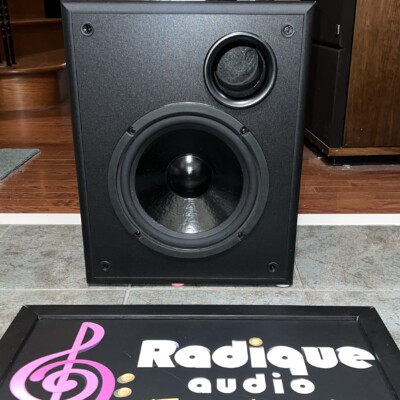
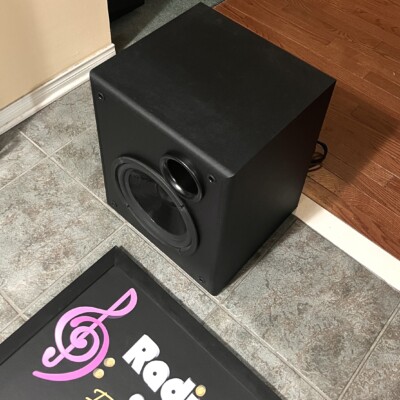
Yamaha SW-3 Active Servo Subwoofer — 10″ Woofer | Air Woofer Tec
Yamaha’s Active Servo Technology couples a negative-impedance drive amplifier to a Helmholtz resonator port — the Air Woofer opening — so the amplifier corrects the driver’s motion as it works. 100 watts into a 25 cm cone, rated down to 25 Hz, with a continuously variable 50–150 Hz high-cut at 24 dB per octave. Speaker-level and line inputs both. Very good condition.
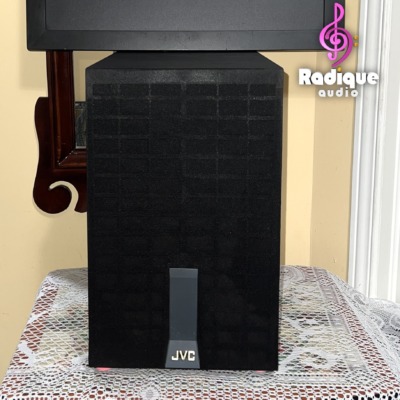
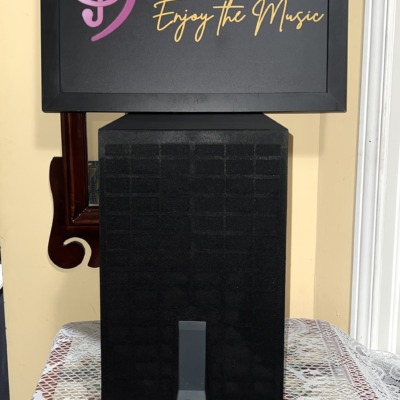
JVC SX-PW33 Slim Tower Subwoofer — 6.5in, 100W, High-Pass Out
A tall, narrow bass column meant to stand beside a cabinet rather than in front of it — 8.25 inches across the front and unusually deep at 17, which is the trade: the depth buys back the internal volume the narrow baffle gives away, so a 6.5 inch woofer is properly loaded in a strip of floor barely wider than a hardcover book. Driven by an integrated 100 watt amplifier, with speaker-level inputs and high-pass outputs so it works with an amplifier that has no subwoofer output at all. Good condition.
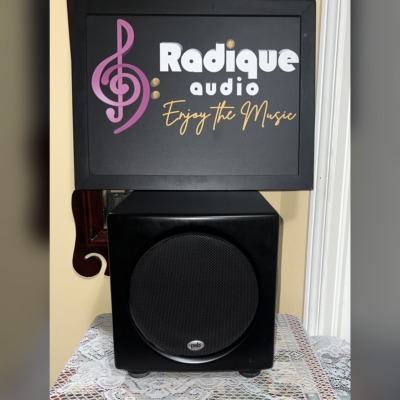
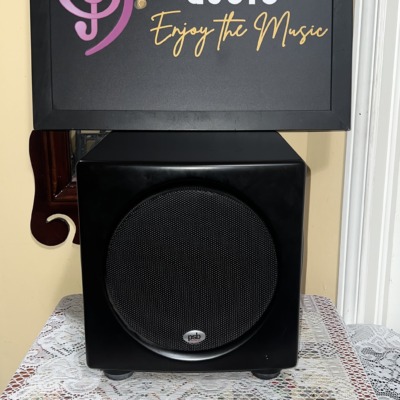
PSB SubSeries HD10 10″ Powered Subwoofer — 750W, 2000W Peak!
A serious subwoofer in about a square foot of floor, from one of the most respected names in Canadian loudspeaker design, with deep, powerful bass for home theatre and most music.
✔️ Good condition — light scuffs on the top, and a little vibration when played loud (details below)
✔️ 10-inch driver, two passive radiators and a 750 W Class H amplifier
✔️ Line-level and high-level inputs — works even with a receiver that has no sub out
✔️ Covered by Radique Warranty
✔️ Includes Perpetual Trade-Back Program eligibility
✔️ Expertly packed for safe shipping
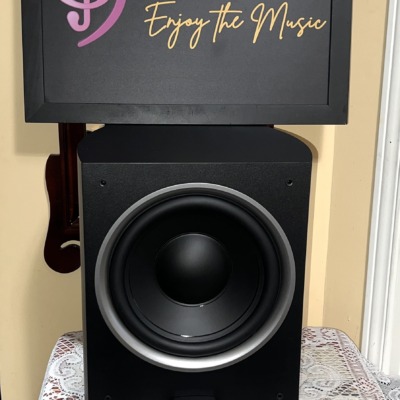
Paradigm PDR-10 v.4 10″ Powered Subwoofer – 300W Peak, Serviced
A black Paradigm PDR-10 v.4 powered subwoofer, with a 10-inch forward-firing driver and 100 watts RMS (300 watts dynamic peak) on board, serviced on our bench and in very good condition.
✔️ Very good condition — free of significant marks
✔️ Serviced on our bench and tested before listing
✔️ 10-inch forward-firing driver, 100 W RMS and 300 W dynamic peak
✔️ Covered by Radique Warranty
✔️ Includes Perpetual Trade-Back Program eligibility
✔️ Expertly packed for safe shipping
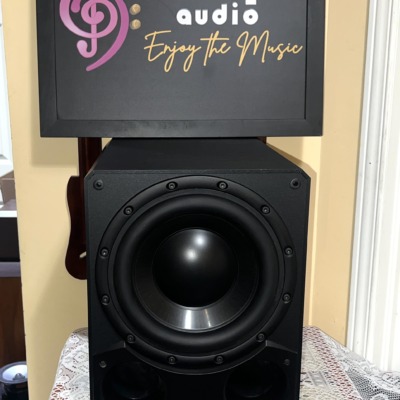
Paradigm DSP-3100 v.2 10″ Subwoofer – 600W Peak, Made in Canada
A black Paradigm DSP-3100 v.2 powered subwoofer, made in Canada, with a 10-inch front-firing driver and 200 watts RMS (600 watts dynamic peak) on board. It has been tested on our bench and is in very good condition.
✔️ Very good condition — removable black cloth grille included
✔️ 10-inch front-firing driver, 200 W RMS / 600 W peak Class-D
✔️ Front ports for hidden installs — made in Canada
✔️ Covered by Radique Warranty
✔️ Includes Perpetual Trade-Back Program eligibility
✔️ Expertly packed for safe shipping
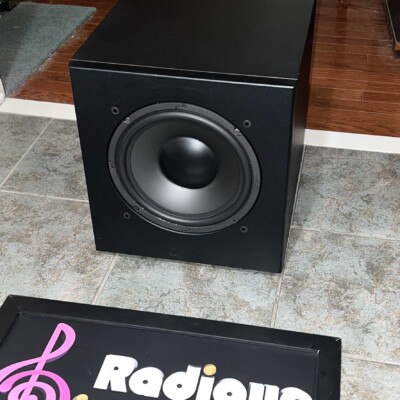
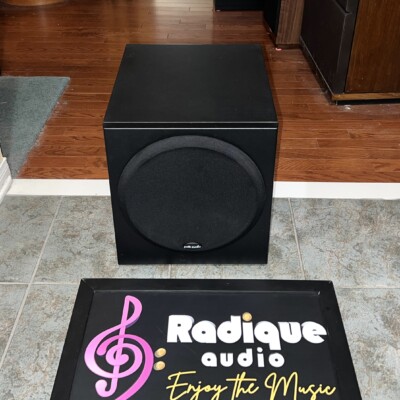
Polk Audio PSW350 10″ Front-Firing Powered Subwoofer 260W
A 10-inch front-firing Dynamic Balance woofer on a 100-watt RMS amplifier — 260 watts dynamic — in a dual-rear-ported cabinet good for 25 to 180 Hz. Speaker-level in and out, stereo line inputs and an unfiltered LFE jack, with a variable 60 to 160 Hz low-pass and a phase switch. 37 lbs, black matte. Very good cosmetic condition.
