


Infinity Minuette MPS Passive Subwoofer – Dual 6.5″, Front-Ported
$95.00
A passive subwoofer, which means no power cord, no built-in amplifier and no electronic crossover to fail. Two 6.5-inch polypropylene woofers in a bandpass box, 40 to 150Hz, wired high-level — your amplifier’s front outputs go in, your main speakers come off the pass-through, and the sub keeps everything below about 150Hz. Twenty-eight pounds of moulded composite. Very good condition.
1 in stock
Infinity Minuette MPS Passive Subwoofer – Dual 6.5″, Front-Ported
The Infinity Minuette passive subwoofer is a heavyweight, beautifully built mid-1990s bandpass subwoofer — the dedicated low-frequency companion to Infinity’s acclaimed Minuette MPS (Music Performance System) and Sterling TS home theater packages, designed and voiced by one of the great names in American loudspeaker engineering.
Unlike the powered subwoofers that dominate the home theater market today, the Minuette sub is a fully passive design — no power cord, no built-in amplifier, and no electronic crossover to wear out over time. Instead, it uses a pair of 6.5-inch polypropylene cone woofers loaded in a carefully tuned bandpass enclosure, with internal crossover networks that both filter low frequencies into the sub and pass the mid-and-high frequencies cleanly through to your main speakers. The result is a subwoofer that integrates seamlessly with small satellite speakers or bookshelves, adding genuine low-frequency weight and scale without the complexity or signal-path compromises of a powered sub.
The cabinet itself is characteristic of Infinity’s 1990s premium-build era: a heavy, dense molded composite enclosure with a textured Black Pica finish — a material chosen specifically to minimise cabinet vibration and colouration. Weighing a substantial 28 pounds in a compact footprint, this is a genuinely dense, inert enclosure that does its low-frequency work without adding box colouration of its own.
The high-level inputs and outputs are provided via rear-panel binding posts, making setup simple: connect the front-left and front-right speaker outputs of your amplifier or receiver into the sub’s inputs, then run speaker wire from the sub’s outputs to your main speakers. The sub handles the low frequencies itself and passes everything above roughly 150 Hz to your mains.
This unit is in very good cosmetic condition and has been thoroughly inspected and tested to confirm full functionality. Ideal as a passive-bass companion for a pair of bookshelf or satellite speakers in a small to mid-sized room — particularly appealing for a system without a dedicated LFE subwoofer output, or for listeners who prefer the simplicity and longevity of passive designs.
Specifications:
Design: Passive bandpass subwoofer, dual-driver
Drivers: Dual 6.5 in. (165 mm) polypropylene cone woofers
Frequency response: 40 Hz – 150 Hz
Sensitivity: 90 dB (2.83 V @ 1 m)
Nominal impedance: Compatible with 8 ohms
Recommended amplifier power: 20 – 100 W RMS
Inputs: High-level (binding posts), with high-level pass-through outputs to main speakers
Finish: Black Pica (textured black composite)
Year of introduction: 1995
Part number marking: IMO12143
Dimensions (W x H x D): 9.25 x 15.5 x 15.25 inches (235 x 394 x 387 mm)
Weight: 28 lbs (12.7 kg)
A rare, heavyweight, fully passive Infinity subwoofer from the brand’s premium 1990s era — ideal for adding genuine low-frequency weight to a bookshelf or satellite system without the complexity of a powered design.
Backed by Radique Audio’s 90-day limited subwoofer warranty and our Perpetual Trade-Back Program, you can purchase with confidence.
| Weight | 30 lbs |
|---|---|
| Dimensions | 19.25 × 13.25 × 19.5 in |
| Impedance | 8 Ω |
| Power Handling | 51–100 W |
| Sensitivity | 90–92 dB |
| Woofer Size | 6–7″ |
Infinity was founded in Los Angeles in 1968 by aerospace engineers Arnie Nudell and John Ulrick, with Cary Christie, and its first speaker was the electrostatic Servo-Statik. We carry Infinity towers, bookshelf speakers, centre channels and subwoofers. We've had more than 45 Infinity listings so far, covering more than 30 different models. Every used Infinity here is inspected, tested and serviced as required, then photographed in-house and covered by our Bumper-to-Bumper Warranty and Perpetual Trade-Back Program. Don't see the model you want? Tell us on First Dibs and we'll email you when one arrives.
Our best-selling Infinity models so far: the Beta 40 towers, then the Interlude IL25C centre, IL30 and IL40 towers and IL36C centre.
The Infinity story
Arnie Nudell and John Ulrick, aerospace engineers at Litton Industries, left with Cary Christie in 1968 to build speakers, starting in Nudell's garage. Their Servo-Statik combined electrostatic panels with a servo-controlled woofer, an idea from their aerospace work, and sold for $2,000 a pair.
EMIT and the reference years. In the late 1970s the Quantum line and the low-priced Qa, Qb and Qe brought in Infinity's EMIT tweeter, a flat plastic diaphragm with etched conductors, and Stereo Review called the $145 Qa one of the best loudspeaker values on the market. Infinity's flagship reference systems arrived at the end of the 1970s, and in Canada its speakers came in through Gray Acoustics of Markham, Ontario.
Harman. Infinity has been part of Harman International since the mid-1980s, and Samsung has owned Harman since 2017. The Kappa, Reference, Interlude, Primus and Beta lines followed through the 1990s and 2000s. In North America, Infinity now sells mainly car and marine audio.
Which Infinity is which?
1970s high end: the Servo-Statik, Monitor and Quantum models.
1970s and 1980s budget: the Qa, Qb and Qe, and the InfiniTesimal mini speakers.
Reference Standard and Kappa (1980s to 1990s): many numbered RS models, and Kappa towers and subwoofers.
Interlude (2000 to 2001): the IL10 bookshelf, the IL30 to IL60 towers, the IL25C and IL36C centres and IL subwoofers, with Infinity's ceramic metal matrix drivers. Infinity lists the IL30 and IL40 as made in the USA.
Primus and Beta (2003 to 2010): such as the Primus 250 and 360 towers, and the Beta bookshelf speakers and subwoofers.
Later lines: Cascade, Classia, TSS and the Reference series of 2014.
Buying used Infinity: what to check
Swap channels first. Infinity's own advice: if one speaker of a pair is silent or distorted, swap amplifier channels. If the fault follows the speaker, look for a loose wire, a bad crossover or a bad driver.
Crossovers. Inspect the crossover board for parts that look burnt or bulged.
Tweeters. Check that every tweeter, EMIT tweeters included, plays at low and moderate levels.
Powered models. Test the bass amplifier of any powered subwoofer or tower at volume.
Parts. Infinity lists no replacement parts for models such as the Interlude series, so replacement drivers come from donor speakers.
Everything we list is inspected, tested and serviced as required here, and comes with our warranty.
You may also like…


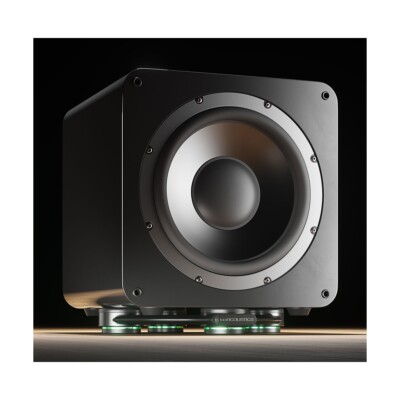
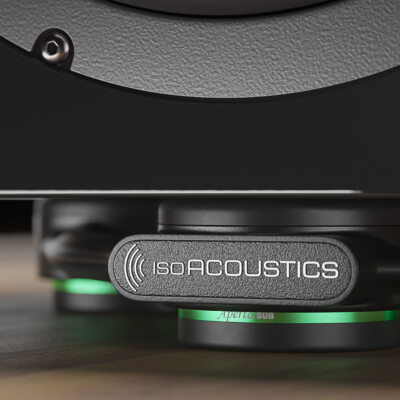
IsoAcoustics Aperta Sub XL Subwoofer Isolation Stand
- ✔️ Genuine IsoAcoustics Aperta Sub XL, brand new in box
- ✔️ Low-profile isolation stand for front-firing and side-firing subwoofers up to 160 lbs (72.6 kg)
- ✔️ Includes 1 stand plus 4 carpet discs for carpeted surfaces
- ✔️ Helps reduce energy transfer, room rattle, and muddy bass smear for tighter low-frequency performance
- ✔️ Backed by a 2-year manufacturer’s warranty in Canada
IsoAcoustics Aperta Sub Subwoofer Isolation Stand
- ✔️ Genuine IsoAcoustics Aperta Sub, brand new in box
- ✔️ Low-profile isolation stand for front-firing and side-firing subwoofers up to 80 lbs (36.3 kg)
- ✔️ Includes 1 stand plus 4 carpet discs for carpeted surfaces
- ✔️ Helps reduce energy transfer, room rattle, and muddy bass smear for tighter low-frequency performance
- ✔️ Backed by a 2-year manufacturer’s warranty in Canada

Related Products
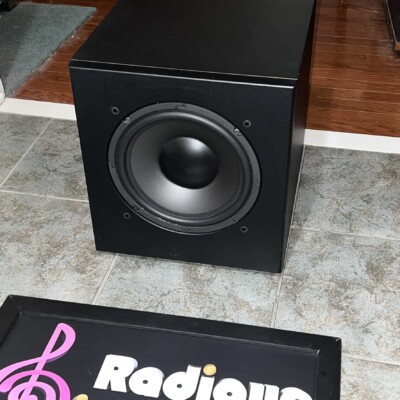
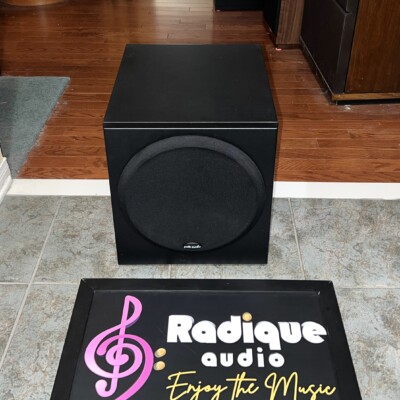
Polk Audio PSW350 10″ Front-Firing Powered Subwoofer 260W
A 10-inch front-firing Dynamic Balance woofer on a 100-watt RMS amplifier — 260 watts dynamic — in a dual-rear-ported cabinet good for 25 to 180 Hz. Speaker-level in and out, stereo line inputs and an unfiltered LFE jack, with a variable 60 to 160 Hz low-pass and a phase switch. 37 lbs, black matte. Very good cosmetic condition.
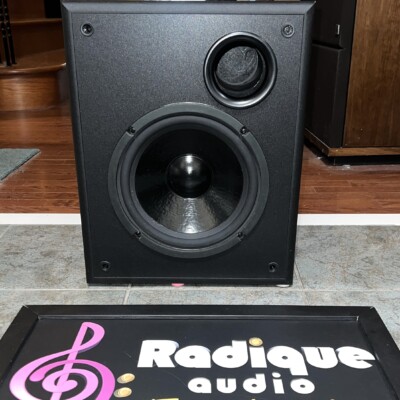
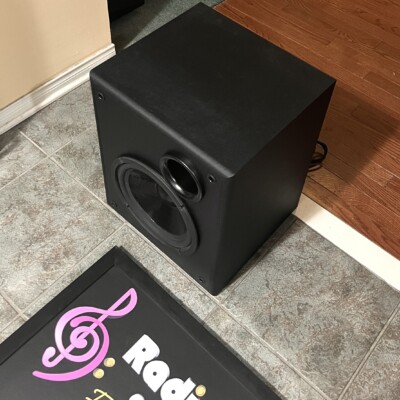
Yamaha SW-3 Active Servo Subwoofer — 10″ Woofer | Air Woofer Tec
Yamaha’s Active Servo Technology couples a negative-impedance drive amplifier to a Helmholtz resonator port — the Air Woofer opening — so the amplifier corrects the driver’s motion as it works. 100 watts into a 25 cm cone, rated down to 25 Hz, with a continuously variable 50–150 Hz high-cut at 24 dB per octave. Speaker-level and line inputs both. Very good condition.
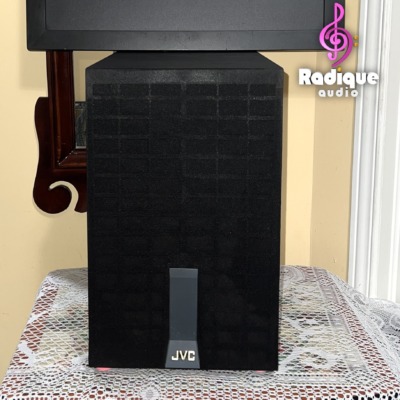
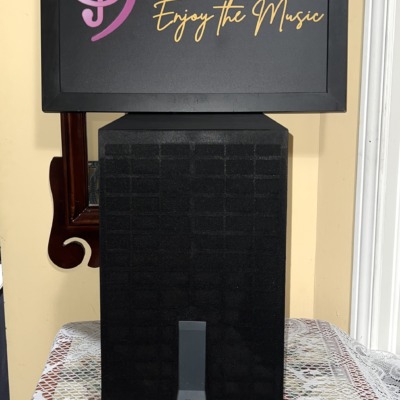
JVC SX-PW33 Slim Tower Subwoofer — 6.5in, 100W, High-Pass Out
A tall, narrow bass column meant to stand beside a cabinet rather than in front of it — 8.25 inches across the front and unusually deep at 17, which is the trade: the depth buys back the internal volume the narrow baffle gives away, so a 6.5 inch woofer is properly loaded in a strip of floor barely wider than a hardcover book. Driven by an integrated 100 watt amplifier, with speaker-level inputs and high-pass outputs so it works with an amplifier that has no subwoofer output at all. Good condition.
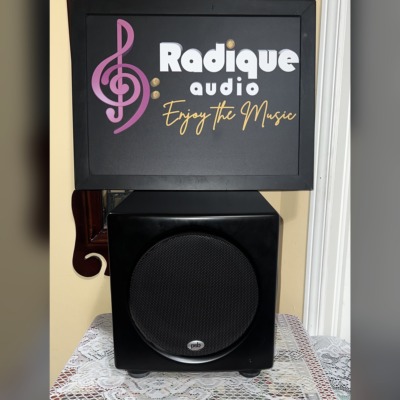
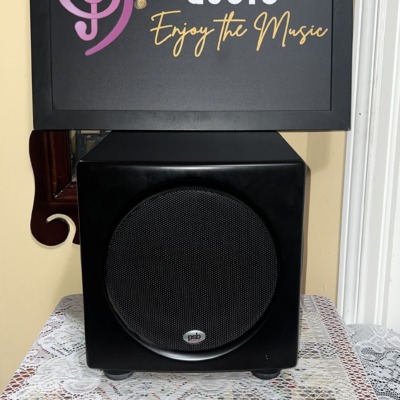
PSB SubSeries HD10 10″ Powered Subwoofer — 750W, 2000W Peak!
A serious subwoofer in about a square foot of floor, from one of the most respected names in Canadian loudspeaker design, with deep, powerful bass for home theatre and most music.
✔️ Good condition — light scuffs on the top, and a little vibration when played loud (details below)
✔️ 10-inch driver, two passive radiators and a 750 W Class H amplifier
✔️ Line-level and high-level inputs — works even with a receiver that has no sub out
✔️ Covered by Radique Warranty
✔️ Includes Perpetual Trade-Back Program eligibility
✔️ Expertly packed for safe shipping
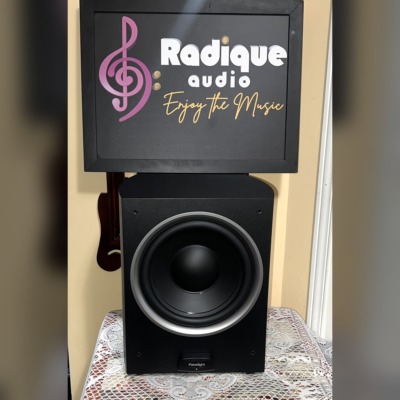
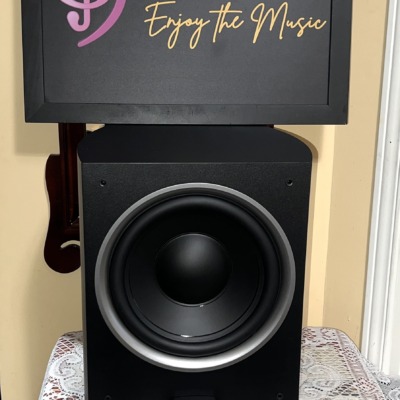
Paradigm PDR-10 v.4 10″ Powered Subwoofer – 300W Peak, Serviced
A black Paradigm PDR-10 v.4 powered subwoofer, with a 10-inch forward-firing driver and 100 watts RMS (300 watts dynamic peak) on board, serviced on our bench and in very good condition.
✔️ Very good condition — free of significant marks
✔️ Serviced on our bench and tested before listing
✔️ 10-inch forward-firing driver, 100 W RMS and 300 W dynamic peak
✔️ Covered by Radique Warranty
✔️ Includes Perpetual Trade-Back Program eligibility
✔️ Expertly packed for safe shipping
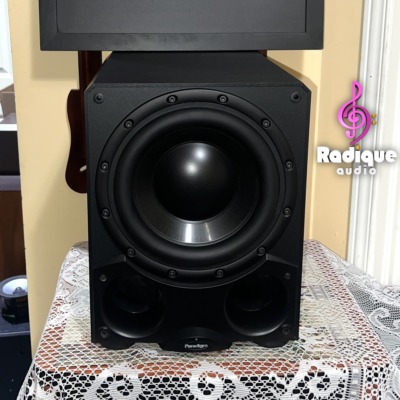
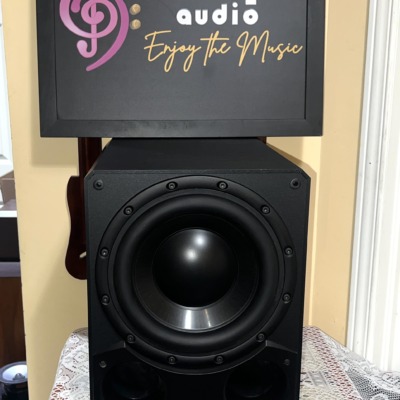
Paradigm DSP-3100 v.2 10″ Subwoofer – 600W Peak, Made in Canada
A black Paradigm DSP-3100 v.2 powered subwoofer, made in Canada, with a 10-inch front-firing driver and 200 watts RMS (600 watts dynamic peak) on board. It has been tested on our bench and is in very good condition.
✔️ Very good condition — removable black cloth grille included
✔️ 10-inch front-firing driver, 200 W RMS / 600 W peak Class-D
✔️ Front ports for hidden installs — made in Canada
✔️ Covered by Radique Warranty
✔️ Includes Perpetual Trade-Back Program eligibility
✔️ Expertly packed for safe shipping
