


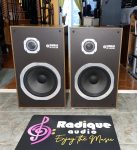

Technics SA-5160 Vintage Stereo Receiver – 25 WPC, Made in Japan
$295.00
Out of stock
This one has sold. Want first dibs on the next one?
We take these in regularly. Leave your name and email, and we’ll email you the moment one is listed, so you hear first. No cost, no obligation.
Email me when one is listed
Give your next receiver Bluetooth. RA-Twin II, $39.00 →
Other stereo receivers we have in stock now
3 in stock · $195.00–$695.00 · all ship
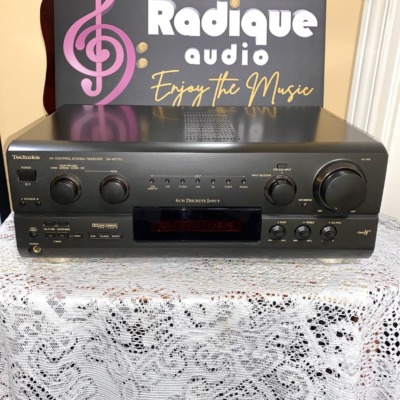 Technics SA-X730 Stereo Receiver – 100 WPC, Phono, Remote$195.00Ships
 Technics SA-600 Vintage Stereo Receiver – 70 WPC, Made in Japan$695.00Ships
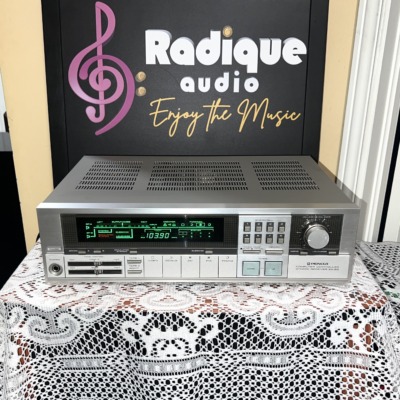 Pioneer SX-50 Vintage Stereo Receiver – 50 WPC, Silver Face$295.00Ships
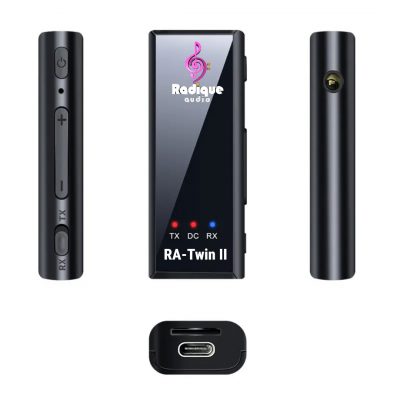
Give your next receiver Bluetooth.
The RA-Twin II adds Bluetooth streaming to any vintage receiver or amp with a spare input. Phone to stereo in about a minute, and nothing on the receiver is modified.
RA-Twin II, $39.00 →Technics SA-5160 AM/FM Stereo Receiver 25WPC – Made in Japan
A beautifully built, Made-in-Japan classic receiver from Technics’ celebrated 1970s golden era — the SA-5160 combines reliable amplification, a highly regarded MM phono stage, and capable AM/FM tuning in a single, handsome package that has been freshly serviced and is ready to perform.
Technics built its finest receivers during the mid-to-late 1970s, and the SA-5160 is a strong example of what made the brand so respected. The thick extruded aluminium faceplate — a Technics signature of the period — gives the SA-5160 a heft and premium feel that many competitors of the era simply couldn’t match, and it has aged beautifully. Inside, the amplifier section delivers 25 watts per channel into 8 ohms across the full 20 Hz–20 kHz bandwidth, with a damping factor of 40 that provides solid speaker control and tight, well-defined bass. A power bandwidth extending to 40 kHz ensures the amplifier never runs out of headroom within the audio band. While 25 watts is a modest figure on paper, an AudioKarma comparison against the Marantz 2216 and Sansui 771 noted the SA-5160’s “warm bass with enough punch if you want to crank it up a bit” — a testament to the quality of its power supply and output stage rather than raw wattage alone.
The MM phono stage is a particular strength — with 2.5 mV sensitivity, 47 kΩ input impedance, and a 75 dB signal-to-noise ratio, it is an excellent and quiet partner for vintage turntables and moving magnet cartridges. The FM tuner section is equally capable, with 1.8 µV sensitivity, 70 dB channel separation, and gyro-tuning that makes station finding smooth and precise. FM muting eliminates interstation noise cleanly, and the analogue signal strength meter helps dial in the best antenna orientation for weak stations.
Tone controls offer ±13 dB at 50 Hz (bass) and ±12 dB at 10 kHz (treble) — generous ranges that make the SA-5160 genuinely useful for correcting room acoustics or source material without reaching for an equalizer. A loudness contour compensates for the ear’s reduced sensitivity to bass and treble at low volumes, dual speaker switching supports two pairs of speakers, and a tape monitor loop accommodates a cassette deck or other outboard recorder with full record/playback functionality.
This receiver has undergone our Level One service and testing which should ensure many more years of reliable performance ahead, and presents in very good cosmetic condition — the aluminium faceplate clean and bright, knobs smooth, and wood side panels showing minimal wear.
Specifications:
Type: AM/FM stereo receiver
Power output: 25 W per channel into 8Ω (stereo, 20 Hz–20 kHz); 30 W per channel into 4Ω
Total harmonic distortion: 0.5%
Frequency response: 20 Hz–20 kHz (power bandwidth: 7 Hz–40 kHz, -3 dB)
Damping factor: 40
Phono input: 2.5 mV / 47 kΩ (S/N: 75 dB)
Line input: 150 mV / 40 kΩ (S/N: 90 dB)
Speaker load impedance: 4–16Ω
FM tuner sensitivity: 1.8 µV; FM channel separation: 70 dB
AM tuner sensitivity: 30 µV
FM tuning range: 88–108 MHz; AM: 525–1605 kHz
Tone controls: Bass ±13 dB @ 50 Hz; Treble ±12 dB @ 10 kHz
Features: FM muting, loudness contour, tape monitor loop, dual speaker switching, 6.3mm headphone output
Year: 1976–1977
Country of manufacture: Japan
Dimensions: (W x H x D) 16.5 x 5.6 x 14.0 inches / 420 x 142 x 355 mm
Weight: 16.5 lbs / 7.5 kg
A freshly serviced, Made-in-Japan classic from Technics’ finest era — the SA-5160 delivers honest, musical performance with an excellent phono stage and capable tuner, and is the perfect foundation for a vintage vinyl-focused system.
Backed by Radique Audio’s Bumper to Bumper Warranty and Perpetual Trade-Back Policy, buy with complete confidence; asking $295.
| Weight | 18.5 lbs |
|---|---|
| Dimensions | 18 × 20.5 × 9.6 in |
Technics is the premium audio name Matsushita (now Panasonic) created in Osaka in 1965, and its direct-drive turntables, above all the SL-1200, made it famous. We carry Technics turntables, stereo receivers, amplifiers, CD players, cassette decks and equalizers. We've had more than 160 Technics listings so far, covering more than 115 different models. Every used Technics here is inspected, tested and serviced as required, then photographed in-house and covered by our Bumper-to-Bumper Warranty and Perpetual Trade-Back Program. Turntables don't travel well by courier, so ours are pickup in Kanata or Curbside Delivery only. Don't see the model you want? Tell us on First Dibs and we'll email you when one arrives.
Our best-selling Technics models so far are two turntables, the SL-3200 and the SL-220.
The Technics story, 1965 to today
Matsushita Electric of Osaka created Technics in 1965 as its premium audio brand. The first product to carry the name was the Technics 1 bookshelf speaker.
Direct drive. The SP-10 of 1969 or 1970 (sources differ), built around a motor invented by Shuichi Obata, is what Technics calls the world's first direct-drive turntable. The SL-1200 followed in 1972 as a home hi-fi turntable, and the SL-1200MK2 of 1979 was redesigned with DJs in mind. About 3.5 million SL-1200s were made.
CD and the 1980s. The SL-P10 of 1982 was Technics' first CD player.
Pause and return. Panasonic ended SL-1200 production in 2010 and brought Technics back in 2014. A new SL-1200G arrived in 2016 and the SL-1200MK7 DJ model in 2019, and turntable production moved from Japan to Malaysia in 2021.
Which Technics is which?
SL-1200 and SL-1210: the MK2 of 1979 added quartz-locked speed control and a slider pitch control. The 1210 is the black version, often with dual-voltage switching.
SL-B, SL-D and SL-Q turntables: in the early-1980s range, Q models were fully automatic and quartz-locked, D models were not, and the SL-B models were belt-drive budget decks.
SL-3200, SL-220 and other home turntables: the Technics decks we sell most often.
SA receivers and SU amplifiers: such as the SA-1000 of 1978 to 1979. The SA-202 is one of the Technics receivers we've sold most.
RS tape decks, SL-P CD players and SB speakers: from the RS-1500U open-reel deck of 1976 to the SB-7000 linear-phase speakers of 1975.
Buying used Technics: what to check
Speed and pitch. On an SL-1200 or SL-1210, use the strobe to confirm the dots hold steady, and sweep the pitch fader at 33 and 45 rpm.
Tonearm. It should move smoothly with no play in the bearings, the headshell should clamp firmly, and the anti-skate, arm lock and cue lift should all work.
Connections. Loose leads cause crackling. Check the ground wire and both channels.
Everything we list is inspected, tested and serviced as required here, and comes with our warranty.
Related Products
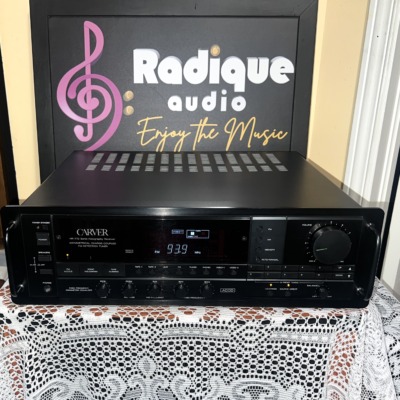
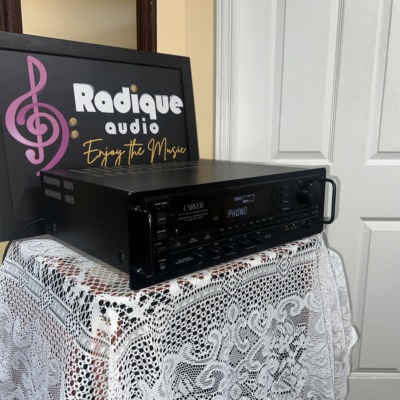
Carver HR-772 Sonic Holography Receiver – 140 WPC, Rack Ears
A Carver HR-772 stereo receiver, Carver's early-1990s flagship: 140 watts per channel, Sonic Holography, and rack ears with front handles.
✔️ Tested on our bench, Sonic Holography included
✔️ Very good condition
✔️ 140 WPC, stable to 2 ohms, MM phono, five-band EQ
✔️ Rack ears and handles for a 19-inch rack
✔️ Covered by Radique Warranty
✔️ Includes Perpetual Trade-Back Program eligibility
✔️ Expertly packed for safe shipping
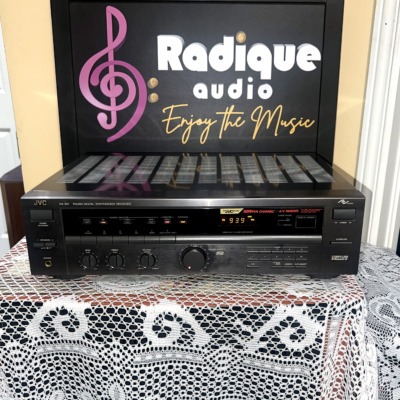
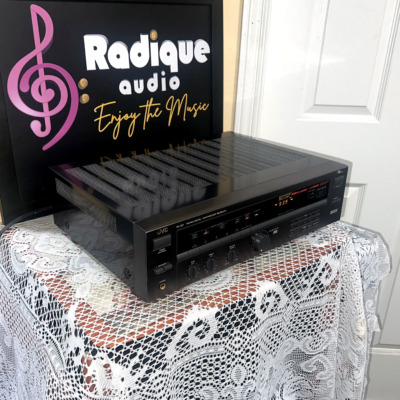
JVC RX-307 Stereo Receiver – 80 WPC, Original Remote & Manual
Eighty watts a side, a proper phono input, and the two things these almost never come with any more: the original remote and the printed manual.
✔️ Condition: Very Good
✔️ Covered by Radique Warranty
✔️ Includes Perpetual Trade-Back Program eligibility
✔️ Expertly packed for safe shipping
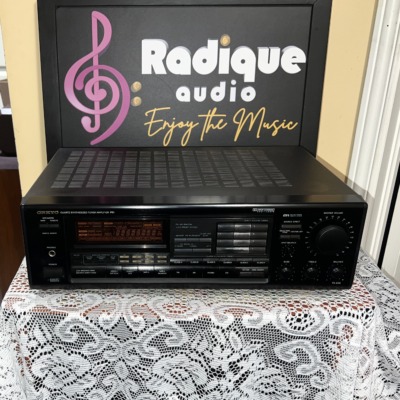
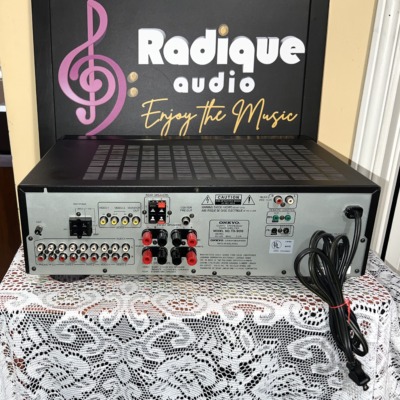
Onkyo TX-906 Stereo Receiver – 80 WPC, Dolby Pro Logic
An early-nineties Onkyo receiver with real power behind it and a phono input for your turntable, through our Level 1 service and playing as it should.
✔️ Good condition — works as it should; the black cabinet and faceplate present well
✔️ Through our Level 1 service — cleaned, deoxidized, checked and thoroughly tested on our bench
✔️ Phono input for your turntable, plus CD and two tape inputs
✔️ Covered by Radique Warranty
✔️ Includes Perpetual Trade-Back Program eligibility
✔️ Expertly packed for safe shipping
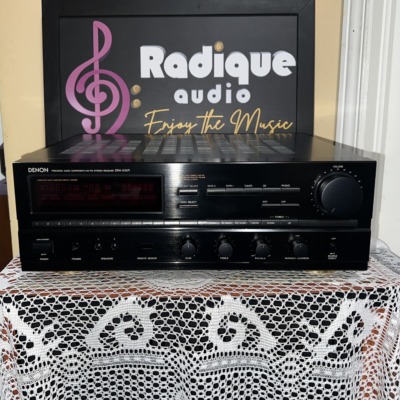
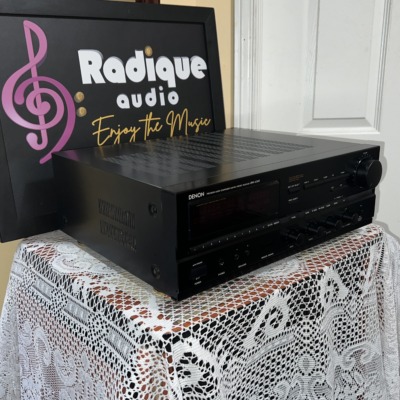
Denon DRA-835R Vintage Stereo Receiver – 100 WPC, Made in Japan
The second-from-the-top model in Denon's early-nineties stereo receiver range, made in Japan and in very good condition, with 100 watts per channel, a phono stage, motorized volume and its original remote.
✔️ Very good condition — free of significant marks
✔️ 100 WPC, MM phono and motorized volume — made in Japan
✔️ Original Denon remote included
✔️ Covered by Radique Warranty
✔️ Includes Perpetual Trade-Back Program eligibility
✔️ Expertly packed for safe shipping
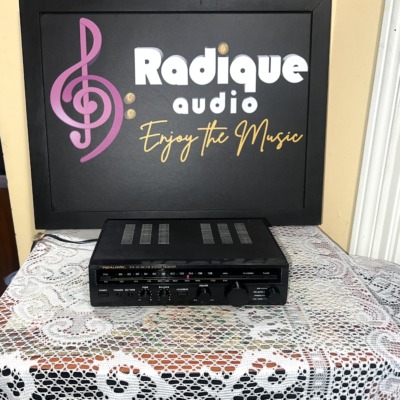
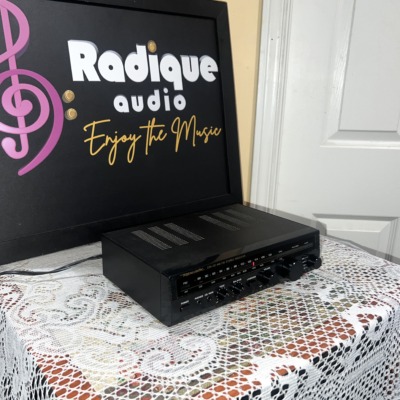
Realistic STA-20 Compact AM/FM Stereo Receiver – 5 WPC, Serviced
Radio Shack's smallest AM/FM stereo receiver of the 1990s, the Realistic STA-20: 5 watts per channel, a rear EQ switch made for mini-speakers, a phono input and a front jack for a phone.
✔️ Serviced on our bench to our Level 1 standard
✔️ Very good condition
✔️ Covered by Radique Warranty
✔️ Includes Perpetual Trade-Back Program eligibility
✔️ Expertly packed for safe shipping
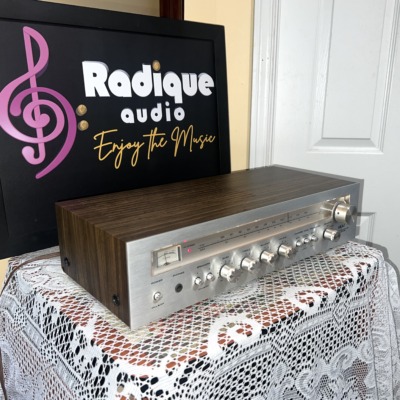
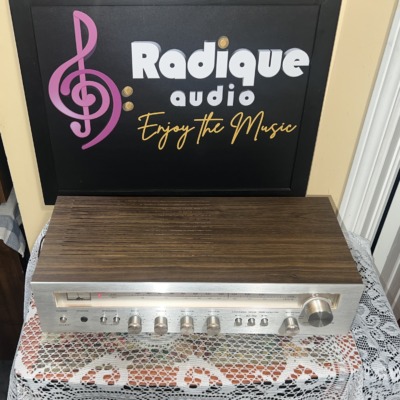
Akai AA-1115 Vintage Stereo Receiver – 15 WPC, Made in Japan
A slim late-1970s Akai AA-1115 AM/FM stereo receiver, made in Japan, silver face in its original woodgrain cabinet.
✔️ Tested on our bench, every input, output and control
✔️ Very good condition
✔️ MM phono, PLL FM tuner, speakers A and B
✔️ Covered by Radique Warranty
✔️ Includes Perpetual Trade-Back Program eligibility
✔️ Expertly packed for safe shipping
