


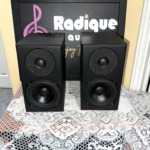
Tannoy HTS200 Satellite Speakers — Black Ash Pair
$125.00
A 19 mm titanium WideBand dome on a neodymium motor over a 75 mm long-throw paper cone, crossed at 3 kHz in a sealed, shielded cabinet. Response runs 100 Hz to 40 kHz, so they want a subwoofer beneath them; 87 dB into 6 ohms on 25 to 100 watts. Same drivers and crossover as the HTS200 towers and centre, so the voicing matches across channels. Black ash, 4.7 inches wide.
1 in stock
Tannoy HTS200 Satellite Speakers — Black Ash Pair
A compact, refined pair of satellite speakers from Tannoy’s HTS 200 home cinema range, finished in black ash and featuring the same titanium WideBand tweeter technology found throughout the series.
The HTS200 satellites share the same driver complement and crossover design as the larger HTS200 towers and centre channel, ensuring seamless voice-matching across all channels in a surround system. Each satellite pairs a 19mm titanium WideBand dome tweeter with neodymium magnet system against a single 75mm long-throw paper cone woofer, crossed over at 3 kHz. The titanium dome extends high-frequency response to an impressive 40 kHz, lending an open, airy quality to dialogue, effects, and music. Frequency response reaches down to 100 Hz, making these ideal for use with a subwoofer handling the lowest octaves.
At just 120mm wide, these satellites virtually disappear into a room. The 5-way binding post terminals are a notable inclusion at this size and price point, accepting bare wire, pins, spades, or banana plugs. The cabinets are magnetically shielded for placement near CRT displays.
These satellites pair naturally with the Tannoy HTS200 towers, centre channel, and subwoofer also available from Radique Audio.
Specifications:
Type: 2-way sealed satellite speaker (pair)
Tweeter: 19mm (3/4 inch) titanium WideBand dome with neodymium magnet
Woofer: 75mm (3 inch) paper cone
Crossover frequency: 3 kHz
Frequency response: 100 Hz – 40 kHz (-6 dB)
Sensitivity: 87 dB (2.83V/1m)
Impedance: 6 ohms
Recommended amplifier power: 25 – 100 watts
Connections: 5-way binding posts
Magnetic shielding: yes
Finish: black ash
Dimensions (each): (Width x Height x Depth) 4.7 x 6.4 x 6.7 inches (120 x 162 x 170 mm)
Weight (each): 2.9 lbs (1.3 kg)
Compact, voice-matched satellite speakers that deliver Tannoy’s signature clarity and openness in the smallest form factor of the HTS 200 range. An excellent surround or desktop speaker option.
Backed by Radique Audio’s Bumper-to-Bumper Warranty and our Perpetual Trade-Back Program, you can purchase with confidence.
| Weight | 7 lbs |
|---|---|
| Dimensions | 10.7 × 16 × 10.4 in |
Tannoy began in London in 1926, and since the late 1940s it has been known for its Dual Concentric driver, with the tweeter set in the centre of the woofer. We carry Tannoy towers, bookshelf speakers, centre channels and subwoofers. We've had more than 210 Tannoy listings so far, covering more than 65 different models. Every used Tannoy here is inspected, tested and serviced as required, then photographed in-house and covered by our Bumper-to-Bumper Warranty and Perpetual Trade-Back Program. Don't see the model you want? Tell us on First Dibs and we'll email you when one arrives.
Our five best-selling Tannoy models so far: the Mercury mx3 towers, the Mercury mx2 and mx1 bookshelf speakers, the PS 110 subwoofer and the Mercury mxC centre.
The Tannoy story, 1926 to today
Guy R. Fountain founded the company in London in 1926 as the Tulsemere Manufacturing Company, making rectifiers and battery chargers for radio sets. It became Tannoy in 1928, a name taken from the tantalum alloy in his rectifier.
The Dual Concentric. Ronnie Rackham's Dual Concentric driver first appeared as the "Monitor Black" in 1947 or 1948 (sources differ). The Monitor Silver, Red and Gold generations followed through the 1950s and 1960s, then the HPD in 1974.
Scotland. Harman International bought Tannoy in 1974, and production moved from London to Coatbridge, Scotland, in 1976. Managers bought the business in 1981, Tannoy merged with Goodmans in the mid-1980s and joined Denmark's TC Group in 2002.
Today. Music Group, later Music Tribe, bought TC Group in 2015. From 2016 the lower-priced ranges, such as Mercury, were made in China, while Prestige stayed in Scotland, where Tannoy's headquarters and assembly are now in Hamilton.
Which Tannoy is which?
1970s HPD cabinets: the Arden, Berkeley, Cheviot, Devon and Eaton, all with Dual Concentric drivers. The Arden, Cheviot and Eaton were reissued as the "Legacy" series in 2017.
Mercury (early 1980s onward): the entry range, through many generations. Our best-selling mx3, mx2, mx1 and mxC come from this family.
Profile (1991 to 1994) and Sensys DC (about 2004): Dual Concentric ranges between Mercury and Prestige.
Revolution (1998 onward): cherry-veneered models such as the R1, R2 and R3.
Prestige (1980s onward): the traditional-styled Dual Concentric range, such as the Westminster and Stirling, later in Gold Reference versions.
Definition (2009): birch-ply Dual Concentric models built in Scotland, such as the DC8 and DC10T.
Buying used Tannoy: what to check
HPD-era surrounds. The surrounds on 1970s drivers rot with age, and many have been replaced. Ask what was replaced and with what.
Dating the drivers. Frame colour alone is not a reliable guide to a Dual Concentric's age; construction details date it better.
Reused names. An Arden, Cheviot or Eaton may be a 1970s original or a 2017 Legacy reissue.
Origin label. From 2016, Mercury and Revolution models were made in China and Prestige in Scotland. Check the label if it matters to you.
Everything we list is inspected, tested and serviced as required here, and comes with our warranty.
Related Products
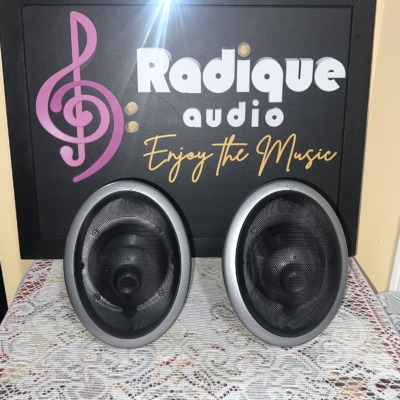
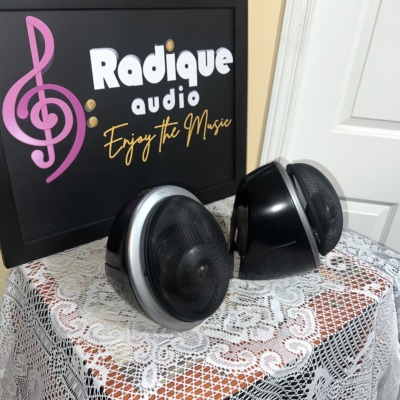
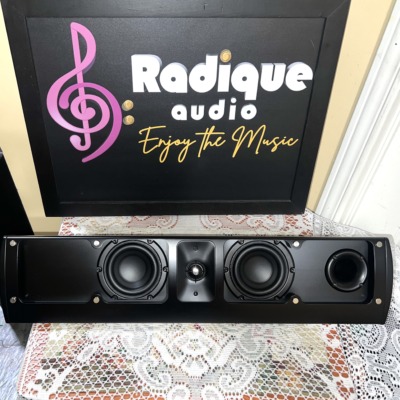
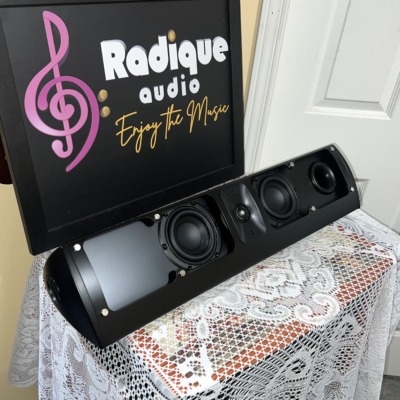
Mirage Omnisat OS 1PB-1 Omnipolar Satellite (Pair) – Made in Canada
Both drivers fire upward into spoon-shaped OMNIGUIDE reflectors, giving 360-degree dispersion with a deliberate forward bias. 70 Hz to 20 kHz, 89 dB, cast aluminum woofer baffle and butyl surrounds rather than foam. These are the original 7 lb version; the later revisions come in under five. Very good condition.
PSB VisionSound VS300 Aluminum On-Wall Speaker
An on-wall speaker engineered as one rather than adapted into one. It shares the tweeter, terminals and crossover of PSB's VS400 floorstander, but the port was moved to the front so the cabinet can sit flat to a wall without the wall changing what it does — and a rear switch selects NORMAL or ON-WALL, filling the 400 to 500 Hz dip that hard mounting creates. Extruded aluminium, built in Pickering, Ontario. Graded Excellent or Very Good; the only thing separating the two is a single Tic Tac-sized hole at the extreme edge of one grille frame.
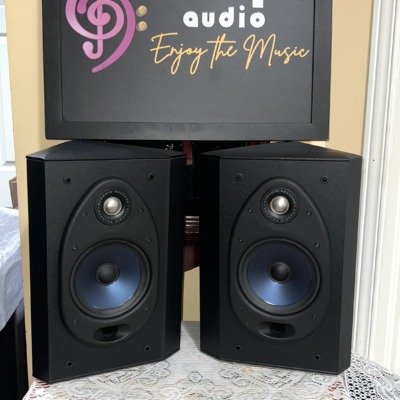
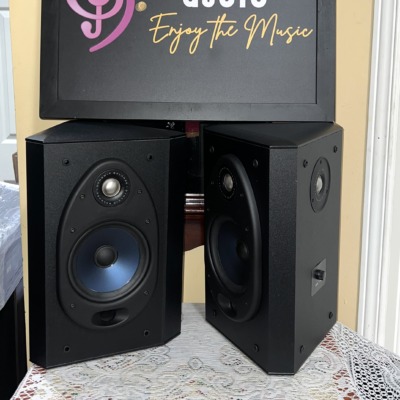
Polk Audio f/x 500i Bipole/Dipole Surrounds — Made in USA, Pair
A genuine mirror-imaged pair, labelled LC and RC, with two driver arrays set 45 degrees apart and a rear-panel switch that flips them between bipole and dipole — locatable effects on the wall behind you, a diffuse field on the side walls, same speakers either way. 19.4 lbs each, half again the weight of the FXi A6 that replaced them, and 2 dB more sensitive. Built in the United States, with keyhole mounts moulded into the cabinet. Very Good condition.
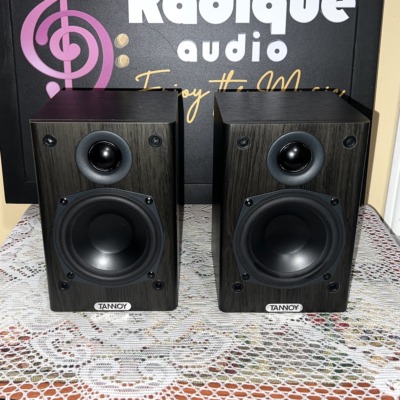
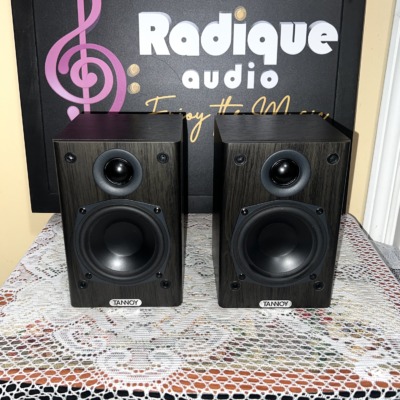
Tannoy Mercury FR Custom Compact Speakers – Dark Oak, Pair
A pair of compact two-way Tannoy speakers from the limited Custom edition of Tannoy's Mercury F-series, in very good condition, with a wall bracket built into the back of each cabinet.
✔️ Very good condition — free of significant marks; both grilles included
✔️ The limited Custom edition of Tannoy's Mercury F-series, in Dark Oak
✔️ Built-in wall bracket — hang them, or stand them on a shelf
✔️ Covered by Radique Warranty
✔️ Includes Perpetual Trade-Back Program eligibility
✔️ Expertly packed for safe shipping
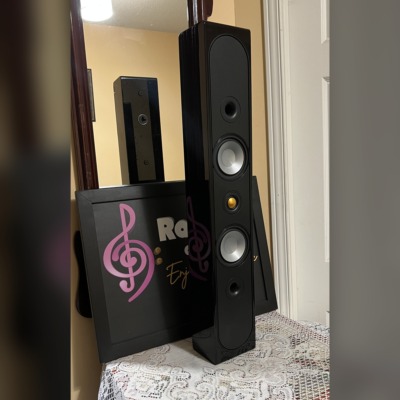
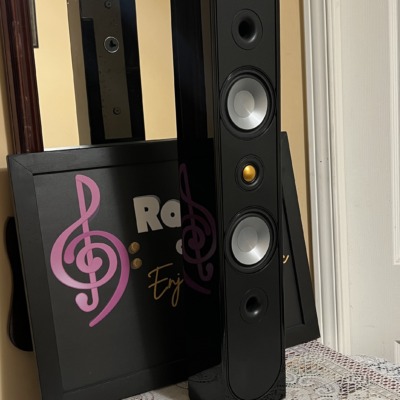
Monitor Audio Radius 250HD LCR Speaker – Gloss Black, Wall-Mount
A slim gloss black Monitor Audio speaker from the Radius HD range, in good condition, built to work as a left, center, right or rear speaker, standing upright, lying flat or hung on a wall.
✔️ Good condition — light scratches visible under bright light; grille included
✔️ One slim speaker for left, center, right or rear duty
✔️ Two rear keyhole slots; the matching wall bracket is listed separately
✔️ Covered by Radique Warranty
✔️ Includes Perpetual Trade-Back Program eligibility
✔️ Expertly packed for safe shipping
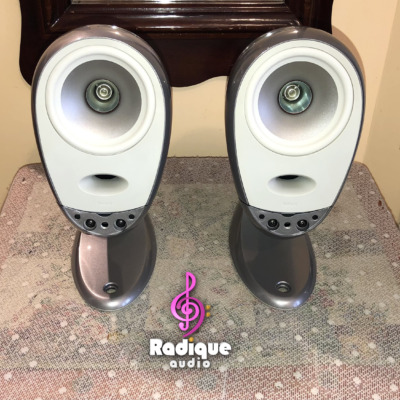
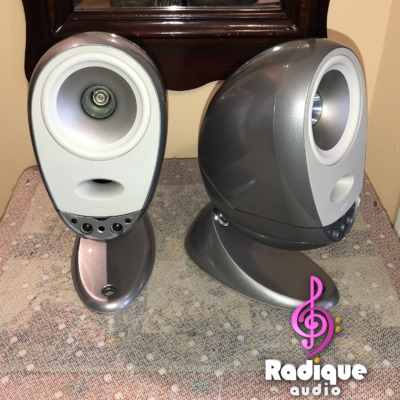
Tannoy Arena Satellites, Pair – Dual Concentric, Four Finishes
Tannoy's die-cast aluminum Arena satellites, in very good condition, offered by the pair in four gloss finishes (white, gloss black, bronze and silver), with or without their matching cast bases.
✔️ Very good condition — the lacquered aluminum shells present well
✔️ Tannoy Dual Concentric drivers in cast aluminum, magnetically shielded
✔️ Four gloss finishes; matching cast bases on the silver, black and bronze pairs
✔️ Covered by Radique Warranty
✔️ Includes Perpetual Trade-Back Program eligibility
✔️ Expertly packed for safe shipping
Monitor Audio Radius 250HD LCR Speakers, Pair – Gloss Black
A matched pair of slim gloss black Monitor Audio speakers from the Radius HD range, in good condition, each built to work as a left, center, right or rear speaker, standing upright, lying flat or hung on a wall.
✔️ Good condition — light scratches visible under bright light; grilles included
✔️ Two slim speakers for a stereo pair, left and right of a center, or a set of rears
✔️ Two rear keyhole slots on each; the matching wall bracket is listed separately
✔️ Covered by Radique Warranty
✔️ Includes Perpetual Trade-Back Program eligibility
✔️ Expertly packed for safe shipping


KEF HTS1001 Uni-Q Satellite Speakers Black (Single)
KEF's Uni-Q array puts a 0.6-inch aluminium dome at the acoustic centre of the 3-inch mid-bass, so dispersion stays even off-axis and the far seat hears what the middle seat does. Sealed cast aluminium cabinet in high-gloss black, magnetically shielded, 120 Hz to 22 kHz, 86 dB, 10 to 100 watts. Terminals take bare wire or pin connectors. Very good cosmetic condition.


KEF HTS1001 Uni-Q Satellite Speakers Black Pair
KEF’s Uni-Q array puts a 0.6-inch aluminium dome at the acoustic centre of a 3-inch mid-bass cone, so the pair behaves as a single source and the tonal balance holds across the room rather than in one chair. Sealed cast aluminium enclosures, 120 Hz to 22 kHz, 86 dB, magnetically shielded. Very good cosmetic condition.
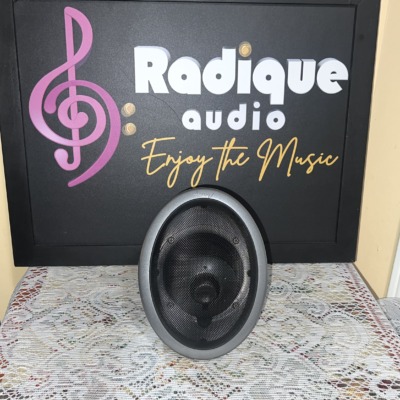
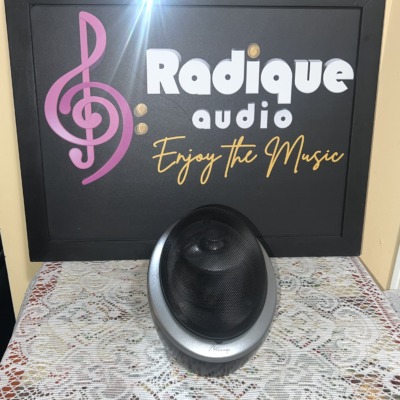
Mirage Omnisat OS 1PB-1 Omnipolar Satellite – Made in Canada
Both drivers fire upward into spoon-shaped reflectors Mirage calls OMNIGUIDEs, throwing sound through a full 360 degrees with a deliberate bias toward the front — which is what takes the sweet spot off a single chair. This is the original version at a genuine 7 lbs each, with a cast aluminium baffle and butyl rubber surrounds rather than foam. Built in Canada; condition very good.
